U.S. Smart Cities Market Size & Share Analysis - Emerging Trends, Growth Opportunities, Competitive Landscape, and Forecasts (2025 - 2032)
This Report Provides In-Depth Analysis of the U.S. Smart Cities Market Report Prepared by P&S Intelligence, Segmented by Component (Infrastructure & Environment, People & Society, Transport & Mobility, Governance and Management), Focus Area (Smart Transportation, Smart Buildings, Smart Utilities, Smart Citizen Services), Technology (Internet-of-Things, Artificial Intelligence, Cloud Computing, Big Data Analytics, Blockchain, 5G Connectivity), City Size (Large Cities, Medium-Sized Cities, Small Cities), and Geographical Outlook for the Period of 2019 to 2032
Explore the market potential with our data-driven report
U.S. Smart Cities Market Future Outlook
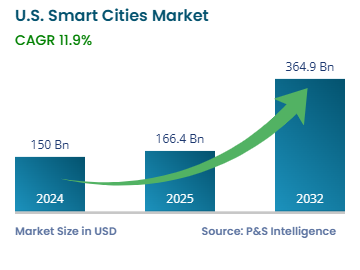
The U.S. smart cities market valued at USD 150.0 billion in 2024 and is expected to grow at a CAGR of 11.9% from 2025 to 2032 to reach USD 364.9 billion by 2032.
This is because urban areas expand, while cities require better resource management systems. The growing number of people moving to cities has created problems in transportation, power usage, and environmental care concerns. Smart city solutions, such as intelligent transportation systems, smart grids, and energy-efficient lighting systems get implemented to enhance urban quality of life and maximize city operational performance. As per the University of Michigan, 83% of the population of the nation resides in urban regions, an increase from 64% in 1950. Moreover, by the year 2050, 89% of the U.S. population will inhabit urban areas.
The market expansion largely depends on government funding that supports digital infrastructure development. State and federal programs support the adoption of IoT technology, smart power systems, and data-based urban planning, which promotes smart ecosystem development for cities. Both environmental sustainability awareness and carbon emission reduction needs urge cities to implement smart technologies during their development processes.
The combination of AI advances with cloud computing and 5G network technology serves as major drivers that speed up market expansion. Smart cities develop innovative protections through joint efforts of technology corporations, urban development specialists, and utility control entities. The U.S. smart cities market will maintain steady growth during the upcoming years because cities remain dedicated to digital transformation and sustainability efforts.
U.S. Smart Cities Market Trends & Drivers
Use of Artificial Intelligence and Data Analytics Is a Trend
AI predictive analytics deliver forecasts about traffic behavior, which enables cities to manage traffic better, minimize congestion, and protect their residents while traveling.
AI-optimized traffic signals have cut vehicle idling by 18–30%, easing congestion and lowering emissions—making cities cleaner, safer, and more efficient.
The implementation of data analytics platforms gives city authorities immediate surveillance capabilities to detect leaks and reinforce efficiency in utility operations via electricity and water control.
Smart grids now forecast demand with 90% accuracy, reducing outages by 30% and enabling more renewable integration.
The implementation of AI-based surveillance technologies with facial recognition features and anomaly detection functions enables better detection of suspicious behavior while reducing emergency response durations.
AI-driven surveillance and predictive policing have reduced crime by 20–25%, while emergency response times have improved by up to 20%.
Smart waste management platforms utilize AI and data analysis to anticipate waste output trends while designing optimized collection routes that decrease fuel usage.
The combination of AI algorithms with IoT sensors enables city planners to study environmental data about air quality and noise pollution for developing sustainable and livable urban spaces.
In buildings, AI-managed HVAC and lighting systems have cut energy consumption by 15–30%, leading to significant cost and emission reductions.
Government Initiatives and Investments in Smart Infrastructure Drive Market
Through the U.S. federal government-run Smart Cities Challenge, cities obtain creative technology strategies while receiving financial support and specialized guidance to build upcoming smart infrastructure and transportation systems.
Through the Infrastructure Inestment and Jobs Act, the government distributes billions of funding to modernize broadband networks as well as public transportation systems and energy grids and thus advances smart city development nationally.
State and local entities strengthen their ventures with technology companies to develop smart street lights, smart parking solutions, and digital public platforms that boost efficiency while improving sustainability in cities.
Government initiatives including funding and grants enable ecosystem development of electric vehicle charging stations as well as renewable energy systems to advance urban transportation with sustainability goals.
Viewing IoT as an investment tool city authorities implement surveillance and traffic systems which lead to safer more efficient cities that maintain security.
Under the Infrastructure Investment and Jobs Act, the DOT’s SMART grant program allocates USD 100 million annually (FY 2022–26), funding Stage 1 (up to USD 2 million) and Stage 2 (up to USD 15 million) urban mobility pilot projects—34 Stage 1 and eight Stage 2 projects were recently awarded.
The Smart City Challenge, supported by over USD 350 million total, included a USD 40 million prize to Columbus, Ohio, plus USD 65 million in follow-up grants.
FHWA’s ATTAIN program awarded more than USD 52 million across eight states for connected vehicle and traffic optimization.
The Biden administration also designated USD 4.3 billion for clean energy and EV infrastructure, including a USD 15 million grant for 284 EV charging ports in Austin.
U.S. Smart Cities Market Segmentation and Category Analysis
Component Insights
The largest category is transportation & mobility with a share of 35% in 2024. The increasing urban populations and worsening traffic congestion increase the need for advanced transportation systems. Smart cities throughout the U.S. dedicate substantial financial resources to advanced traffic management systems smart transportation systems and vehicle tracking solutions which increase urban mobility and cut carbon emissions. The category leads because the government actively promotes sustainable transportation and is developing electric vehicle charging networks. As per studies, the country already had more than 64,00 EV charging stations in October 2024, while 289 million light vehicles are operating currently.
Smart utilities are the dominant category with 30% market share in 2024. This is because these fundamental operational components require top-priority investment for urban development. Smart grids, smart water meters, and IoT-based utility management systems deployed across the country boost resource performance and decrease operational expenses. This category leads the market due to government rules that support sustainable energy practices through investments in smart utility operations.
As per the Federal Energy Regulatory Commission (FERC), the spending by major electric utilities in the country rose by 12%, to USD 320 billion in 2023 from USD 287 billion in 2003. The funding was directed at replacing or upgrading outdated infrastructure, adding natural gas, wind, solar, and battery storage capacities, and deploying innovative technologies, such as smart meters, sensors, and automated controls.
Focus areas analyzed in the report:
Smart Transportation (Fastest-Growing Category)
Smart Buildings
Smart Utilities (Largest Category)
Smart Citizen Services
Technology Insights
5G is the fastest-growing category, at a CAGR of 12%, during the forecast period. 5G rollouts in the U.S. change smart city infrastructure by providing quick data speeds, improved performance, and enhanced network stability. The growing demand for connected devices with fast communication requires 5G connectivity which has become the leading technology in smart cities because of this accelerating need. Network expansion has a critical function for city officials who aim to develop their digital infrastructure because it improves urban operational efficiency and sustainability goals. Spending by the major U.S. telecom operators Verizon, AT&T, and T-Mobile rose from ~USD 29 billion/year during 4G to USD 32 billion annually through 2025. Verizon alone is spending ~USD 17 billion yearly, while carriers paid over USD 100 billion for C-band spectrum licenses.
Technologies studied in the report:
Internet of Things (Fastest-Growing Category)
Artificial Intelligence
Cloud Computing
Big Data Analytics
Blockchain
5G (Largest Category)
City Size Analysis
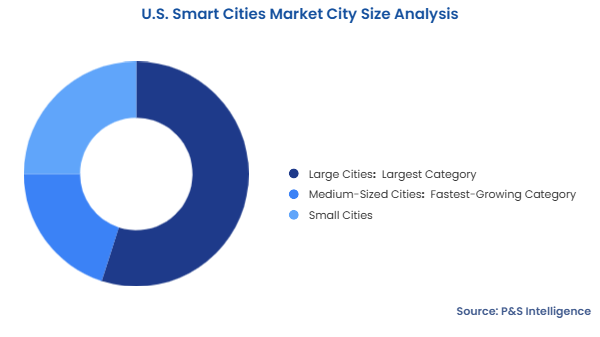
Large cities are the largest category with a share of 55% in 2024. Metro cities, such as New York, Los Angeles, and Chicago are leading the smart city technology adoption as they have greater population densities and intricate urban infrastructure. These cities also have severe issues of traffic congestion, power usage, and public safety, which are compelling them to demand sophisticated smart solutions. Also, major cities enjoy more government grants, increased technological resources, and planned collaborations with technology suppliers, so they are the major adopters of smart city programs. In the U.S., there are over 325 urban regions with populations exceeding 100,000, with New York City being the most populous, with 8.34 million residents.
City sizes considered:
Large Cities (Largest Category)
Medium-Sized Cities (Fastest-Growing Category)
Small Cities
Drive strategic growth with comprehensive market analysis
U.S. Smart Cities Market Geographical Analysis
West is the dominant region with a share of 35% in 2024. This region is inhabited by big metropolitan cities such as Los Angeles, San Francisco, and Seattle, which are the pioneers of using smart city technology. The dense population of tech companies, huge investments in digital infrastructure, and emphasis on sustainability fuel the dominance of this region. In addition, policies from the government promoting smart energy solutions, electric vehicle charging infrastructure, and smart transport systems also strengthen the West's dominance in the market.
Regions covered in the report:
Northeast
Midwest
West (Largest-Category)
South (Fastest-Growing Category)
U.S. Smart Cities Market Share
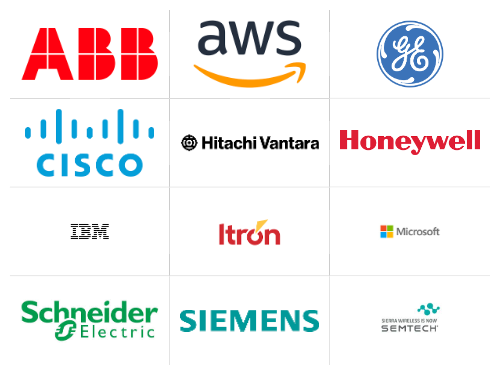
The market is fragmented due to the wide variety of firms providing customized solutions across different components, ranging from smart energy management to transportation, public safety, and governance. The presence of international technology giants, such as Cisco Systems Inc. IBM Corporation, and Microsoft Corporation, as well as niche players, such as Itron Inc. and Sierra Wireless S.A., establishes a competitive landscape where firms serve distinct segments of smart city infrastructure.
Growing government partnerships and public-private initiatives enable smaller firms to compete with major players by providing innovative solutions specific to particular urban issues, adding to the market's fragmented character. The ongoing influx of start-ups and technology vendors providing IoT-based solutions, smart mobility systems, and energy-efficient technologies introduces new levels of competition, further diversifying the market.
Key U.S. Smart Cities Companies:
Cisco Systems, Inc.
IBM Corporation
Microsoft Corporation
Siemens AG
Honeywell International Inc.
Schneider Electric
Itron Inc.
Sierra Wireless S.A.
General Electric
Amazon Web Services, Inc.
ABB Ltd
Hitachi Vantara LLC
U.S. Smart Cities Market News & Updates
In May 2025, Smart Cities Americas and the Smart Cities Council hosted the Smart Cities Summit North America on May 7-8. The summit brought together U.S. and international city leaders, federal agencies, and investors to accelerate multimillion-dollar smart-city projects.
In May 2025, the Center for Urban Informatics and Progress (CUIP) at the University of Tennessee at Chattanooga Research Institute (UTCRI) received USD 500,000 from the Tennessee Department of Economic and Community Development (TNECD) under the Transportation Network Growth Opportunity (TNGO) program. This financial support will facilitate the creation and implementation of two systems to enhance Chattanooga’s strategies for road safety and smart mobility.
In January 2025, Ouster Inc. secured a contract worth USD 2 million to implement its Ouster BlueCity traffic management solution in Chattanooga, Tennessee.
In March 2024, L&T Technology Services Limited, a subsidiary of Larsen & Toubro Limited, collaborated with Intel Corporation to bring innovation in the fields of smart city infrastructure and smart transportation systems. The collaboration focused on cellular vehicle-to-everything (CV2X) applications by exploiting LTTS's experience in connected vehicles and smart transportation systems and using Intel's scalable edge-AI solutions.
Want a report tailored exactly to your business need?
Leading companies across industries trust us to deliver data-driven insights and innovative solutions for their most critical decisions. From data-driven strategies to actionable insights, we empower the decision-makers who shape industries and define the future. From Fortune 500 companies to innovative startups, we are proud to partner with organisations that drive progress in their industries.
Client Testimonials
Working with P&S Intelligence and their team was an absolute pleasure – their awareness of timelines and commitment to value greatly contributed to our project's success. Eagerly anticipating future collaborations.
McKinsey & Company
India
Unmatched Standards
Our insights into the minutest levels of the markets, including the latest trends and competitive landscape, give you all the answers you need to take your business to new heights
Complete Data Security
We take a cautious approach to protecting your personal and confidential information. Trust is the strongest bond that connects us and our clients, and trust we build by complying with all international and domestic data protection and privacy laws