Key Highlights
| Study Period | 2019 - 2032 |
| Market Size in 2024 | USD 85.5 Million |
| Market Size in 2025 | USD 92.8 Million |
| Market Size by 2032 | USD 174.8 Million |
| Projected CAGR | 9.5% |
| Largest Region | West |
| Fastest Growing Region | South |
| Market Structure | Fragmented |

| Study Period | 2019 - 2032 |
| Market Size in 2024 | USD 85.5 Million |
| Market Size in 2025 | USD 92.8 Million |
| Market Size by 2032 | USD 174.8 Million |
| Projected CAGR | 9.5% |
| Largest Region | West |
| Fastest Growing Region | South |
| Market Structure | Fragmented |
|
Explore the market potential with our data-driven report
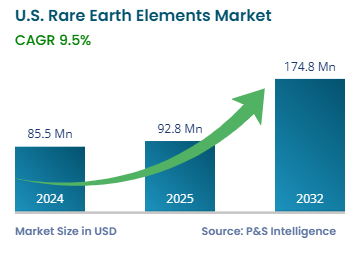
The U.S. rare earth elements market size was USD 85.5 million in 2024, and it will grow by 9.5% during 2025–2032, reaching USD 174.8 million by 2032.
The market is primarily driven by the growing demand in electric vehicles (EVs), renewable energy, and advanced defense systems. These materials are essential in the production of the permanent magnets used in EV motors, wind turbines, and precision-guided military weapons.
Initiatives such as the Inflation Reduction Act and the Defense Production Act provide funding for critical mineral supply chains. Public and private investment in refining capacity and technological innovation drives the demand for rare earth metals. For instance, MP Materials is building a rare earth metal and magnet factory in Texas, supported, in part, by a USD 35-million contract from the Department of Defense (DoD).
The neodymium category held the largest market share, of 35%, in 2024, because of its usage in the production of permanent magnets for electronic devices, telecommunications networks, and clean energy technologies. Specific applications include electric vehicle (EV) motors wind, turbine generators, and hard drives. The worldwide transition toward renewable energy sources drives the demand for electric vehicles and wind power, thus leading to a substantial neodymium demand.
The praseodymium category will grow at the highest CAGR, of 10.5%, during the forecast period. This is because the addition of praseodymium in neodymium magnetics allows for enhanced durability and steady operation. These two elements form an essential combination for the electric vehicle and renewable energy sectors due to their requirement in powerful and dependable magnetic components.
The element types analyzed here are:
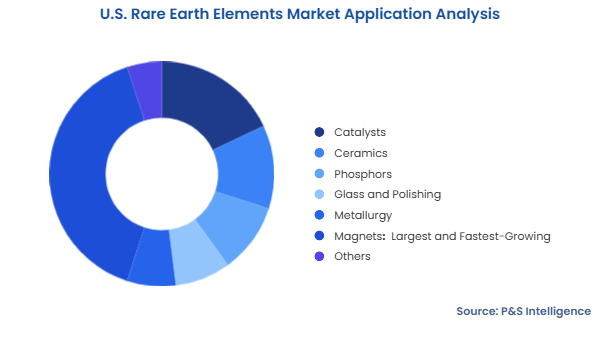
The magnets category held the largest market share, of 40%, in 2024, and it will grow at the highest CAGR, of 10.8%, during the forecast period. This is because many key industries rely on magnets composed of neodymium, praseodymium, and dysprosium for essential operational components. Primary applications are the production of electric motors, hard drives, wind turbines, and EVs. The worldwide initiatives for clean energy drive the demand for rare earth magnets.
The applications analyzed here are:
Drive strategic growth with comprehensive market analysis
The Western region held the largest market share, of 45%, in 2024, because it hosts substantial rare earth mining activities, particularly California and Nevada. One of the few domestic rare earth mines operates in the Mountain Pass Mines area. The West region also possesses important industries that heavily utilize rare earth elements, including electronics, aerospace, and renewable energy.
The Southern region in the U.S. will grow at the highest CAGR, of 11%, during the forecast period, because of the rising need from manufacturing plants and high-tech sectors in Texas and Florida. In addition, the South takes advantage of a growing customer interest in clean energy products, which drives the demand for rare earth materials for electric vehicle motors, renewable energy components, and magnetic systems.
The regions analyzed in this report are:
The market is fragmented in nature because of the involvement of multiple players, both large and small, across different stages of the supply chain. The specific requirements of industries and the presence of companies dedicated to specific ones prevent the industry from being controlled by just a few big companies. The rare earth industry is in an early stage of development, with many players engaged in operational capability expansion. Numerous companies are entering the market by targeting niche applications and enhancing production methods. A lot of rare earth elements are imported from China and other countries, which fragments the market.
Want a report tailored exactly to your business need?
Request CustomizationLeading companies across industries trust us to deliver data-driven insights and innovative solutions for their most critical decisions. From data-driven strategies to actionable insights, we empower the decision-makers who shape industries and define the future. From Fortune 500 companies to innovative startups, we are proud to partner with organisations that drive progress in their industries.

Working with P&S Intelligence and their team was an absolute pleasure – their awareness of timelines and commitment to value greatly contributed to our project's success. Eagerly anticipating future collaborations.
McKinsey & Company
India
Our insights into the minutest levels of the markets, including the latest trends and competitive landscape, give you all the answers you need to take your business to new heights

We take a cautious approach to protecting your personal and confidential information. Trust is the strongest bond that connects us and our clients, and trust we build by complying with all international and domestic data protection and privacy laws


Customize the Report to Align with Your Business Objectives

Request the Free Sample Pages