U.S. Private Equity Market Size & Share Analysis - Emerging Trends, Growth Opportunities, Competitive Landscape, and Forecasts (2025 - 2032)
This Report Provides In-Depth Analysis of the U.S. Private Equity Market Report Prepared by P&S Intelligence, Segmented by Fund Type (Buyout, Venture Capital, Real Estate, Growth Equity, Private Debt, Infrastructure), Sector (Technology, Healthcare, Consumer & Retail, Financial Services, Industrial & Manufacturing, Energy & Power, Real Estate and Services, Media & Entertainment, Telecom), Investments (Large Cap, Upper Middle Market, Lower Middle Market), and Geographical Outlook for the Period of 2019 to 2032
Explore the market potential with our data-driven report
U.S. Private Equity Market Future Outlook
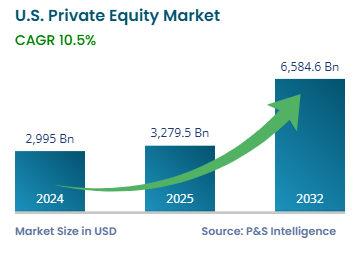
The U.S. private equity market size was USD 2,995 billion in 2024, which is expected to reach 6584.6 billion by 2032, growing at a CAGR of 10.5% during the forecast period 2025-2032.
This expansion is because investors seek robust returns and adaptable features during economic uncertainty. The long-term growth management and enhanced resilience make private equity investments more favorable than public markets. The increasing inflation and changing interest rate environment drive investors toward private equity as their choice for protecting and increasing their financial assets.
As per studies, over 25 million companies, which is 99% of all the business in the U.S., are private. Many of them actively choose to remain independent, to avoid the public trading requirements and associated expenses. Private equity firms give businesses access to financial resources and operational guidance, which helps them accomplish growth goals, organizational restructuring, and innovation projects. Private equity firms acquire businesses through this approach to later achieve increased business value, which results in profits for firms and their investors.
The investment volume of pension funds, insurance entities, and university endowments has steadily risen for U.S. private equity opportunities. These investors recognize private equity as part of a diverse portfolio structure since they await high returns over extended periods. The consistent capital flow permits U.S. private equity firms to advance their operations, conduct substantial business transactions, and investigate fresh market sectors.
U.S. Private Equity Market Trends & Drivers
Longer Holding Periods Are Trending
Private equity firms extend investment durations of acquired businesses to between 5 to 7 years since they previously maintained ownership for 3 to 5 years during the previous decade.
The primary motive behind this practice involves allowing businesses to expand their profitability while they remain under private equity investment until sale time.
Private equity firms delay sales to concentrate on business development through operational improvements, market expansion, and technology advancement.
By waiting longer, firms can enhance their company value, which results in higher profits at the point of sale.
As per estimates, the average time private equity providers spend holding companies increased to over 6 years.
The investment period often gets extended when firms decide to sell companies to their continuation vehicles or new funds that they own.
Private equity firms delay business exits to generate superior investor returns through extensive value growth since the current economic conditions make rapid disposal less profitable.
Private Company Boom Drives Market
The U.S. business landscape has expanded its private business duration, which increases the investment prospects for private equity firms.
Data from Pitchbook indicates that companies spent 12 years on average before going public in 2023, while the figure stood at 8 years in 2013.
Private funding has become plentiful; thus, companies can develop without facing immediate public market pressure.
Businesses maintain better focus on enduring strategies because staying private shields them from public shareholder expectations for quarterly financial statements.
The U.S. was home to 33.2 million businesses in 2024, only 0.1% of which were large entities.
Private equity investments can benefit from the extensive number of private companies operating in the U.S. market.
Businesses choose private ownership to preserve their autonomy and freedom to adapt their strategies.
Private equity firms exploit market interest in private businesses by investing in such companies until they achieve returns through strategic deals or public stock releases during favorable market periods.
U.S. Private Equity Market Segmentation and Category Analysis
Insights by Fund Type
Buyout is the largest category, with a market share of 45% in 2024. The acquisition strategy of these funds involves purchasing established companies through full control to enhance operating performance and profitability before selling the acquired entities. The buyout investment led market activity in 2024 through 58 transactions worth USD 16.8 billion, which demonstrated a 39% increase over the previous year. The substantial funds under management and their capacity to execute significant transactions make them the fundamental elements of private equity operations.
Private debt is the fastest-growing category. The tightening of bank lending policies has led businesses to seek loan alternatives from private equity firms. Private equity loans provide businesses with financing to expand their operations or reorganize their structure and funding to obtain acquisitions, while bypassing traditional banking institutions. Investors receive higher returns through these arrangements, and borrowing companies gain better financing flexibility. Private debt stands as a primary market force in private equity due to rising interest rate fluctuations and increasing demand for non-bank lending.
The following fund types are studied in the report:
Buyout (Largest Category)
Venture Capital
Real Estate
Growth Equity
Private Debt (Fastest-Growing Category)
Infrastructure
Others
Insights by Sector
Technology is the largest category, with a market share of 30% in 2024. The continuous digitalization with the increasing adoption of artificial intelligence, machine learning, and big data analytics attracts private equity firms to large investment opportunities. Digital adoption growth during the pandemic has increased the investment value of tech companies, making them highly attractive targets.
Energy & power is the fastest-growing category, with CAGR of approx. 10.5% in forecast period. Investments in the energy and power sector achieve high potential due to global sustainable trends, government support for renewable initiatives, and technological developments in renewable energy systems. Private equity firms spend money on renewable energy projects because they see superior growth prospects and rising consumer need for green energy solutions.
Here are the sectors studied in this report:
Technology (Largest Category)
Healthcare
Consumer & Retail
Financial Services
Industrial & Manufacturing
Energy & Power (Fastest-Growing Category)
Real Estate and Services
Media & Entertainment
Telecom
Others
Insights by Investment
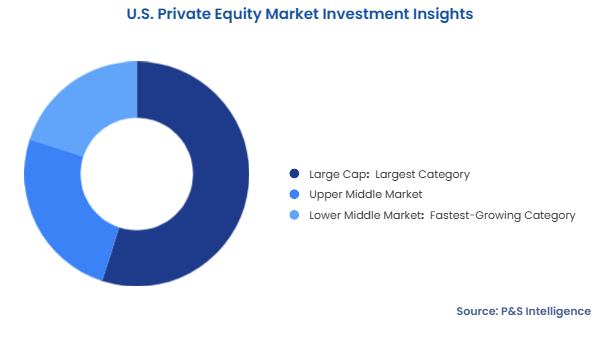
Large cap is the largest category, with a market share of 55% in 2024. They demonstrate strong stability, robust business operations, and predictable cash flow patterns, which appeal to investors who want conservative risk levels. The strategic acquisitions and operational enhancement possibilities offered by large-cap enterprises make these companies highly desirable to investors. The ability to access capital abundantly makes these entities powerful contributors to private equity markets.
Lower middle market is the fastest-growing category. Private equity firms discover substantial value-generating opportunities because these companies work in specific market segments and allow private equity firms to enhance operations and grow their business presence. The revenue and EBITDA growth from middle-market private equity investments reach 2.9 times and 2.7 times higher, respectively, than what large-cap companies achieve.
The rapid expansion of middle-market companies mainly results from their size and fragmented structure, which offers adaptability and room for development. Private equity investments in the lower middle market segment provide appealing valuations, which make this market segment highly attractive for investment opportunities.
Here are the categories of this segment:
Large Cap (Largest Category)
Upper Middle Market
Lower Middle Market (Fastest-Growing Category)
Drive strategic growth with comprehensive market analysis
U.S. Private Equity Market Geographical Analysis
Northeast is the largest region, with a market share of 25% in 2024. The New York City financial hub accounts for major private equity dominance and venture capital growth through the density of private equity firms, venture capitalists, and institutional investors present there. Private equity activities are drawn to the region because of its strong infrastructure and market connectivity between domestic and international sectors. Universities and research institutions in the region support innovation by creating successful high-growth startups.
The West is the fastest-growing region, because of powerful technology companies, active venture capital operations, and a thriving startup environment. The private sector in California includes 263,297 companies, which stand as the most numerous private entities across U.S. states, and among them, 18,382 businesses receive venture capital or private equity funding for a penetration rate of 6.98%. Private equity firms find California to be an appealing location because its forward-thinking business environment and its dynamic startup scene, specifically within technology, creates ideal conditions to find growth opportunities.
Here are the categories of this segment:
Northeast (Largest Category)
Midwest
West (Fastest-Growing Category)
South
U.S. Private Equity Market Competitive Landscape
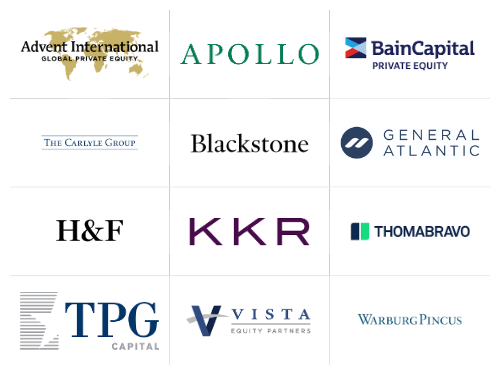
The market is fragmented because this market structure contains numerous firms without any controlling firms. The private equity market contains well-known firms Blackstone, KKR, and Carlyle, and thousands of smaller and mid-sized firms operating throughout the country. This fragmentation is because it covers enormous corporate acquisitions worth billions, with investments in local businesses. Multiple players can thrive in their specialized market segments because of which makes the market diverse and competitive.
Key U.S. Private Equity Companies:
Blackstone Inc.
Kohlberg Kravis Roberts & Co. L.P.
Apollo Global Management, Inc.
The Carlyle Group
TPG Inc.
Bain Capital, LP
Warburg Pincus LLC
Advent International, L.P.
General Atlantic Service Company L.P.
Vista Equity Partners Management, LLC
Hellman & Friedman LLC
Thoma Bravo, L.P.
U.S. Private Equity Market News & Updates
In March 2025, Sycamore Partners completed the acquisition of Walgreens Boots Alliance for USD 24.7 billion.
In September 2023, Align Capital Partners launched Align Collaborate, a strategy focused on partnering with independent sponsors. This initiative aims to provide equity capital and support to independent sponsors targeting lower-middle-market businesses, enhancing growth opportunities in this segment.
Want a report tailored exactly to your business need?
Leading companies across industries trust us to deliver data-driven insights and innovative solutions for their most critical decisions. From data-driven strategies to actionable insights, we empower the decision-makers who shape industries and define the future. From Fortune 500 companies to innovative startups, we are proud to partner with organisations that drive progress in their industries.
Client Testimonials
Working with P&S Intelligence and their team was an absolute pleasure – their awareness of timelines and commitment to value greatly contributed to our project's success. Eagerly anticipating future collaborations.
McKinsey & Company
India
Unmatched Standards
Our insights into the minutest levels of the markets, including the latest trends and competitive landscape, give you all the answers you need to take your business to new heights
Complete Data Security
We take a cautious approach to protecting your personal and confidential information. Trust is the strongest bond that connects us and our clients, and trust we build by complying with all international and domestic data protection and privacy laws