U.S. Nonferrous Metal Rolling & Alloying Market Size & Opportunities Analysis - Growth Strategies, Competitiveness, and Forecasts (2025 - 2032)
This Report Provides In-Depth Analysis of the U.S. Nonferrous Metal Rolling & Alloying Market Report Prepared by P&S Intelligence, Segmented by Metal Type (Aluminum, Copper, Nickel, Titanium, Zinc), Alloy Type (Pure Metals, Alloyed Metals), End Use Industry (Automotive & Transportation, Aerospace & Defense, Electrical & Electronics, Construction & Infrastructure, Industrial Machinery, Consumer Goods & Packaging, Medical Devices), Company Size (Large Enterprises, Mid Sized Companies, Small & Niche Manufacturers), and Geographical Outlook for the Period of 2019 to 2032
U.S. Nonferrous Metal Rolling & Alloying Market Revenue Scope
Key Highlights
Study Period
2019 - 2032
Market Size in 2024
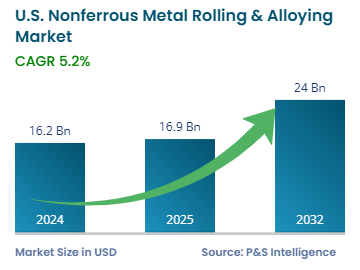
USD 16.2 Billion
Market Size in 2025
USD 16.9 Billion
Market Size by 2032
USD 24.0 Billion
Projected CAGR
5.2%
Largest Region
Midwest
Fastest Growing Region
South
Market Structure
Fragmented
Market Size
Major Companies
Important Takeaways
Market Size and Forecast
Industry Trend
Regulatory Landscape
Demand Trend Analysis
Companies Recent Strategical Developments
Key Stakeholders
Voice of Industry Experts/KOLs
Future Opportunity
Explore the market potential with our data-driven report
U.S. Nonferrous Metal Rolling & Alloying Market Outlook
The U.S. nonferrous metal rolling & alloying market was valued at USD 16.2 billion in 2024, and this number is expected to increase to USD 24.0 billion by 2032, advancing at a CAGR of 5.2% during 2025–2032.
This is because of the burgeoning product requirement in the automotive, aerospace, construction, and electronics industries. Aluminum and titanium alloys expect substantial growth from sustainability developments because manufacturers need lightweight materials in electric vehicles and renewable energy applications.
Modern manufacturing approaches in powder metallurgy and additive processes improve production speed and material strength, which makes nonferrous materials attractive for demanding applications. The increase in circular economy principles leads to the increasing metal recycling, which cuts down raw material demands and improves cost-effectiveness.
The demand for copper, nickel, and specialty alloys will increase because of the government programs that promote the modernization of defense systems and infrastructure expansion.
U.S. Nonferrous Metal Rolling & Alloying Market Growth Factors
Shift toward Circular Economy and Sustainability Is a Key Trend
The industry has undergone a fundamental transformation because sustainability measures and circular economy models now receive paramount attention.
Companies and government entities now focus on sustainable metal recycling practices while developing eco-friendly process methods.
Manufacturing processes that depend on raw materials exploit virgin sources with negative impacts on mining operations and refining procedures of bauxite, aluminum, and nickel ores.
The recycling method results in emission reduction while also reducing economic costs.
The Environmental Protection Agency (EPA) and the U.S. Department of Energy implement sustainability guidelines that force manufacturers to adopt low-carbon production approaches.
The use of secondary metal markets boosts profitability because scrap metal efficiently improves metal rolling and alloying operations, which reduces energy usage for maintaining material strength.
Large automotive, aerospace, and industrial manufacturing companies support nonferrous metal sustainable procurement to boost their environmental, social, and governance (ESG) assessment positions.
The electric vehicle (EV) market surge demands aluminum for lightweighting applications, copper for wiring, and nickel for battery components that use either NCA or NMC chemistries.
The conversion to renewable energy systems necessitates extensive use of nonferrous metals to build solar panels and wind turbines, while transmission cables need aluminum.
These materials receive accelerated investment momentum because of policies that advance clean energy and carbon neutrality in the U.S. government.
Infrastructure Development and Industrialization Drive Market
The USD 1.2-trillion Bipartisan Infrastructure Law (BIL), and other U.S. government initiatives stimulate investments that utilize nonferrous metals to construct roads, bridges, railways, power grids, and telecommunications networks.
The rising need for electrical systems and industrial automation in smart cities requires high-performance alloys and advanced machinery throughout manufacturing.
Defense and aerospace industries expand because of the modernization programs that drive titanium, aluminum, and specialty alloy requirements for military aircraft, ships, and defense systems.
Industrialization and infrastructure development are key drivers of the U.S. nonferrous metal rolling and alloying market, particularly in sectors like transportation, power, and construction.
According to the U.S. Geological Survey, over 35% of domestically consumed aluminum is used in the transportation industry, with infrastructure applications such as electrical wiring and structural components accounting for another significant share.
The U.S. Department of Energy notes that copper demand is expected to rise by 30% by 2035 due to grid modernization and electrification.
The Aluminum Association also reports a steady increase in domestic rolled product usage, driven by lightweighting trends and green building initiatives.
U.S. Nonferrous Metal Rolling & Alloying Market Segmentation Analysis
Insights by Metal Type
Aluminum represents the largest category, with 35% share, because it serves multiple industries, spanning automotive, aerospace, construction, and packaging. Its weight benefits, resistance to corrosion, and high strength per unit weight make it preferred for transportation and infrastructure development. A growing preference for eco-friendly materials has led to the increasing market share of recycled aluminum end products and its existing dominance in the U.S. nonferrous metal rolling & alloying market. The growing EV output and rising renewable capacity lead to the dominance of aluminum on the market.
The metal types covered in this report are:
Aluminum (Largest Category)
Copper
Nickel (Fastest-Growing Category)
Titanium
Zinc
Others
Insights by Alloy Type
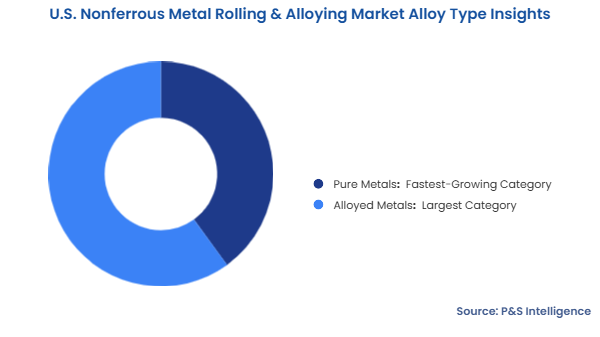
Alloys are the larger category, with 80% share, because alloying makes materials strong, durable, and suitable for a variety of industrial applications. The alloying process enhances strength and corrosion resistance while improving thermal stability, which enables important applications, such as automotive, aerospace, and industrial production, especially aluminum alloys, titanium alloys, and nickel-based superalloys. The segment remains dominant due to the continuously rising demand for high-performance alloys that power EVs, aircraft, and advanced machinery applications. The demand for custom metal alloys for defense and infrastructure projects receives an additional boost from government funding and a strong focus on superior performance attributes and longevity.
The alloy types covered in this report are:
Pure Metals (Fastest-Growing Category)
Alloys (Largest Category)
Insights by End-Use Industry
Construction & infrastructure is the largest category, with 30% share, because these metals are extensively utilized for buildings, bridges, railways, and electrical systems. The Bipartisan Infrastructure Law (BIL) creates rising market demand for nonferrous metals used in structural elements, corrosion-resistant coatings, and electrical wiring systems. The smart city initiatives and the implementation of energy-efficient buildings continue to escalate metal consumption for this sector. The sector involving urbanization and infrastructure modernization stands as the prime consumer of nonferrous metals due to the continuous infrastructural advancements. The U.S. Census Bureau calculated construction spending in the U.S. for May 2025 at USD 2,138.2 billion.
The end-use industries covered in this report are:
Large enterprises are the largest category, with 60% share, because they maintain extensive production capabilities, advanced technologies, and robust supply chain operations. The companies Alcoa, Arconic, and Kaiser Aluminum possess the capabilities to invest in high-efficiency manufacturing, recycling, and advanced alloy research and development. Established relationships between large enterprises and the aerospace, construction, and automotive industries guarantee them a continuous supply of their consistent large-scale product requirements.
The company sizes covered in this report are:
Large (Largest Category)
Mid-Sized (Fastest-Growing Category)
Small & Niche
Drive strategic growth with comprehensive market analysis
U.S. Nonferrous Metal Rolling & Alloying Market Regional Growth Dynamics
The Midwest dominates the market with 40% share because of its robust manufacturing capabilities and easy access to raw materials. The states of Ohio, Michigan, and Indiana drive the demand for nonferrous rolled metals and alloys from automotive, aerospace, and industrial sectors. The region stands strong as a market leader because of its major processing plants, foundries, and recycling facilities. Governments and expansions in EV technology back the Midwest's status as a vital market force.
The regions analyzed in this report are:
Northeast
Midwest (Largest Region)
West
South (Fastest-Growing Region)
U.S. Nonferrous Metal Rolling & Alloying Market Share
The market is fragmented due to competition between large enterprises alongside mid-sized companies and niche manufacturers. Large-scale manufacturing mostly belongs to industry leaders such as Alcoa, Arconic, and Kaiser Aluminum although the market contains various specialized and regional enterprises that serve the demands of custom alloys, high-purity metals, and emerging applications in electric vehicles and aerospace technology and renewable energy production.
The market structure becomes fragmented because end-use industries operate differently and the industry possesses distinctive technological limits and operates with supply chain arrangements. Market competition persists because of continuous advancements in sustainable metallurgy and recycling even though major industry players exist in the market.
Key U.S. Nonferrous Metal Rolling & Alloying Companies:
Alcoa Corporation
Kaiser Aluminum Corporation
Novelis Inc.
Haynes International, Inc.
Materion Corporation
Commercial Metal Exchange
Cada Stainless & Alloys
Beartech Alloys, Inc.
A-1 Alloys Inc.
Schnitzer Steel Industries, Inc.
Sims Metal Management
Nucor Corporation
U.S. Nonferrous Metal Rolling & Alloying Market News
In June 2025, Nordisk Hydro ASA announced the full commercial availability of its Hydro CIRCAL in the U.S. Made from recycled aluminum with at least 75% post-consumer scrap, Hydro CIRCAL is designed to redue emissions from the construction, electronics, and automotive sectors.
In June 2025, ArcelorMittal S.A. bought the remaining 50% stake in AM/NS Calvert from Nippon Steel Corporation to achieve full ownership. The acquired company was renamed ArcelorMittal Calvert.
In August 2023, Sims Metal announced plans to acquire Baltimore Scrap Corp. to expand its recycling domain and bolster its position across the U.S. metallurgy industry through advanced processing facilities.
Want a report tailored exactly to your business need?
Leading companies across industries trust us to deliver data-driven insights and innovative solutions for their most critical decisions. From data-driven strategies to actionable insights, we empower the decision-makers who shape industries and define the future. From Fortune 500 companies to innovative startups, we are proud to partner with organisations that drive progress in their industries.
Client Testimonials
Working with P&S Intelligence and their team was an absolute pleasure – their awareness of timelines and commitment to value greatly contributed to our project's success. Eagerly anticipating future collaborations.
McKinsey & Company
India
Unmatched Standards
Our insights into the minutest levels of the markets, including the latest trends and competitive landscape, give you all the answers you need to take your business to new heights
Complete Data Security
We take a cautious approach to protecting your personal and confidential information. Trust is the strongest bond that connects us and our clients, and trust we build by complying with all international and domestic data protection and privacy laws