U.S. Metalworking Machinery Market Size & Share Analysis - Trends, Drivers, Competitive Landscape, and Forecasts (2025 - 2032)
This Report Provides In-Depth Analysis of the U.S. Metalworking Machinery Market Report Prepared by P&S Intelligence, Segmented by Product Type (Machine Tools, Cutting Tools & Equipment, Forming Machines, Welding & Joining Equipment, Accessories & Attachments), Automation Level (Manual Machines, Semi- Automated Machines, Fully Automated & Smart Machines), Distribution Channel (Direct Sales, Distributors & Dealers, Online Sales), End-Use (Automotive, Aerospace & Defense, Construction & Heavy Equipment, Medical Devices), and Geographical Outlook for the Period of 2019 to 2032
U.S. Metalworking Machinery Market Growth Potential
Key Highlights
Study Period
2019 - 2032
Market Size in 2024
USD 14.7 billion
Market Size in 2025
USD 15.3 billion
Market Size by 2032
USD 21.4 billion
Projected CAGR
5%
Largest Region
Midwest
Fastest Growing Region
South
Market Structure
Fragmented
Market Size
Major Companies
Important Takeaways
Market Size and Forecast
Industry Trend
Regulatory Landscape
Demand Trend Analysis
Companies Recent Strategical Developments
Key Stakeholders
Voice of Industry Experts/KOLs
Future Opportunity
Explore the market potential with our data-driven report
U.S. Metalworking Machinery Market Overview
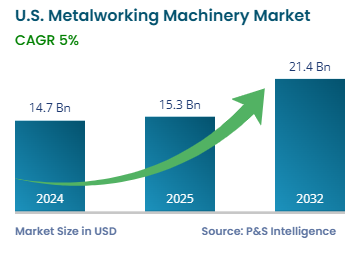
The U.S. metalworking machinery market size was USD 14.7 billion in 2024, and it will grow by 5% during 2025–2032, to reach USD 21.4 billion by 2032.
This market is driven by the expansion of advanced manufacturing sector, adoption of automation & Robotics, reshoring and localization of supply chains, government incentives and infrastructure investment, labor shortages, adoption of automation, rising demand for high-precision components, and growth in used and refurbished machinery market.
The CHIPS and Science Act and infrastructure investments are broadening demand through policy incentives for local manufacturing and the reshoring of manufacturing operations.
U.S. Metalworking Machinery Market Growth Factors
Adoption of Automation & Robotics Is a Key Trend
The usage of automation and robotics for better precision, efficiency, and cost savings is trending.
CNC machines, robotic arms, and AI-driven systems are now common in modern, tech-driven factories to improve efficiency, reduce labor costs, maintain consistent product quality, scale production, meet high-volume demand, and stay competitive.
The Chips And Science Act, Advanced Robotics for Manufacturing (ARM) Institute, Future Of Artificial Intelligence Innovation Act, and Occupational Safety And Health Administration (OSHA) guidelines support the adoption of automation and robotics in manufacturing to improve productivity, competitiveness, and workforce development.
The Census Bureau reports that 52% of the manufacturing workers are exposed to automation technologies, compared to 28% in other sectors.
This shows a higher adoption rate of AI and robotics in manufacturing for increased productivity and efficiency.
Expansion of U.S. Manufacturing Sectors Fueling Drives Market
Businesses are investing money in new factories, production lines, and smart manufacturing systems.
EV manufacturers, such as Tesla, Ford, and GM, are spending billions on battery plants and lightweight component production, which require high-precision CNC machines and robotic tools.
The U.S. states, such as Texas, Tennessee, Georgia, and Kentucky, offer tax credits, grants, and low regulatory hurdles, which inspire companies to relocate or expand manufacturing facilities.
This increases the demand for automated tools, driving the machinery market.
The growth of the semiconductors, aerospace, and defense sectors leads to large-scale investments in advanced fabrication equipment at domestic production hubs.
The Future of AI Innovation Act and U.S. Innovation and Competition Act encourage businesses to adopt advanced manufacturing technologies responsibly and sustainably.
U.S. Metalworking Machinery Market Segmentation Analysis
Product Type Analysis
Machine tools have the largest market share, with 35%, in 2024, because lathes, mills, and grinders, are widely used in industries such as automotive, aerospace, and manufacturing. This is because they offer high precision for making parts that require high tolerance. With automation, manual machines are being replaced with CNC systems to enhance productivity and make advanced, complex parts, especially for EVs and aerospace markets.
The cutting tools & equipment category will grow at the highest CAGR during the forecast period. This is because advancement in technology, such as fiber laser cutters, waterjet systems, and plasma-cutting machines, have made metal fabrication faster, cleaner, and more efficient. These systems are used in the automotive industry for lightweight EV parts, aerospace sector for detailed metal structures, and electronics industry for micro-cutting.
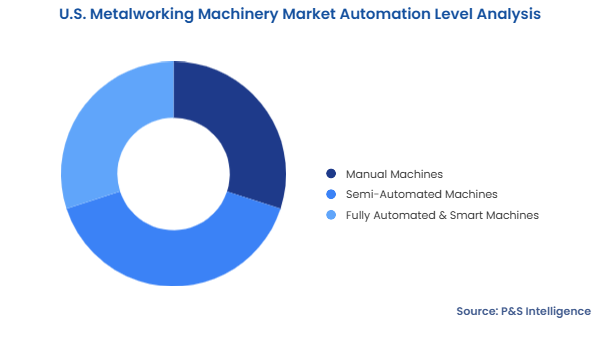
The semi-automated category has the largest market share, with 40%, in 2024. These systems are preferred by small and medium-scale manufacturers as they offer good productivity at a low cost. Semi-automated machines still need an operator, making them flexible for job shops and mid-level production, where full automation is not economically viable.
The fully automated and smart machines category will grow at the highest CAGR during the forecast period. The progress of Industry 4.0 and small manufacturing raise the demand for unmanned production, increased operational efficiencies, and AI precision. This is the most apparent in high-volume industries, such as aerospace, electric vehicles, and electronics. Labor shortages and the rising wages are also pushing manufacturers to invest in CNC systems with self-adjustment, robotics automation, and IoT-enabled predictive maintenance features.
The automation levels analyzed in this report are:
The distributors & dealers category held the larger market share, of 50%, in 2024. Industries traditionally rely on local, relationship-based sales because distributors offer important on-site services, such as technical support, equipment demonstration, financing, and maintenance. This makes them preferred among buyers of heavy-duty, high-precision machines.
The online sales category will grow at the highest CAGR during the forecast period. This is because of the increasing rate of digitalization, emergence of B2B e-commerce platforms, and entry of tech-savvy SMEs. Moreover, startups now prefer online marketplaces due to their transparency, competitive pricing, and easy comparison of machinery specifications. Online auctions for surplus and refurbished machinery offer cost-effective alternatives to buying new equipment.
The distribution channels analyzed in this report are:
Direct Sales (Larger Category)
Distributors & Dealers
Online Sales
End Use Analysis
The automotive category held the larger market share, of 35%, in 2024. This is due to the requirements for precise parts, such as engine blocks, transmission systems, and suspension components. The rising popularity of EVs has increased the demand for highly specialized parts, such as battery enclosures, motor housings, and lightweight aluminum and magnesium components, to improve efficiency.
The aerospace & defense category will grow at the highest CAGR during the forecast period. This is due to the increasing spending on defense, commercial aviation, and space exploration. The modernization of the military with next-generation fighter jets, drones, and hypersonic weapons requires ultra-precision machining of high-strength alloys, such as titanium and Inconel.
The end uses in this report are:
Automotive
Aerospace & Defense
Construction & Heavy Equipment
Medical Devices
Others
Drive strategic growth with comprehensive market analysis
U.S. Metalworking Machinery Market Regional Outlook
The Midwest region held the largest market share, of 35%, in 2024. This is because Michigan, Ohio, and Illinois have a long manufacturing history and concentration of heavy industries. These states support automotive OEMs, producers of industrial equipment, and suppliers of machinery.
The South region has the highest CAGR, of 5.5%, during the forecast period. Texas, Tennessee, and Georgia are witnessing huge investments in the EV, aerospace, and energy sectors due to their low operating costs, tax incentives, and business-friendly environment. The rising competition creates new manufacturing hubs, such as battery plants in Kentucky and aerospace facilities in Alabama, thus increasing the demand for metalworking machinery.
The geographical breakdown of the market is as follows:
Northeast
West
Midwest(Largest Region)
South (Fastest-Growing Region)
U.S. Metalworking Machinery Market Share
The market is fragmented because a large number of small and large companies operate in it. The large variety of metalworking machinery fragments the market as no company offers everything. Moreover, end users differ in their requirements for throughput, actual process, precision, and safety, which offers opportunities to multiple players. End users that have less-specialized requirements buy from local and regional firms, whereas those that must meet strict safety and performance requirements generally contract the established players.
Key U.S. Metalworking Machinery Companies:
haas automation
Okuma America
Gleason Corporation
Hardinge Inc.
Fryer Machine Systems
Milltronics USA
Kitamura Machinery
Elite Metal Tool
INDEX Corporation
ANCA CNC Machines
EMAG LLC
Bystronic Inc.
U.S. Metalworking Machinery Market News
In October 2024, Haas Automation kicked off the construction of a new 2.4 million-square-foot manufacturing site in Henderson, Nevada.
Want a report tailored exactly to your business need?
Leading companies across industries trust us to deliver data-driven insights and innovative solutions for their most critical decisions. From data-driven strategies to actionable insights, we empower the decision-makers who shape industries and define the future. From Fortune 500 companies to innovative startups, we are proud to partner with organisations that drive progress in their industries.
Client Testimonials
Working with P&S Intelligence and their team was an absolute pleasure – their awareness of timelines and commitment to value greatly contributed to our project's success. Eagerly anticipating future collaborations.
McKinsey & Company
India
Unmatched Standards
Our insights into the minutest levels of the markets, including the latest trends and competitive landscape, give you all the answers you need to take your business to new heights
Complete Data Security
We take a cautious approach to protecting your personal and confidential information. Trust is the strongest bond that connects us and our clients, and trust we build by complying with all international and domestic data protection and privacy laws