Key Highlights
| Study Period | 2019 - 2032 |
| Market Size in 2024 | USD 5.2 Billion |
| Market Size in 2025 | USD 5.5 Billion |
| Market Size by 2032 | USD 8.3 Billion |
| Projected CAGR | 6.1% |
| Largest Region | South |
| Fastest Growing Region | West |
| Market Structure | Consolidated |

| Study Period | 2019 - 2032 |
| Market Size in 2024 | USD 5.2 Billion |
| Market Size in 2025 | USD 5.5 Billion |
| Market Size by 2032 | USD 8.3 Billion |
| Projected CAGR | 6.1% |
| Largest Region | South |
| Fastest Growing Region | West |
| Market Structure | Consolidated |
|
Explore the market potential with our data-driven report
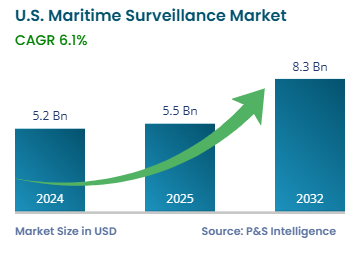
The U.S. maritime surveillance market size was USD 5.2 billion in 2024, and it will grow by 6.1% during 2025–2032, reaching USD 8.3 billion by 2032.
The market is driven by the technological advancements, security concerns, cost efficiency, and unmanned systems, such as surface vessels and drones, support modern monitoring by covering large maritime areas efficiently. These systems enable real-time data acquisition and continuous monitoring while allowing operations to occur in distant dangerous regions without needing human operators.
For instance, in May 2024, NATO officially launched a new Maritime Centre for Security of Critical Undersea Infrastructure (CUI). This networking and knowledge center assists Commander MARCOM in making decisions, deploying forces, and coordinating action.
Furthermore, autonomous platforms and floating drones enable cost-effective and operationally efficient maritime surveillance solutions compared to conventional manned ships. Such technological developments boost operational potential and make maritime observation more available and environmentally sustainable.
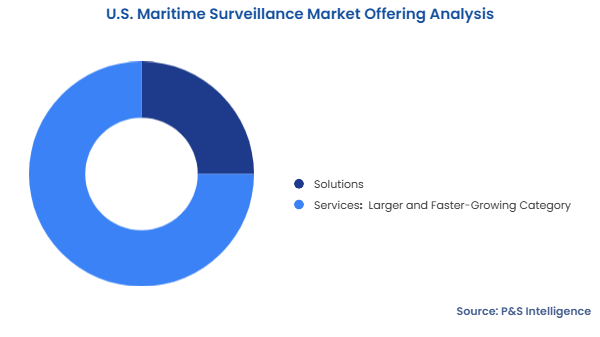
The services category held the larger market share, of 75%, in 2024, and it will grow at the higher CAGR, during the forecast period. Ongoing maintenance operations for complex surveillance systems including radars, sonar, and satellite systems must be carried out in the market.
Maritime surveillance consulting services demonstrate the highest projection of market growth because businesses need advanced technologies and solutions that follow regulations. Modern security threats challenge organizations to seek specialized expert help for optimizing their surveillance functions, merging new technologies, and securing systems from cyber-attacks.
The offerings analyzed in this report are:
The surveillance & tracking category held the largest market share, of 35%, in 2024. This is because it establishes the backbone of maritime protection and monitoring operations. The identification and tracking of maritime traffic depend on radar systems, sonar systems, satellite tracking, and automatic identification system (AIS).
The data acquisition category will grow at the highest CAGR, of 6.5%, during the forecast period, due to the rising demand for technical solutions for acquiring data. Nowadays, maritime surveillance heavily depends on gathering substantial real-time data from different sources to enhance decision-making capabilities.
The technologies analyzed in this report are:
The radar category held the larger market share, of 45%, in 2024. This is because radar stands as the primary technology for identifying, tracing, and tracking maritime vehicles, aircraft, and monitoring sea domain objects. Vessel collision avoidance, navigation, and maritime security significantly depend on radar systems.
The weather station category will grow at the higher CAGR, during the forecast period. This is because modern weather station systems are quickly being adopted by maritime sectors because of increasing climate-associated safety risks, navigation obstacles, and an increased demand for predictive analytic capabilities.
The components analyzed in this report are:
The vessel monitoring & management category held the larger market share, of 30%, in 2024. This is because these systems serve as fundamental tools for observing ships, controlling their tracking activities, and organizational management duties. These systems offer real-time access to information about vessel locations, speeds, movements, and operation data.
The automatic identification system (AIS) category will grow at the higher CAGR, during the forecast period. This is because it supports maritime safety and better situational awareness. The rising necessity for maritime safety, accurate navigation, and current tracking in busy maritime spaces has accelerated the deployment of AIS technology.
The systems analyzed in this report are:
The government category held the largest market share, of 40%, in 2024. This is because the U.S. Coast Guard and the Department of Defense represent the main purchaser group of maritime surveillance systems. National security missions, maritime border protection, anti-piracy, search, rescue operations, and maritime law enforcement constitute the primary applications of these systems by government agencies.
The oil & gas category will grow at the highest CAGR, during the forecast period. This is because offshore infrastructure protection needs are driving the rising demand to safeguard oil platforms, pipelines, and additional offshore assets. Between 2012 and 2020, the Bureau of Safety and Environmental Enforcement (BSEE) reported 4,474 offshore incidents, resulting in 1,654 injuries and 23 fatalities. The majority of these incidents occurred in the Gulf of Mexico, emphasizing the need for robust maritime surveillance to enhance safety in offshore energy operations.
The end uses analyzed in this report are:
Drive strategic growth with comprehensive market analysis
The South is the largest region, with 30% share, due to its dense port activity, offshore energy infrastructure, and strategic importance, particularly the Gulf Coast. The Port of Houston is among the busiest in the U.S. by tonnage, and the Gulf of Mexico hosts over 1,800 offshore oil & gas platforms. The U.S. Coast Guard’s Eighth District, headquartered in New Orleans, manages more than 1.25 million square miles of maritime territory and responds to over 5,000 incidents annually. Surveillance in this region supports energy security, border protection, and disaster preparedness, especially during hurricane season.
The West is the fastest-growing region, due to increasing Arctic operations, commercial traffic, and fishing activity, especially in Alaska. The Coast Guard’s Seventeenth District in Alaska logs over 1,000 search and rescue missions annually, driven by dangerous conditions in the Bering Sea during crab fishing seasons. The Port of Los Angeles and Long Beach together handled over 17 million TEUs in recent years, making them critical for global trade monitoring. Rising geopolitical attention on the Arctic, combined with growing maritime commerce in the Pacific, is accelerating investment in radar systems, drones, and satellite-based surveillance technologies.
The regions analyzed in this report are:
The market is consolidated in nature because major companies control most market shares. The provision of maritime surveillance demands specialized advanced technology and expansive infrastructure that solely select companies possess. Complex tracking systems, maritime management systems, regulatory compliance systems cost a significant amount due to their extensive operational requirements. Companies with ample resources, expert knowledge, and international capabilities maintain control of advanced solution supply in this domain.
Want a report tailored exactly to your business need?
Request CustomizationLeading companies across industries trust us to deliver data-driven insights and innovative solutions for their most critical decisions. From data-driven strategies to actionable insights, we empower the decision-makers who shape industries and define the future. From Fortune 500 companies to innovative startups, we are proud to partner with organisations that drive progress in their industries.

Working with P&S Intelligence and their team was an absolute pleasure – their awareness of timelines and commitment to value greatly contributed to our project's success. Eagerly anticipating future collaborations.
McKinsey & Company
India
Our insights into the minutest levels of the markets, including the latest trends and competitive landscape, give you all the answers you need to take your business to new heights

We take a cautious approach to protecting your personal and confidential information. Trust is the strongest bond that connects us and our clients, and trust we build by complying with all international and domestic data protection and privacy laws


Customize the Report to Align with Your Business Objectives

Request the Free Sample Pages