U.S. Low- and Medium-Voltage Electrical Equipment Market Size & Share Analysis - Emerging Trends, Growth Opportunities, Competitive Landscape, and Forecasts (2025 - 2032)
This Report Provides In-Depth Analysis of the U.S. Low- and Medium-Voltage Electrical Equipment Market Report Prepared by P&S Intelligence, Segmented by Product Type (Switchboards & Panelboards, Switchgear Assemblies, Circuit Protection Devices, Motor Control Centers, Busducts & Cable Assemblies, Transformers & Power Conditioning Units, Power Generation Electrical Equipment, Power Monitoring & Control Devices, Industrial Automation Components), Voltage Type (Low, Medium), Application (Residential, Commercial, Industrial, Utilities), and Geographical Outlook for the Period of 2019 to 2032
U.S. Low- and Medium-Voltage Electrical Equipment Market Size Estimation
Key Highlights
Study Period
2019 - 2032
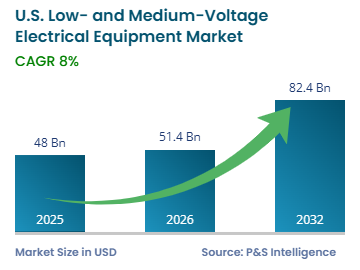
Market Size in 2025
USD 48.0 Billion
Market Size in 2026
USD 51.4 Billion
Market Size by 2032
USD 82.4 Billion
Projected CAGR
8%
Largest Region
South
Fastest Growing Region
Midwest
Market Structure
Semi-Consolidated
Market Size
Explore the market potential with our data-driven report
U.S. Low- and Medium-Voltage Electrical Equipment Market Future Outlook
The U.S. low and medium-voltage electrical equipment market size was USD 48.0 billion for 2025, and it will grow by 8.0% during 2025–2032, to reach USD 82.4 billion by 2032.
This growth is driven by large-scale grid modernization, expansion of renewable energy infrastructure, and increasing electrification across industrial and commercial sectors. LV/MV equipment, including switchgear, transformers, circuit protection devices, and automation components, forms the backbone of electrical distribution systems, ensuring safe and efficient power delivery.
The U.S. Department of Energy reports that over 70% of the U.S. transmission and distribution infrastructure is more than 25 years old, highlighting the urgent need for modernization. In addition, the U.S. Energy Information Administration notes that electricity consumption continues to rise due to the electrification of transportation and industry. Moreover, federal initiatives under the Infrastructure Investment and Jobs Act have allocated over USD 65 billion toward power infrastructure, supporting grid resilience, modernization, and integration of clean energy sources. Additionally, rising electricity demand from data centers and the accelerating deployment of EV charging networks are further contributing to higher load requirements, reinforcing the expansion of LV/MV electrical systems nationwide.
Key Market Insights
The switchgear assemblies category holds the largest market share, of 25%, in 2025, driven by its critical role in power distribution, protection, and control across utilities, industrial facilities, and commercial infrastructure.
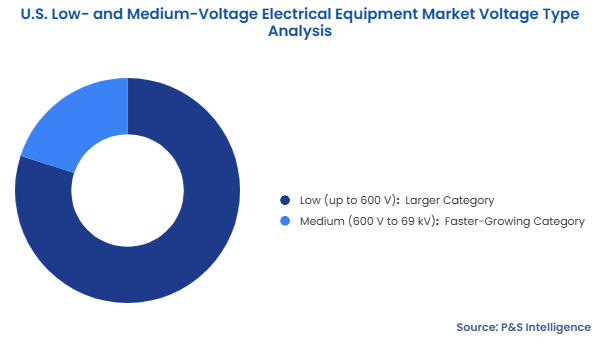
The low category holds the larger market share, of 80%, in 2025, driven by its widespread deployment across residential, commercial, and industrial applications.
The utilities category will have the highest CAGR, of 16.3%, driven by grid expansion, renewable energy integration, and infrastructure modernization.
South holds the largest market share, of 45%, in 2025, driven by rapid population growth, expanding industrial base, and high electricity consumption.
The Midwest region will have the highest CAGR, of 12.4%, driven by strong industrial expansion, manufacturing investments, and increasing electrification of industrial operations.
U.S. Low- and Medium-Voltage Electrical Equipment Market Dynamics
Increasing Adoption of Digital and Intelligent LV/MV Equipment Is Key Trend
A major trend in the U.S. LV/MV electrical equipment market is the growing adoption of digital and intelligent systems, including smart switchgear, IoT-enabled monitoring devices, and automated control systems. These technologies enable real-time monitoring, predictive maintenance, and improved energy efficiency, transforming traditional electrical distribution networks into intelligent systems. Industrial facilities, utilities, and commercial buildings are increasingly integrating digital solutions to optimize power usage and reduce operational downtime. The U.S. Department of Energy emphasizes the importance of smart grid technologies in enhancing grid reliability and efficiency, while the National Institute of Standards and Technology supports interoperability standards that enable seamless integration of advanced digital equipment, accelerating the transition toward intelligent LV/MV systems across the U.S.
Furthermore, increasing adoption of data-driven energy management systems is enabling utilities and industries to monitor load distribution and optimize power consumption, while also supporting integration of renewable energy sources. The U.S. has already deployed over 100 million smart meters, strengthening real-time grid visibility and automation capabilities, and utility investments are increasingly focused on digital infrastructure such as communication networks and intelligent control systems. In addition, the growing penetration of distributed energy resources, including rooftop solar and battery storage, is driving demand for advanced LV/MV equipment capable of managing bidirectional power flows and dynamic load balancing. This trend is further supported by recent product innovations, such as Emerson Electric Co.’s launch of the Ovation AI-enabled Virtual Advisor in July 2025 and Legrand Holding SA’s Wattstopper i3 platform introduced in May 2025, which deliver AI-powered automation and smart building control solutions for U.S. commercial and data-center infrastructure. The Federal Energy Regulatory Commission has also supported grid modernization policies that encourage deployment of advanced metering infrastructure and grid automation technologies, further reinforcing the expansion of intelligent LV/MV systems nationwide.
Modernization of Aging Electrical Infrastructure Is Biggest Driver
The modernization of aging electrical infrastructure is the primary driver of the U.S. LV/MV electrical equipment market. A large portion of the U.S. electrical grid was installed decades ago and is now approaching the end of its operational life. Upgrading this infrastructure requires replacement of outdated switchgear, transformers, and distribution systems with modern, high-efficiency equipment, while annual grid investment in the U.S. has surpassed USD 100 billion, reflecting the scale of ongoing upgrade activities. The U.S. Department of Energy highlights that billions of dollars are being invested in grid modernization programs to improve resilience and reliability, including up to USD 10.5 billion allocated under the Grid Resilience and Innovation Partnerships (GRIP) program for grid resilience, smart grid, and innovation projects.
Additionally, the Federal Energy Regulatory Commission supports infrastructure upgrades through regulatory frameworks aimed at enhancing grid performance, significantly increasing demand for LV/MV equipment across utilities and industrial sectors, with utilities expanding capital expenditure on substation automation, underground cabling, and advanced distribution systems. This growing demand is also driving strategic acquisitions, such as Littelfuse Inc.’s acquisition of Basler Electric Company in October 2025 for approximately USD 350 million, strengthening its capabilities in grid, utility, and power-control solutions for mission-critical infrastructure.
High Cost of Advanced LV/MV Electrical Distribution Equipment Is Key Restraint
The U.S. LV/MV electrical equipment market is constrained by the high cost associated with advanced electrical distribution systems. Modern LV/MV equipment, including digital switchgear, automation systems, and smart monitoring devices, involves significant upfront investment, making it challenging for smaller utilities and industrial operators to adopt. In many cases, digital and intelligent equipment can cost substantially more than conventional systems due to the inclusion of sensors, communication modules, and software integration.
In addition, installation, integration, and maintenance of advanced systems require specialized expertise and infrastructure upgrades. Utilities often need to invest in workforce training, cybersecurity systems, and communication networks to support digital infrastructure. These financial and operational challenges can slow adoption, particularly in cost-sensitive sectors and regions with limited capital investment capacity. Furthermore, long replacement cycles of existing electrical equipment and budget constraints in municipal and cooperative utilities delay large-scale upgrades, while uncertainty around return on investment for digital solutions can further restrict spending on advanced LV/MV systems.
Rising Demand for SF₆-Free, Environmentally Friendly, and Compact/Modular Switchgear Is Key Opportunity
A major opportunity in the U.S. LV/MV electrical equipment market lies in the growing demand for SF₆-free, environmentally friendly, and compact modular switchgear solutions. Traditional switchgear relies on sulfur hexafluoride (SF₆), a greenhouse gas with a global warming potential nearly 24,000 times higher than CO₂, making it one of the most potent industrial gases. Increasing environmental regulations and corporate sustainability targets are accelerating the transition toward alternative insulation technologies such as vacuum and clean-air-based systems. The U.S. Environmental Protection Agency is emphasizing greenhouse gas reduction across industrial sectors, while utilities are increasingly setting targets to phase down SF₆ usage in power equipment.
Additionally, utilities and industries are adopting compact and modular switchgear systems to address space constraints and improve installation flexibility, particularly in urban environments. This opportunity is further supported by large-scale manufacturing expansions, including Schneider Electric SE’s new facility in Tennessee, ABB Ltd.’s USD 110-million U.S. investment, and GE Vernova Inc.’s planned USD 600-million investment to scale production of grid and power equipment. The expansion of distributed energy systems is further driving demand for scalable and flexible grid infrastructure, as decentralized power generation requires efficient grid connectivity. Modular switchgear offers benefits such as faster deployment, scalability, and improved operational efficiency, making it well-suited for modern electrical networks.
U.S. Low- and Medium-Voltage Electrical Equipment Market Segmentation Analysis
Product Type Analysis
The switchgear assemblies category holds the largest market share, of 25%, in 2025, driven by its critical role in power distribution, protection, and control across utilities, industrial facilities, and commercial infrastructure. Switchgear is essential for ensuring safe operation of electrical networks, handling load switching, and preventing faults. This dominance is also supported by continuous innovation in electrical protection technologies; for instance, Littelfuse Inc. launched the Nano² 415 SMD Series fuse designed for advanced circuit protection applications.
The industrial automation components category will have the highest CAGR, of 15.5%, driven by increasing adoption of smart manufacturing and digital control systems across industries. These components enable real-time monitoring, predictive maintenance, and energy optimization, improving operational efficiency. Growth in the U.S. manufacturing sector is further accelerating the deployment of automation technologies across industrial facilities, with the U.S. Department of Commerce reporting that manufacturing contributes over USD 2.3 trillion to the U.S. economy. Leading industrial automation companies, including Rockwell Automation, have been expanding their smart control and digitalization portfolios to support industrial modernization and efficiency improvements.
The low category holds the larger market share, of 80%, in 2025, driven by its widespread deployment across residential, commercial, and industrial applications. LV systems are essential for end-use electricity distribution, making them the most commonly installed electrical infrastructure. The U.S. Energy Information Administration reports that the U.S. consumes approximately 4 trillion kilowatt-hours (kWh) of electricity annually, reinforcing extensive low-voltage equipment usage across residential, commercial, and industrial applications.
The medium category will have the higher CAGR, of 13.8%, driven by increasing investments in power distribution networks and industrial electrification. MV systems are critical for transmitting electricity across large facilities and grid networks. The Federal Energy Regulatory Commission oversees transmission system reliability and grid planning initiatives aimed at enhancing grid resilience and capacity. Leading electrical equipment manufacturers, including Siemens, continue to expand their medium-voltage switchgear and grid solutions portfolios to support modernization of power infrastructure and renewable energy integration.
The voltage types analyzed in this report are:
Low (up to 600 V) (Larger Category)
Medium (600 V to 69 kV) (Faster-Growing Category)
Application Analysis
The industrial category holds the largest market share, of 45%, in 2025, driven by high electricity consumption and continuous operations in manufacturing, oil & gas, and heavy industrial facilities. These sectors require reliable, high-capacity electrical systems to ensure uninterrupted operations. The industrial sector accounts for approximately 26% of total U.S. electricity consumption, according to the U.S. Energy Information Administration, supporting steady demand for low- and medium-voltage electrical equipment.
The utilities category will have the highest CAGR, of 16.3%, driven by grid expansion, renewable energy integration, and infrastructure modernization. Utilities are investing heavily in upgrading transmission and distribution systems, reflecting large-scale modernization efforts. The U.S. Department of Energy supports large-scale grid modernization initiatives, including multi-billion-dollar funding programs for transmission upgrades, smart grid deployment, and grid resilience projects, accelerating growth in this segment. This is further supported by strategic initiatives such as Hitachi Ltd.’s agreement with the U.S. Department of Commerce to modernize grid infrastructure and expand transformer production capacity.
The applications analyzed in this report are:
Residential
Commercial
Industrial (Largest Category)
Utilities (Fastest-Growing Category)
Drive strategic growth with comprehensive market analysis
U.S. Low- and Medium-Voltage Electrical Equipment Market Regional Outlook
South Low and Medium Voltage Electrical Equipment Market Size
South holds the largest market share, of 45%, in 2025, driven by rapid population growth, expanding industrial base, and high electricity consumption. States such as Texas and Florida are leading in energy demand and infrastructure development. The U.S. Energy Information Administration reports that Texas alone generates over 500 terawatt-hours of electricity annually, the highest in the U.S., supporting strong demand for LV/MV equipment. In addition, the U.S. Census Bureau highlights that the South accounts for the majority of U.S. population growth, increasing demand for residential and commercial electrical infrastructure. Rapid industrial expansion, particularly in manufacturing, energy, and data center development across southern states, is further increasing electricity demand and infrastructure requirements, prompting key LV/MV equipment manufacturers such as Eaton to expand their production capabilities, including the expansion of electrical manufacturing capacity in the southern U.S. in February 2026 to meet rising market demand.
Midwest Low and Medium Voltage Electrical Equipment Market Size
The Midwest region will have the highest CAGR, of 12.4%, driven by strong industrial expansion, manufacturing investments, and increasing electrification of industrial operations. The region serves as a major hub for automotive and heavy industries, requiring advanced electrical systems for production efficiency. The U.S. Bureau of Economic Analysis reports significant industrial output contribution from Midwest states, supporting strong equipment demand. The region is also witnessing investments in energy infrastructure and grid upgrades to support industrial demand. Regional grid operators such as Midcontinent Independent System Operator have approved multi-year transmission expansion plans of USD 10.3 billion to enhance grid reliability and integrate new energy capacity.
The regions analyzed in this report include:
Northeast
Midwest (Fastest-Growing Region)
West
South (Largest Region)
U.S. Low- and Medium-Voltage Electrical Equipment Market Share Analysis
The market is semi-consolidated because it combines strong dominance by a few global multinational companies with a wide base of regional and niche suppliers. Major players such as Siemens, Schneider Electric, ABB, and Eaton control large-scale utility, industrial, and infrastructure projects due to their advanced technology, certifications, and ability to meet strict U.S. electrical safety standards. These firms secure long-term contracts in grid modernization and industrial electrification programs, creating concentration at the top end of the market. However, the market is not fully consolidated because switchboards, panelboards, and low-voltage components are also supplied by numerous regional manufacturers. Utilities and industrial buyers further maintain fragmentation by adopting multi-vendor procurement strategies to ensure cost efficiency, supply security, and reduced dependency on single suppliers.
Leading Companies in the U.S. Low- and Medium-Voltage Electrical Equipment Market:
Siemens AG
Schneider Electric SE
ABB Ltd.
Legrand Holding SA
Hitachi Ltd.
Panasonic Holdings Corporation
Emerson Electric Co.
Eaton Corporation plc
Mitsubishi Electric Corporation
Toshiba Corporation
GE Vernova
Littelfuse Inc.
U.S. Low- and Medium-Voltage Electrical Equipment Market News
In October 2025, Legrand Holding SA acquired Avtron Power Solutions (USA), a provider of load banks and power quality/critical power equipment—strengthening Legrand’s presence in data-center power infrastructure, microgrids, and energy-transition-related solutions.
In September 2025, ABB Ltd. declared a USD 110-million investment in U.S. manufacturing and R&D to expand advanced electrification solutions and support rising demand from data-center, grid, and utility sectors.
In March 2025, Siemens AG announced a USD 285-million investment in U.S. manufacturing, including new facilities in Fort Worth (TX) and Pomona (CA), to produce electrical equipment for commercial, industrial, and AI-data-center markets.
In March 2025, Littelfuse Inc. launched the 823A Series high-voltage (1000 V DC) surface-mount fuse, designed for modern automotive and EV applications.
In October 2024, Mitsubishi Electric Corporation invested approximately USD 86 million in advanced switchgear production and power-electronics equipment in the U.S., to respond to increasing demand for transmission and distribution grid products as part of the U.S. energy transition.
Frequently Asked Questions About This Report
What is driving growth in the U.S. low- and medium-voltage electrical equipment market?+
Market growth is driven by increasing electrification across residential, commercial, and industrial sectors, along with grid modernization, infrastructure upgrades, and rising integration of renewable energy in the U.S.
What is the expected CAGR of the U.S. low- and medium-voltage electrical equipment market?+
The market is growing at a CAGR of 8.0% during 2026-2032.
How is renewable energy expansion impacting demand for electrical equipment in the U.S.?+
Renewable energy expansion is increasing the need for grid connectivity, substations, and advanced switchgear, thereby driving demand for low- and medium-voltage electrical equipment across utility and infrastructure projects.
How is industrial automation influencing the U.S. Low- and Medium-Voltage Electrical Equipment Market?+
Industrial automation is driving demand for advanced electrical components that enable real-time monitoring, digital control, predictive maintenance, and energy optimization in manufacturing and industrial operations.
What role does grid modernization play in the U.S. Low- and Medium-Voltage Electrical Equipment Market?+
Grid modernization is enhancing the efficiency, reliability, and resilience of power systems, leading to increased deployment of smart grids, digital substations, and advanced electrical equipment.
Want a report tailored exactly to your business need?
Leading companies across industries trust us to deliver data-driven insights and innovative solutions for their most critical decisions. From data-driven strategies to actionable insights, we empower the decision-makers who shape industries and define the future. From Fortune 500 companies to innovative startups, we are proud to partner with organisations that drive progress in their industries.
Client Testimonials
Working with P&S Intelligence and their team was an absolute pleasure – their awareness of timelines and commitment to value greatly contributed to our project's success. Eagerly anticipating future collaborations.
McKinsey & Company
India
Unmatched Standards
Our insights into the minutest levels of the markets, including the latest trends and competitive landscape, give you all the answers you need to take your business to new heights
Complete Data Security
We take a cautious approach to protecting your personal and confidential information. Trust is the strongest bond that connects us and our clients, and trust we build by complying with all international and domestic data protection and privacy laws