U.S. Lime Market Size & Share Analysis - Emerging Trends, Growth Opportunities, Competitive Landscape, and Forecasts (2025 - 2032)
This Report Provides In-Depth Analysis of the U.S. Lime Market Report Prepared by P&S Intelligence, Segmented by Product Type (Quicklime, Hydrated Lime, Pulverized Lime, Lime Slurry), Application (Building & Construction, Metallurgy, Chemical Industry, Environmental Applications, Agriculture, Paper & Pulp Industry), Distribution Channel (Direct Sales, Distributors & Wholesalers, Retail Sales, Online Sales), and Geographical Outlook for the Period of 2019 to 2032
Explore the market potential with our data-driven report
U.S. Lime Market Future Outlook
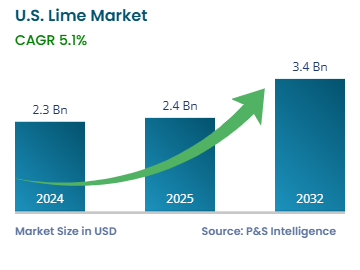
The U.S. lime market is valued at USD 2.3 billion in 2024, and this number is expected to increase to USD 3.4 billion by 2032, advancing at a CAGR of 5.1% during 2025–2032.
The market is driven by the growing construction, steel manufacturing, environmental sciences, and agriculture sectors. Lime demand for cement production and soil stabilization within the construction sector will keep increasing because of infrastructure improvements and environmentally friendly building methods. The demand for lime has been rising as environmental sustainability becomes more important for water treatment, industrial waste management, and flue gas desulfurization.
The metallurgy industry continues as a major customer as current advancements and green steel programs are expected to boost lime usage rates. As per the American Iron and Steel Association, 1,781,000 tonnes of steel were produced in the country in the week that ended on July 5, 2025, which was 0.8% more than the 1,776,000 tonnes produced the previous week.
Soil conditioning agents and pH regulators will experience increased demand in agriculture because of expanding precision farming methods. The newly developed lime-based chemical applications, such as carbon capture and lithium processing for batteries, have created novel prospects for industry growth.
U.S. Lime Market Trends & Drivers
Sustainability and Green Initiatives Is a Key Trend
The market has experienced a major transformation because industries are increasingly focusing on environment-friendly operations and adhering to sustainability standards.
As per the Environmental Protection Agency (EPA), industries are not the largest polluter in the U.S., accounting for 30% of the country’s emissions.
Eco-friendly lime-based solutions have become crucial for industries due to current government prerequisites related to carbon emission reduction, industrial pollution standards, and waste management protocols.
Hydrated lime serves as an important component in flue gas desulfurization (FGD) applications that reduce sulfur dioxide (SOâ‚‚) emissions from power plant exhaust to ensure standards set by the Clean Air Act.
The implementation of carbon capture technologies uses lime as an essential component to reduce industrial carbon dioxide emissions.
The construction industry now develops sustainable cement and concrete compositions using lime to achieve durability and decreased environmental effects.
The steel industry implements green steel production with lime performing dual functions to remove impurities and maintain low carbon intensity levels during operations.
The focus on the circular economy by companies has brought lime recycling and reprocessing methods into mainstream practice.
Growing Construction and Metallurgy Sectors Propel Market Advance
The Infrastructure Investment and Jobs Act from the U.S. government provides funding of USD 1.2 trillion to rebuild roads, bridges, public transportation systems, and smart cities.
Lime consumption has increased significantly because of the rapid expansion in infrastructure initiatives, which apply in various application domains.
Modern construction depends on cement production, through which lime serves as a primary ingredient to create cement and concrete.
Road and foundation builders use quicklime during soil stabilization techniques to strengthen weak and expansive soil characteristics.
The durability of asphalt pavements improves simultaneously with the use of hydrated lime, which protects surfaces from moisture-induced damage.
Lime functions as a fundamental material within the steel and metallurgical industry because it serves as the central ingredient to remove impurities from steel, including phosphorus and sulfur.
The rising steel demand in automobiles, aircraft, shipbuilding, construction, and energy projects create a growing demand for lime.
Electrical arc furnaces (EAF) are becoming popular because the steel manufacturing industry now focuses on green production technology, and EAF-based steelmaking processes require lime.
The steel industry uses lime as a tool to capture COâ‚‚ and decrease emissions when pursuing carbon-neutral steelmaking projects.
The growth of steel production results from industrial developments in renewable energy facilities, infrastructure projects, and manufacturing plants, which, in turn, raises the demand for lime.
As per the U.S. Census Bureau, the May 2025 construction spending in the country stood at USD 2,138.2 billion.
The U.S. has the largest railway network in the world, with around 137,000 miles (220,480 kilometers) of track, which needs frequent maintenance and relaying.
U.S. Lime Market Segmentation and Category Analysis
Insights by Product Type
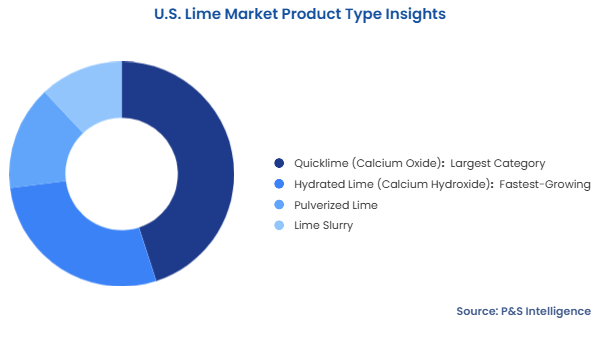
Quicklime (calcium oxide) is the largest category, with 45% share, because the steel and metallurgical industry consumes the most of it. A large volume of lime products goes into steel production since quicklime enables the removal of phosphorus and sulfur impurities from molten metal. Quicklime maintains a consistently high demand throughout the U.S. because the nation actively produces steel for infrastructure, automotive applications, and industrial applications. Quicklime also finds widespread application throughout the construction, water treatment, and chemical industries.
The metallurgy sector stands as the largest category, with 30% share, because of its indispensable function supports steel production and non-ferrous metal production. The steelmaking industry heavily relies on quicklime to eliminate steel-polluting elements such as phosphorus and sulfur for producing superior steel products. The steady steel production across automotive, industrial, and construction sectors in the U.S. sustains market demand for lime because of its essential role in steel production.
The metallurgy sector's dominant position of lime is strengthened by growing EAF installations and green steel program developments. Quicklime plays a central role in steelmaking operations because it removes steel impurities, including phosphorus sulfur, and silica, which produces high-grade metal outputs. As the U.S. stands as a leading steel manufacturer for construction, automotive, and industrial uses, the market demand for lime endures stability. Derived steel production using electric arc furnaces (EAFs) and green steel initiatives will maintain extensive use of lime in metallurgical applications.
Major application areas covered in this report:
Building & Construction
Metallurgy (Largest Category)
Chemical
Environmental Sciences (Fastest-Growing Category)
Agriculture
Paper & Pulp
Insights by Distribution Channel
The direct sales (B2B) category has the largest share, of 65%, because most lime products are delivered to major industrial clients, including steel & metallurgy, construction, chemical manufacturing, and environmental management. These industries require significant quantities and specialized lime products, which lead manufacturers to secure extended supply agreements for bulk delivery and consistent quality. Industrial customers mostly prefer direct sales channels for lime products because of their production cost requirements and specific production needs.
The distributional channels covered in this report are:
Direct Sales (B2B) (Largest Category)
Distributors & Wholesalers
Retail Sales
Online Sales (Fastest-Growing Category)
Drive strategic growth with comprehensive market analysis
U.S. Lime Market Geographical Analysis
Midwest region is the prime revenue contributor, with 40% share, because of the extensive steel production, construction activities, and industrial manufacturing. Mining firms operating at the largest steel mills and metallurgy plants in Ohio Indiana, Illinois, and Michigan consume the majority of lime products. The Midwest operates numerous agricultural sites that consume large amounts of quicklime and hydrated lime since these products remain essential for preparing farmland soil and balancing its acidity. The region facilitates cement production and power plant flue gas desulfurization operations, which function for environmental control purposes.
The regions analyzed in this report are:
Northeast
Midwest (Largest Region)
West
South (Fastest-Growing Region)
U.S. Lime Market Competitive Landscape
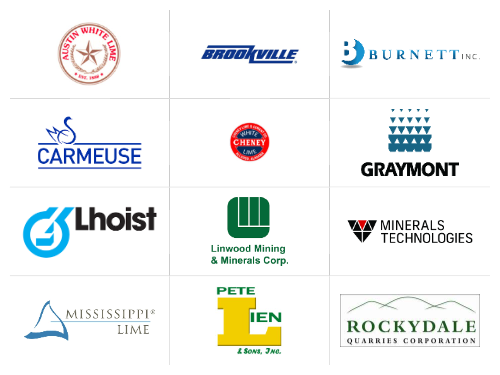
The U.S. lime market features strong market consolidation because several major corporations control most lime production and distribution activities. Companies manufacturing lime need large capital investments to sustain mining operations, processing plants, and specialized distribution networks, leading to restricted small-business participation. The market leadership of Graymont, Carmeuse Lime & Stone, Mississippi Lime Company, and Lhoist North America is credited to their complete supply chain integration and extended business deals with steel producers, construction firms, and environmental service providers. The consolidation of the market occurs because of stringent regulatory requirements coupled with high production expenditures and restricted access to quality limestone reserves, which keeps dominant control within a few major corporations.
Key U.S. Lime Companies:
Carmeuse Lime & Stone, Inc.
Lhoist North America, Inc.
Graymont Limited
Mississippi Lime Company
United States Lime & Minerals, Inc.
Linwood Mining & Minerals Corporation
Minerals Technologies Inc.
Cheney Lime & Cement Company
Pete Lien & Sons, Inc.
Valley Minerals LLC
Brookville Manufacturing Company
Austin White Lime Company
Rockydale Quarries Corporation
Burnett, Inc.
U.S. Lime Market News & Updates
In June 2025, GAMMA Investing LLC announced the raising of its stake in United States Lime & Minerals by over 10,800%.
In May 2025, the Portland Cement Association rechristened itself the American Cement Association and announced plans to re-launch with this new identity in June.
In September 2023, Lhoist North America Inc. announced plans to raise lime production at its Texas plant.
Want a report tailored exactly to your business need?
Leading companies across industries trust us to deliver data-driven insights and innovative solutions for their most critical decisions. From data-driven strategies to actionable insights, we empower the decision-makers who shape industries and define the future. From Fortune 500 companies to innovative startups, we are proud to partner with organisations that drive progress in their industries.
Client Testimonials
Working with P&S Intelligence and their team was an absolute pleasure – their awareness of timelines and commitment to value greatly contributed to our project's success. Eagerly anticipating future collaborations.
McKinsey & Company
India
Unmatched Standards
Our insights into the minutest levels of the markets, including the latest trends and competitive landscape, give you all the answers you need to take your business to new heights
Complete Data Security
We take a cautious approach to protecting your personal and confidential information. Trust is the strongest bond that connects us and our clients, and trust we build by complying with all international and domestic data protection and privacy laws