U.S. Hydrochloric Acid Market Size & Share Analysis - Emerging Trends, Growth Opportunities, Competitive Landscape, and Forecasts (2026 - 2032)
This Report Provides In-Depth Analysis of the U.S. Hydrochloric Acid Market Report Prepared by P&S Intelligence, Segmented by Application (Steel Pickling, Oil Well Acidizing, Food Processing, Ore Processing, Pool Sanitation, Calcium Chloride Production), Source (By-product, Synthetic), Grade (Technical Grade, Industrial Grade, Reagent Grade), Concentration (Below 20%, 20%, Above 30%), and Geographical Outlook for the Period of 2021 to 2032
Explore the market potential with our data-driven report
U.S. Hydrochloric Acid Market Overview
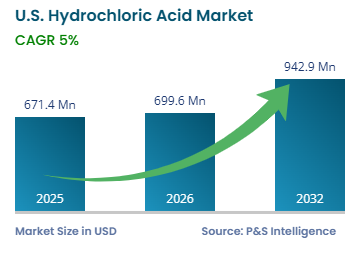
The U.S. hydrochloric acid market size was USD 671.4 million for 2025, and it will grow by 5.0% during 2026–2032, to reach USD 942.9 million by 2032.
This growth is supported by escalating demand across steel pickling, oil well acidizing, and food processing applications, reinforcing hydrochloric acid's position as an essential industrial chemical throughout the American manufacturing landscape. The compound's role as a pH regulator and metal surface treatment agent drives its integration into diverse production workflows, particularly as regulatory frameworks mandate stringent water quality standards and food safety protocols.
Industrial expansion across multiple sectors fuels sustained market development. The American Iron and Steel Institute reports that U.S. raw steel production was approximately 88 million net tons in 2024, directly correlating with elevated hydrochloric acid consumption in steel pickling operations that remove surface oxidation and prepare metal for downstream processing. In the food industry, the U.S. Food and Drug Administration (FDA) recognizes hydrochloric acid as an approved acidity regulator, authorizing its use in corn syrup production, dairy processing, and pH adjustment across food manufacturing.
Key Market Insights
The calcium chloride production category will have the highest CAGR, of 5.1%, driven by expanding demand for de-icing chemicals in northern states.
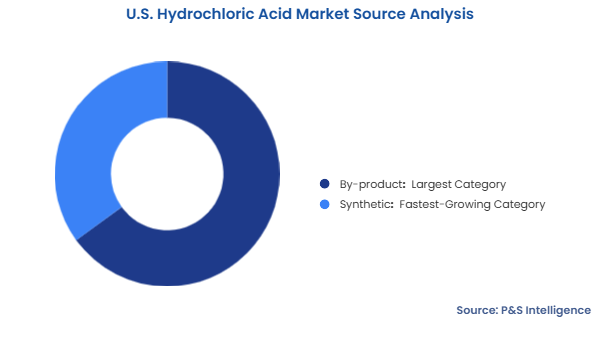
The by-product category holds the largest market share, of 65%, in 2025, driven by its large-scale generation as a co-product of chlor-alkali and vinyls manufacturing.
The industrial category holds the largest market share, of 50%, in 2025, serving high-volume applications in steel pickling, ore processing, and oil well acidizing.
The above 30% concentration category will have the highest CAGR, driven by increasing demand from applications requiring higher reaction efficiency and controlled downstream dilution.
South holds the largest market share, of 45%, in 2025, due to Gulf Coast chemical manufacturing clusters and oil and gas production operations concentrated in Texas, Louisiana, and Oklahoma.
U.S. Hydrochloric Acid Market Dynamics
Technological Advancements in Oil and Gas Extraction Are Key Trends
Enhanced oil recovery techniques and horizontal drilling proliferation continue transforming hydrochloric acid utilization patterns across U.S. shale formations. The U.S. Energy Information Administration reports that U.S. crude oil production reached a record 13.2 million barrels per day in 2024, with the Permian Basin alone accounting for 48% of total production and demonstrating sustained growth despite reduced rig counts. This production expansion relies heavily on well stimulation treatments where hydrochloric acid dissolves carbonate formations and removes near-wellbore damage, enhancing permeability and hydrocarbon flow rates.
Operators increasingly deploy artificial intelligence-guided acidizing protocols that optimize acid concentration, injection pressure, and contact time based on real-time formation response, improving recovery efficiency compared to conventional approaches. The shift toward multi-stage hydraulic fracturing in deeper formations intensifies acid consumption per well, with typical horizontal completions requiring 5,000-15,000 gallons of hydrochloric acid compared to 2,000-4,000 gallons for traditional vertical wells. According to the American Petroleum Institute, acidizing remains one of the most widely used well-stimulation techniques in U.S. oil and gas operations, particularly in carbonate-rich basins such as the Permian. As unconventional resource development extends into tighter formations with lower natural permeability, acidization becomes essential rather than optional, fundamentally altering demand patterns from cyclical to structural. In 2024, Olin Corporation announced the shutdown of select diaphragm chlor-alkali capacity in the U.S., a move expected to rebalance chlorine derivatives production and influence regional hydrochloric acid by-product availability.
Steel Industry Pickling Requirements Is Biggest Driver
Sustained steel production for construction and automotive applications generates stable baseline demand for hydrochloric acid in metal surface preparation. The American Iron and Steel Institute data shows that domestic raw steel production reached 88 million net tons in 2024, maintaining production levels that support continuous pickling operations removing mill scale and surface oxidation before cold rolling, galvanizing, and coating processes. Steel service centers utilize 18-22% hydrochloric acid solutions in continuous pickling lines operating at temperatures between 60-80°C, with typical consumption rates of 15-25 kilograms of acid per ton of steel processed.
Infrastructure development initiatives including highway reconstruction, bridge rehabilitation, and renewable energy installations drive steel demand for structural components, reinforcing bars, and electrical steel grades, all requiring hydrochloric acid pickling prior to downstream processing. Additionally, automotive lightweighting trends favor advanced high-strength steels that demand more aggressive pickling protocols to achieve required surface cleanliness specifications, incrementally increasing acid consumption per ton of finished product. The steel industry's adoption of closed-loop acid regeneration systems using fluidized bed or spray roaster technologies improves resource efficiency while maintaining steady virgin acid makeup requirements, creating predictable long-term demand patterns that stabilize market fundamentals.
Food Safety Regulations and Water Treatment Mandates Are Biggest Opportunities
Stringent federal regulations governing food processing sanitation and municipal water quality standards present structured growth pathways for food-grade and industrial-grade hydrochloric acid. The U.S. Food and Drug Administration permits hydrochloric acid as a direct food substance and processing aid under 21 CFR §184.1054, allowing its use for pH adjustment and acidification in accordance with Good Manufacturing Practices across food manufacturing operations. This regulatory framework supports hydrochloric acid usage in corn syrup production, dairy processing, meat preparation, and beverage formulation, where precise pH control is essential for product quality and microbial safety. Increasing adoption of automated pH control and continuous dosing systems in food processing facilities is further shifting hydrochloric acid demand from batch-based to steady-state consumption patterns.
In municipal water treatment, compliance with the Safe Drinking Water Act and tightening standards for emerging contaminants, including per- and polyfluoroalkyl substances (PFAS), are expanding the application scope for hydrochloric acid in ion-exchange resin regeneration, membrane cleaning, and pH adjustment processes. The U.S. Environmental Protection Agency indicates that the United States operates more than 50,000 public water systems, many of which are undergoing treatment upgrades to meet evolving regulatory requirements. Federal infrastructure investment programs supporting water system modernization, particularly in underserved and aging municipalities, are therefore expanding the addressable market for industrial-grade hydrochloric acid as utilities implement advanced treatment and compliance technologies.
U.S. Hydrochloric Acid Market Segmentation Analysis
Application Analysis
The food processing category holds the largest market share in 2025, driven by widespread utilization as an acidity regulator, pH control agent, and processing aid across corn syrup manufacturing, protein hydrolysis, and beverage formulation. For instance, under the U.S. Food and Drug Administration 21 CFR Part 114 acidified foods regulations, food processors must maintain finished equilibrium pH at or below 4.6 using accurate, calibrated pH measurement systems.
The calcium chloride production category will have the highest CAGR, of 5.1%, driven by expanding demand for de-icing chemicals in northern states. Winter road maintenance programs in states experiencing severe weather conditions, particularly the Northeast and Midwest regions, require massive quantities of calcium chloride for ice prevention and snow melting, with hydrochloric acid serving as the primary reagent for calcium carbonate conversion into calcium chloride brine. This demand is reinforced by company-level initiatives, such as Occidental Chemical Corporation supplying calcium chloride products for U.S. highway de-icing and industrial applications, supporting year-round hydrochloric acid consumption beyond seasonal winter use.
The applications analyzed in this report are:
Steel Pickling
Oil Well Acidizing
Food Processing (Largest Category)
Ore Processing
Pool Sanitation
Calcium Chloride Production (Fastest-Growing Category)
Others
Source Analysis
The by-product category holds the largest market share, of 65%, in 2025, driven by its large-scale generation as a co-product of chlor-alkali and vinyls manufacturing. The U.S. Environmental Protection Agency's supply chain analysis confirms that more than 90% of U.S. hydrochloric acid is produced as a by-product from chlorinated organic chemical manufacturing, establishing structural cost advantages over synthetic production methods. Integrated chemical complexes along the Gulf Coast generate hydrochloric acid continuously during primary product manufacturing, creating reliable merchant supply without dedicated capital investment in thermal synthesis equipment or hydrogen chloride generation systems.
The synthetic category will have the highest CAGR, of 5.3%, propelled by semiconductor fabrication expansion requiring ultra-high-purity grades with metallic impurities below 10 parts per billion. Federal and state economic development programs, such as the U.S. CHIPS and Science Act, incentivizing advanced manufacturing facility construction in Arizona, Texas, and New York create demand for electronic-grade hydrochloric acid meeting stringent semiconductor industry specifications where by-product acid's trace contamination precludes usage in critical cleaning and etching processes.
The sources analyzed in this report are:
By-product (Larger Category)
Synthetic (Faster-Growing Category)
Grade Analysis
The industrial category holds the largest market share, of 50%, in 2025, serving high-volume applications in steel pickling, ore processing, and oil well acidizing where performance depends on acid concentration and reactivity rather than ultra-low impurity specifications. According to the U.S. EPA supply chain data, industrial applications such as oil and gas well acidification and steel pickling comprise the majority of hydrochloric acid consumption in the United States, underscoring the dominance of industrial-grade material over higher-purity grades. Oil and gas service companies similarly deploy industrial-grade material for matrix acidizing treatments dissolving carbonate formations and enhancing permeability around wellbores, where dissolved minerals and formation particulates enter the acid stream during injection operations regardless of initial purity.
The reagent category will have the highest CAGR, of 5.4%, driven by pharmaceutical industry expansion requiring high-purity materials for active pharmaceutical ingredient synthesis, analytical testing laboratories demanding traceable reference standards, and advanced battery manufacturing necessitating contamination-free electrolyte precursors. The proliferation of contract manufacturing organizations supporting pharmaceutical development and commercialization multiplies demand for documented, lot-traceable reagent-grade materials complying with current Good Manufacturing Practices and enabling regulatory submission packages demonstrating raw material quality control.
The grades analyzed in this report are:
Industrial Grade (Largest Category)
Technical Grade
Reagent Grade (Fastest-Growing Category)
Concentration Analysis
The 20%-30% concentration category holds the largest market share in 2025, driven by steel pickling operations, food processing applications, and municipal water treatment systems optimized for this acid strength balancing reactivity with handling safety. This concentration range is widely adopted because it is compatible with standard bulk storage, transportation, and dosing infrastructure across industrial facilities, reducing handling risks while meeting process performance requirements.
The above 30% concentration category will have the highest CAGR, driven by increasing demand from applications requiring higher reaction efficiency and controlled downstream dilution, such as oil and gas well stimulation, semiconductor manufacturing, and specialty chemical processing. These sectors favor higher-strength feedstock to optimize transportation efficiency and enable precise concentration control at the point of use, supporting faster adoption relative to conventional concentration ranges.
The concentrations analyzed in this report are:
Below 20%
20%-30% (Largest Category)
Above 30% (Fastest-Growing Category)
Drive strategic growth with comprehensive market analysis
U.S. Hydrochloric Acid Market Regional Outlook
South Hydrochloric Acid Market Size
South holds the largest market share, of 45%, in 2025, due to Gulf Coast chemical manufacturing clusters and oil and gas production operations concentrated in Texas, Louisiana, and Oklahoma. According to U.S. Department of Energy data, about 72% of U.S. chlorine production occurs in chlor-alkali facilities along the Gulf Coast, highlighting the region’s dominant chlor-alkali infrastructure that underpins hydrochloric acid supply chains. This geographic dominance stems from integrated chlor-alkali production facilities that generate hydrochloric acid as a co-product alongside caustic soda and chlorine, creating localized supply chains that support petrochemical complexes, steel service centers, and oil well acidizing activities throughout the region. Advanced hydrochloric acid by-product recovery and reuse practices at Gulf Coast facilities, including optimization initiatives at BASF SE’s McIntosh, Alabama site, strengthen the South’s position as the most integrated and operationally efficient hydrochloric acid production region in the U.S.
The Permian Basin, the largest oil-producing region in the United States, where hydrochloric acid demand continues to rise due to well stimulation and acidizing requirements drive the demand in the region. Limited long-distance transport feasibility of hydrochloric acid further concentrates demand growth near Gulf Coast production hubs, accelerating regional consumption relative to other U.S. regions. Major producers including Occidental Petroleum Corporation, Olin Corporation, and Westlake Chemical Corporation operate substantial production capacity along the Gulf Coast, positioning this corridor as the nation's primary hydrochloric acid manufacturing hub.
West Hydrochloric Acid Market Size
West will have the highest CAGR, of 5.2%, propelled by California's diversified industrial base and Arizona's emerging chemical production infrastructure. According to the U.S. Census Bureau and the U.S. Environmental Protection Agency, California accounts for approximately 12% of the U.S. population and represents the largest public water system market by served population and treatment volume, supporting sustained demand for hydrochloric acid in pH control and water treatment optimization. The U.S. Environmental Protection Agency data indicates that over 90% of U.S. hydrochloric acid is produced as a by-product from chlorinated organic chemical manufacturing. Meanwhile, Western states are increasingly developing integrated production capabilities to serve semiconductor fabrication, food processing, and water treatment markets.
Moreover, California's stringent environmental regulations drive the adoption of advanced water treatment technologies requiring precise pH control, while the state's food processing sector, encompassing dairy, fruits, vegetables, and wine production, generates sustained demand for food-grade hydrochloric acid in acidification and sanitation applications. Arizona's recent investments in chlor-alkali facilities, exemplified by Chlorum Solutions USA's planned production site, aim to reduce regional dependence on Gulf Coast supply chains and capitalize on proximity to mining operations and growing metropolitan water treatment needs.
The regions of the market are as follows:
Northeast
Midwest
South (Largest Region)
West (Fastest-Growing Region)
U.S. Hydrochloric Acid Market Competitive Landscape
The market exhibits semi-consolidation, with integrated chemical producers maintaining dominant positions through vertical integration across chlor-alkali production and downstream applications. This structural characteristic stems from the economics of hydrochloric acid generation, creating inherent advantages for companies operating large-scale chlor-alkali electrolysis units. This results in a concentrated upstream supply landscape in which a limited number of integrated producers account for a significant share of national production capacity, while no single company dominates the market. At the same time, downstream distribution remains regionally fragmented, as transportation constraints, safety considerations, and proximity to end-use industries require localized supply networks, reinforcing the market’s overall semi-consolidated structure.
Key U.S. Hydrochloric Acid Market Companies:
Olin Corporation
Westlake Chemical Corporation
Occidental Petroleum Corporation
Dow Inc.
Formosa Plastics Corporation
BASF SE
ERCO Worldwide
Jones-Hamilton Co.
Chemtrade Logistics Inc.
Univar Solutions Inc.
Brenntag SE
PVS Chemicals, Inc.
U.S. Hydrochloric Acid Market News & Updates
In August 2025, Chemtrade Logistics Inc. entered into a definitive agreement to acquire Polytec, Inc., a provider of turnkey water treatment solutions serving food-processing and municipal markets, for approximately USD 150 million, expanding its water treatment chemicals platform and supporting cross-selling opportunities across North America.
In January 2025, Jones-Hamilton Co. acquired Nexchlor LLC, a Dallas-based hydrochloric acid marketer and distributor serving oil and gas, water treatment, and specialty chemicals sectors.
In August 2023, Univar Solutions Inc. completed its acquisition by funds managed by Apollo Global Management, strengthening its financial position and operational scale for distributing industrial chemicals, including hydrochloric acid, across the U.S. market.
Frequently Asked Questions About This Report
What is the size of the U.S. Hydrochloric Acid Market?+
The U.S. hydrochloric acid market was valued at USD 671.4 million in 2025.
What is the growth rate for the U.S. Hydrochloric Acid Market?+
The market is growing at a CAGR of 5.0% during the forecast period.
What are the key drivers of the U.S. Hydrochloric Acid Market?+
Key drivers include rising steel pickling demand, strong oil well acidizing activity in shale basins, growing water and wastewater treatment requirements, and stable consumption in food processing and chemical synthesis applications.
Which industries are the largest consumers of hydrochloric acid in the U.S.?+
The largest consuming industries are steel manufacturing, oil and gas, chemical processing, food processing, and municipal water treatment.
Who are the key players in the U.S. Hydrochloric Acid Market?+
The market is characterized by the presence of large integrated chemical producers and regional suppliers, with competition based on production integration, logistics efficiency, safety compliance, and long-term supply contracts.
Want a report tailored exactly to your business need?
Leading companies across industries trust us to deliver data-driven insights and innovative solutions for their most critical decisions. From data-driven strategies to actionable insights, we empower the decision-makers who shape industries and define the future. From Fortune 500 companies to innovative startups, we are proud to partner with organisations that drive progress in their industries.
Client Testimonials
Working with P&S Intelligence and their team was an absolute pleasure – their awareness of timelines and commitment to value greatly contributed to our project's success. Eagerly anticipating future collaborations.
McKinsey & Company
India
Unmatched Standards
Our insights into the minutest levels of the markets, including the latest trends and competitive landscape, give you all the answers you need to take your business to new heights
Complete Data Security
We take a cautious approach to protecting your personal and confidential information. Trust is the strongest bond that connects us and our clients, and trust we build by complying with all international and domestic data protection and privacy laws