Key Highlights
| Study Period | 2019 - 2032 |
| Market Size in 2024 | USD 20.0 Billion |
| Market Size in 2025 | USD 20.6 Billion |
| Market Size by 2032 | USD 27.1 Billion |
| Projected CAGR | 4% |
| Largest Region | Midwest |
| Fastest Growing Region | West |
| Market Structure | Consolidated |

| Study Period | 2019 - 2032 |
| Market Size in 2024 | USD 20.0 Billion |
| Market Size in 2025 | USD 20.6 Billion |
| Market Size by 2032 | USD 27.1 Billion |
| Projected CAGR | 4% |
| Largest Region | Midwest |
| Fastest Growing Region | West |
| Market Structure | Consolidated |
Explore the market potential with our data-driven report
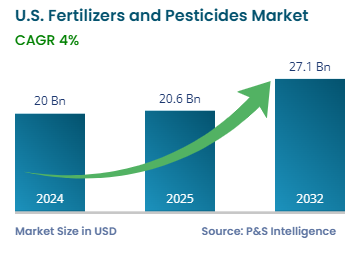
The U.S. fertilizers and pesticides market was valued at USD 20.0 billion in 2024, and this number is expected to increase to USD 27.1 billion by 2032, advancing at a CAGR of 4% during 2025–2032.
The agriculture sector plays a significant role in the U.S.’s economy, encompassing nearly 900 million acres of land allocated for farming, which represents approximately 40% of the nation's total land area. There are about 2 million farms throughout the country, varying from small family-run operations to extensive commercial enterprises. This sector provides employment for approximately 2.6 million agricultural workers, comprising both permanent and seasonal staff.
This is because of the rising needs of the agriculture industry coupled with more precise farming techniques and better biotechnology methods. Bio-based fertilizers and pesticides now gain acceptance because they help retain agricultural output while protecting the environment. Government rules regarding synthetic pesticides enforced by the Environmental Protection Agency (EPA) have expedited the movement toward organic and environmentally friendly solutions.
By integrating artificial intelligence and data analytics in agriculture, it helps in optimizing fertilizer and pesticide usage, reduces costs, and improves efficiency. Manufacturers now develop weather-resistant fertilizers and climate-resistant pest-control solutions because of growing concerns about climate change. Specialty fertilizer markets especially demand controlled-release and water-soluble versions because they focus on high-value produce, including fruits and vegetables.
The industry presents numerous opportunities but regulators and market price changes create business challenges. The sector of fertilizers and pesticides will evolve with new improvements in microbial derivatives, robotic pesticide deployment techniques, and state programs that support environmentally friendly agricultural systems. The U.S. market for fertilizers and pesticides remains ready for change while it works to align productivity needs with sustainability goals.
Nitrogen-based fertilizers are the largest category, with 70% share, due to the vital function nitrogen-based fertilizers play for plant growth and yield increase. Major crop production depends on nitrogen-based fertilizers due to their accessibility and affordability, and widespread application in corn and wheat fields, which positions them at the market forefront. Nitrogen-based fertilizers are vital for plant growth, as nitrogen is a core component of chlorophyll, amino acids, and nucleic acids. These compounds are essential for photosynthesis, protein synthesis, and cell development. By enhancing leaf growth, root structure, and overall vigor, nitrogen fertilizers directly improve crop health and productivity.
The product types covered in this report are:
Cereals & grains are the largest category, with 50% share. The major crop cultivation of corn, wheat, and rice drives this market segment because these crops need extensive fertilizer and pesticide application to maximize their production output. The production of staple crops at large scales is fundamental to meet the needs of the growing national and global population. According to the USDA, nearly 75% of the nation's farmland is dedicated to the cultivation of cereal grains and oilseeds. Additionally, 91.5 million acres were planted with corn and 47.2 million acres with wheat in the country in 2024.
The crop types covered in this report are:
Granular & powder fertilizers account for the largest market share, of 45%. Their dominance in the marketplace stems from the combination of three important attributes, which include easy application, prolonged shelf life, and their economical nature. Large agricultural operations prefer granular fertilizers because these fertilizers allow uniform distribution across extensive areas and gradually release nutrients, which promotes continuous plant development. The market leaders are supported by their versatility to work with different land and plant types.
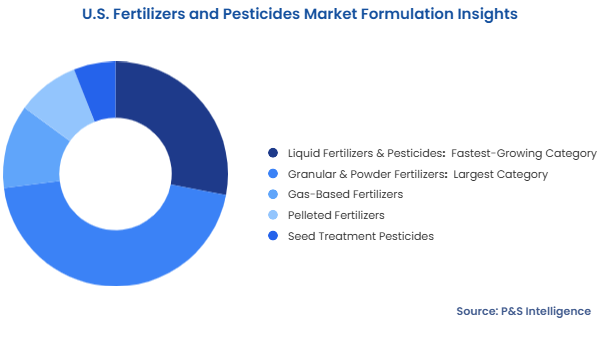
The formulations covered in this report are:
Soil treatment represents the largest category, with 60% share. The approach gains popularity because it sends nutrients directly to plant roots for the best possible uptake. The application of treatments to soil benefits extensive farming operations because it improves the soil's fertility ability while ensuring continuous crop development. The substantial application of soil treatment in essential crops, including corn, wheat, and soybeans, drives its market dominance.
The application methods covered in this report are:
Commercial farmers dominate the market with 80% share. Commercial farming controls the market due to their massive agricultural production that requires large quantities of fertilizers and pesticides for maximum yield performance. Farmers who operate commercially practice extensive cultivation of fundamental crops including corn, soybeans, and wheat, requiring large-scale inputs to foster effective crop growth while achieving pest management. Due to their increased investments in modern agricultural equipment and bulk buying practices, the market leaders maintain their dominant position.
According to the USDA, the count of farms encompassing an area of 5,000 acres or greater increased from 26,000 in 2017 to 27,000 in 2022, whereas the quantity of smaller farms diminished. Additionally, throughout this timeframe, the average size of farms escalated from 441 acres to 463 acres. Nevertheless, the total number of farms experienced a decline of 6.9% during this period, suggesting the acquisition of smaller farms and their amalgamation into larger entities.
The end users covered in this report are:
Drive strategic growth with comprehensive market analysis
The Midwest region is the prime revenue contributor, with 50% share. The Corn Belt is an agricultural region that maintains significant farming activities due to its extensive corn, soybeans, and wheat cultivation. Fertilizers and pesticides used at large agricultural scales create substantial market income because of high demand. Intensive crop cultivation in the Midwest depends on suitable land conditions and abundant soil nutrients because farmers need plenty of fertilizers alongside pesticides to sustain productivity and preserve high yields.
According to the USDA, numerous counties in the Midwestern region, stretching from North Dakota to Texas, had more than 70% of their land dedicated to agriculture. Following Texas, the states with the highest number of farms in the nation include Missouri, Iowa, Oklahoma, Ohio, Kentucky, Illinois, Tennessee, California, and Minnesota, the majority of which are located in the Midwest.
These regions are analyzed:
The market is largely consolidated due to the tight control of several major corporations, which maintain significant hold over both manufacturing and distribution sectors. High production costs coupled with advanced technology requirements push firms to consolidate because they limit new entry points for smaller companies. That power concentration in the market was exacerbated by leading companies who merged and acquired additional businesses. The concentration of the market through acquisitions provides scaling benefits, yet it creates problems regarding market dominance that may lead to elevated farm input costs and potential exploitation by companies.
Want a report tailored exactly to your business need?
Request CustomizationLeading companies across industries trust us to deliver data-driven insights and innovative solutions for their most critical decisions. From data-driven strategies to actionable insights, we empower the decision-makers who shape industries and define the future. From Fortune 500 companies to innovative startups, we are proud to partner with organisations that drive progress in their industries.

Working with P&S Intelligence and their team was an absolute pleasure – their awareness of timelines and commitment to value greatly contributed to our project's success. Eagerly anticipating future collaborations.
McKinsey & Company
India
Our insights into the minutest levels of the markets, including the latest trends and competitive landscape, give you all the answers you need to take your business to new heights

We take a cautious approach to protecting your personal and confidential information. Trust is the strongest bond that connects us and our clients, and trust we build by complying with all international and domestic data protection and privacy laws


Customize the Report to Align with Your Business Objectives

Request the Free Sample Pages