U.S. Fence Construction Market Size & Share Analysis - Emerging Trends, Growth Opportunities, Competitive Landscape, and Forecasts (2025 - 2032)
This Report Provides In-Depth Analysis of the U.S. Fence Construction Market Report Prepared by P&S Intelligence, Segmented by Type (Metal Fencing, Wood Fencing, Plastic & Composites Fencing, Concrete Fencing), Product (Hinge-Joint Fences, Electric Fences, Welded Fences), End User (Residential, Commercial, Industrial, Agriculture), and Geographical Outlook for the Period of 2019 to 2032
Explore the market potential with our data-driven report
U.S. Fence Construction Market Analysis
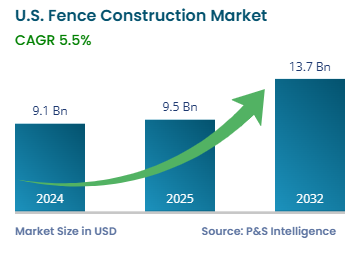
This U.S. fence construction market size was USD 9.1 billion in 2024, which is expected to reach USD 13.7 billion by 2032, growing at a CAGR of 5.5% during the forecast period (2025– 2032).
More people and businesses are investing in fence construction for securing properties, with a focus on stylish designs. Homeowners construct new houses, which leads them to install fences primarily for safety functions along with pet containment and visual enhancement purposes. Businesses, schools, and industrial facilities depend on fencing for better security alongside controlled entry access.
The need for safety, along with property protection, has raised residential and commercial fencing requirements which continue to grow steadily. The market receives additional growth from the need to repair or replace aged fences that sustain weather damage and normal deterioration. The market expands because property owners choose long-lasting fencing materials such as vinyl, metals, and composites. Building owners, along with private householders, find this long-lasting material superior to wood since they need less maintenance.
Government infrastructure projects that require fencing contribute to market expansion because of their widespread implementation of parks and public facilities and highway construction. The growing pattern of home renovation and security investment trends will maintain steady demand for fences over the coming years.
U.S. Fence Construction Market Emerging Trends & Growth Drivers
Customization & Aesthetic Appeal Are Key Trending Preferences
Today, fences serve dual functions as access controllers while also functioning as beautiful home and business design elements.
House owners seek fences that reflect their style and simultaneously boost property value and home appearance.
People focus on customization when choosing between decorative metal designs, modern horizontal wood panels, and sleek vinyl options, which offer multiple colors and textures.
Residential owners prefer either decorative fencing with detailed designs or privacy fences designed with various stylish coatings.
Businesses and public facilities, make distinctive design choices to establish a welcoming atmosphere that matches their professional image.
Today, fences serve dual purposes by bringing beauty as well as function to properties because of the expanded material choices along with coloring options and decorative styles.
Rising Security Concerns and Government Infrastructure Projects Drive Market
The growing security concern has prompted more people to choose fencing as a basic solution to safeguard their properties and possessions.
A durable fence functions as both security protection and a privacy solution by blocking the entry of intruders and unwanted individuals.
A sturdy fence offers multiple advantages to homeowners through child and pet safety in their play area alongside business use for controlling access to vital equipment and critical spaces.
People choose security through gated communities and surveillance-enabled fences with automated gates as their main safety measure.
Fencing serves as an accessible security measure that secures properties and protects them from unauthorized entry both physically and socially beyond techniques based on alarms or surveillance.
The country shares a land border approximately 12,218 km (7,592 miles) long with Canada and Mexico.
The U.S.–Mexico land border stretches approximately about 3,145 km (1,954 miles) across four U.S. states to the Pacific and Gulf.
Out of this, roughly 1,126.5 km (700 miles) are currently lined with some form of manmade barrier—ranging from steel bollards and mesh fencing to vehicle barriers,
Government and private construction projects substantially increase fencing demand.
Still, almost 3 million people try to illegally cross over from Mexico each year.
The Bipartisan Infrastructure Law has sanctioned USD 1.2 trillion for energy, transportation, and climate resilience infrastructure projects.
Highways demand soundproof barriers and safety fences for both safety and noise reduction, while military bases need high-security fencing to protect restricted zones.
Public parks, government campuses, farms, industrial sites, wildlife conservation territories, military bases, and recreational facilities employ fences as boundary markers, playground defenders, and foot traffic regulators.
Security and crowd management needs in airports, as well as railways and government institutions, depend on strong and lasting fence solutions.
The continuous expansion of cities, along with new public project development, drives increased demand for fencing, which establishes itself as a vital component of urban planning and infrastructure growth.
U.S. Fence Construction Market Segmentation and Category Analysis
Insights by Type
Metal is the largest category, with a market share of 55% in 2024, because they provide remarkable strength, long service life, and minimal upkeep needs compared to wooden fences. The market chooses metal fences primarily for commercial and industrial applications and residential purposes because they provide security benefits at affordable prices. Businesses, schools, and public institutions commonly use chain-link fences as their security solution because these fences provide cost-efficient boundary protection for extensive areas. Homeowners typically choose ornamental metal fences because they offer both durability and a sophisticated appearance.
Plastics & composites are the fastest-growing category, with 6.3% CAGR, because consumers appreciate its durability, low weight, easy availability and installation, and cost-efficient maintenance. Plastic fencing stands out from wood since it does not decay and remains free of staining while featuring multiple design options. People are selecting sustainable, long-lasting materials at an increasing rate which drives up their popularity.
The following types are studied in this report:
Metal (Largest Category)
Wood
Plastics & Composites (Fastest-Growing Category)
Concrete
Others
Insights by Product
Welded fences are the largest category, with a market share of 30%, in 2024 because consumers require increased security and livestock management capabilities. Welded fences are popular in the U.S. for their durability, security, and low maintenance. Commonly used in residential, agricultural, and industrial settings, they offer a strong barrier with clean aesthetics. Their rigid structure resists damage and deformation, making them ideal for both perimeter protection and controlled-access applications across various sectors. As per the USDA, the country had 1.88 million farms in 2024.
Electric fences are the fastest-growing category, with 6.5% CAGR, because modern security and livestock management needs continue to expand. The fencing solution finds its primary use among farmers and ranchers for animal containment, but businesses and high-security facilities deploy them to deter trespassers. The advancement of technology brought forth electric fences that are efficient in operation, easier to maintain, and safer for users than the traditional models. People are selecting electric fences because of rising security concerns while recognizing their reliable and effective characteristics. Electric fences serve both purposes of animal enclosure for farmers and business facility protection. Better technological development has resulted in electric fences that are safer and at the same time they offer better efficiency and easy maintenance.
Here are the categories of this segment:
Hinge-Joint
Electric (Fastest-Growing Category)
Welded (Largest Category)
Others
Insights by End User
Residential is the largest category, with a market share of 55% in 2024. Homeowners seek security and privacy in addition to appealing property appearance, which drives them to purchase fences for residential use. The growth of house construction and home remodeling trends continue to sustain high demand for fences. People construct fences to provide both safety measures for children and pets and to achieve attractive home design while increasing security protection. As per studies, over 85 million single-family homes exist in the country, and a large proportion of those are fenced.
Commercial is the fastest-growing category, with 6.8% CAGR, because businesses, schools, and public facilities are increasing their spending on security and property protection measures. Rising security fears have led commercial properties to install fences, as well as gates and high-security barriers. Retail stores, office buildings, and warehouses require fencing installations primarily for access regulations and to prevent theft. The expanding cities and growing businesses create an expanding requirement for commercial fencing.
Here are the end users studied in this report:
Residential (Largest Category)
Commercial (Fastest-Growing Category)
Industrial
Agriculture
Drive strategic growth with comprehensive market analysis
U.S. Fence Construction Market Regional Market Performance
The southern region is the largest, with a market share of 45% in 2024, because it contains the most people, fast-growing cities, and numerous new residential properties. Texas, Florida, and Georgia maintain continuous residential and commercial construction expansion, which drives up fence requirements. Due to its warm weather conditions, southern residents frequently allocate greater financial resources to outdoor areas that require fencing to achieve privacy, security, and enhance home aesthetics. The market receives additional support from South-based ranches and farms that need fencing to contain their livestock. As per the USDA, Texas leads the U.S. agricultural sector with 230,662 farms in 2022 spanning 125.5 million acres.
The West is the fastest-growing region. More property owners and business operators, are making investments in durable fencing systems because of their growing interest in protecting homes from security threats and wildfires. The market for metal and composite materials continues to grow because customers want environmentally sustainable and fireproof fencing options. The number of people migrating to Western urban and suburban locations boosts the rapid expansion of fencing requirements.
Here are the categories of this segment:
Northeast
Midwest
West (Fastest-Growing Category)
South (Largest Category)
U.S. Fence Construction Market Competitive Landscape
The market is fragmented because large-scale industry domination remains rare. The fencing business operates on a local level, and regional contractors perform most of the installations. The national market is controlled by large manufacturers and distributors who supply fencing materials across the country, yet local businesses handle all actual construction tasks. One company faces challenges in controlling the entire market because different regions select different fence types according to their climate conditions, regulatory requirements, and customer taste preferences. The market remains competitive and diverse because the demand originates from homeowners, businesses, farms, and government projects, which prevents any one company from gaining full market control.
Key U.S. Fence Construction Companies:
Trex Company, Inc.
Allied Fence Co.
American Fence Company
Master-Halco, Inc.
Superior Fence
Eaton
Long Fence
Anchor Fence
Peerless Fence
Fenceworks LLC
Saddleback Fence and Vinyl Products
United Fence & Construction Co., Inc.
U.S. Fence Construction Market News & Updates
In February 2025, the federal government restarted the construction of walls along the Mexican border in Texas and California.
In January 2023, Fencing Supply Group, backed by The Sterling Group, bought Hartford Fence Supply, a supplier of vinyl and aluminum fencing, to expand its product range and strengthen its distribution in the area.
In November 2023, U.S. Fence Solutions sold Ideal Fencing Corp. to Soil Nail Holdings. Based in Colorado, Ideal Fencing made and installed guardrails and commercial chain-link and iron fencing along highways and bridges.
Want a report tailored exactly to your business need?
Leading companies across industries trust us to deliver data-driven insights and innovative solutions for their most critical decisions. From data-driven strategies to actionable insights, we empower the decision-makers who shape industries and define the future. From Fortune 500 companies to innovative startups, we are proud to partner with organisations that drive progress in their industries.
Client Testimonials
Working with P&S Intelligence and their team was an absolute pleasure – their awareness of timelines and commitment to value greatly contributed to our project's success. Eagerly anticipating future collaborations.
McKinsey & Company
India
Unmatched Standards
Our insights into the minutest levels of the markets, including the latest trends and competitive landscape, give you all the answers you need to take your business to new heights
Complete Data Security
We take a cautious approach to protecting your personal and confidential information. Trust is the strongest bond that connects us and our clients, and trust we build by complying with all international and domestic data protection and privacy laws