US and EU Osteoporosis Drugs Market Size & Opportunities Analysis - Growth Strategies, Competitiveness, and Forecasts (2025 - 2032)
This Report Provides In-Depth Analysis of the US and EU Osteoporosis Drugs Market Report Prepared by P&S Intelligence, Segmented by Type (Bisphosphonates, RANK Ligand Inibitors, Parathhyroid Hormone Therapy, Selective Estrogen Receptor Modulators), Route of Administration (Injectable, Oral & Spray), Application (Primary Osteoporosis, Secondary Osteoporosis), and Geographical Outlook for the Period of 2019 to 2032
Explore the market potential with our data-driven report
US and EU Osteoporosis Drugs Market Outlook
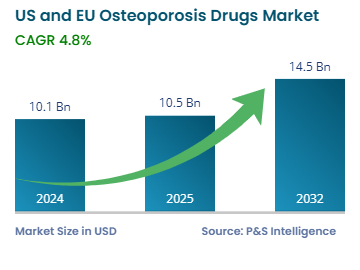
The U.S. osteoporosis drugs market size was USD 10.1 billion in 2024, and it will grow by 4.8% during 2025–2032, reaching USD 14.5 billion by 2032. This is due to the presence of a large number of industry giants, enhanced healthcare infrastructure, high investment by the government in the healthcare sector, and increased consciousness regarding the disease in the country.
Additionally, companies in the U.S. are continuously involved in boosting awareness of the disease and the development of drugs, and numerous initiatives aimed at educating women about the importance of bone health will further contribute to the market growth in the nation in the coming years.
On the other hand, the European Union osteoporosis drugs market size is growing rapidly. This is ascribed to the growing aging population, changing lifestyles, rapid urbanization, and increasing awareness about osteoporosis care in the region.
The market is also growing due to the increasing prevalence rate of osteoporosis diseases, the growing geriatric population, the surging cases of obesity, the rising prevalence of lifestyle-associated diseases, and the mounting healthcare spending.
US and EU Osteoporosis Drugs Market Emerging Trends
Increasing Awareness of Osteoporosis Care Is a Key Trend
Government and health organizations, such as the CDC, WHO, and national osteoporosis foundations, raise awareness of the risks, symptoms, and long-term consequences of osteoporosis via educational campaigns.
Patients are being educated about bone density, calcium and Vitamin D intake, lifestyle changes, and the importance of drug adherence.
These initiatives promote early screening, diagnosis, and treatment, leading to an increasing demand for osteoporosis drugs.
The improvements in diagnostic tools, such as DEXA scans; and the vast availability of screening and diagnosis services make it easier for healthcare providers to detect osteoporosis early.
Because of the rising the awareness, more people are undergoing testing, resulting in increasing count of prescriptions for the associated drugs.
Researchers from the University of Arkansas for Medical Sciences received USD 2.27 million from the NIH for research on the role of estrogen in preventing bone loss and osteoporosis, focusing on its impact on osteoclast activity.
The availability of advanced medical facilities and focus on preventive healthcare measures in Europe supports the market growth.
The Federal Food, Drug, and Cosmetic Act (FDCA), Biologics Control Act, Public Health Service Act, and Patent Term Restoration Act impact drug development, approval, marketing, and safety monitoring in the U.S.
The EU Directive 2001/83/EC, the EMA’s Biosimilar regulatory framework, International Council for Harmonisation (ICH), and the WHO’s Essential Medicines List play the same role in Europe.
Rising Osteoporosis Incidence due to Growing Elderly Population Is Major Growth Driver
The factor most-directly responsible for the growth of the market is the rise in the incidence of osteoporosis in the U.S. and EU.
In the U.S., there are around 2 million osteoporosis-related fractures, and the cost related to osteoporosis every year is around USD 19 billion.
As per the FDA, 10 million people, including 8 million women, in the U.S. suffer from this condition.
The International Osteoporosis Foundation estimates that 54 million people in the U.S. are at a risk of osteoporosis.
Presently, more than 30 million people in the EU suffer from this disease, and the cases of osteoporotic fractures could increase from 4.28 million in 2019 to 5.34 million in 2034.
Age, family history, low body weight, smoking, excessive alcoholism, and sedentary lifestyles are the key risk factors.
The U.S. and EU are also major markets for osteoporosis drugs because Caucasians are a high-risk group for this disease.
Further, these two geographies are the cradles of the global healthcare industry, with a high focus on pharmaceutical R&D and clinical trials.
According to Tampa General Hospital, 50% of the women and 30% of the men aged 65 or above suffer an osteoporotic fracture at some point in their lives.
The latest study by the Census Bureau estimated the population in the age group of 65 and above in the U.S. at 55.8 million in 2020.
Further studies suggest that 1 in 5 people in the country will fall in this age group by 2040.
Similarly, compared to 17.4% in 2010, 29.% of the EU27’s population will be aged 65 and above by 2060.
US and EU Osteoporosis Drugs Market Segmentation and Category Analysis
Type Analysis
The bisphosphoates category held the largest market share, of 35%, in 2024. This is because bisphosphonates have verified efficacy to minimize fracture risk at the hip, spine, and other non-vertebral skeletal sites, increase the survival rate, and decrease the significant risk of morbidity. Moreover, the growing count of women in the post-menopausal stage and a surge in the prevalence of bone diseases will further contribute to the demand for such drugs.
The RANK ligand inhibitors category will grow at the highest CAGR, of 5.4%, during the forecast period. This can be ascribed to the growing inorganic activities such as licensing agreements among players, the rising number of clinical trial approvals for biosimilars, and RANK ligand inhibitors can be utilized in combination with other drugs to convey the synergetic effect on the comprehensive treatment system. Furthermore, other benefits associated with RANKL include a decrease in osteoclastogenesis and osteoclast activity, thereby reducing bone resorption; and an upsurge in bone mineral density.
The types analyzed here are:
Bisphosphonates (Largest Category)
RANK Ligand Inhibitors (Fastest-Growing Category)
Parathyroid Hormone Therapy
Selective Estrogen Receptor Modulators (SERMs)
Others
Route of Administration Analysis
The oral & spray category held the largest market share, of 55%, in 2024. These forms are more accessible, non-invasive, easy to give, and usually less expensive than injectables, which is why most patients go for it. In Addition, commonly recommended oral bisphosphonates have shown effectiveness in slowing down bone loss.
The injectable category will grow at the highest CAGR, of 4.9%, during the forecast period. This is due to the innovation of biologic therapies, such as denosumab and romosozumab, which provide higher efficacy and better patient compliance. Furthermore, patients who suffer gastrointestinal side-effects from oral drugs or have advanced disease are increasingly being prescribed injectable treatments.
The routes of administration analyzed here are:
Injectable (Fastest-Growing Category)
Oral & Spray (Largest Category)
Application Analysis
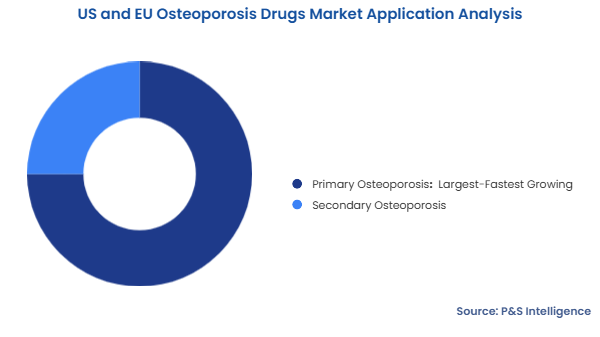
The primary osteoporosis category held the larger market share, of 75%, in 2024, and it will grow at the higher CAGR, of 5%, during the forecast period. This is because the majority of cases are of the primary type, which affects women after menopause as a result of a sudden reduction in estrogen production. On the other hand, in men, the loss of bone structure due to the lack of testosterone is the key cause. The growing aging population in the U.S. and the EU is the key driver for the market.
The applications analyzed here are:
Primary Osteoporosis (Larger and Faster-Growing Category)
Secondary Osteoporosis
Drive strategic growth with comprehensive market analysis
US and EU Osteoporosis Drugs Market Geographical Outlook
The U.S. dominates the market. This is due to the high prevalence rate of bone-related diseases and osteoporosis-related fractures, the increasing number of hospitals and clinics, the rising government investment for developing advanced healthcare infrastructure, and the surging number of awareness programs in the country.
The Europe will grow at a higher CAGR during the forecast period. This can be ascribed to the rising approvals for a number of medications by the European Medicines Agency, the increasing number of drug manufacturers, the mounting share of healthcare in the region’s GDP, and the growing elderly population coupled with osteoporosis-related fractures. In addition, Germany contributes the largest revenue share to the regional market, and it is further expected to maintain its dominance in the coming years. This is due to the presence of a large number of advanced medical device and drug providers, and the mounting patient consciousness regarding the disease.
The regions analyzed in this report are:
U.S. (Largest Regional Market)
Europe (Fastest-Growing Regional Market)
Germany
U.K.
France
Italy
Russia
Rest of Europe
US and EU Osteoporosis Drugs Market Share
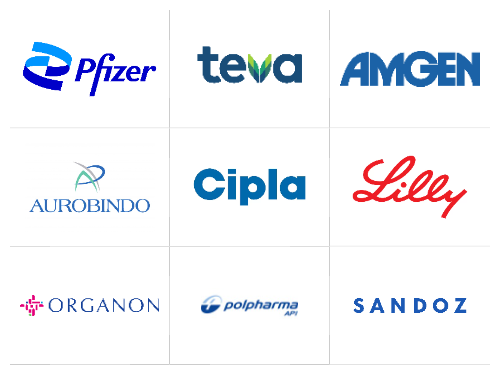
The market is consolidated in nature because of a few companies holding a combined major market share. They include Amgen, Eli Lilly, Pfizer, Merck, and Novartis. This is due to the strict regulations and complex approval process of the FDA and EMA and excessive research & development investments. Hence, smaller companies find it difficult to enter or scale in the osteoporosis space. Moreover, biologic therapies require even better R&D and production capabilities, which leads to extremely high entry barriers.
Key US and EU Osteoporosis Drugs Companies:
SGS SA
Eli Lilly Company
Amgen Inc.
Aurobindo Pharma
Sandoz International Gmbh
Organon & Co.
Cipla Ltd.
Polpharma API
Tava Pharmaceutical Industries Limited
Pfizer Inc.
US and EU Osteoporosis Drugs Market News
In June 2025, CuraTeQ Biologics—a subsidiary of Aurobindo Pharma Limited—announced positive results of the phase 1 clinical trial of its osteoporosis candidate BP16. A biosimilar of denosumab, already sold in the U.S. and EU under the brand name Prolia, this RANK ligand inhibitor is intended to treat bone thinning and loss due to menopause, metastasis, and cancer drugs.
In January 2025, Celltrion Inc. settled its copyright infringement court case with Amgen Inc., paving the way for the launch of the former’s biosimilars Stoboclo and Osnvelt by June 2025.
In September 2024, the National Institute for Health and Care Excellence of the U.K. approved abaloparatide for the prevention of fractures due to osteoporosis in high-risk patients.
In June 2023, Pfizer Inc. again launched DUAVEE in the U.S. market after a voluntary recall in May 2020 due to packaging issues. DUAVEE is indicated for the prevention of postmenopausal osteoporosis and the treatment of moderate-to-serve vasomotor symptoms associated with menopause.
Want a report tailored exactly to your business need?
Leading companies across industries trust us to deliver data-driven insights and innovative solutions for their most critical decisions. From data-driven strategies to actionable insights, we empower the decision-makers who shape industries and define the future. From Fortune 500 companies to innovative startups, we are proud to partner with organisations that drive progress in their industries.
Client Testimonials
Working with P&S Intelligence and their team was an absolute pleasure – their awareness of timelines and commitment to value greatly contributed to our project's success. Eagerly anticipating future collaborations.
McKinsey & Company
India
Unmatched Standards
Our insights into the minutest levels of the markets, including the latest trends and competitive landscape, give you all the answers you need to take your business to new heights
Complete Data Security
We take a cautious approach to protecting your personal and confidential information. Trust is the strongest bond that connects us and our clients, and trust we build by complying with all international and domestic data protection and privacy laws