U.S. Distilleries Market Size & Share Analysis - Key Trends, Future Opportunities, Growth Strategies, and Forecasts (2025 - 2032)
This Report Provides In-Depth Analysis of the U.S. Distilleries Market Report Prepared by P&S Intelligence, Segmented by Spirit Type (Whiskey, Vodka, Rum, Gin, Tequila & Mezcal, Brandy & Cognac, Liqueurs & Specialty Spirits), Production Scale (Large-Scale Distilleries, Craft & Artisan Distilleries, Micro-Distilleries), Distribution Channel (On-Trade, Off-Trade, Direct-to-Consumer), Price Segment (Mass Market, Premium, Super-Premium & Ultra-Premium), and Geographical Outlook for the Period of 2019 to 2032
Explore the market potential with our data-driven report
U.S. Distilleries Market Analysis
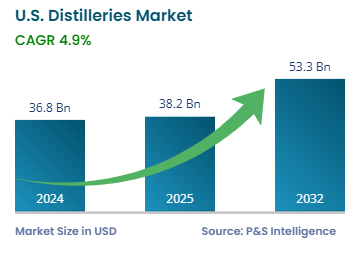
The U.S. distilleries market size was USD 36.8 billion in 2024, which is expected to reach 53.3 billion by 2032, growing at a CAGR of 4.9% during the forecast period 2025–2032.
This is due to the rich alcoholic beverage tradition in the country, with celebrations and get-togethers happening around a range of liquors. Craft and small-batch liquor production of whiskey, gin, and bourbon grows in popularity because consumers want distinctive flavors and traditional manufacturing techniques. The brand stories are compelling because of their family ownership, sustainable production methods, and local roots, which jointly enhance product attractiveness.
As per the National Institute on Alcohol Abuse and Alcoholism, over 22.4 million people aged 12 and more in the U.S. consumed alcohol in 2023. The agency also reports an 2.9% increase in per capita alcohol consumption, from 2.44 gallons in 2020 to 2.51 gallons in 2021.
The drinking patterns of millennials and Gen Z members constitute a major driver for the growth of the spirits industry. Instead of excessive consumption, these drinking groups choose premium liquors, quirky cocktails, and artisanal qualities in their beverages. Distilleries must now develop new forms of spirits with different ingredients and add exclusive bottles and organic products to maintain their consumer base.
The regulatory climate has shifted toward support of distilleries throughout the last decade. Statewide regulation changes in multiple states now enable small distilleries to reach their consumers through retail sales, tasting room operations, and interstate product delivery services. Startups and established distilleries benefit from modern laws by gaining new revenue channels with marketing possibilities, which contribute to industry expansion.
U.S. Distilleries Market Emerging Trends & Growth Drivers
Evolving Consumer Preferences Are Key Trends
The U.S. population today shows a heightened focus on their food and beverage consumption, with alcoholic beverages included in their interest.
People who focus on their health, with younger adults now selecting spirits with less alcohol and fewer calories.
People who want to experience social drinking and taste without intense alcohol effects seek beverage alternatives.
One indicator of this change in consumer preferences is the growing demand for vodka and gin spirits with reduced alcohol content and spritzes as moderate-proof mixed drinks.
A new report indicated that health concerns motivated U.S. alcohol consumers to reduce their alcohol consumption, while nearly 4 out of 10 people choose alcoholic beverages containing organic and natural elements.
Spirit manufacturers now produce various alcoholic drinks that contain no artificial additives, such as sugar, preservatives, or added flavors.
Modern companies are integrating botanical ingredients with herbs because these natural substances appeal to consumers seeking more beneficial alternatives.
Products display wellness-oriented labels that identify products as gluten-free, vegan, and all-natural, ensuring direct recognition for consumers who value health.
Premiumization of Spirits Is Major Driver for Market
People in the country now want superior spirits at premium and super-premium price points.
Consumers prefer brands that deliver premium taste, distinctive histories, and authentic fabrication methods over basic, cheap products.
The market transition occurs because customers seek better quality and authentic experiences.
The results from a 2023 survey indicate that premium drinks are chosen by 54% of those between 18, and 34 while only 35% of consumers past 35 prefer premium products.
The aging process of barrels and barley production in small quantities, coupled with historical branding elements, strongly influences whiskey and bourbon beverages.
People value more than just the product, but the method of manufacture and the symbolic meaning of their chosen spirit.
The experience of drinking premium spirits often represents self-treatment and luxurious moments for most customers in the market.
Consumers throughout the nation have chosen whiskey and bourbon as their preferred selections in this market transition.
These beverages attain their mature taste through aging methods and rich flavors, which satisfy seasoned drinkers and exploratory people.
People prefer to obtain this premium drinking experience through house enjoyment and shared bottles among friends because they see the price increase as worth it.
Brand companies now provide exclusive bottlings, finishing options, special bottles, and elaborate craftsmanship designs.
U.S. Distilleries Market Segmentation Analysis
Insights by Spirit Type
Vodka is the largest category, with a market share of 25% in 2024. Mixologists find it suitable as an ingredient for all kinds of cocktails, including traditional martinis and fruity spritz drinks. The smooth and subtle flavor of vodka satisfies different types of drink enthusiasts who desire lightweight spirits. The smooth blending ability of vodka has kept it prominent in retail stores and bars throughout numerous decades due to its social drink suitability.
Tequila & mezcal are the fastest-growing category, with approx. 5.5% CAGR, because consumers want premium authentic drinks and shifting beverage choices. Today's consumers actively seek out premium tequila products mainly including pure agave tequila without additives that they drink, mixers or mix them into handcrafted cocktails. Mezcal delivered a smoky bold flavor, which has achieved a respected position among consumers who continue to adopt it. The spirits world demonstrates a growing appreciation for these alcoholic drinks due to their traditional roots and their reputation for being natural and “cleaner” products, which attracts the younger demographic.
Here are the spirit types studied in the report:
Whiskey
Vodka (Largest Category)
Rum
Gin
Tequila & Mezcal (Fastest-Growing Category)
Brandy & Cognac
Liqueurs & Specialty Spirits
Insights by Production Scale
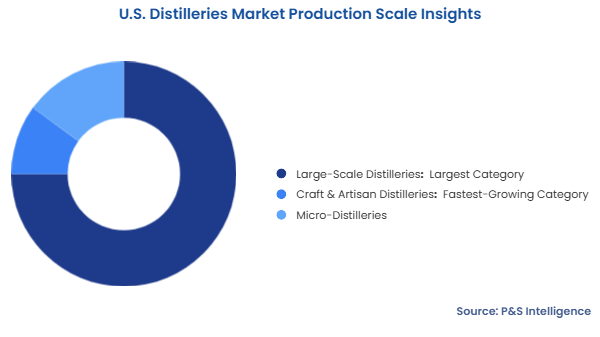
Large-scale distilleries are the largest category, with a market share of 75% in 2024. The existing producers achieve market dominance through extensive distribution systems, significant marketing funds, and established brand identities, which give them strong market positions in domestic and international territories. The market leadership of Brown-Forman Corp. stands strong due to its portfolio, including Jack Daniel's and other brands.
Craft & artisan distilleries are the fastest-growing category because a drop in craft distillery volume during 2023 did not stop the U.S. from adding 11.5% more active craft distilleries, for a total of 3,069 active facilities. Customers want special spirits made locally and authentic small-batch distilling. The pursuit of innovation by craft distillers encourages them to develop various ingredients and special processing techniques, which produce many distinctive flavor experiences from their distillates. The challenge of distributing their products and meeting various regulations prevents smaller producers from reaching full profit potential and achieving maximum market scalability.
Off-trade is the largest category, with a market share of 60% in 2024. Off-trade channels provide consumers with extensive product selection, with competitive prices, and enable them to buy spirits jointly with their household goods. Customers benefit from convenient access to numerous products. The market for premium spirits contributes to increased off-trade sales because consumers buy high-quality products for drinking at home. As per studies, over 45,000 liquor stores exist across the U.S.
Direct-to-consumer is the fastest-growing category because drizly and Reserve Bar operate online platforms, which enable customers to buy spirits more easily and provides convenience and custom shopping features. Online alcohol shopping expanded rapidly during the COVID-19 pandemic and consumers maintained this practice because they value convenient home delivery and broader product variety.
The following distribution channels are analyzed in the report:
On-Trade
Off-Trade (Largest Category)
Direct-to-Consumer (Fastest-Growing Category)
Insights by Price Segment
Mass market is the largest category, with a market share of 45% in 2024. The mass market consists of prominent, affordable drink brands that can be discovered in all major retail locations and bars throughout the nation. The market dominance stems from its wide range of consumers who focus on low prices and simple accessibility. The wide distribution systems and widespread brand recognition lead to a major portion of spirits consumption in the market.
Super-premium and ultra-premium are the fastest-growing categories, because premium spirits have gained consumer popularity because people now seek authentic products with high quality and distinctiveness, leading to expanding market demand for upscale spirits. Super-premium tequila experienced remarkable expansion during the last twenty years, resulting in a 2,000% increase in volume. These prestigious spirits attract clients who want to spend money on superior drinking experiences because of their authentic craft origins and rare status.
Drive strategic growth with comprehensive market analysis
U.S. Distilleries Market Regional Market Performance
South is the largest region, with a market share of 35% in 2024, because it has a long history of whiskey and bourbon production, particularly within Kentucky and Tennessee. A combination of ideal maturation conditions and deep cultural spirit traditions allows these states to maintain leadership positions in industry. Its developed infrastructure and its long-standing tradition as a main American distilling area are also main reasons. The Southern region of the U.S. has the largest population, of 132,665,693, which accounts for 39% of the overall population in 2024.
West is the fastest-growing region because Tequila and mezcal consumption, continues to rise, which fuels the market expansion in California, Arizona, and Nevada. California stands as a vital market for tequila consumption because its well-educated populace enjoys premium spirits, including tequila. West is close to Mexico, has an expanding cocktail craft industry, and residents who are learning more about spirits.
Here are the categories of this segment:
Northeast
Midwest
West (Fastest-Growing Category)
South (Largest Category)
U.S. Distilleries Market Share Analysis
The market is fragmented due to the presence of major companies and an expanding number of small, independent producers. The market features large companies Diageo, Brown-Forman, and Beam Suntory, but has experienced a quick surge of craft and micro-distilleries nationwide. The market now offers diverse competition because small distilleries produce unique premium spirits for consumers who want local and handmade spirits. The combination of major industry players and new inventive competitors maintains a diverse and active market, which does not allow control by a handful of brands.
Key U.S. Distilleries Companies:
Brown-Forman Corporation
Diageo North America, Inc.
Sazerac Company, Inc.
Pernod Ricard S.A.
Heaven Hill Brands
Suntory Global Spirits Inc.
Constellation Brands, Inc.
Moët Hennessy Usa, Inc.
Davide Campari-Milano N.V.
MGP Processing, Inc.
BeamSuntory
Proximo Spirits
U.S. Distilleries Market Developments
In July 2025, Suntory Global Spirits launched a new Combo Flavor Variety Pack for its ready-to-drink 196 vodka seltzer. The new flavors include strawberry & watermelon, lemon & lime, strawberry & pineapple, and lemon & raspberry.
In July 2025, Caffo Group announced plans to acquire the Cinzano brand of sparkling wines and vermouth from Campari Group for EUR 100 million.
In June 2025, Hawk’s Rock Distillery, owned by Sazerac Company, launched Garavogue single-malt Irish whiskey. This 94-proof liquor is aged for 20 years: 14 years in American oak casks previously used for bourbon and then, in French Muscat, Spanish Pedro Ximénez Sherry, French Sauternes, and Barbadian Rum casks for 6 more years.
In May 2025, Casamigos Tequila, a brand of Diageo PLC, launched its Anything Goes with My Casamigos creative campaign. Boasting a design reminiscent of the arched walkways in Turin, Italy, the 1-liter bottle has a weight of 30 grams less.
In February 2025, Bacardi Limited launched a new bottle for its Italian vermouth brand MARTINI.
In December 2024, the Alcohol and Tobacco Tax and Trade Bureau (TTB) officially recognized American single-malt whiskey as a distinct type of spirit, marking the first new federal whiskey designation in over 50 years.
In March 2025. Michter's Distillery released its US*1 Barrel Strength Rye, a limited-edition whiskey. The latest batch, marking the 10th anniversary of its 2015 debut, is now available in limited quantities.
Want a report tailored exactly to your business need?
Leading companies across industries trust us to deliver data-driven insights and innovative solutions for their most critical decisions. From data-driven strategies to actionable insights, we empower the decision-makers who shape industries and define the future. From Fortune 500 companies to innovative startups, we are proud to partner with organisations that drive progress in their industries.
Client Testimonials
Working with P&S Intelligence and their team was an absolute pleasure – their awareness of timelines and commitment to value greatly contributed to our project's success. Eagerly anticipating future collaborations.
McKinsey & Company
India
Unmatched Standards
Our insights into the minutest levels of the markets, including the latest trends and competitive landscape, give you all the answers you need to take your business to new heights
Complete Data Security
We take a cautious approach to protecting your personal and confidential information. Trust is the strongest bond that connects us and our clients, and trust we build by complying with all international and domestic data protection and privacy laws