U.S. Digital Twin Market Size & Opportunities Analysis - Growth Strategies, Competitiveness, and Forecasts (2026 - 2032)
This Report Provides In-Depth Analysis of the U.S. Digital Twin Market Report Prepared by P&S Intelligence, Segmented by Type (System, Product, Process), Technology (IoT, AI and ML, Big Data Analytics, Blockchain, Enterprise), Application (Predictive Maintenance, Performance Monitoring, Product Design and Development, Business Optimization, Inventory Management), Industry (Manufacturing, Autmotive, Healthcare, Energy and Utilities, Aerospace and Defense, Oil and Gas), and Geographical Outlook for the Period of 2019 to 2032
Explore the market potential with our data-driven report
U.S. Digital Twin Market Outlook
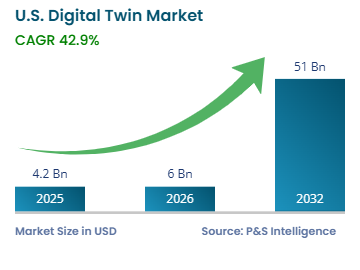
The U.S. digital twin market size will be an estimated USD 4.2 billion for 2025, and it will grow by 42.9% during 2026–2032, to reach USD 51.0 billion by 2032.
The market growth is primarily driven by the accelerating adoption of Industry 4.0 initiatives, widespread integration of IoT sensors and AI-powered analytics, and the expanding deployment across critical industries such as manufacturing, energy, aerospace, and healthcare.
Federal infrastructure investments through the Infrastructure Investment and Jobs Act and the CHIPS and Science Act are channeling billions into smart transportation, energy grids, and broadband expansion, which directly accelerate digital twin deployments for urban planning and industrial optimization. Companies leveraging digital twin technology report significant operational gains, including reduced downtime, extended equipment lifespan, and lower maintenance costs, driving continued investment across verticals as organizations seek competitive advantages in increasingly digital markets.
U.S. Digital Twin Market Growth Factors
Manufacturing Digital Transformation InitiativesAre Key Trends
The U.S. manufacturing sector's ongoing digital transformation represents a major key trend for the digital twin market as companies modernize operations to improve efficiency and competitiveness.
Smart factory implementations increasingly incorporate digital twin technology as a core component, enabling manufacturers to create virtual replicas of production lines, equipment, and entire facilities.
Organizations deploy digital twins for diverse applications, including production planning, quality control, supply chain optimization, and workforce training.
The technology allows engineers to test process modifications, layout changes, and equipment upgrades in the virtual environment before implementing physical changes, reducing risk and accelerating time-to-value.
Digital twin adoption is supported by cloud and hybrid architectures, enabling faster deployment of IoT-enabled digital twin solutions and balancing latency, data sovereignty, and analytics scalability.
Hyundai Motor Company is building a USD 7.6 billion EV Metaplant in Georgia, designed from the ground up with AI, robotics, and a central digital-twin hub to mirror its real-world production in real time.
Hyundai is also investing another USD 6 billion to expand innovation partnerships (AI, advanced robotics) and drive local production capacity.
SAS Institute has teamed up with Epic Games (Unreal Engine) to build high-fidelity digital twins that combine SAS’s AI/analytics with realistic 3D simulations.
Their pilot is live at Georgia-Pacific’s Savannah River Mill, where the digital twin models AGVs, worker movement, and logistics, enabling real-time testing of layout or process changes without disrupting physical operations.
Siemens and Microsoft are deepening their partnership: Siemens’ Xcelerator suite (which supports digital twin workflows) is being offered as a service via Azure, merging simulation, PLM, and AI.
They launched Teamcenter X on Azure, enabling manufacturers to run their product lifecycle management, digital twin models, and generative-AI workflows in a secure cloud environment.
Siemens is also deploying its Industrial Edge + Azure integration to stream real-time factory floor data into cloud-hosted digital twin models, improving predictive maintenance and process optimization.
Growing Usage of IoT and Real-Time Data AnalyticsIs Biggest Driver
The convergence of IoT infrastructure and digital twin platforms represents a critical enabler for market expansion in the U.S.
Industrial automation applications particularly benefit from this integration, with sensors embedded across production lines, equipment, and facilities feeding real-time performance metrics into virtual models.
Manufacturing environments utilize condition-monitoring sensors to track temperature, vibration, pressure, and other critical parameters, enabling digital twins to predict equipment failures before they occur.
This predictive capability reduces unscheduled downtime and maintenance costs while extending asset lifecycles, creating compelling ROI that drives broader adoption across U.S. industrial sectors.
According to the National Institute of Standards and Technology (NIST) of the U.S. Department of Commerce, digital twins leverage real-time sensor data not only for descriptive analytics but also for predictive and prescriptive analytics, assisting with maintenance scheduling, operational control, and optimization.
GE Vernova’s SmartSignal is a predictive-maintenance software that builds AI/ML-driven digital twins, using real-time sensor data from IoT-connected assets to forecast failures, minimize unplanned downtime, and extend asset life.
Its digital twin models help detect, diagnose, and forecast emerging issues — customers reportedly avoid billions in losses using this.
GE also uses process-simulation digital twins that stream data from plant-floor historians to the cloud for real-time operational optimization.
At Hannover Messe 2025, Siemens showcased a first industrial foundation model, which uses live IoT data and AI to continuously optimize automation systems.
PTC’s ThingWorx platform is a mature IIoT framework that integrates with digital twins to deliver real-time analytics on connected devices, enabling predictive maintenance and process optimization.
Its digital twin plus IoT setup helps monitor machinery, improve energy efficiency, and reduce machine failures by anticipating issues.
ThingWorx supports hybrid deployments (edge + cloud), which lets real-time sensor data feed twin models with minimal latency for faster insights.
Rockwell and Microsoft have launched a factory of the future program using digital twin, IoT, and AI to simulate and monitor production plants, optimize processes, and improve workforce productivity.
This collaboration helps companies deploy real-time twin models for things like predictive maintenance, “digital commissioning,” and sustainable operations by reducing waste and unplanned stoppages.
U.S. Digital Twin Market Segmentation Analysis
Type Analysis
The system category holds the largest market share, of 40%, in 2025, driven by the widespread deployment of comprehensive virtual replicas that simulate entire operational environments, including processes, equipment, and infrastructure. System digital twins enable organizations to visualize and optimize complex interdependencies across manufacturing facilities, energy grids, transportation networks, and urban infrastructure. These implementations provide holistic visibility into operational performance, allowing stakeholders to evaluate system-level changes, test contingency scenarios, and identify optimization opportunities that span multiple assets or processes.
The product category will have the highest CAGR, of 43.3%, driven by expanding applications in product design, development, and lifecycle management across automotive, aerospace, consumer electronics, and industrial equipment sectors. Product digital twins create virtual representations of individual products that accompany physical assets throughout their lifecycle from design through disposal. Organizations utilize these models to accelerate development cycles, validate designs through simulation rather than physical prototyping, and provide aftermarket services, including predictive maintenance and performance optimization. The product category also aligns with sustainability initiatives, helping manufacturers design for energy efficiency, recyclability, and reduced environmental impact across the product lifecycle.
The types analyzed in this report are:
System (Largest Category)
Product (Fastest-Growing Category)
Process
Technology Analysis
The IoT category holds the largest market share, of 30%, in 2025, reflecting the fundamental role of connected sensors and devices in feeding real-time data into virtual models. IoT-enabled digital twins rely on extensive networks of sensors embedded in physical assets to continuously capture operational parameters, including temperature, pressure, vibration, location, and performance metrics. This constant data flow ensures that virtual models accurately reflect current conditions and behavior of their physical counterparts, enabling stakeholders to monitor operations remotely, detect anomalies, and optimize performance based on actual operating data rather than assumptions or periodic inspections.
The AI & ML category will have the highest CAGR, of 43.2%, driven by advancing capabilities in predictive analytics, autonomous optimization, and decision support systems. AI algorithms process the massive datasets generated by IoT sensors to identify patterns, predict future states, and recommend actions that human operators may not discern through traditional analysis methods. Machine learning models continuously improve their predictive accuracy as they ingest additional operational data, creating increasingly valuable insights over time. Organizations adopt AI-driven digital twins to compress decision-making cycles, reduce operational costs, and uncover optimization opportunities that traditional approaches overlook, creating sustained growth momentum throughout the forecast period.
The technologies analyzed in this report are:
IoT (Largest Category)
AI and ML (Fastest-Growing Category)
Big Data Analytics
Blockchain
Others
Enterprise Analysis
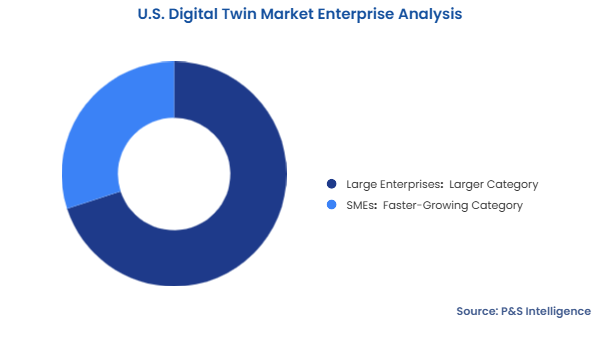
The large enterprises category holds the larger market share, of 70%, in 2025, reflecting the substantial resources and technical expertise required to implement comprehensive digital twin solutions across complex operational environments. Large organizations typically maintain extensive IT infrastructure, dedicated data science teams, and substantial capital budgets that enable them to deploy sophisticated digital twin platforms integrating multiple data sources, advanced analytics, and simulation capabilities.
The SMEs category will have the higher CAGR, of 43.4%, driven by the increasing availability of cloud-based digital twin platforms with lower upfront costs and simplified implementation processes. Small and medium-sized enterprises historically faced barriers to digital twin adoption, including high capital requirements, technical complexity, and lack of in-house expertise, but the emergence of software-as-a-service offerings and industry-specific solutions is democratizing access to these technologies. Cloud platforms eliminate the need for substantial on-premises infrastructure investments while providing scalable computing resources that adjust to business requirements.
The enterprises analyzed in this report are:
Large Enterprises (Larger Category)
SMEs (Faster-Growing Category)
Application Analysis
The predictive maintenance category holds the largest market share in 2025, driven by the compelling value proposition of reducing unplanned downtime and extending equipment lifecycles through data-driven maintenance scheduling. Digital twins continuously monitor asset health by analyzing sensor data, including vibration patterns, temperature fluctuations, acoustic signatures, and performance metrics, to detect early warning signs of impending failures. Manufacturing facilities, energy plants, transportation fleets, and aerospace operators widely deploy predictive maintenance digital twins to optimize maintenance resources, reduce spare parts inventory, and maximize asset availability across mission-critical equipment.
The business optimization category will have the highest CAGR during the forecast period, reflecting expanding recognition of digital twin potential beyond asset management to encompass strategic planning, process improvement, and supply chain coordination. Organizations leverage digital twins to simulate business scenarios, evaluate investment alternatives, and optimize resource allocation across complex operational networks. As organizations increasingly compete on operational excellence and agility, digital twin applications that deliver business-level insights and optimization recommendations gain traction, driving sustained growth in this category throughout the forecast period.
The applications analyzed in this report are:
Predictive Maintenance (Largest Category)
Performance Monitoring
Product Design and Development
Business Optimization (Fastest-Growing Category)
Inventory Management
Others
Industry Analysis
The manufacturing category holds the largest market share in 2025, reflecting the sector's early adoption of Industry 4.0 technologies and substantial ROI from digital twin implementations. Manufacturing organizations deploy digital twins across design, production, quality control, and maintenance operations to optimize efficiency, reduce waste, and accelerate time-to-market. Production facilities create digital replicas of assembly lines, robotic systems, and processing equipment to simulate process changes, identify bottlenecks, and validate improvements before physical implementation.
The energy and utilities category will have the highest CAGR during the forecast period, driven by grid modernization initiatives, renewable energy integration challenges, and aging infrastructure management requirements. Adoption is further boosted by U.S. government initiatives supporting smart manufacturing, renewable energy, and infrastructure modernization, while AI, IoT, and cloud integration provide real-time insights to enhance efficiency, reduce costs, and accelerate innovation.
The industries analyzed in this report are:
Manufacturing (Largest Category)
Automotive
Healthcare
Energy and Utilities (Fastest-Growing Category)
Aerospace and Defense
Oil and Gas
Drive strategic growth with comprehensive market analysis
U.S. Digital Twin Market Regional Outlook
Western U.S. Digital Twin Market Size
The West holds the largest market share, of 35%, in 2025, due to its concentration of high-tech, semiconductor, and advanced manufacturing firms, particularly in states like California and Washington. This leads not only to the high demand for digital twin solutions but also their easy availability with comprehensive consulting. The Department of Energy’s national labs and the National Institute of Standards and Technology Manufacturing Extension Partnership programs also support smart manufacturing and digital twin adoption, strengthening the region’s technological ecosystem.
Southern U.S. Digital Twin Market Size
The South will have the highest CAGR, of 43.1%, driven by rapid industrial expansion in sectors such as oil & gas, clean energy, electric vehicles, and battery manufacturing. Southern states benefit from favorable energy costs, supportive regulatory environments, and federal incentives that encourage investment in advanced manufacturing. The presence of the SMART USA Institute in North Carolina, along with the increasing industrial investments across the South, accelerates digital twin adoption by providing research capacity, workforce development, and technology deployment. Together, federal programs and regional advantages in both the West and South create a strong foundation for digital twin growth, with the West leading in market size and the South showing the fastest projected growth.
The regions analyzed in the market are as follows:
Northeast
Midwest
West (Largest Category)
South (Fastest-Growing Category)
U.S. Digital Twin Market Share
The market is semi-consolidated with a moderate number of established technology providers maintaining significant market presence alongside emerging specialists. The market presents opportunities for specialized providers offering industry-specific solutions, advanced analytics capabilities, or integration services that help organizations deploy and optimize digital twin implementations across their operations. Ongoing technological advancements and strategic acquisitions continue to shape competition, allowing both major players and niche vendors to expand their market influence.
Key U.S. Digital Twin Companies:
General Electric
Microsoft
IBM
ANSYS
PTC
Autodesk
Rockwell Automation
Schneider Electric
Bentley Systems
SAS Institute
Hopara
Unity Software
U.S. Digital Twin Market News
In April 2025, Hexagon AB launched Digital Factory, a cloud-based digital twin service designed to create accurate 3D replicas of manufacturing facilities using laser scanning to help manufacturers plan factory upgrades and optimize operations.
In March 2025, Siemens Aktiengesellschaft completed its acquisition of Altair Engineering Inc., for an enterprise value of approximately USD 10 billion, strengthening its industrial software portfolio with Altair’s capabilities in simulation, high‑performance computing (HPC), data science, and AI.
In March 2025, Emerson Electric Co. completed the acquisition of Aspen Technology, Inc. to strengthen its position in industrial automation by adding advanced software capabilities, including simulation, optimization, and asset performance tools.
In January 2024, Siemens Aktiengesellschaft and UL LLC achieved the first product certification via digital twin simulation with minimal physical testing for the SINAMICS G220 drive, demonstrating the technology's potential to accelerate product development cycles.
Want a report tailored exactly to your business need?
Leading companies across industries trust us to deliver data-driven insights and innovative solutions for their most critical decisions. From data-driven strategies to actionable insights, we empower the decision-makers who shape industries and define the future. From Fortune 500 companies to innovative startups, we are proud to partner with organisations that drive progress in their industries.
Client Testimonials
Working with P&S Intelligence and their team was an absolute pleasure – their awareness of timelines and commitment to value greatly contributed to our project's success. Eagerly anticipating future collaborations.
McKinsey & Company
India
Unmatched Standards
Our insights into the minutest levels of the markets, including the latest trends and competitive landscape, give you all the answers you need to take your business to new heights
Complete Data Security
We take a cautious approach to protecting your personal and confidential information. Trust is the strongest bond that connects us and our clients, and trust we build by complying with all international and domestic data protection and privacy laws