Key Highlights
| Study Period | 2019 - 2032 |
| Market Size in 2024 | USD 35.6 Billion |
| Market Size in 2025 | USD 36.5 Billion |
| Market Size by 2032 | USD 46.3 Billion |
| Projected CAGR | 3.5% |
| Largest Region | West |
| Fastest Growing Region | South |
| Market Structure | Fragmented |
Report Code: 13630
This Report Provides In-Depth Analysis of the U.S. Copier & Optical Machinery Market Report Prepared by P&S Intelligence, Segmented by Optical Measurement & Inspection Tools (Copiers & Printers, Optical Machinery), AI-Integrated Optical Systems (Copiers & Printers, Optical Machinery), Industry (Office & Commercial, Healthcare & Life Sciences, Manufacturing & Industrial, Retail & Hospitality, Defense & Aerospace, Media & Entertainment), Distribution Channel (Direct Sales, Retail Stores & Office Supply Chains, Online Marketplaces & E-Commerce), and Geographical Outlook for the Period of 2019 to 2032
| Study Period | 2019 - 2032 |
| Market Size in 2024 | USD 35.6 Billion |
| Market Size in 2025 | USD 36.5 Billion |
| Market Size by 2032 | USD 46.3 Billion |
| Projected CAGR | 3.5% |
| Largest Region | West |
| Fastest Growing Region | South |
| Market Structure | Fragmented |
|
Explore the market potential with our data-driven report
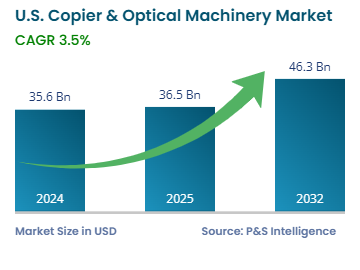
The size of the U.S. copier & optical machinery market in 2024 was USD 35.6 billion, and it will reach USD 46.3 billion by 2032 at a CAGR of 3.5% during 2025–2032.
The market expands due to growing business interest in single-machine solutions that unite printing and scanning, copying and faxing features. The combined hardware conserves space resources and decreases operational expenditures in the business environment. The market expansion emerges from industries adopting multifunctional copiers because of their efficient operations and their affordable solutions.
The market is driven by technological advancements and the changing business needs. It includes a wide range of products such as multifunction printers (MFPs), digital copiers, laser and inkjet printers, 3D printers, as well as optical scanners, image processing equipment, microscopes, and optical measurement tools. The market is supported by the growing need for efficient document handling, precise imaging, and automated inspection solutions across various sectors.
Workplace digitization is a key factor driving demand for smart, multifunctional printing and scanning devices, especially in enterprise and government settings. At the same time, industries like manufacturing, research, and healthcare are increasingly relying on high-precision optical tools and microscopes for tasks ranging from quality control to diagnostics. The expansion of 3D printing technology in areas such as prototyping, education, and healthcare has added another layer of growth to the overall market. Meanwhile, automation and artificial intelligence are being integrated into both printers and optical equipment to enable smarter functionality, predictive maintenance, and improved efficiency.
Among printing devices, inkjet printers remain the most widely used category due to their affordability and adaptability for both personal and professional use. On the optical side, scanners have emerged as the fastest-growing segment, driven by advancements in image processing and the rising need for digital archiving and recognition systems. The shift toward remote and hybrid work models continues to influence purchasing patterns, with many businesses and individuals investing in compact, connected devices suitable for home offices.
There are several promising opportunities in this space. Educational and research institutions are investing more in STEM-focused tools, including microscopes and optical measurement devices. In healthcare, the demand for non-invasive imaging and diagnostic equipment is spurring the adoption of digital optical solutions. Small and medium enterprises are modernizing their workflows by replacing outdated printing systems with cloud-enabled MFPs. The rise of customized 3D printing, particularly in dental and medical applications, presents specialized growth potential. Additionally, ongoing modernization efforts in the public and defense sectors continue to drive demand for durable, high-precision optical machinery.
Inkjet printers dominate the market with a share of 55% due to economical printing solutions, multi-tasking capabilities and superior print quality which attract customers at all levels. The combination of economical prices and support for photo paper, labels, and fabrics serves multiple printing requirements. Portable ink tank systems with refills, large ink cartridge capacity have improved the products' usefulness in professional printing environments. Inkjet printers maintain their dominant market position due to their small design that works well for home-based offices and minimal workspace requirements.
The products analyzed here are:
Multifunction printers dominate the market with a share of 65%. The MFP configuration unifies printing with scanning and copying functions as well as faxing capabilities into one device which makes operations more efficient and reduces space requirements. Merged functions in these devices optimize document operations leading to greater operational speed. the marketplace expands due to rising requirements for versatile printing systems at cost-efficient prices.
Modern MFPs now support digital workplaces through their wireless connections, mobile printing features, and their updated security features because of technological progress. Remote and hybrid work models have driven up the demand for dependable multi-purpose devices, which execute diverse document management operations.
The technologies analyzed here are:
The office & commercial category dominates the market with a share of 40% because of the constant requirement of efficient document management solutions within business operations that depend on copiers and multifunction printers for everyday tasks. The market demand within this sector keeps increasing due to the implementation of advanced technologies including wireless connectivity and cloud-based services that improve productivity while streamlining workflows.
The digitalization revolution and new work arrangements through remote systems raise business dependence on adaptable office machines. Businesses have favored multifunction devices for their printing, scanning, copying, and fax functions because these devices provide cost-effective space-saving solutions. As per studies, more than 20,000 large corporations operate in the U.S.
The industries analyzed here are:
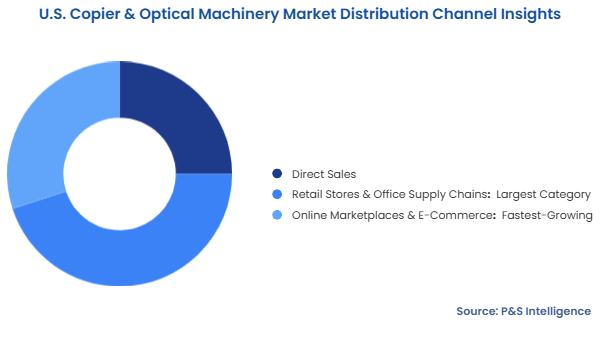
Retail stores & office supply chains dominate the market with a share of 45%. The physical outlets enable their customers to have direct human contact while experiencing products firsthand and receiving individualized help from well-informed sales personnel. The physical engagement has brought immediate trust and quick purchases to customers which makes offline stores retain leading market positions. The distribution environment changes because of the accelerating development of online retail channels.
Online platforms through e-commerce services offer shoppers enhanced convenience services plus market-leading prices, extensive product quantity selection which caters to modern technology-oriented buyers. The traditional store format continues to dominate the sales market because customers seek personal advice from store representatives and fast product delivery.
The distribution channels analyzed here are:
Drive strategic growth with comprehensive market analysis
The West region dominates the market with a share of 50%. The location is strategic and on major international trade routes, which supports strong industrial manufacturing activities. The coastal position of California supports efficient international trade, which is critical to run industry supply chains and distribution channels. The state's sustained focus on innovation and sustainability strengthens its position which enables the attraction of established industrial companies, emerging startups. Advanced copier and optical machinery solutions has regular demand because the Western economy includes technology and healthcare and educational sectors. California has the largest number of offices of Fortune 500 companies in the U.S., with around 57.
The regions analyzed here are:
Want a report tailored exactly to your business need?
Request CustomizationLeading companies across industries trust us to deliver data-driven insights and innovative solutions for their most critical decisions. From data-driven strategies to actionable insights, we empower the decision-makers who shape industries and define the future. From Fortune 500 companies to innovative startups, we are proud to partner with organisations that drive progress in their industries.
Working with P&S Intelligence and their team was an absolute pleasure – their awareness of timelines and commitment to value greatly contributed to our project's success. Eagerly anticipating future collaborations.
McKinsey & Company
IndiaOur insights into the minutest levels of the markets, including the latest trends and competitive landscape, give you all the answers you need to take your business to new heights
We take a cautious approach to protecting your personal and confidential information. Trust is the strongest bond that connects us and our clients, and trust we build by complying with all international and domestic data protection and privacy laws
Customize the Report to Align with Your Business Objectives
Request the Free Sample Pages