Key Highlights
| Study Period | 2019 - 2032 |
| Market Size in 2024 | USD 145.0 Billion |
| Market Size in 2025 | USD 149.4 Billion |
| Market Size by 2032 | USD 196.1 Billion |
| Projected CAGR | 4% |
| Largest Region | South |
| Fastest Growing Region | South |
| Market Structure | Fragmented |

| Study Period | 2019 - 2032 |
| Market Size in 2024 | USD 145.0 Billion |
| Market Size in 2025 | USD 149.4 Billion |
| Market Size by 2032 | USD 196.1 Billion |
| Projected CAGR | 4% |
| Largest Region | South |
| Fastest Growing Region | South |
| Market Structure | Fragmented |
|
Explore the market potential with our data-driven report
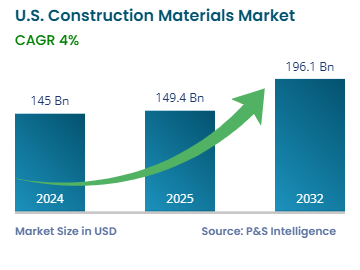
The U.S. construction materials market is valued at USD 145.0 billion in 2024 and is expected to grow at a CAGR of 4.0% from 2025 to 2032, reaching USD 196.1 billion by 2032.
The market is booming due to rapid infrastructure development, rising housing demand, and increasing government investment in modernization projects. It includes cement, concrete, aggregates, steel, and wooden materials, among many others, which are required for both residential and commercial constructions. And, there is also a rising demand for high-quality construction materials, driven by the continuing urbanization and booming smart city projects throughout the country. A significant driver of this growth is the Infrastructure Investment and Jobs Act (IIJA), enacted in November 2021, which allocated USD 1.2 trillion over five years for infrastructure projects, including transportation, energy, and water systems.
The growth of the market can be attributed mainly to the increasing expenditure by the government on infrastructure projects. With the advent of federal initiatives such as the Bipartisan Infrastructure Law, which provides funding for highways and bridges, airports, and water systems, the demand for construction materials has tremendously increased. In addition to this, the aught for sustainable and eco-friendly materials provides some new space for innovation in the market.
Additionally, the housing sector, which is projected to expand due to population growth, urban migration, and some remaining low mortgage rates, is further causing heightened demand for construction materials. A rise in commercial and industrial projects, paired with ongoing advances in construction technologies, will fuel a really good snapshot of driving growth over the coming years.
Green construction is one of the biggest trends in the country, as LEED-certified structures can achieve sales prices that are up to 11% higher and rental rates that can be as much as 20% greater, according to the U.S. Green Building Council. According to research, buildings are responsible for 40% of the energy and 74% of the electricity used in the nation, underscoring a significant demand for energy efficiency in this sector.
Concrete is the largest category, with 30% share, and the fastest-growing, with 5.3% CAGR. This is due to its flexibility, durability, and affordability, which makes it a must-have in many different types of construction projects, ranging from houses to large-scale infrastructure projects. Its versatility in use makes it applicable to foundations, structural systems, pavements, and architectural ornamentation, thus cementing its leading position.
Material types studied in the report:
Residential construction is both the largest and the fastest-growing category, with 45% market share in 2024 and CAGR of 4.8% during the forecast period. This sector creates a steady demand for basic materials like lumber, concrete, roofing materials, and drywall, fueled by the high number of housing projects nationwide. Population growth, urbanization, and the increasing demand for affordable housing are additional factors that support the dominance of the sector.
Also, residential construction is the most rapidly growing segment, driven mainly by government policies that encourage homebuying, low mortgage rates, and growing investment in smart homes and green housing. According to the Consumer Financial Protection Bureau, mortgage interest rates have been lowered from 7.79% in October 2023 to 6.2% in September 2024. The movement towards green and energy-efficient homes also is increasing demand for new materials, so this segment is a major driver of market growth.
The U.S. housing construction remains active, with notable completions like the 260-unit Residences at Main in Connecticut, nearly fully leased after opening in 2024. Michigan recently approved 204 affordable housing units at Eastlawn with a USD 31-million grant. In February 2025, multifamily starts rose to approximately 393,000 units, and single-family starts reached around 1.11 million.
Applications considered here:
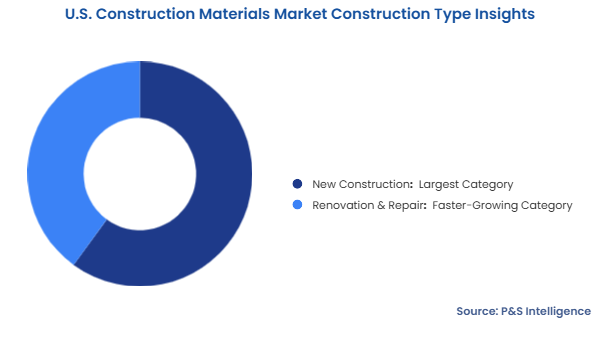
New construction is the larger category, with a share of 60% in 2024. This can be largely accounted for by the increasing demand for commercial and residential buildings due to quick urbanization and population growth. Furthermore, investment in real estate and industrial facilities expansion also results in higher construction material demand for new construction work. According to the U.S. Census Bureau, new construction that happened in the U.S. was valued at USD 2,138.2 billion in May 2025 and it increased to 2,192,540 in January 2025.
Renovation & repair is the faster-growing category, with 4.9% CAGR, as aging buildings, climate resilience upgrades, and sustainability retrofits increase spending on repairs and modernization. Renovation is benefiting from government incentives promoting energy efficiency and building upgrades, making it a key growth driver alongside new builds.
The American Society of Civil Engineers gave U.S. public infrastructure a C rating in its 2021 review, highlighting the need for repairs and renovation. Moreover, studies suggest that people in the country renovate their homes every 3–5 years, and with more new houses becoming old, the need for renovations will rise.
Construction types analyzed in the report:
Contractors are the largest category with 60% share. Contractors are either directly or indirectly accountable for purchasing and utilizing materials for various building projects such as residential structures, commercial developments, and infrastructure works. Their critical role in executing construction timetables makes them the largest consumers of products such as cement, aggregates, and steel.
End Users studied in the report:
Drive strategic growth with comprehensive market analysis
The South is the largest and fastest-growing region with 40% share in 2024 and 5.2% forecast CAGR. This is due to the high-paced population growth, urbanization, and economic development. Increased demand for residential, commercial, and industrial infrastructure pushes demand for materials such as cement, concrete, and steel. Its pleasant climate supports year-round construction, and government investment in infrastructure projects further accelerates market growth, making the South a leading player in the market. growing population, increasing urban densities, and extensive infrastructure development. As per the Census Bureau, the South was home to 132,665,693 people in 2024, which was almost 40% of the country’s total population.
Regions covered in the report:
Want a report tailored exactly to your business need?
Request CustomizationLeading companies across industries trust us to deliver data-driven insights and innovative solutions for their most critical decisions. From data-driven strategies to actionable insights, we empower the decision-makers who shape industries and define the future. From Fortune 500 companies to innovative startups, we are proud to partner with organisations that drive progress in their industries.


Working with P&S Intelligence and their team was an absolute pleasure – their awareness of timelines and commitment to value greatly contributed to our project's success. Eagerly anticipating future collaborations.
McKinsey & Company
India
Our insights into the minutest levels of the markets, including the latest trends and competitive landscape, give you all the answers you need to take your business to new heights

We take a cautious approach to protecting your personal and confidential information. Trust is the strongest bond that connects us and our clients, and trust we build by complying with all international and domestic data protection and privacy laws


Customize the Report to Align with Your Business Objectives

Request the Free Sample Pages