Key Highlights
| Study Period | 2019 - 2032 |
| Market Size in 2024 | USD 42.9 Billion |
| Market Size in 2025 | USD 45.5 Billion |
| Market Size by 2032 | USD 73.4 Billion |
| Projected CAGR | 7.1% |
| Largest Region | South |
| Fastest Growing Region | West |
| Market Structure | Consolidated |

| Study Period | 2019 - 2032 |
| Market Size in 2024 | USD 42.9 Billion |
| Market Size in 2025 | USD 45.5 Billion |
| Market Size by 2032 | USD 73.4 Billion |
| Projected CAGR | 7.1% |
| Largest Region | South |
| Fastest Growing Region | West |
| Market Structure | Consolidated |
|
Explore the market potential with our data-driven report
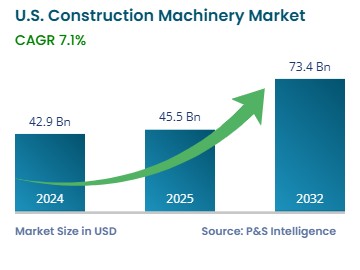
The size of the U.S. construction machinery market in 2024 was USD 42.9 billion, and it will reach USD 73.4 billion by 2032 at a CAGR of 7.1% during 2025–2032.
The market is driven by increased infrastructure investments, urbanization, and a resurgence in residential and commercial construction projects. Federal initiatives aimed at rebuilding transportation networks, utilities, and green infrastructure have significantly boosted demand for heavy equipment such as excavators, loaders, and cranes. Rising labor shortages in the construction sector are also accelerating the adoption of automation and advanced technologies, including telematics, GPS-based control systems, and electric or hybrid machinery.
Manufacturers are focusing on fuel efficiency, emissions compliance, and intelligent machinery to meet evolving regulatory and operational demands. Additionally, rental services are gaining popularity, especially among small to mid-sized contractors, due to high equipment costs and maintenance considerations. The market remains moderately consolidated, with a mix of large multinational players and regional manufacturers competing across various segments.
Industry statistics show a consistent year-over-year increase in equipment utilization rates and fleet expansions, especially in urban development zones and public infrastructure projects. Trends such as digital fleet management, predictive maintenance, and remote equipment monitoring are transforming operational efficiency across the value chain. Overall, the U.S. construction machinery market is poised for continued expansion, supported by policy momentum, technology integration, and strong end-user demand across both public and private sectors.
Earth-moving machinery leads the market with a share of 45% because of the growing need for excavators and loaders for infrastructure expansion and commercial construction. The versatility of excavators enables them to perform digging operations and trenching work as well as demolition tasks in projects of urban development and highway expansion which receive support from federal infrastructure investments. The market relies heavily on skid steers and wheel loaders for handling materials and preparing construction sites.
Smart city initiatives and transportation network development have caused the industry to accept enhanced earth-moving equipment utilizing GPS alongside automation systems and telematics components. Caterpillar, John Deere, and Komatsu dedicate their investment resources to developing technology-based solutions that address the transforming requirements of the industry. Billions of dollars’ worth of investment in construction infrastructure through the Infrastructure Investment and Jobs Act will ensure earth-moving machinery retains its dominance in the U.S. market.
The products analyzed here are:
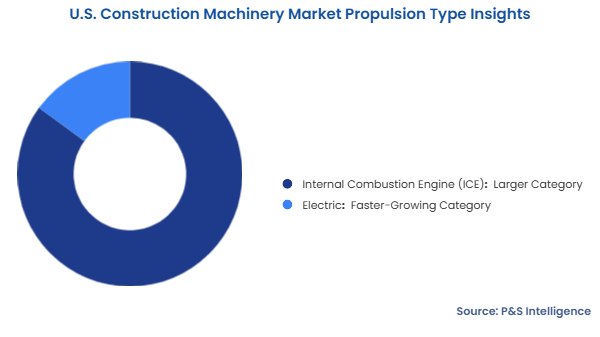
Internal combustion engines have the largest revenue share, of 85%, because they perform reliably and generate substantial power for demanding applications. Large-scale infrastructure operations, mining projects, and commercial construction depend on diesel-powered machinery, such as excavators, loaders, and cranes, because these machines represent the standard for industry operations. ICE machinery stays in high demand because of federal infrastructure spending and active road building projects house construction activities and industrial development projects.
The demand for ICE-powered construction equipment remains dominant because electric alternatives experience longer operational usage have greater access to fuel stations and begin at lower prices. The manufacturing companies including Caterpillar and Komatsu reconstruct their products to develop hybrid machinery alongside cleaner diesel engine technologies because of rising emission regulations and sustainability requirements.
The propulsion types analyzed here are:
Commercial construction dominates the market with a share of 45%, because investors are spending more on office space, retail facilities, warehouses, hospitals, hotels, and other buildings. The increase in e-commerce operations requires the construction of logistics hubs and fulfillment centers thus extending the operational time of excavators, loaders, and cranes. The fast-growing number of urban residents coupled with escalating population numbers has quickened the pace of constructing hotels shopping complexes and business districts.
The Infrastructure Investment and Jobs Act from the government continues commercial expansion through its network improvements that increase utility needs which drives more equipment purchases for construction. Decreasing mortgage rates and employee shortages have limited residential construction growth although this sector still remains robust. The commercial segment will continue leading market growth of the U.S. construction machinery market because of ongoing corporate expansions and urban redevelopment projects.
The applications analyzed here are:
The market is dominated by machines with engine horsepower between 201 and 400 hp, with a share of 50%, because they serve major commercial and industrial infrastructure construction needs. The broad range of equipment from mid-to-large excavator models alongside wheel loaders and bulldozers satisfies all operational requirements and makes these machines the top selection for road building and heavy site preparation work and material transfer tasks. The rising federal investments in infrastructure facilities including bridges urban renewal and highways have generated additional market demand for machinery in this segment.
Hybrid technology while incorporating telematics systems has advanced the productivity of 201–400-hp machines and reduced their environmental impact. Caterpillar, John Deere, and Komatsu keep enhancing their product lines to target durability, and operational efficiency. This power output sector will persist in the US construction machinery market due to expanding infrastructure development initiatives.
The power outputs analyzed here are:
Drive strategic growth with comprehensive market analysis
South region leads the market with a share of 35% because of a rapidly growing population, increasing urban densities, and extensive infrastructure development. As per the Census Bureau, the South was home to 132,665,693 people in 2024, which was almost 40% of the country’s total population.
Texas, Florida, and Georgia face commercial and residential construction explosions because of enterprises establishing new offices and relocating operations, a high demand for homes. The South gains access to vital infrastructure initiatives such as road expansion projects, and airport modernization efforts that push overall demand for equipment like earthmoving apparatus cranes and concrete machines.
Construction activity rises in the region because of its industrial strength, especially in manufacturing and logistics which creates greater demand for heavy machinery. South Asian construction machine manufacturers and rental companies advance their market expansion to satisfy increasing demand. The South will continue its position as the top region of the U.S. construction machinery market because of state and federal infrastructure investments, and population growth initiatives.
The regions analyzed here are:
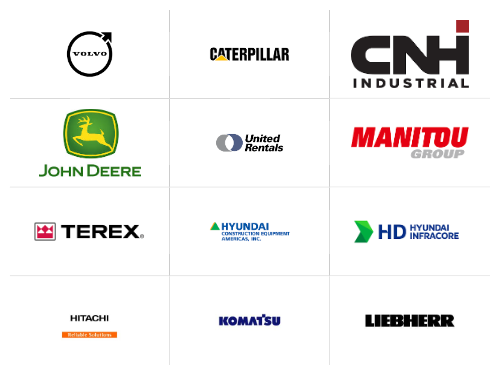
The market is moderately consolidated, especially among key equipment manufacturers. A small number of large companies such as Caterpillar, John Deere, and CNH Industrial control a significant portion of the market, offering a broad range of machinery and strong distribution networks. These players dominate through brand recognition, technological innovation, and expansive service networks. However, the market also includes a variety of mid-sized and niche manufacturers, particularly in specialized segments like compact equipment or concrete machinery. While the top companies hold substantial influence, the presence of rental firms, aftermarket service providers, and imports from global brands adds a layer of fragmentation at the operational and distribution level.
Want a report tailored exactly to your business need?
Request CustomizationLeading companies across industries trust us to deliver data-driven insights and innovative solutions for their most critical decisions. From data-driven strategies to actionable insights, we empower the decision-makers who shape industries and define the future. From Fortune 500 companies to innovative startups, we are proud to partner with organisations that drive progress in their industries.

Working with P&S Intelligence and their team was an absolute pleasure – their awareness of timelines and commitment to value greatly contributed to our project's success. Eagerly anticipating future collaborations.
McKinsey & Company
India
Our insights into the minutest levels of the markets, including the latest trends and competitive landscape, give you all the answers you need to take your business to new heights

We take a cautious approach to protecting your personal and confidential information. Trust is the strongest bond that connects us and our clients, and trust we build by complying with all international and domestic data protection and privacy laws


Customize the Report to Align with Your Business Objectives

Request the Free Sample Pages