Key Highlights
| Study Period | 2019 - 2032 |
| Market Size in 2024 | USD 39.4 Billion |
| Market Size in 2025 | USD 40.9 Billion |
| Market Size by 2032 | USD 57.1 Billion |
| Projected CAGR | 4.9% |
| Largest Region | Midwest |
| Fastest Growing Region | West |
| Market Structure | Fragmented |

| Study Period | 2019 - 2032 |
| Market Size in 2024 | USD 39.4 Billion |
| Market Size in 2025 | USD 40.9 Billion |
| Market Size by 2032 | USD 57.1 Billion |
| Projected CAGR | 4.9% |
| Largest Region | Midwest |
| Fastest Growing Region | West |
| Market Structure | Fragmented |
|
Explore the market potential with our data-driven report
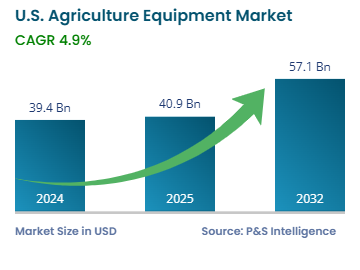
The U.S. agricultural equipment market valued USD 39.4 billion in 2024, and this number is expected to increase to USD 57.1 billion by 2032, advancing at a CAGR of 4.9% during 2025–2032.
The U.S. agriculture sector is a major part of the economy, with approximately 900 million acres of land dedicated to farming, which accounts for about 40% of the country’s total land area. There are roughly 2 million farms across the nation, ranging from small family-owned operations to large commercial enterprises. The sector employs around 2.6 million agricultural laborers, including both permanent and seasonal workers. Permanent farm workers make up a significant portion, while seasonal laborers—often hired during planting and harvest seasons—are crucial to managing labor-intensive crops. Labor shortages, especially for seasonal workers, remain an ongoing challenge in the industry.
American farmers face an upcoming revolutionary evolution of agricultural equipment because of new precision farming and automation technology that integrates sustainable practices. The agricultural sector now relies more frequently on AI-powered autonomous machines, which include self-driving tractors and robotic harvesters to handle projects more effectively and reduce labor expenses. Similarly, the combination of IoT, GPS, systems and data analytics functionalities helps agricultural equipment users make better choices, maximize their resources, and perform equipment forecast maintenance.
The adoption of electric and hybrid propulsion technologies in tractors and harvester equipment receives substantial backing from government-sponsored incentives and sustainability programs. Agribusinesses are implementing these technologies to decrease agricultural carbon emissions. As per the EPA, agriculture results in 11% of the country’s GHG emissions. Precision agriculture receives increased value through drones and sensor-based technologies which enhance crop health observations and optimize input utilization.
Tractors occupy the largest share, of 40%, since they find use on every farm dimension and all agricultural cultivation types. These machines serve as central elements in agricultural work since they provide capabilities for plowing, tilling, planting, and transporting material. Particularly at their core are utility and row-crop tractors because they satisfy farmers of every scale with their diverse capabilities. Technological advancements, including GPS guidance systems, automation processes, and electric systems, have made tractors even more dominant in the market. The market expands steadily because of the prominent role played by tractor manufacturers including John Deere, CNH Industrial, TAFE, and Kubota.
The product types covered in this report are:
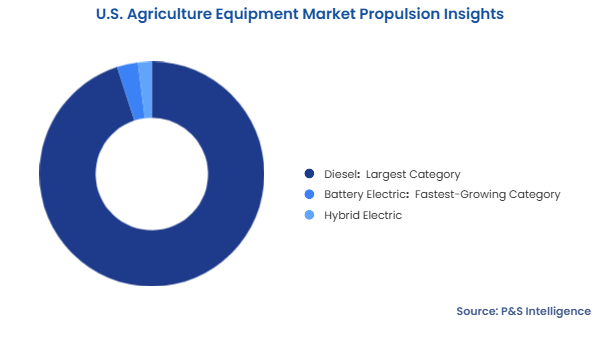
Diesel is the largest category, with 95% share, because it delivers substantial power, durability, and operational efficiency in big farming markets. The capabilities of diesel engines to run extended hours under heavy burdens keep tractors as well as harvesters and irrigation systems dependent on diesel power. The present farm infrastructure and current oil supplies enable the continued usage of diesel-powered farming machinery. The continued push for environmental sustainability has not shifted away from diesel fuel dominance because this method powers the majority of row-crop and articulated tractors used commercially.
The propulsions covered in this report are:
This 30–100 hp category has the largest share in 2024, because its multiple applications appeal to the needs of farms between small and medium sizes. This horsepower segment fits all farming requirements, including plowing, tilling, and moving, thus serving row-crop and livestock farming operations. The market demand continues to grow because of their affordable price points and simple maintenance requirements. The dominance of this power range occurs because farmers opt for this segment. It effectively combines performance capabilities with cost-effectiveness and efficiency.
The power outputs covered in this report are:
Manual & mechanized is the largest category, with 40% share, because farmers still depend on tractors and harvesters as well as tillage equipment. Farms that fall in the small to mid-sized classification mostly maintain their initially manual or minimally automated equipment because it keeps initial costs affordable and remains familiar to them. The agricultural workforce adopts mechanized equipment instead of automated systems because they need reliable technology, which does not require advanced technological adaptability.
The automation levels covered in this report are:
Cereal & grains constitute the largest category, with 50%, share because the nation produces substantial quantities of wheat and rice and large amounts of corn that serve as fundamental agricultural output. Each year, 90 million acres of farmland across the country are planted with corn.
For optimal yield efficiency, the crops necessitate broad mechanization systems which comprise tractors and combine harvesters as well as seed drills and irrigation systems. Because the country leads as both a producer and exporter of cereals, the marketplace remains strong for power-intensive tractor equipment alongside big farm harvest tools. Grain production receives additional support from government policies that extend with financial subsidies resulting in greater dominance of this agricultural segment.
The crop types covered in this report are:
Large arms are the largest category, with 65% share, because industrial farming businesses depend on robust machinery to operate at large production scales. High-powe, tractors, combine harvesters, advanced irrigation systems, and precision agriculture technologies serve the primary purpose of efficiency and profitability for these farms. The substantial control which large-scale farming operations maintain over U.S. land continues to ensure the dominance of automated equipment and AI-powered farm management systems together with GPS-guided machinery because they support these operations’ long-term success.
As per the USDA, the number of farms with an area of 5,000 acres or more grew from 26,000 in 2017 to 27,000 in 2022, while the number of smaller farms decreased. Moreover, during this period, average farm size rose from 441 acres to 463 acres. However, the number of farms declined by 6.9% during this period, hinting at the purchase of smaller farms and their consolidation into larger ones.
The farm sizes covered in this report are:
Original equipment manufacturers (OEM) stand as the largest category, with 85% share, because major providers such as John Deere, AGCO, CNH Industrial, and Kubota rule equipment sales. OEM purchases are preferred by farmers because they receive products of guaranteed quality and warranties with full access to new agricultural technology in machinery. Larger and medium-scale farms choose OEMs as their preferred supplier because they offer customized financing arrangements as well as maintenance support and after-sale services. The dominant position of this segment gains more strength through continual advances in autonomous tractors as well as precision farming tools and AI-driven solutions.
The sale channels covered in this report are:
Drive strategic growth with comprehensive market analysis
The Midwest is the leading revenue contributor, with 35% share, because this area maintains massive agricultural lands and controls most grain and cereal cultivation. This agricultural zone called the "Corn Belt" supports immense farming operations of corn, soybeans, wheat, and their corresponding high-horsepower tractor equipment, combine harvesters, and precision farming technologies. States Iowa, Illinois, Indiana, and Nebraska act as major drivers who fuel the need for modern agricultural equipment. The Midwest supports agricultural machinery manufacturing businesses and receives major government funding for farm mechanization, thus strengthening its economic influence. The market in the Midwest shows growing expansion because farms are integrating AI-powered systems, GPS, and autonomous devices into their operations.
As per the USDA, in the Midwestern belt from North Dakota to Texas, many counties had over 70% of their land under farming. After Texas, the states with the most farms in the country are Missouri, Iowa, Oklahoma, Ohio, Kentucky, Illinois, Tennessee, California, and Minnesota, most of which are in the Midwest.
These regions are covered:
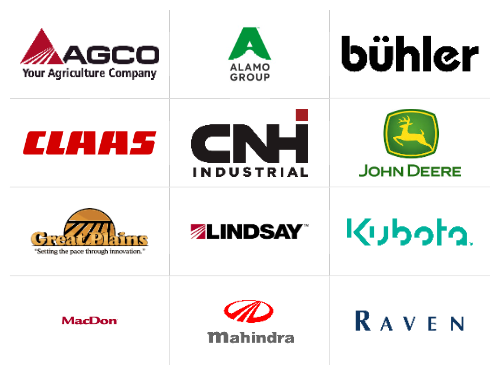
The market features multiple competing players, which include worldwide corporate titans, local businesses as well as small-scale firms, operating in specific product areas. The market is primarily controlled by John Deere, CNH Industrial, AGCO, and Kubota, but specific farming requirements are addressed by many specialized suppliers and aftermarket manufacturers.
The competition within the market expands through OEMs and aftermarket dealers as well as online platforms. Market fragmentation grew as precision agriculture, autonomous equipment, and sustainable farming technologies enabled the entrance of new companies into the farming industry. The market remains decentralized because different public and private agricultural operators have varying demands across small, medium, and large farming enterprises.
Want a report tailored exactly to your business need?
Request CustomizationLeading companies across industries trust us to deliver data-driven insights and innovative solutions for their most critical decisions. From data-driven strategies to actionable insights, we empower the decision-makers who shape industries and define the future. From Fortune 500 companies to innovative startups, we are proud to partner with organisations that drive progress in their industries.

Working with P&S Intelligence and their team was an absolute pleasure – their awareness of timelines and commitment to value greatly contributed to our project's success. Eagerly anticipating future collaborations.
McKinsey & Company
India
Our insights into the minutest levels of the markets, including the latest trends and competitive landscape, give you all the answers you need to take your business to new heights

We take a cautious approach to protecting your personal and confidential information. Trust is the strongest bond that connects us and our clients, and trust we build by complying with all international and domestic data protection and privacy laws


Customize the Report to Align with Your Business Objectives

Request the Free Sample Pages