This Report Provides In-Depth Analysis of the Ultra-low-Power Microcontroller Market Report Prepared by P&S Intelligence, Segmented by Architecture (32-bit, 16-bit, 8-bit), Peripheral Device Type (Analog-Centric, Digital-Centric), Connectivity Integration (Wireless ULP Microcontrollers (SoCs), Standalone / Non-Wireless ULP Microcontrollers), End-Use Application (Consumer Electronics & Wearables, Industrial Automation & Smart Utilities, Healthcare & Medical Devices, Automotive & Transportation, Telecommunications & IoT Infrastructure), and Geographical Outlook for the Period of 2022 to 2033
Explore the market potential with our data-driven report
Ultra-low-power Microcontroller Market Overview
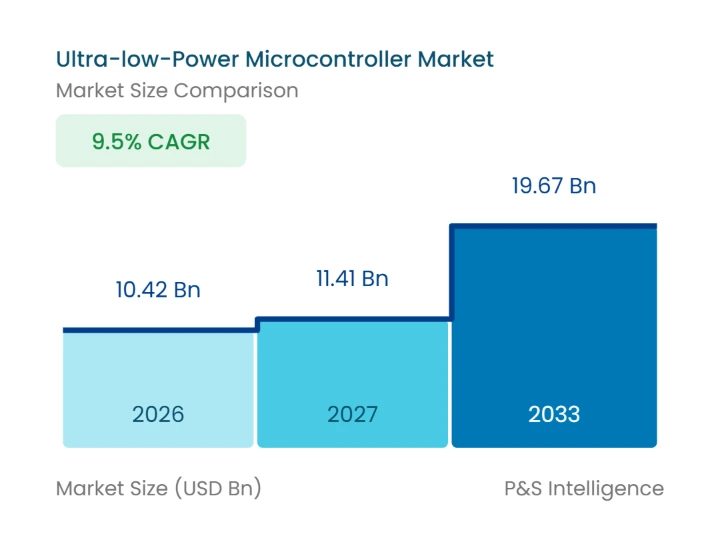
The global ultra-low-power microcontroller market size is estimated at USD 10.42 Billion in 2026 and is expected to climb to USD 11.41 Billion in 2027. Revenue is projected to reach USD 19.67 Billion by 2033, rising at a CAGR of 9.5% during 2027-2033. Makers of smartwatches, glucose sensors, utility meters, and tire-pressure modules are among the main buyers, since each of these products must run for years on a coin cell or a sealed battery. A controller with lower sleep current can win a design socket on total device cost even when its unit price is higher.
Medical device makers shifting chronic-disease monitoring onto adhesive wearable sensors are opening one of the most demanding sources of ultra-low-power controller demand. The International Diabetes Federation estimates that 589 million adults aged 20-79 were living with diabetes in 2024, a figure it expects to rise to 853 million by 2050. That population sizes the patient base for continuous glucose monitors and similar devices, not the number of chips sold. Each wearable sensor must sample, process, and transmit data for days on a tiny battery, which favors controllers that combine sensitive analog inputs with very low sleep current.
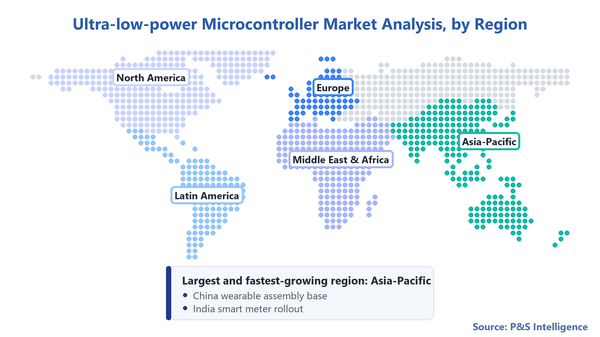
Asia-Pacific holds the largest share of 2026 revenue, more than a third of the global total, and is also projected to grow fastest, at a 10.4% CAGR during 2027-2033. China anchors high-volume wearable and consumer-electronics assembly, while India's microcontroller demand benefits from a government-funded utility metering program that adds a volume channel, so design wins in the region often convert into factory-scale orders. North America follows in size, and ultra-low-power microcontroller market growth there depends more on medical, automotive, and industrial redesigns, where higher-specification parts raise value per unit.
Key market insights
By architecture, 32-bit accounts for 63.8% of revenue in 2026 and is also projected to grow fastest, at a 10.8% CAGR during 2027-2033.
By peripheral device type, analog-centric holds 56.5% in 2026, while Digital-Centric posts the faster 10.6% CAGR over 2027-2033.
By connectivity integration, wireless ULP microcontrollers (SoCs) account for 52.2% in 2026 and are projected to post the fastest growth, at an 11.2% CAGR during 2027-2033.
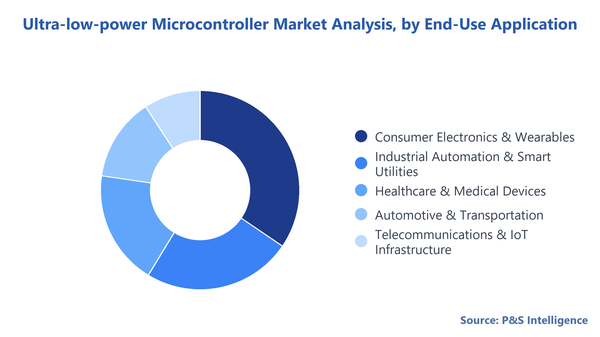
By end-use application, consumer electronics & wearables holds 34.5% in 2026, while healthcare & medical devices posts the faster 11.4% CAGR over 2027-2033.
By geography, Asia-Pacific holds 36.2% in 2026 and is also projected to grow fastest, at a 10.4% CAGR during 2027-2033.
Low-cost 32-bit cores with nanoamp sleep modes are redefining entry-level designs
Appliance, sensor, and meter makers refreshing older products can now move to entry-level 32-bit Arm Cortex-M0+ controllers without giving up the standby current that once kept them on 8-bit and 16-bit families. A 32-bit core brings a larger software base, standard security blocks, and code reuse across product lines, which lowers engineering cost on each new model. Because a redesign reopens the bill of materials, every refresh cycle gives a 32-bit vendor a chance to take a socket held by a legacy architecture.
STMicroelectronics specifies its STM32U0 series of Cortex-M0+ controllers at 160 nA in standby with the real-time clock running and 16 nA in shutdown, and launched the series at prices starting at USD 0.68 in 1,000-unit lots. At those power and price points, requalification cost, more than power draw or unit price, is often what keeps a coin-cell product on a proprietary 8-bit or 16-bit part. Vendors with long-running legacy families still earn repeat revenue from installed designs, while new design starts are likely to favor broad, pin-compatible 32-bit catalogs.
Binding cybersecurity rules for connected products are accelerating secure controller adoption
Manufacturers of thermostats, smart locks, meters, and wearables sold in Europe now carry legal cybersecurity duties, and meeting them starts at the microcontroller. Secure boot, protected key storage, and authenticated firmware updates are far easier to deliver on a controller with built-in cryptographic hardware than on an older part without it. OEMs that must redesign products to keep selling in the EU are likely to specify secure low-power parts in the same project, which raises the average value of each socket.
As per Regulation (EU) 2024/2847, the Cyber Resilience Act, manufacturers have had to report actively exploited vulnerabilities and severe incidents since September 11, 2026, and the regulation's main product requirements apply from December 11, 2027. The regulation sets product-level requirements and does not prescribe any specific chip, so the silicon choice stays with the OEM. Suppliers that offer independently certified security on low-power parts can shorten an OEM's compliance work, which strengthens their hand in redesigns timed to the December 2027 date.
Battery-powered products that need local inference are opening a premium controller tier
Makers of hearables, smart cameras, wearables, and industrial sensors increasingly want devices that recognize a voice command, a gesture, or a machine fault on the device itself, without streaming raw data to a phone or the cloud. Running those models on the CPU alone drains small batteries quickly, so OEMs are beginning to specify controllers with a built-in neural processing unit. These parts integrate more memory and dedicated accelerator silicon than general-purpose low-power devices, which can lift revenue per design win even where unit volumes stay flat.
NXP Semiconductors' MCX N series fact sheet puts the gain from its integrated eIQ Neutron NPU at up to 42 times faster machine-learning inference than the CPU cores alone. Faster inference lets a device finish its task and return to sleep sooner, which is what makes always-on intelligence workable on a coin cell or a small rechargeable battery. Vendors that pair NPU silicon with model-conversion tools and ready-made reference models could gain ground, because the software toolchain often decides how quickly an OEM moves a model onto production hardware.
Lengthy qualification cycles in regulated end markets are limiting how fast new silicon replaces approved parts
Automotive, medical, and utility OEMs treat a microcontroller change as a requalification event, which slows how quickly new low-power families displace parts already in production. A tire-pressure module, glucose sensor, or electricity meter that passed qualification on one controller may need new stress testing, new documentation, and sometimes a fresh regulatory filing if the chip changes. Many of these OEMs keep an approved part in production for years and introduce new silicon only with the next product generation, which stretches the revenue ramp of every new family.
The Automotive Electronics Council's AEC-Q100 standard defines failure-mechanism-based stress-test qualification for packaged integrated circuits, with Grade 1 parts rated for operation from -40°C to +125°C. Clearing that qualification takes time and test investment from both the chip vendor and the module maker, and a design that has passed it is costly to reopen mid-cycle. Many controller vendors offer automotive-qualified variants backed by long-term supply programs, which eases the barrier, yet adoption timing stays tied to vehicle and device platform cycles.
Segmentation Analysis
Architecture
32-bit devices account for 63.8% of the ultra-low-power microcontroller market in 2026, as OEMs standardize on Arm Cortex-M cores across wearables, meters, and sensors. Firmware teams working on one 32-bit architecture can reuse code, security libraries, and wireless stacks across product lines, the same economics behind 32-bit adoption in the broader microcontroller market. Entry-level 32-bit parts have also closed much of the sleep-current gap with older families, which engineers can compare across vendors using EEMBC's ULPMark suite and its separate deep-sleep, peripheral, and active-power scores.
The 32-bit category is also expected to post the fastest growth, at a 10.8% CAGR during 2027-2033. Edge-AI accelerators, hardware security, and multiprotocol radios are being added mainly to 32-bit families, so feature-driven redesigns shift volume toward them. 16-bit and 8-bit parts keep a base in long-running appliance, metering, and control designs where requalification costs more than the power or feature gain, so much of their revenue is likely to come from repeat orders on existing products.
Peripheral Device Type
Analog-centric devices hold 56.5% of 2026 revenue, because many of the highest-volume low-power applications are measurement products. Meters need precise metrology converters, and medical and industrial sensors need low-noise front ends, so integrating those blocks on the controller removes separate converter chips. The U.S. Energy Information Administration recorded 147.1 million advanced metering infrastructure meters among the country's 169.8 million electricity meters in 2025, a count of the meter base rather than of controllers. Meter makers that have qualified a specific analog front end tend to keep it across product generations, which favors incumbent suppliers.
Digital-centric devices are projected to expand at a 10.6% CAGR during 2027-2033, the faster pace on this axis. Their growth comes from autonomous digital peripherals, such as event systems and smart DMA engines that move and pre-process sensor data while the CPU sleeps, together with neural accelerators for local inference. These blocks cut the time the core spends awake, which lowers average power in always-on products. Wearable, hearable, and smart-home makers adding on-device intelligence are the main buyers, and they tend to pay for larger memory and faster cores in the same part.
Connectivity Integration
Wireless ULP microcontrollers, sold as integrated system-on-chips, account for 52.2% of 2026 revenue. Combining the radio, protocol stack, and application core on one die removes a separate transceiver, cuts certification work, and shrinks the board in earbuds, trackers, and sensor tags. Pre-certified modules built on these chips let smaller OEMs reach market without in-house RF engineering staff. Standalone parts, at 47.8%, remain the default in products with no network link and in designs that pair a controller with a separate cellular or power-line modem.
Wireless system-on-chips are also expected to grow fastest, at an 11.2% CAGR during 2027-2033. Smart-home interoperability standards such as Matter over Thread, Bluetooth LE Audio, and multiprotocol designs that run Bluetooth and IEEE 802.15.4 on one radio are increasing the number of IoT microcontroller designs that ship with a radio from launch. Each product that gains a network link can convert a standalone socket into a wireless one, which typically carries more silicon and a higher selling price.
End-Use Application
Consumer Electronics & Wearables lead the end-use split with 34.5% of 2026 revenue. Smartwatches, fitness bands, earbuds, and trackers ship in very large volumes and refresh on short product cycles, so each new model generation reopens the controller decision. Battery life is a headline feature on retail packaging in these categories, which makes sleep current and radio efficiency direct selling points for the OEM. The flip side is price pressure, since consumer brands can rebid the socket at every refresh and often buy on cost once power targets are met.
Copyright P&S Intelligence. Reuse requires attribution under CC BY 4.0.
Healthcare & Medical Devices are set to grow at an 11.4% CAGR over 2027-2033, the quickest pace among end uses. Continuous glucose monitors, cardiac patches, and connected drug-delivery devices must run for days without a recharge, which rewards controllers that pair precise analog front ends with very low sleep current. According to the U.S. Food and Drug Administration, manufacturers of cyber devices have had to include cybersecurity information, including a software bill of materials, in premarket submissions since March 29, 2023. The rule names no chip, though controllers with documented security features can shorten that work.
The following segments are analysed in this report.
Architecture
32-bit
16-bit
8-bit
Peripheral Device Type
Analog-Centric
Digital-Centric
Connectivity Integration
Wireless ULP Microcontrollers (SoCs)
Standalone / Non-Wireless ULP Microcontrollers
End-Use Application
Consumer Electronics & Wearables
Industrial Automation & Smart Utilities
Healthcare & Medical Devices
Automotive & Transportation
Telecommunications & IoT Infrastructure
Geographical Outlook
Asia-Pacific ultra-low-power microcontroller market outlook
Asia-Pacific accounts for 36.2% of global revenue in 2026 and is projected to post the fastest growth of any region, at a 10.4% CAGR during 2027-2033. China is the region's largest market, because its contract manufacturers and domestic brands assemble a large share of the world's smartwatches, earbuds, and smart-home devices, so design wins made in other regions often turn into chip deliveries to Chinese factories. Taiwan, Japan, and South Korea add design centers and module makers that specify parts for global OEMs.
India stands out as the region's fastest-growing market, with utility metering as the main source of new volume. Ministry of Power figures put the smart meters sanctioned under the Revamped Distribution Sector Scheme at 203.3 million, with 57.3 million installed by June 30, 2026. Each smart meter needs metrology and communication electronics, though the meter count sizes the installed base and not the controller content per unit. As installations catch up with sanctions, meter makers buying secure, analog-rich controllers in volume are likely to keep regional demand ahead of the global average.
Japan and South Korea add a different kind of demand, built on automotive electronics, medical devices, and appliance makers that specify controllers for global product lines. Vietnam, Malaysia, and Thailand are taking on more electronics assembly as brands diversify production across the region, which spreads chip deliveries over a wider factory base. For suppliers, Asia-Pacific rewards local field-application engineering and short sample-to-production cycles, because design decisions at contract manufacturers are often made quickly and close to the production line.
Copyright P&S Intelligence. Reuse requires attribution under CC BY 4.0.
North America market analysis
North America ranks behind Asia-Pacific in revenue, with demand driven more by product redesigns at medical-device, automotive, and industrial OEMs headquartered in the U.S. and Canada than by local assembly volume. Engineering teams there choose parts for glucose monitors, insulin pumps, smart thermostats, and vehicle electronics, and often specify higher-end controllers with integrated security and wireless connectivity. That design authority lets North American OEMs set the controller choice even when the finished product is built in Asia.
Federal vehicle rules add a steady automotive channel. NHTSA's Federal Motor Vehicle Safety Standard No. 138 has required tire pressure monitoring systems on new light vehicles sold in the U.S. since September 1, 2007, with limited exceptions, and direct systems place a battery-powered sensor in each wheel. The mandate sizes a platform base for sealed, long-life wheel sensors, not a count of ultra-low-power controller shipments. Suppliers holding automotive qualification and long-term supply programs are better positioned to serve this design-in channel.
Europe market analysis
Europe holds a smaller share than the two leading regions, with demand anchored in industrial automation, building controls, metering, and automotive electronics. German, French, and Nordic equipment makers buy controllers for long-lived products such as heating controls, factory sensors, and utility meters, where multi-year field lifetimes push buyers toward suppliers with long-term availability commitments. The region is also home to several of the main controller vendors, which shortens engineering support lines for local OEMs.
Utility metering gives the region a steady, policy-led volume channel. Statistics from the Department for Energy Security and Net Zero count 42 million smart and advanced meters in homes and small businesses across Great Britain at the end of June 2026, 72% of all meters, with large suppliers installing 1.1 million in the April-June quarter. That pace sizes the meter base, not controller content per meter, but the remaining non-smart stock continues to support orders for metering-grade, analog-rich controllers.
Latin America market analysis
Latin America contributes a smaller share of global revenue, with demand concentrated in Mexico's export-oriented electronics and automotive assembly and in Brazil's utility and consumer markets. Much of the regional volume is built to designs specified elsewhere, so controller choices are often fixed by North American, European, or Asian OEMs before production reaches Mexican or Brazilian plants. Local spending depends on how much final assembly and electronic module production these countries win.
INEGI data show that Mexico produced 3,953,494 light vehicles in 2025, of which 3,385,785 were exported, so the figure measures manufacturing output, most of it shipped abroad, and not domestic demand. Vehicle production sizes the platform base for body electronics, tire-pressure sensors, and key fobs, not the adoption of low-power controllers in those vehicles. Suppliers with local distribution and automotive-qualified parts are better positioned to serve module makers expanding in the country.
Middle East & Africa market analysis
Middle East & Africa trails the other regions in revenue, with demand led by utility metering, building automation in Gulf construction projects, and a design base in Israel that develops low-power sensing and connectivity products. Most devices arrive as imported finished goods, so regional controller revenue depends on how much meter and module assembly takes place locally. Israeli design teams, by contrast, influence part selection for products that are built and sold elsewhere.
Gulf utilities have already moved large customer bases onto smart metering. According to the Dubai Electricity and Water Authority, 1,202,411 smart electricity meters and 1,103,901 smart water meters were installed across the emirate as of July 2025. With that base in place, further meter orders there depend more on new connections than on first-time conversions, while South Africa, Egypt, and Nigeria can add prepaid-metering volume as utility budgets allow. Chip vendors with regional distribution partners and parts approved by the main meter makers are better positioned for these tenders.
The following geographies are analysed in this report.
Ultra-low-power microcontroller market share is divided between a group of broad-line microcontroller vendors and a smaller set of low-power and wireless specialists. Three factors shape that structure. Process technology and wafer supply favor companies with their own fabs or long foundry agreements, software toolchains and pin-compatible catalogs make switching costly once an OEM has written firmware for a family, and qualification in automotive and medical designs keeps a part in place for a product's life. The structure is evolving, as a broad-line vendor's pending purchase of a wireless specialist and the arrival of NPU-equipped parts change where vendors compete.
Broad-line suppliers such as STMicroelectronics, Texas Instruments, Renesas Electronics, NXP Semiconductors, Microchip Technology, and Infineon Technologies compete on catalog breadth, migration paths between pin-compatible families, long-term supply programs, and price at volume, serving meters, appliances, industrial sensors, and vehicles from shared development platforms. Wireless specialists including Silicon Labs and Nordic Semiconductor compete on radio efficiency, multiprotocol software stacks, and certified modules for smart-home, wearable, and asset-tracking designs. Niche specialists such as Ambiq and Analog Devices compete on subthreshold circuit design, precision analog, and low-power AI parts for wearables and always-on sensing.
For buyers, the number of credible suppliers keeps unit pricing competitive in high-volume consumer and appliance sockets, where OEMs can rebid at each product refresh. Bargaining power narrows once a design is qualified, because firmware, certifications, and regulatory filings tie the OEM to a specific family for years. Suppliers therefore compete hardest at the design-in stage, through reference designs, development kits, and field-application support, since a socket won there tends to remain with that supplier for the product's life.
Major Companies in Ultra-low-power Microcontroller Market:
In March 2026, Nordic Semiconductor ASA launched the nRF54LM20B, its first wireless system-on-chip with a neural processing unit, which runs TensorFlow Lite-class models up to 15 times faster than its Arm Cortex CPU, with volume production expected to begin in the second quarter of 2026. The launch brings on-device AI into battery-powered Bluetooth LE products.
In March 2026, STMicroelectronics N.V. introduced the STM32C5 series of entry-level Arm Cortex-M33 microcontrollers built on its 40 nm process, entering production with prices starting at USD 0.64 for orders of 10,000 units. Aimed at smart thermostats, door locks, wearables, and industrial sensors, the series pushes security-capable 32-bit cores further into cost-sensitive designs.
In February 2026, Texas Instruments Incorporated agreed to acquire Silicon Laboratories Inc. for USD 231.00 per share in cash, an enterprise value of approximately USD 7.5 Billion, a deal that would add about 1,200 wireless connectivity products. The deal, expected to close in the first half of 2027, would pair TI's embedded processing catalog with Silicon Labs' wireless SoCs.
In January 2026, Microchip Technology Incorporated added the PIC32CM PL10 family of Arm Cortex-M0+ microcontrollers, designed to operate from 1.8 to 5.5 volts, for industrial control, building automation, consumer appliances, power tools, and sensor systems. The 5-volt capability can let designers moving off 8-bit parts keep existing supply rails while adopting a 32-bit core.
In January 2026, Ambiq Micro Inc. unveiled Atomiq, a system-on-chip built on its subthreshold SPOT platform that pairs an Arm Ethos-U85 NPU with more than 200 GOPS of on-device AI performance. Aimed at smart cameras, AR glasses, wearables, and industrial edge devices, the chip extends ultra-low-power design into always-on vision and voice workloads.
Last Updated: November 2026
Frequently Asked Questions About This Report
How big is the ultra-low-power microcontroller market?+
The global ultra-low-power microcontroller market size is estimated at USD 10.42 Billion in 2026 and is expected to climb to USD 11.41 Billion in 2027.
What is driving demand for ultra-low-power microcontrollers?+
Makers of smartwatches, glucose sensors, utility meters, and tire-pressure modules are among the main buyers, since each of these products must run for years on a coin cell or a sealed battery.
Which region leads the ultra-low-power microcontroller market?+
Asia-Pacific holds the largest share of 2026 revenue, more than a third of the global total, and is also projected to grow fastest, at a 10.4% CAGR during 2027-2033.
Which architecture dominates the ultra-low-power microcontroller market, 8-bit, 16-bit, or 32-bit?+
32-bit devices account for 63.8% of the ultra-low-power microcontroller market in 2026, as OEMs standardize on Arm Cortex-M cores across wearables, meters, and sensors.
How does the EU Cyber Resilience Act affect microcontroller makers and their customers?+
As per Regulation (EU) 2024/2847, the Cyber Resilience Act, manufacturers have had to report actively exploited vulnerabilities and severe incidents since September 11, 2026, and the regulation's main product requirements apply from December 11, 2027.
How much faster are microcontrollers with a built-in NPU for edge AI?+
NXP Semiconductors' MCX N series fact sheet puts the gain from its integrated eIQ Neutron NPU at up to 42 times faster machine-learning inference than the CPU cores alone.
Want a report tailored exactly to your business need?
Leading companies across industries trust us to deliver data-driven insights and innovative solutions for their most critical decisions. From data-driven strategies to actionable insights, we empower the decision-makers who shape industries and define the future. From Fortune 500 companies to innovative startups, we are proud to partner with organisations that drive progress in their industries.
Client Testimonials
Working with P&S Intelligence and their team was an absolute pleasure – their awareness of timelines and commitment to value greatly contributed to our project's success. Eagerly anticipating future collaborations.
McKinsey & Company
India
Unmatched Standards
Our insights into the minutest levels of the markets, including the latest trends and competitive landscape, give you all the answers you need to take your business to new heights
Complete Data Security
We take a cautious approach to protecting your personal and confidential information. Trust is the strongest bond that connects us and our clients, and trust we build by complying with all international and domestic data protection and privacy laws