This Report Provides In-Depth Analysis of the UAV Market Report Prepared by P&S Intelligence, Segmented by Component (Hardware, Software, Services), Drone Type (Fixed-Wing Drones, Rotary-Wing Drones, Hybrid Drones, Nano / Micro Drones), End-Use (Defense & Military, Agriculture, Construction & Infrastructure, Energy & Utilities, Logistics & Transportation, Media & Entertainment, Public Safety & Law Enforcement, Environmental Monitoring), and Geographical Outlook for the Period of 2021 to 2032
Explore the market potential with our data-driven report
UAV Market Future Outlook
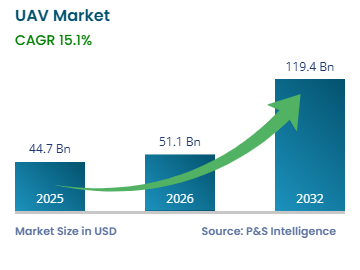
The UAV market size was USD 44.7 billion for 2025, and it will grow by 15.1% during 2026-2032, to reach USD 119.4 billion by 2032.
The market is expanding because drones are increasingly used across industries for data collection, inspection, monitoring, and delivery operations. Organisations are adopting unmanned aerial vehicles to improve operational efficiency, reduce fieldwork costs, and obtain accurate information from locations that are difficult, expensive, or risky to access through conventional methods. In agriculture, drones support crop monitoring and resource management, while in construction and mining they assist with surveying, site assessment, and project tracking. Energy and utility companies are also deploying drones for infrastructure inspections to reduce downtime and improve worker safety. At the same time, advancements in battery technology, imaging systems, sensors, artificial intelligence, and autonomous flight capabilities have improved flight performance and data quality, making drones suitable for a wider range of commercial and public sector applications.
According to the International Civil Aviation Organisation, 193 Member States implemented new global standards for Remotely Piloted Aircraft Systems operations in 2024, supporting the safe integration of drones into international airspace. The introduction of these standards reflects growing regulatory support for safe and scalable drone operations across different regions. As airspace management frameworks become more structured, businesses are gaining greater confidence in incorporating drones into routine operations rather than using them only for specialised projects. This is encouraging wider deployment across infrastructure management, environmental monitoring, emergency response, public safety, logistics, and asset inspection activities. Growing acceptance from both regulators and end users is strengthening the role of drones in day-to-day operations, creating new opportunities for service providers, software developers, equipment manufacturers, and organisations seeking faster and more efficient field operations.
Key Market Insights
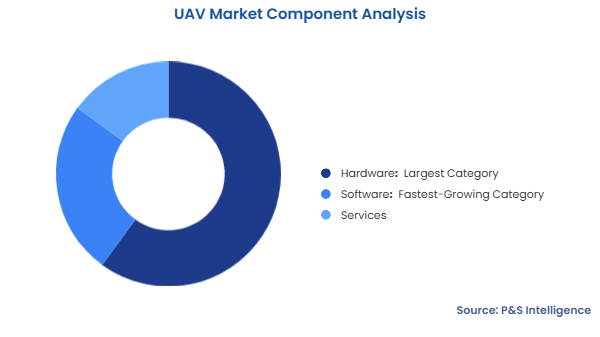
Hardware is the largest component, holding a market share of 60%, due to continuous demand for airframes, sensors, and battery advancements
Software is the fastest-growing component, registering a CAGR of approximately 15.3%, driven by rising demand for AI analytics, fleet management, and cloud integration
Rotary-wing drones are the largest type, holding a market share of 40%, due to their hovering ability, vertical take-off, and suitability for precision tasks
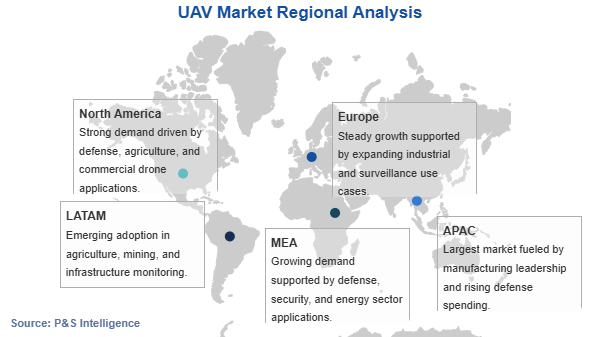
North America is the largest regional market, holding a market share of 40%, due to strong defence spending and early adoption of advanced drone applications
Asia-Pacific is the fastest-growing region, registering a CAGR of approximately 16.0%, driven by supportive government policies, rural demand, and increasing local drone manufacturing
UAV Market Emerging Trends & Growth Drivers
Shift Toward Autonomous and AI-Driven Drone Operations Is Major Trend
The market is witnessing a shift toward autonomous and AI-driven drone operations as organizations seek greater efficiency, scalability, and accuracy across commercial applications. Companies are increasingly deploying drones that can perform navigation, route planning, obstacle detection, and data collection with limited human involvement. This trend is being supported by advances in artificial intelligence, machine learning, computer vision, and edge computing technologies, which enable drones to process information in real time and respond to changing operating conditions. The focus is also moving beyond standalone aircraft toward integrated platforms that combine automation, analytics, and fleet management capabilities within a single operational ecosystem.
According to the International Federation of Robotics, global sales of professional service robots reached nearly 200,000 units in 2024, driven by increasing automation adoption across logistics, healthcare, and other service-intensive industries. Additionally, according to the International Telecommunication Union, 5G network coverage reached 51% of the global population in 2024, improving the communication infrastructure required for autonomous drone navigation, real-time data transmission, and beyond-visual-line-of-sight operations. These developments are strengthening the commercial viability of autonomous drone systems by improving connectivity, operational reliability, and decision-making capabilities. Organizations are therefore expanding drone deployments for inspection, surveillance, mapping, logistics, and asset monitoring activities where continuous operations and rapid data processing are becoming increasingly important.
Rising Need for Faster and Low-Cost Field Operations Drives Market
The market is growing as businesses focus on improving operational efficiency while controlling labor, equipment, and project costs. Drones are increasingly used to perform inspection, mapping, surveying, and monitoring tasks that traditionally require significant manpower and longer completion times. Their ability to capture accurate data quickly helps organizations improve workflow productivity while reducing exposure to hazardous environments. Adoption is particularly increasing across construction, agriculture, mining, energy, and logistics, where faster decision-making and efficient asset management have become operational priorities.
In July 2025, Wingtra launched WingtraRAY, a professional survey drone for mapping workflows. The product release is relevant to faster and lower-cost field operations because it links flight planning, data capture, and CAD or GIS-ready outputs in one workflow, helping survey teams reduce tool switching during field projects and post-flight handling. Additionally, in June 2025, Flyability launched a high-capacity battery for its flagship inspection drone and made it available for purchase. The release supports field-operation efficiency because inspection teams can run longer missions with fewer interruptions, especially in confined or hazardous locations where repeated battery changes can slow down data collection on site. These developments are strengthening the value proposition of drones by helping organizations complete projects faster, improve resource utilization, and increase productivity across large-scale field operations where operational efficiency directly affects project timelines and operating costs.
Strict Airspace Rules and Safety Concerns Limiting Wider Use
The market faces challenges because drone operations remain subject to strict regulatory requirements across many countries. Governments impose restrictions on flight zones, altitude limits, pilot certification, and operations near airports, urban centers, and critical infrastructure. These requirements can delay deployment timelines and increase compliance costs for commercial operators. According to the Federal Aviation Administration, civil penalties ranging from USD 1,771 to USD 36,770 were levied for 18 unauthorized drone operations that occurred between 2023 and 2025, reflecting increased regulatory scrutiny and stricter enforcement of drone safety and airspace compliance requirements. This regulatory environment affects business expansion plans, particularly for companies seeking large-scale drone deployment. Privacy concerns and safety risks associated with system failures or improper operation also influence public acceptance, requiring organizations to invest further in compliance, training, and risk management programs.
Expanding Role in Last-Mile Delivery and Emergency Services
The market presents growth opportunities as drones are increasingly used for delivery services and emergency response operations. Organizations are evaluating drone-based logistics to transport medical supplies, consumer goods, and critical materials to locations where conventional transportation may be slow or inefficient. Drones also provide rapid situational awareness during natural disasters and humanitarian emergencies, supporting faster assessment and resource distribution. According to the United Nations Office for the Coordination of Humanitarian Affairs, 299.4 million people were estimated to need humanitarian assistance and protection globally in 2024, increasing demand for efficient emergency response, logistics, and relief delivery systems. This growing operational need is encouraging public agencies, humanitarian organizations, and logistics providers to expand drone deployment strategies, creating new commercial opportunities while broadening the role of drones beyond traditional inspection, mapping, and monitoring applications.
UAV Market Segmentation Analysis
Component Analysis
Hardware is the largest category, holding a market share of 60%, because drone performance depends heavily on physical components such as airframes, batteries, sensors, cameras, and propulsion systems. Commercial and military operators continuously invest in hardware upgrades to improve flight endurance, payload capacity, and operational reliability. According to the International Energy Agency, global battery demand surpassed 1 terawatt-hour in 2024, reflecting continued advancements in battery technologies that support longer operating times and improved energy efficiency across electric-powered systems, including drones. These improvements support wider deployment across surveillance, mapping, inspection, and defense applications, sustaining demand for advanced drone hardware across multiple end-use sectors.
Software is the fastest-growing category, registering a CAGR of approximately 15.3%, as drone users increasingly require capabilities beyond flight operations. Organizations need software platforms for mission planning, fleet coordination, data processing, and operational management. AI-enabled analytics and cloud-based systems help convert aerial data into actionable insights, supporting applications such as agriculture, inspection, surveillance, and mapping. As rotary-wing and fixed-wing drone deployments expand across industries, software plays a larger role in managing complex workflows. This is increasing investment in integrated platforms that improve operational efficiency, support data-driven decision-making, and simplify large-scale drone operations.
Emerging Trends & Growth Drivers
The components analysed in this report are:
Hardware (Largest Category)
Software (Fastest-Growing Category)
Services
Drone Type Analysis
Rotary-Wing Drones are the largest category, holding a market share of 40%, because they offer operational flexibility and are well suited for short-range missions requiring precision and maneuverability. Their ability to hover, perform vertical take-off and landing, and operate in confined spaces makes them valuable for inspection, surveillance, photography, and infrastructure monitoring. Many commercial applications also rely on software-based flight planning and analytics to improve mission outcomes. Strong demand from industrial, commercial, and public safety users continues to support widespread adoption, particularly where accuracy, accessibility, and ease of deployment are important operational requirements.
Fixed-Wing Drones are the fastest-growing category, as organizations increasingly require long-range aerial platforms for large-area coverage and extended flight operations. Their ability to remain airborne for longer periods makes them suitable for environmental monitoring, agriculture, border security, and infrastructure assessment. According to UNEP-WCMC protected-area data, terrestrial protected areas covered approximately 26 million square kilometres globally in 2024, increasing demand for scalable monitoring solutions such as drones and remote sensing technologies for conservation and environmental management. Growing monitoring requirements are encouraging broader adoption of fixed-wing platforms, particularly in applications where operational efficiency and coverage area are critical.
The drone types analysed in this report are:
Rotary-Wing Drones (Largest Category)
Single-rotor
Multi-rotor
Fixed-Wing Drones (Fastest-Growing Category)
Medium Altitude Long Endurance
High Altitude Long Endurance
Hybrid Drones
Nano / Micro Drones
Others
End-Use Analysis
Defence & Military is the largest category, because armed forces increasingly depend on drones for intelligence gathering, surveillance, reconnaissance, and tactical mission support. These systems provide real-time information while reducing personnel exposure in complex operational environments. According to the United Nations, more than 185 armed conflicts were recorded globally in 2024, driving the deployment of unmanned systems for real-time battlefield intelligence. Rising security requirements are also supporting investment in advanced drone hardware and long-endurance fixed-wing platforms, reinforcing demand across military modernization and defense technology programs.
Agriculture is the fastest-growing category, registering a CAGR of approximately 15.8%, as farmers increasingly adopt drones to improve productivity and field management practices. Drone systems help monitor crop conditions, assess plant health, optimize fertilizer application, and identify issues across large farming areas more efficiently than conventional methods. The growing use of software analytics is also helping farmers interpret aerial data and make more informed decisions. As precision agriculture practices become more common, drone adoption is expanding across both large commercial farms and smaller agricultural operations seeking better resource utilization and improved crop management outcomes.
The end-uses analysed in this report are:
Defense & Military (Largest Category)
Agriculture (Fastest-Growing Category)
Construction & Infrastructure
Energy & Utilities
Logistics & Transportation
Media & Entertainment
Public Safety & Law Enforcement
Environmental Monitoring
Others
Drive strategic growth with comprehensive market analysis
UAV Market Regional Outlook
North America UAV Market Analysis
North America holds the largest share, of 40%, due to strong defense investments, advanced technological capabilities, and early adoption of unmanned systems across commercial and government sectors. The region benefits from a mature ecosystem comprising drone manufacturers, software developers, service providers, and research institutions that continuously drive innovation. Commercial applications such as aerial mapping, infrastructure inspection, construction monitoring, precision agriculture, and public safety operations are witnessing widespread adoption. Regulatory advancements by aviation authorities have also enabled broader deployment of drones for business use, including beyond-visual-line-of-sight (BVLOS) testing and autonomous operations. Furthermore, growing demand from defense agencies for surveillance, reconnaissance, and border security applications continues to support market expansion. The presence of major technology companies and increasing investments in drone-related software, AI, and analytics further strengthen North America's leadership position in the global UAV market.
U.S. UAV Market Analysis
The U.S. holds a leading position in the drone market due to its advanced defence capabilities and early adoption of commercial drone applications. The country supports large-scale operations through strong regulatory frameworks and extensive testing programs, including approvals for beyond-visual-line-of-sight operations. According to the FAA, the active fleet of large unmanned aircraft systems (LUAS) in the United States was 4,314 aircraft at the end of 2024, reflecting a structured and expanding ecosystem. Private sector participation is also increasing, particularly in delivery and infrastructure inspection services. The continuous innovation and regulatory support drive widespread adoption across both defence and commercial sectors.
Canada UAV Market Analysis
Canada is expanding its drone market with a strong focus on operations in remote and hard-to-reach regions. The country deploys drones for environmental monitoring, mining support, and pipeline inspections where accessibility remains limited. According to Transport Canada, the number of registered Remotely Piloted Aircraft Systems (RPAS) in Canada reached 97,706 in 2024, highlighting the growing adoption of drone technology across recreational, commercial, and public-sector applications. Additionally, the inventory of major natural resource projects reached 504 active developments in 2024, increasing demand for drones in site mapping and infrastructure inspection. The regulatory clarity and challenging terrain continue to support steady adoption across key sectors.
Asia-Pacific UAV Market Analysis
Asia-Pacific has the highest CAGR, of approximately 16.0%, driven by rapid industrialization, expanding commercial applications, and supportive government initiatives promoting drone adoption. Countries such as China, India, Japan, South Korea, and Australia are increasingly utilizing drones across agriculture, logistics, infrastructure monitoring, mining, and public service operations. Large agricultural landscapes in the region create significant demand for crop monitoring, spraying, and precision farming solutions that improve productivity and reduce operational costs. The presence of cost-competitive manufacturers, particularly in China, has increased the accessibility of drone technology across both enterprise and consumer segments. Additionally, rising startup activity, increasing venture capital investments, and government-backed pilot programs are fostering innovation in autonomous drone systems. Growing demand for last-mile delivery, smart city development, and industrial inspections is expected to further accelerate market growth across the region.
China UAV Market Analysis
China has a strong position in the drone market due to its large-scale manufacturing capabilities and widespread domestic adoption. Local companies supply both domestic and international markets, strengthening export competitiveness. According to the Civil Aviation Administration of China, the number of registered unmanned aerial vehicles exceeded 2 million units in 2024, while annual drone flight hours surpassed 26 million, highlighting the rapid expansion of China's civil drone ecosystem. Drones are extensively used in agriculture, surveillance, and public services. Government support and large-scale deployment programs sustain high demand, while cost advantages further accelerate adoption across multiple sectors.
India UAV Market Analysis
India is one of the fastest-growing drone markets due to strong government support and increasing adoption across agriculture and public sector applications. The government promotes drone usage through targeted policies and financial incentives to expand rural and industrial deployment. According to the Ministry of Agriculture and Farmers Welfare, 1,094 drones were distributed to women’s self-help groups under the Namo Drone Didi initiative in 2024 to modernise farming practices. Demand is rising for crop spraying, monitoring, and land mapping. As startups introduce localised solutions, drone adoption continues to expand across diverse use cases.
Europe UAV Market Analysis
Europe continues to experience steady growth in the UAV market, supported by a structured regulatory framework and increasing adoption of drones across commercial and public-sector applications. The region emphasizes safe drone integration through harmonized regulations, airspace management systems, and stringent operational standards, creating a stable environment for market development. Drones are increasingly being deployed for environmental monitoring, energy infrastructure inspection, construction surveying, precision agriculture, and urban planning activities. Investments in sustainable technologies and digital transformation initiatives are further encouraging the use of UAVs for data collection and operational efficiency. Collaborative efforts among European countries and regulatory bodies support cross-border drone operations and innovation within the industry. While growth remains moderate compared to emerging markets, Europe’s focus on compliance, safety, and long-term scalability positions the region as a key contributor to the global UAV market's development.
The regions and countries analysed in this report are:
North America (Largest Regional Market)
U.S. (Larger Country)
Canada (Faster-Growing Country)
Europe
Germany (Largest Country)
U.K. (Fastest-Growing Country)
France
Italy
Spain
Rest of Europe
Asia-Pacific (Fastest-Growing Regional Market)
China (Largest Country)
India (Fastest-Growing Country)
Japan
South Korea
Australia
Rest of APAC
Latin America
Brazil (Largest Country)
Mexico (Fastest-Growing Country)
Rest of LATAM
Middle East and Africa
Saudi Arabia (Largest Country)
U.A.E. (Fastest-Growing Country)
South Africa
Rest of MEA
UAV Market Share Analysis
The market is fragmented, with many players operating across different regions and use cases. There is no single company controlling the entire space, as demand varies widely from defence to agriculture and logistics. Large companies focus on advanced systems, while smaller firms target niche applications or local markets. New startups continue to enter with specialised solutions, which increases competition. Technology is evolving quickly, so companies keep launching new features to stay relevant. Also, regulations differ by country, which allows regional players to grow independently instead of being dominated by a few global firms.
Key Players in the UAV Market:
SZ DJI Technology Company Limited
AeroVironment Incorporated
General Atomics
Northrop Grumman Corporation
Lockheed Martin Corporation
The Boeing Company
Israel Aerospace Industries Limited
Elbit Systems Limited
Textron Incorporated
Teledyne Technologies Incorporated
Parrot SA
Skydio Incorporated
EHang Holdings Limited
Autel Robotics Company Limited
Baykar Makina Sanayi ve Ticaret Anonim Sirketi
UAV Market Developments
In March 2026, Volarious launched a tethered power system built for enterprise drones. Bypassing standard internal batteries, this hardware connects a ground power source directly to the aircraft using a specialised transmission cable.
In February 2026, HoverAir initiated shipments of its Aqua waterproof drone to customers. Featuring a sealed chassis and buoyant exterior, the machine takes off from and lands directly on water surfaces during flights.
In January 2026, DJI released an updated aircraft firmware package for its flagship drone model. The software patch modified core control parameters and adjusted integration protocols connecting remote controllers with the flight application interface.
In December 2025, DefendEye and EAGL Technology launched an integrated autonomous drone response platform. Linking outdoor acoustic detection sensors with an aerial vehicle, this system automates drone deployment to specific geographic coordinates upon activation.
In November 2025, Indrajaal Drone Defence launched the mobile Anti-Drone Patrol Vehicle. This ground unit incorporates detection sensors alongside interception mechanisms to track and neutralise unauthorised aerial vehicles across restricted zones.
Frequently Asked Questions About This Report
What factors are driving growth in the UAV drone market?+
Growth is driven by inspection, agriculture, defense, mapping, logistics, and public safety demand, supported by better sensors, battery systems, autonomy, and airspace rules.
What are the major applications of UAV drones across industries?+
Major applications include aerial surveying, crop monitoring, infrastructure inspection, surveillance, emergency response, delivery trials, environmental mapping, and data collection for field operations.
What is the main restraint for commercial UAV drone adoption?+
Strict flight approvals, airspace restrictions, safety risks, and privacy concerns limit faster adoption, especially for operations near cities, airports, and sensitive infrastructure.
Which technology trends are shaping the UAV drone market?+
Artificial intelligence, autonomous navigation, cloud analytics, fleet management software, improved batteries, and advanced imaging systems are shaping next-generation drone operations.
Why is software becoming important in UAV drone operations?+
Software helps users plan missions, process aerial data, manage fleets, automate workflows, and convert drone outputs into practical business insights.
Want a report tailored exactly to your business need?
Leading companies across industries trust us to deliver data-driven insights and innovative solutions for their most critical decisions. From data-driven strategies to actionable insights, we empower the decision-makers who shape industries and define the future. From Fortune 500 companies to innovative startups, we are proud to partner with organisations that drive progress in their industries.
Client Testimonials
Working with P&S Intelligence and their team was an absolute pleasure – their awareness of timelines and commitment to value greatly contributed to our project's success. Eagerly anticipating future collaborations.
McKinsey & Company
India
Unmatched Standards
Our insights into the minutest levels of the markets, including the latest trends and competitive landscape, give you all the answers you need to take your business to new heights
Complete Data Security
We take a cautious approach to protecting your personal and confidential information. Trust is the strongest bond that connects us and our clients, and trust we build by complying with all international and domestic data protection and privacy laws