This Report Provides In-Depth Analysis of the UAE Waste-to-Energy Market Report Prepared by P&S Intelligence, Segmented by Technology (Thermochemical, Biochemical), Waste Type (Municipal Solid Waste, Process Waste, Agriculture Waste, Construction and Demolition Waste, Medical Waste), Application (Electricity, Heat, Steam, Biogas/ Biofuel, Industrial Processes, Wastewater Treatment, Transportation Fuel), Capacity (Below 10 MW, 10-50 MW, 50-100 MW, 100-200 MW, Over 200 MW), and Geographical Outlook for the Period of 2019 to 2032
Explore the market potential with our data-driven report
UAE Waste-to-Energy Market Outlook
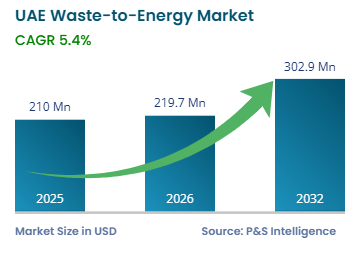
The UAE waste-to-energy market size will be an estimated USD 210.0 million for 2025, and it will grow by 5.4% during 2026–2032, to reach USD 302.9 million by 2032.
The market growth is primarily driven by ambitious sustainability targets under UAE Vision 2050, rapid urbanization generating substantial municipal waste volumes, and strategic initiatives to reduce landfill dependency while diversifying the
The UAE aims for net-zero emissions by 2050 and a waste‑diversion rate by 2035 through recycling, waste-to-energy, and circular economy initiatives. These facilities not only address the challenge of managing 21 million tonnes of municipal solid waste generated annually but also contribute significantly to renewable energy generation. The successful commissioning of multiple large-scale facilities demonstrates the commercial and environmental viability of waste-to-energy technology in hot climate conditions, positioning the UAE as a model for sustainable waste management across the Gulf region.
UAE Waste-to-Energy Market Trends & Drivers
Technological Advancement in Thermochemical Conversion Is Key Trend
Advanced thermochemical technologies, particularly high-efficiency incineration systems, have proven their effectiveness in UAE’s conditions.
Modern facilities incorporate sophisticated air pollution control systems, ensuring compliance with international emission standards while maximizing energy recovery efficiency.
The success of operational plants has validated technology performance in challenging desert conditions.
The integration of advanced features, including automated waste sorting, continuous emission monitoring, and bottom ash recovery for construction applications, demonstrates the sector's technological maturity.
These proven capabilities, combined with decreasing technology costs and improved operational expertise, position thermochemical waste-to-energy as the preferred solution for large-scale waste management challenges across the UAE.
The UAE’s National Agenda for Integrated Waste Management, launched by the Ministry of Climate Change and Environment, calls for innovation in waste treatment technologies and alignment with circular economy goals.
Abu Dhabi’s Policy for Energy from Waste explicitly supports thermochemical EFW (Energy from Waste) development by removing regulatory barriers and aligning waste sector and energy sector goals.
Further, the UAE Circular Economy Council has approved 22 policies to accelerate circular economy implementation, including waste-to-resource approaches and advanced waste-treatment technologies.
Government Sustainability Initiatives and Circular Economy Policies Are Biggest Drivers
The UAE's comprehensive policy framework supporting waste-to-energy development has emerged as the primary market driver.
In December 2023, at COP28 in Dubai, MOCCAE and Tadweer officially launched the Waste to Zero initiative, further solidifying the national commitment to waste management transformation.
These policy initiatives are backed by substantial financial commitments and regulatory mandates.
Federal Decree‑Law No. 11 of 2024 mandates that all corporate entities in the UAE, including free‑zone firms, must monitor and report their greenhouse‑gas emissions, with the law coming into force on 30 May 2025 and full compliance expected by 30 May 2026.
The integration of waste-to-energy into national energy strategies, combined with mandatory waste diversion targets, ensures a predictable feedstock supply and long-term revenue streams for project developers.
This regulatory certainty has attracted international technology providers and investors, accelerating market maturity and technological advancement.
UAE Waste-to-Energy Market Segmentation Analysis
Technology Analysis
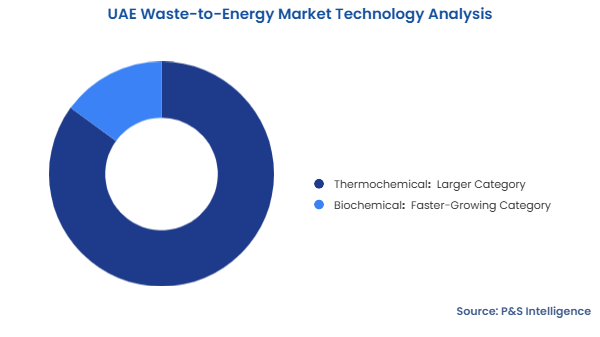
The thermochemical category holds the largest market share, of 85%, in 2025, driven by its proven efficiency in processing mixed municipal solid waste streams and generating stable baseload electricity. This is due to the successful deployment of large-scale incineration facilities that demonstrate commercial viability in UAE's hot climate conditions. Advanced moving grate technology, coupled with sophisticated flue gas treatment systems, ensures compliance with stringent European emission standards while maximizing energy recovery from diverse waste feedstocks. The high calorific value of UAE's waste stream, containing substantial plastic and paper fractions, makes thermochemical conversion particularly effective for energy generation.
The biochemical category will have the highest CAGR, of 5.8%, driven by the increasing organic waste segregation initiatives and growing interest in biogas production for industrial applications. The segment benefits from lower capital requirements compared to large-scale incineration and alignment with circular economy principles through digestate utilization as agricultural fertilizer. Government initiatives promoting food waste diversion and industrial symbiosis create favorable conditions for anaerobic digestion deployment, particularly for treating segregated organic waste from hotels, restaurants, and food processing facilities.
The technologies analyzed in this report are:
Thermochemical (Largest Category)
Incineration
Pyrolysis
Gasification
Plasma Gasification
Biochemical (Fastest-Growing Category)
Anaerobic Digestion
Waste Type Analysis
The municipal solid waste category holds the largest market share, of 65%, in 2025, reflecting the massive volumes generated by urban populations and the established collection infrastructure across major cities. The dominance of this segment aligns with government priorities to divert municipal waste from landfills while recovering energy value. According to the UAE Ministry of Climate Change and Environment, per capita municipal solid waste generation reached about 2.1 kg/day, one of the highest in the world, creating substantial feedstock availability for waste-to-energy facilities. The heterogeneous composition of municipal waste, including high fractions of combustible materials, makes it ideal for thermochemical conversion processes deployed in major facilities.
The agriculture waste category will have the highest CAGR, of 5.6%, driven by the increasing focus on agricultural sustainability and waste valorization initiatives. The UAE's agricultural sector expansion under food security programs generates increasing volumes of crop residues, greenhouse waste, and date palm fronds suitable for energy recovery. Government support for converting agricultural waste into renewable energy, combined with the development of smaller-scale distributed waste-to-energy systems, accelerates this segment's growth.
The waste types analyzed in this report are:
Municipal Solid Waste (Largest Category)
Process Waste
Agriculture Waste (Fastest-Growing Category)
Construction and Demolition Waste
Medical Waste
Others
Application Analysis
The electricity category holds the largest market share, of 70%, in 2025, as large-scale facilities primarily focus on power production to feed the national grid and support renewable energy targets. The segment's leadership reflects the strategic alignment between waste management objectives and clean energy goals, with major plants designed to maximize electrical output through high-efficiency steam turbines. Dubai's facility will feed 200MW of electricity into the local grid, demonstrating the significant contribution waste-to-energy makes to the power generation mix.
The steam category will have the highest CAGR, of 5.7%, driven by increasing industrial demand for process steam and district cooling applications. The integration of waste-to-energy facilities with industrial zones enables direct steam supply to manufacturing plants, enhancing overall energy efficiency and reducing fossil fuel consumption. Developments in cogeneration systems that simultaneously produce electricity and useful thermal energy maximize resource utilization from waste feedstock. The growing emphasis on industrial decarbonization and energy efficiency creates expanding markets for steam applications, particularly in petrochemical complexes and food processing clusters where consistent thermal energy demand exists.
The applications analyzed in this report are:
Electricity (Largest Category)
Heat
Steam (Fastest-Growing Category)
Biogas/Biofuel
Industrial Processes
Wastewater Treatment
Transportation Fuel
Capacity Analysis
The 50–100 MW category holds the largest market share in 2025, as it offers the optimal balance between economies of scale and manageable project complexity for UAE conditions. This capacity range aligns with emirate-level waste generation volumes while enabling efficient plant operation and maintenance. Facilities in this range include Sharjah's plant, which produces up to 30 MW of electrical power. Hence, it demonstrates commercial viability, while serving metropolitan waste management needs.
The 10–50 MW category will have the highest CAGR during the forecast period, driven by the increasing deployment of distributed waste-to-energy solutions for smaller emirates and industrial applications. This capacity range suits secondary cities and specialized waste streams, offering flexibility in project development and reduced capital requirements. The category's growth reflects market evolution toward diversified project sizes, enabling waste-to-energy deployment beyond major metropolitan areas.
The capacities analyzed in this report are:
Below 10 MW
10–50 MW (Fastest-Growing Category)
50–100 MW (Largest Category)
100–200 MW
Over 200 MW
Drive strategic growth with comprehensive market analysis
UAE Waste-to-Energy Market Geographical Analysis
Dubai Waste-to-Energy Market Size
Dubai holds the largest market share, of 45%, in 2025, anchored by the world's largest single-site waste-to-energy facility that exemplifies the emirate's commitment to sustainable urban development. The Warsan plant will use 2 million metric tons of trash annually to produce electricity, enough to power approximately 135,000 homes, representing a landmark achievement in waste management infrastructure.
Dubai Municipality's proactive approach includes mandatory waste segregation programs and industrial waste management regulations that channel appropriate materials to energy recovery. The emirate's success in project execution, demonstrated through on-schedule completion of mega-facilities and achievement of performance targets, positions Dubai as the regional benchmark for waste-to-energy deployment and attracts continued investment in capacity expansion.
Abu Dhabi Waste-to-Energy Market Size
Abu Dhabi will have the highest CAGR, of 5.5%, driven by ambitious waste management transformation under Tadweer Group's strategic leadership and substantial infrastructure investments. The emirate's first waste-to-energy plant will have an annual capacity for the treatment of 900,000 tons of waste and for 80MW power generation, marking a significant milestone in sustainable waste management. The facility's development through international partnerships with Japanese technology providers ensures the adoption of world-class standards and operational excellence.
Tadweer's comprehensive waste management strategy includes a target to divert 80% of Abu Dhabi's waste from landfill by 2030, creating substantial demand for waste-to-energy infrastructure across the emirate. The integration of waste-to-energy projects with broader circular economy initiatives, including material recovery facilities and recycling programs, maximizes resource efficiency. Abu Dhabi's strong financial capacity, demonstrated through sovereign-backed project financing and public-private partnership models, accelerates project development timelines. The emirate's focus on industrial waste management, driven by its substantial oil and gas sector, opens additional opportunities for specialized waste-to-energy applications beyond municipal solid waste.
The emirates of the market are as follows:
Dubai (Largest Emirate)
Abu Dhabi (Fastest-Growing Emirate)
Sharjah
Ajman
Fujairah
Ras Al Khaimah
Umm Al Quwain
UAE Waste-to-Energy Market Share
The market is semi-consolidated due to its strategic partnerships and technology collaborations, which characterize the competitive landscape. International technology providers, including Hitachi Zosen Inova, BESIX, and Veolia, bring proven waste-to-energy solutions adapted for local conditions. The competitive environment encourages innovation in areas including emission control, energy efficiency optimization, and bottom ash utilization. Companies differentiate through comprehensive service offerings, including waste collection integration, renewable energy certificates, and carbon credit generation capabilities.
Key UAE Waste-to-Energy Companies:
Tadweer Group
BEEAH Group
Masdar
Emirates Waste to Energy Company
Veolia Middle East
Hitachi Zosen Inova AG
BESIX Group
Averda International
SUEZ
Mitsubishi Heavy Industries Ltd.
Marubeni Corporation
Keppel Seghers
UAE Waste-to-Energy Market News
In January 2025, BEEAH Energy and Masdar partnered to announce the expansion of the Sharjah Waste-to-Energy Plant to increase its processing capacity from 300,000 to 450,000 tons of municipal solid waste annually. The expansion integrates advanced incineration technology, generating up to 45 MW of clean electricity.
In January 2025, BEEAH Group and Chinook Hydrogen launched construction of the Middle East's first commercial hydrogen-from-waste plant, converting municipal waste into clean hydrogen fuel and demonstrating technological diversification beyond conventional energy recovery.
In July 2024, The Tadweer Group and Emirates Water and Electricity Company received legal advice from international law firm Ashurst about the finance, procurement, and construction of the first waste-to-energy plant to be built in the Emirate of Abu Dhabi.
In March 2024, EWEC and Tadweer Group signed a concession agreement with a Japan-based consortium for the Abu Dhabi Waste-to-Energy project, establishing a 30-year partnership for the 900,000 tons per year facility.
In October 2024, the Sharjah Waste-to-Energy plant reached a key milestone, processing over 500,000 tonnes of non-recyclable waste since its 2022 launch, demonstrating operational reliability and efficiency.
Want a report tailored exactly to your business need?
Leading companies across industries trust us to deliver data-driven insights and innovative solutions for their most critical decisions. From data-driven strategies to actionable insights, we empower the decision-makers who shape industries and define the future. From Fortune 500 companies to innovative startups, we are proud to partner with organisations that drive progress in their industries.
Client Testimonials
Working with P&S Intelligence and their team was an absolute pleasure – their awareness of timelines and commitment to value greatly contributed to our project's success. Eagerly anticipating future collaborations.
McKinsey & Company
India
Unmatched Standards
Our insights into the minutest levels of the markets, including the latest trends and competitive landscape, give you all the answers you need to take your business to new heights
Complete Data Security
We take a cautious approach to protecting your personal and confidential information. Trust is the strongest bond that connects us and our clients, and trust we build by complying with all international and domestic data protection and privacy laws