This Report Provides In-Depth Analysis of the UAE Mining and Minerals Market Report Prepared by P&S Intelligence, Segmented by Mineral Type (Metallic Minerals, Non-Metallic Minerals), Application (Construction & Infrastructure, Manufacturing, Energy Production, Chemical Industry, Agriculture), Mining Type (Surface Mining & Quarrying, Underground Mining), and Geographical Outlook for the Period of 2021 to 2032
Explore the market potential with our data-driven report
UAE Mining and Minerals Market Analysis
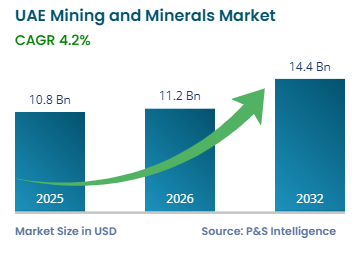
The UAE mining and minerals market size will be an estimated USD 10.8 billion for 2025, and it will grow by 4.2% during 2026–2032, to reach USD 14.4 billion by 2032.
The market expansion is primarily driven by robust construction activities, economic diversification initiatives under Operation 300bn, and strategic infrastructure investments across the seven emirates.
The UAE has abundant reserves of limestone, gypsum, silica sand, and aluminum, which serve as critical inputs for construction, cement manufacturing, and glass production. The country's efforts to achieve self-sufficiency in raw materials have led to increased mining activities and exploration projects. Emirates Global Aluminium produced 2.74 million tonnes of cast metal in 2024, making it one of the world's largest premium aluminum producers and contributing significantly to the UAE's mining sector.
The government's commitment to economic diversification through the Operation 300bn strategy aims to increase the industrial sector's contribution to GDP from AED 133 billion to AED 300 billion by 2031, providing significant growth opportunities for the mining and minerals sector. Additionally, major infrastructure projects, including the Etihad Rail network, Dubai Creek Harbour, and Palm Jebel Ali development, are creating sustained demand for construction minerals and aggregates, positioning the UAE as a regional leader in mineral processing and exports.
UAE Mining and Minerals Market Segmentation Analysis
Mineral Type Analysis
The metallic category holds the larger market share, of 45%, in 2025, driven primarily by the country's position as a leading global aluminum producer. This dominance is attributed to Emirates Global Aluminium's large-scale operations, which produce one in every 25 tonnes of aluminum made worldwide. The company's metal comprises the UAE's largest made-in-the-UAE export after oil and gas and is shipped to more than 50 countries. The aluminum subsegment leads within metallic minerals due to established infrastructure, substantial production capacity exceeding 2.69 million tonnes annually, and strong government support through Operation 300bn strategy.
The non-metallic category will have the higher CAGR, of 4.4%, propelled by explosive growth in construction activities and infrastructure development across all seven emirates.
Gypsum and silica sand subsegments are experiencing robust growth driven by construction finishing requirements and glass manufacturing expansion. The UAE imports gypsum primarily from Oman and Iran to supplement domestic production, while silica sand is essential for the country's growing glass industry and specialized construction applications. The government's focus on sustainable building materials and green construction practices is further stimulating demand for high-quality non-metallic minerals across residential, commercial, and industrial projects.
The mineral types analyzed in this report are:
Metallic Minerals (Larger Category)
Aluminum
Copper
Iron
Others
Non-Metallic Minerals (Faster-Growing Category)
Limestone
Gypsum
Silica Sand
Salt
Others
Application Analysis
The construction & infrastructure category holds the largest market share, of 55%, in 2025. This is due to the UAE's ambitious urban development agenda, including Dubai's Urban Master Plan 2040 and mega-projects, such as Dubai Creek Harbour, spanning 1,480 acres; and Palm Jebel Ali development, exceeding 90 kilometers of beachfront. The construction sector's demand encompasses limestone for cement production, gypsum for plasterboard and finishes, silica sand for concrete and glass, and aggregates for roads and infrastructure.
The manufacturing category will have the highest CAGR, driven by Operation 300bn's objective to increase the manufacturing sector's GDP contribution from 9% to 25% by 2031. This application segment includes aluminum smelting and processing, steel production, cement manufacturing, and glass production, all of which are priority sectors under the national industrial strategy. The Emirates Development Bank’s AED 30-billion multi-year financing program for priority industrial sectors, including heavy industries, machinery, and manufacturing, is accelerating mineral utilization in value-added production processes.
The applications analyzed in this report are:
Construction & Infrastructure (Largest Category)
Manufacturing (Fastest-Growing Category)
Energy Production
Chemical Industry
Agriculture
Others
Mining Type Analysis
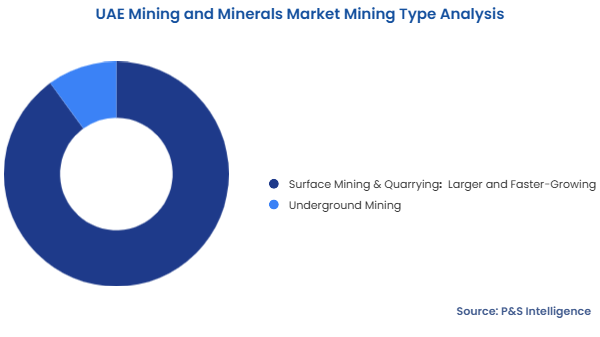
The surface mining & quarrying category holds the larger market share, of 90%, in 2025, and it will have the higher CAGR, of 4.5%. This dominance is attributed to the geological characteristics of UAE's mineral deposits, with limestone, gypsum, and silica sand primarily located near the surface and accessible through open-pit and quarrying methods. Surface mining offers lower operational costs, reduced safety risks compared to underground methods, and higher production efficiency, making it the preferred extraction approach for non-metallic minerals.
The UAE's cement production facilities rely heavily on government quarries that provide stable, high-quality limestone resources. The Ras Al Khaimah emirate hosts mining licenses for various metallic and non-metallic minerals, including exploratory copper and zinc projects. The emirate's large deposits of limestone and other minerals have prompted expansion of surface mining infrastructure, with companies investing in advanced crushing, screening, and processing equipment to maximize recovery and meet stringent environmental standards.
The mining types analyzed in this report are:
Surface Mining & Quarrying (Larger and Faster-Growing Category)
Underground Mining
Drive strategic growth with comprehensive market analysis
UAE Mining and Minerals Market Geographical Analysis
Abu Dhabi Market Size
Abu Dhabi holds the largest market share, of 40%, in 2025, driven by Emirates Global Aluminium's Al Taweelah smelter, the world's largest single-site primary aluminum producer with a capacity of 1.3 million tonnes per annum. The emirate hosts industrial zones, including KEZAD, that serve as strategic hubs for mineral processing and advanced manufacturing. The emirate's proximity to EGA and EMSTEEL plants creates integrated supply chains for aluminum and steel production, driving consistent demand for bauxite, alumina, iron ore, and other metallic minerals. Moreover, Abu Dhabi's mining sector benefits from government support through the Economic Vision 2030 and strategic infrastructure investments.
Ras Al Khaimah Market Size
Ras Al Khaimah will have the highest CAGR, of 4.3%, propelled by its extensive limestone deposits and strategic position as the UAE's cement production hub. The emirate hosts five of the 13 cement production facilities currently operating in the UAE, supported by large deposits of limestone and other minerals necessary for cement manufacture.
The emirate's annual mineral output exceeds 102 million tonnes, with exports facilitated through upgraded port infrastructure that enables direct shipments to Gulf Cooperation Council countries and South Asian markets. Ras Al Khaimah's focus on sustainable mining practices positions it for accelerated growth as demand from construction and manufacturing sectors intensifies across the forecast period.
The regions of the market are as follows:
Abu Dhabi (Largest Regional Market)
Ras Al Khaimah (Fastest-Growing Regional Market)
Dubai
Sharjah
Fujairah
Ajman
Umm Al Quwain
UAE Mining and Minerals Market Share
The market is semi-consolidated characterized by a mix of large-scale integrated producers and specialized regional operators. The market concentration is particularly evident in the metallic minerals segment, where Emirates Global Aluminium maintains a dominant market position, while the non-metallic minerals segment demonstrates greater fragmentation with multiple quarrying and cement companies competing across different emirates. Key competitive strategies include vertical integration to secure raw material supplies, technology adoption for operational efficiency, strategic partnerships for market expansion, and sustainability initiatives aligned with the UAE's Net Zero by 2050 objectives. Companies are investing in automated equipment, digital mining technologies, and renewable energy integration to reduce the environmental footprint while improving productivity and cost competitiveness in regional and global markets.
Key UAE Mining and Minerals Companies:
Emirates Global Aluminium PJSC
Emirates Steel Arkan PJSC
RAK White Cement Company
Union Cement Company
Star Cement
National Cement Company
Fujairah Cement Industries
Stevin Rock
RAK Cement Company
Gulf Cement Company
Sharjah Cement and Industrial Development Company
Al Ghurair Iron & Steel
UAE Mining and Minerals Market News
In May 2025, Abu Dhabi National Oil Company (ADNOC) and Emirates Global Aluminium PJSC signed a five-year supply agreement, valued at AED 1.84 billion, for 1.5 million tonnes of calcined petroleum coke, strengthening domestic supply chains and reducing import dependency.
In February 2024, Emirates Steel Arkan PJSC entered into a strategic partnership with Finnish firm Magsort to implement innovative solutions at the Al Ain Cement Factory, aiming to reduce CO2 emissions by up to 15% through steel slag processing.
Frequently Asked Questions About This Report
What are the major drivers of the UAE mining & minerals market?+
The major drivers of the UAE mining & minerals market include large-scale infrastructure development, rapid urbanization, strong construction activity, industrial expansion, and government-led economic diversification initiatives.
Which companies operate in the UAE mining & minerals market?+
Key companies operating in the UAE mining & minerals market include cement producers, quarrying and aggregates companies, and metals manufacturers serving domestic and export demand.
What minerals are primarily produced in the UAE?+
The UAE primarily produces construction and industrial minerals such as limestone, aggregates, gypsum, sand, clinker, and cement-related raw materials.
What is the future outlook of the UAE mining & minerals market?+
The UAE mining & minerals market is expected to grow steadily, supported by infrastructure investments, real estate development, sustainable quarrying practices, and expansion of downstream mineral-based industries.
Want a report tailored exactly to your business need?
Leading companies across industries trust us to deliver data-driven insights and innovative solutions for their most critical decisions. From data-driven strategies to actionable insights, we empower the decision-makers who shape industries and define the future. From Fortune 500 companies to innovative startups, we are proud to partner with organisations that drive progress in their industries.
Client Testimonials
Working with P&S Intelligence and their team was an absolute pleasure – their awareness of timelines and commitment to value greatly contributed to our project's success. Eagerly anticipating future collaborations.
McKinsey & Company
India
Unmatched Standards
Our insights into the minutest levels of the markets, including the latest trends and competitive landscape, give you all the answers you need to take your business to new heights
Complete Data Security
We take a cautious approach to protecting your personal and confidential information. Trust is the strongest bond that connects us and our clients, and trust we build by complying with all international and domestic data protection and privacy laws