UAE Green Hydrogen Market Size & Share Analysis - Trends, Drivers, Competitive Landscape, and Forecasts (2026 - 2032)
This Report Provides In-Depth Analysis of the UAE Green Hydrogen Market Report Prepared by P&S Intelligence, Segmented by Technology (Alkaline Electrolysis, Proton Electrolyte Membrane Electrolysis, Solid-Oxide Electrolysis), Distribution Channel (Pipeline, Cargo), Renewable Energy Source (Solar, Wind), End Use (Residential and Commercial Heating, Industrial, Transportation, Power generation), and Geographical Outlook for the Period of 2021 to 2032
Explore the market potential with our data-driven report
UAE Green Hydrogen Market Overview
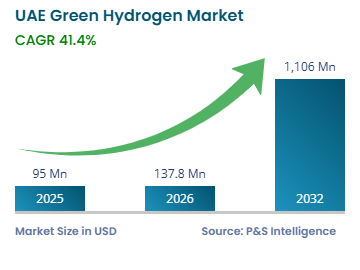
The UAE green hydrogen market value stood at USD 95.0 million in 2025, and it is anticipated to expand at a CAGR of 41.4% during 2026–2032, reaching approximately USD 1,106.0 million by 2032. This growth is driven by the country's strategic pivot toward low-carbon energy systems, supported by abundant solar irradiation, large-scale electrolysis project deployments, and comprehensive policy frameworks positioning the UAE as a global hydrogen hub.
Key Market Insights
Alkaline electrolysis held the largest share of the UAE green hydrogen market in 2025, of 55%.
Cargo-based distribution is anticipated to experience the fastest growth through 2032, at 41.7% CAGR.
Solar energy held the largest share of the UAE green hydrogen market in 2025, of 60%.
Power generation is expected to register the fastest growth through 2032, at 41.9% CAGR.
Abu Dhabi accounts for the largest share of the market, of 40%.
Dubai represents the fastest-growing emirate-level market, with 41.5% CAGR.
The UAE's National Hydrogen Strategy 2050 targets the production of 1.4 million tonnes per annum of low-carbon hydrogen by 2031, including 1 million tonnes of green hydrogen exclusively from renewable sources. The UAE Ministry of Energy and Infrastructure (MOEI) confirmed that the strategy aims to reduce emissions in hard-to-abate sectors, such as transport, chemicals, fertilizers, and metals, by 25% by 2031 and achieve 100% reduction by 2050. The market is further reinforced by the UAE's significant renewable energy infrastructure, which underpins green hydrogen electrolysis capacity.
UAE Green Hydrogen Market Trends & Drivers
Vertically Integrated Renewable-to-Hydrogen Value Chains Are Trending
A structural shift is underway in the UAE as energy stakeholders move from standalone renewable energy or hydrogen projects toward fully integrated production-to-offtake ecosystems. ADNOC, Masdar, and DEWA are developing vertically integrated platforms that combine captive solar PV generation, electrolyzer capacity, hydrogen storage, and downstream ammonia conversion within single industrial clusters. This integration model reduces intermediary costs, optimizes capacity utilization, and creates bankable project structures, which attract institutional financing.
This is exemplified by the KEZAD green hydrogen-to-ammonia complex and the TA'ZIZ industrial hub. The International Energy Agency (IEA) reported in its Global Hydrogen Review 2025 that low-emission hydrogen production from projects at final investment decision is set to reach 4.2 million tonnes per annum by 2030, a fivefold increase from 2024 levels.
Decarbonization and Hydrogen-Specific Policy Frameworks Drive Market
The UAE government's multi-layered decarbonization policy is directly catalyzing capital deployment into green hydrogen production infrastructure. The National Hydrogen Strategy 2050 establishes binding production targets of 1.4 million tonnes per annum by 2031 and 15 million tonnes by 2050, while mandating the creation of dedicated hydrogen oases and a national R&D center. This policy is reinforced by the UAE Energy Strategy 2050, which commits AED 150 to 200 billion in energy investments by 2030 and targets a 32% clean energy contribution to the national generation mix by the same year.
The alignment of federal and emirate-level framework provides regulatory predictability that reduces investment risk and encourages multinational energy companies to commit capital to UAE-based electrolysis projects. As Abu Dhabi's draft Low-Carbon Hydrogen Regulatory Framework and regulatory structures mature from draft to enforceable policy, capital allocation toward large-scale electrolyzer installations is expected to intensify through 2030.
Elevated Production Costs and Infrastructure Gaps Restrain Market Advance
The green hydrogen market in the UAE faces near-term scalability challenges from the economics of electrolysis and the absence of dedicated hydrogen transport infrastructure. The IEA noted in its Global Hydrogen Review 2024 that electrolyzer system costs outside China remained at USD 2,000 to 2,600 per kilowatt in 2024, limiting project bankability for non-subsidized ventures.
Additionally, the UAE currently lacks a purpose-built hydrogen pipeline network, requiring costly compressed or liquefied transport solutions for inter-emirate distribution. The absence of a finalized regulatory framework adds regulatory uncertainty, which could delay final investment decisions. However, the declining electrolyzer costs, expanding renewable capacity, and progressive regulatory development are expected to progressively alleviate these constraints through the latter half of the forecast period.
The UAE's strategic geographic position between Europe and Asia, combined with established port infrastructure and maritime logistics capabilities, generates significant green hydrogen export potential. The country has established bilateral hydrogen cooperation agreements with Germany, Japan, South Korea, India, and several other nations. Masdar's strategic alliance with ENGIE, targeting 2 GW of electrolyzer capacity, is specifically oriented toward international green ammonia and liquid hydrogen export. With the IEA estimating global low-emissions hydrogen production costs at USD 2–9 per kilogram by 2030, the UAE's solar-advantaged production could become increasingly competitive for cross-border trade. This export orientation transforms domestic production capacity into globally connected hydrogen supply chains, with Fujairah and Abu Dhabi ports serving as primary export nodes.
UAE Green Hydrogen Market Segmentation Analysis
Technology Analysis
Alkaline electrolysis held the largest share of the UAE green hydrogen market in 2025, of 55%, driven by its maturity, lower capital expenditure, and proven reliability for large-scale H2 production. UAE project developers, including ADNOC and TAQA, have prioritized alkaline systems for Gigawatt-scale deployments due to their longer operational lifespans and compatibility with the nation's existing petrochemical infrastructure.
Proton exchange membrane electrolysis is expected to register the fastest growth during the forecast period, with 41.6% CAGR. The Proton Exchange Membrane technology's superior dynamic response to fluctuating solar power output, compact modular design, and higher current density make it attractive for distributed hydrogen production and solar-coupled installations across Abu Dhabi and Dubai.
The market segments into the following technologies:
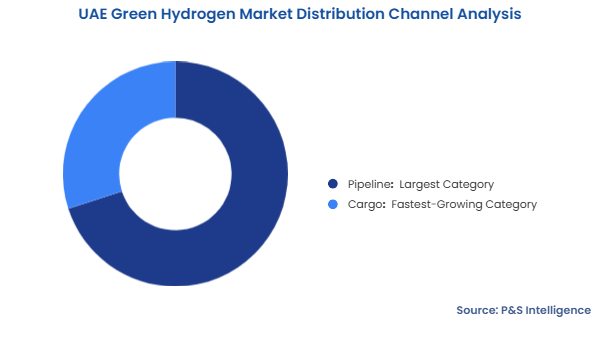
Pipeline distribution commanded the largest market share in 2025, of 70%, reflecting the strategic concentration of hydrogen production and consumption within integrated industrial clusters. The most significant of them are the TA'ZIZ ecosystem in Ruwais and the KEZAD complex in Abu Dhabi. Co-locating electrolyzers adjacent to ammonia conversion and refining facilities minimizes transport requirements and enables direct pipeline delivery over short distances, reducing compression and storage costs. The National Hydrogen Strategy includes the development of dedicated hydrogen oases and infrastructure corridors to support domestic distribution and export connectivity.
Cargo-based distribution is anticipated to experience the fastest growth through 2032, at 41.7% CAGR. It encompasses compressed hydrogen trailers, liquid hydrogen tankers, and ammonia carrier vessels, Fujairah's East Coast port and Abu Dhabi's planned chemicals terminal at TA'ZIZ enable the development of maritime export corridors to Japan, South Korea, Germany, and India. This factor will accelerate the transition from domestic pipeline networks to international cargo shipments.
The market segments into the following distribution channels:
Pipeline (Largest Category)
Cargo (Fastest-Growing Category)
Renewable Energy Source Analysis
Solar energy held the largest share of the UAE green hydrogen market in 2025, of 60%, due to the country's exceptional solar irradiation levels exceeding 2,000 kWh per square meter annually and the availability of large-scale solar PV infrastructure. The Mohammed bin Rashid Al Maktoum Solar Park, targeting over 5,000 MW of production capacity by 2030; and the 2 GW Al Dhafra Solar PV facility provide dedicated clean electricity feedstock for adjacent electrolyzer installations. In 2024, solar PV generation in the UAE grew strongly, with solar output up by around 29 % year-on-year.
Wind energy is projected to demonstrate the fastest growth, at 41.8% CAGR, during the forecast period, supported by Masdar's UAE Wind Program and emerging offshore wind assessment initiatives along the Arabian Gulf coast. The UAE’s first utility-scale wind power project, part of the UAE Wind Programme, has a combined wind capacity of about 103.5 MW across Sir Bani Yas Island, Delma Island, Al Sila, and Al Halah. The Masdar wind project, which includes 103.5 MW of wind power, was also completed in late 2023. As the country diversifies its renewable generation mix beyond solar PV, wind-powered electrolysis offers complementary production profiles that can extend daily hydrogen generation hours.
The market segments into the following renewable energy sources:
Solar (Largest Category)
Wind (Fastest-Growing Category)
Others
Application Analysis
Industrial application accounted for the largest share of the UAE green hydrogen market in 2025. This is due to the high demand from oil refining, ammonia-based fertilizer manufacturing, and petrochemical processing operations concentrated in Abu Dhabi's Ruwais industrial corridor. ADNOC currently produces over 300,000 tonnes per year of hydrogen for internal refining operations and has targeted expansion to 500,000 tonnes per annum. Fertiglobe's ammonia plants at Ruwais represent the most-immediate large-scale offtake pathway, with green hydrogen displacing natural gas-derived grey hydrogen in existing ammonia synthesis processes.
Power generation is expected to register the fastest growth through 2032, as DEWA and other utilities explore hydrogen-fueled gas turbine blending and fuel cell integration to decarbonize peak-load electricity production and enhance grid storage capabilities. The UAE’s Energy Strategy 2050 targets a 70% reduction in the carbon footprint of power generation and aims to increase the share of clean energy in the total energy mix to 30% by 2030 and 50% by 2050. Supporting this transition, DEWA’s Green Hydrogen Project at the Mohammed bin Rashid Al Maktoum Solar Park has been producing green hydrogen since 2021, with cumulative output exceeding 100 tonnes and more than 1 GWh of electricity generated from stored hydrogen.
The market segments into the following applications:
Residential and Commercial Heating
Industrial (Largest Category)
Transportation
Power Generation (Fastest-Growing Category)
Others
Drive strategic growth with comprehensive market analysis
UAE Green Hydrogen Market Regional Analysis
Abu Dhabi
Abu Dhabi accounts for the largest share of the market, of 40%, underpinned by the emirate's dominance in the national energy ecosystem and the presence of major state-owned petrochemical entities and utilities. The Abu Dhabi Hydrogen Alliance, formed by ADNOC, Mubadala, and ADQ, coordinates large-scale blue and green hydrogen initiatives. Similarly, Masdar's portfolio targets 1 million tonnes of annual green hydrogen capacity by 2030. The emirate hosts the Khalifa Industrial Zone Abu Dhabi (KEZAD), where a 2-GW solar-powered green hydrogen-to-ammonia facility is under development, and the Ruwais TA'ZIZ industrial hub, housing ADNOC's world-scale ammonia production operations.
Dubai
Dubai represents the fastest-growing emirate-level market, with 41.5% CAGR, catalyzed by the DEWA’s industrial-scale, solar-driven green hydrogen pilot facility at the Mohammed bin Rashid Al Maktoum Solar Park. The emirate is advancing hydrogen mobility through ADNOC Distribution's H2GO high-speed green hydrogen refueling station in Masdar City and the Jebel Ali industrial cluster. Anchored by DP World's largest port in the Middle East and Emirates Global Aluminium's smelting operations, these initiatives represent a significant potential demand center for green hydrogen.
The emirates analyzed in this report include:
Abu Dhabi (Largest Emirate Market)
Dubai (Fastest-Growing Emirate Market)
Sharjah
Ras Al Khaimah
Fujairah
Ajman
Umm Al Quwain
UAE Green Hydrogen Market Share Analysis
The UAE green hydrogen market exhibits a semi-consolidated structure, characterized by the prominent influence of state-backed energy conglomerates alongside select multinational technology and industrial gas providers. This structure reflects the capital-intensive nature of large-scale electrolysis projects, the strategic role of sovereign entities in energy transition policy execution, and the technical complexity of integrating renewable power generation with hydrogen production, storage, and distribution systems.
Project development in the UAE typically involves multi-billion-dollar investments, long development timelines, and coordination across utilities, transmission operators, export terminals, and industrial off-takers. As a result, market participation tends to be concentrated among entities with strong balance sheets, access to low-cost capital, and established infrastructure portfolios. The alignment of hydrogen deployment with national decarbonization targets and export ambitions further reinforces centralized planning and structured partnerships.
In addition, the integration of hydrogen into existing power, refining, petrochemical, and mobility ecosystems requires advanced engineering capabilities and regulatory alignment across sectors. Electrolyzer deployment must be synchronized with renewable capacity expansion, grid stability considerations, and water supply infrastructure, particularly in a region with high desalination dependency. These technical and infrastructural requirements create natural entry barriers, limiting fragmented competition while encouraging strategic collaborations, joint ventures, and long-term offtake agreements within the broader hydrogen value chain.
Key Players in the UAE Green Hydrogen Market:
Abu Dhabi National Oil Company (ADNOC)
Abu Dhabi Future Energy Company PJSC (Masdar)
Air Products and Chemicals Inc.
ENGIE SA
Linde plc
Fertiglobe plc
Dubai Electricity and Water Authority (DEWA)
Nel ASA
Brooge Renewable Energy Limited
Abu Dhabi Ports Company
Al Fattan Energy Company
L'Air Liquide SA
UAE Green Hydrogen Market News
In November 2025, Abu Dhabi Future Energy Company PJSC (Masdar) signed a binding joint venture agreement with OMV AG to develop and operate a 140-MW green hydrogen plant in Bruck an der Leitha, Austria, with a production capacity of up to 23,000 tonnes per annum. The facility, expected to be operational by 2027, lays the foundation for expanded Masdar-OMV collaboration on green hydrogen and sustainable aviation fuel production across the UAE and Central Europe.
In February 2025, SAMSUNG E&A signed a USD 1.7-billion (AED 6.2 billion) EPC contract with TA'ZIZ for a methanol production facility in Al Ruwais Industrial City, targeting annual output of up to 1.8 million metric tonnes.
In November 2024, TA'ZIZ awarded EPC contracts valued at more than USD 2 billion (AED 7.34 billion) for the development of essential site infrastructure, including a dedicated chemicals port and terminal, at the TA'ZIZ chemical and transition fuel ecosystem in Al Ruwais. The infrastructure will enable exports from the 1-million-tonne-per-annum low-carbon ammonia facility and world-scale methanol plant under construction at the site.
In May 2024, Abu Dhabi National Oil Company (ADNOC) delivered a certified bulk commercial shipment of low-carbon ammonia enabled by carbon capture and storage to Mitsui & Co. Ltd. for use in clean-power generation in Japan.
Frequently Asked Questions About This Report
What was UAE green hydrogen market size in 2025?+
In 2025, the green hydrogen market in UAE size was USD 95.0 million.
Which technology has largest UAE green hydrogen industry share?+
Alkaline electrolysis has the largest UAE green hydrogen industry share, of 55%.
What are the key UAE green hydrogen industry drivers?+
The major drivers for the UAE green hydrogen market are the country's pivot toward low-carbon energy systems, abundant solar irradiation, large-scale electrolysis projects, and favourable government policies.
What is the UAE green hydrogen market nature?+
The green hydrogen market in UAE is semi-consolidated.
Want a report tailored exactly to your business need?
Leading companies across industries trust us to deliver data-driven insights and innovative solutions for their most critical decisions. From data-driven strategies to actionable insights, we empower the decision-makers who shape industries and define the future. From Fortune 500 companies to innovative startups, we are proud to partner with organisations that drive progress in their industries.
Client Testimonials
Working with P&S Intelligence and their team was an absolute pleasure – their awareness of timelines and commitment to value greatly contributed to our project's success. Eagerly anticipating future collaborations.
McKinsey & Company
India
Unmatched Standards
Our insights into the minutest levels of the markets, including the latest trends and competitive landscape, give you all the answers you need to take your business to new heights
Complete Data Security
We take a cautious approach to protecting your personal and confidential information. Trust is the strongest bond that connects us and our clients, and trust we build by complying with all international and domestic data protection and privacy laws