UAE Green Buildings Market Size & Share Analysis - Emerging Trends, Growth Opportunities, Competitive Landscape, and Forecasts (2026 - 2032)
This Report Provides In-Depth Analysis of the UAE Green Buildings Market Report Prepared by P&S Intelligence, Segmented by Application (Insulation, Roofing, Framing, Interior Finishing, Exterior Siding), Material Type (Bamboo, Sustainable Wood, Cob, Recycled Steel, Sheep's Wool, Straw Bale), End User (Non-Residential, Residential), and Geographical Outlook for the Period of 2019 to 2032
Explore the market potential with our data-driven report
UAE Green Buildings Market Outlook
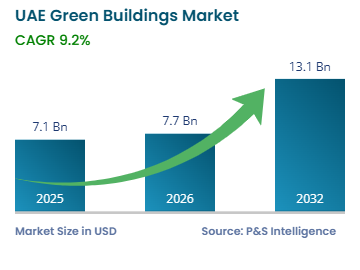
The UAE green buildings market size will be an estimated USD 7.1 billion for 2025, and it will grow by 9.2% during 2026–2032, to reach USD 13.1 billion by 2032.
The market growth is primarily driven by stringent government regulations, ambitious sustainability targets, and increasing awareness of environmental responsibility across the construction sector.
Government investment in renewable energy provides strong momentum for the green buildings sector. Additionally, the Central Bank of THE UAE announced a commitment of AED 1 trillion in sustainable finance by 2030 to support energy-efficient building projects, retrofitting existing infrastructure, and integrating renewable energy systems. Private‑sector commitments for operational carbon and embodied emissions reductions are becoming mainstream. Green buildings in the UAE are proven to reduce energy consumption by 25–30%, water use by around 11% and greenhouse gas emissions by approximately 34%.
UAE Green Buildings Market Emerging Trends
Technological Advancements in Construction Are Key Trends
The integration of advanced technologies represents a key trend reshaping the UAE green buildings landscape.
The UAE is at the forefront of construction technology, leveraging innovations like drones, robotics, Building Information Modeling, artificial intelligence, and Internet of Things to transform the industry.
These technologies enable smart building systems that improve energy efficiency and occupant comfort while streamlining labor-intensive tasks, reducing costs, and improving safety.
Building Information Modeling has become increasingly mandated across major construction projects in the UAE, with government initiatives promoting adoption to enhance efficiency, collaboration, and project outcomes.
The technology enables energy analysis, lifecycle assessment, and efficient building operations management, supporting sustainable construction practices throughout the building lifecycle.
Iconic projects like the Museum of the Future and Expo 2020 Dubai exemplify how construction technology enhances precision, reduces costs, and minimizes environmental impact.
Smart building technologies monitor construction site conditions in real-time through IoT sensors, while AI algorithms optimize project scheduling and resource allocation.
This technological momentum was showcased at CTF THE UAE 2025, a premier event for construction innovation, further solidifying the UAE 's position as a global hub for green building and technological advancement.
Mandatory Green Building Standards and Net Zero Initiatives Are Biggest Drivers
Government initiatives and mandatory sustainability frameworks, along with Net Zero initiatives, are the primary drivers accelerating green building adoption across the UAE .
Since January 2025, Abu Dhabi City Municipality has been advancing the Sustainable Green Building Concept through this system, with 304 design-phase and 81 construction-phase projects meeting these standards in early 2025 alone.
Dubai Municipality implemented the Green Building Regulations and Specifications for all new buildings starting March 2014, later rebranded as Al Sa'fat - the Green Building Evaluation System in 2017.
By the second quarter of 2023, Dubai Municipality statistics showed that 72,000 buildings in Dubai complied with Green Building Specifications, accounting for 57% of all buildings in the emirate.
The regulations have led to a reduction in carbon dioxide emissions of 1.4 million tonnes, saving an estimated AED 4.5 billion on energy costs.
The UAE 's Net Zero 2050 Strategy encompasses over 25 programs across key sectors, including buildings, power, industry, transport, waste, and agriculture, focusing on enhancing efficiency, expanding renewable energy use, and implementing green building practices.
This comprehensive approach is expected to create approximately 200,000 job opportunities while contributing around 3% to national GDP.
The transition toward net-zero buildings is supported by innovative financing mechanisms, including green bonds and sustainability-linked loans, which provide incentives for LEED-certified projects.
In 2023, MENA issued USD 24 billion in green and sustainability-linked bonds, a 155% increase from 2022, with the UAE and Saudi Arabia leading the market.
UAE Green Buildings Market Segmentation Analysis
Application Analysis
The roofing category holds the largest market share in 2025 of 25%. This lead stems from the critical role of roofing in thermal insulation and energy efficiency in the UAE 's extreme climate conditions. Dubai's stringent regulations mandate high-performance roofing systems that minimize heat absorption and reduce cooling requirements. Green roofing solutions use cool roof technologies, solar-reflective materials, and integrated photovoltaic systems to lower building temperatures while producing renewable energy.
The insulation category will have the highest CAGR during the forecast period, driven by increased awareness of thermal insulation's role in reducing energy consumption by up to 50% in Middle Eastern green buildings. Enhanced building envelope designs incorporating advanced insulation materials like sheep's wool, recycled steel, and sustainable wood alternatives are becoming standard practice as developers seek to exceed minimum regulatory requirements and achieve higher sustainability certifications.
The applications analyzed in this report are:
Insulation (Fastest-Growing Category)
Roofing (Largest Category)
Framing
Interior Finishing
Exterior Siding
Others
Material Type Analysis
The sustainable wood category holds the largest market share, of 30%, in 2025, reflecting its versatility, availability, and alignment with both traditional architectural aesthetics and modern sustainability requirements. Sustainable wood sourced from certified forests provides excellent thermal properties while reducing embodied carbon compared to conventional construction materials. The material's adaptability across multiple applications, including framing, interior finishing, and exterior siding, makes it the preferred choice for developers seeking to balance sustainability with construction efficiency. Major developments like Dubai Creek Harbour incorporate sustainable wood extensively in residential clusters, combining energy-efficient design with aesthetic appeal and environmental responsibility.
The recycled steel category will have the highest CAGR, of 9.3%, driven by the construction industry's transition toward circular economy principles. THE UAE 's Circular Economy Policy 2021–2031 prioritizes green infrastructure, emphasizing renovation, better material use, and recycling targets. The rising demand is also supported by the material’s lower embodied carbon and durability, making it an attractive choice for developers aiming to meet sustainability certifications and reduce the environmental footprint of buildings.
The material types analyzed in this report are:
Bamboo
Sustainable Wood (Largest Category)
Cob
Recycled Steel (Fastest-Growing Category)
Sheep's Wool
Straw Bale
Others
End User Analysis
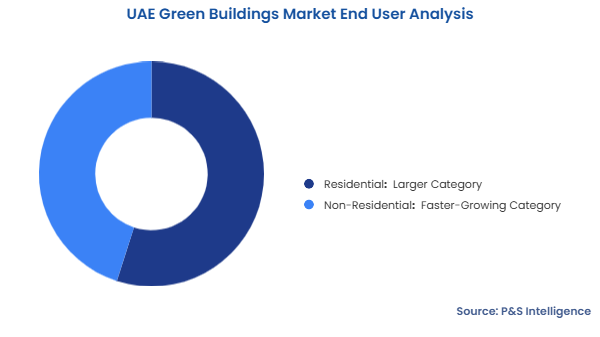
The residential category holds the larger market share, of 55%, in 2025, driven by increasing urbanization, population growth projected at 2–3% annually, and rising demand for sustainable living spaces that offer reduced operational costs and improved quality of life. Major developers, including Emaar, Aldar, and LEAD Development, now systematically incorporate sustainability into residential portfolios, with LEED and Estidama certifications becoming market baseline rather than premium differentiation.
The non-residential category will have the higher CAGR, of 9.5%, driven by the UAE 's strategic positioning as a global business hub and the resulting demand for modern office spaces, retail outlets, and mixed-use developments. This growth is further supported by the adoption of energy-efficient designs, smart building technologies, and green certifications that enhance operational efficiency and reduce long-term costs for commercial properties.
The end users analyzed in this report are:
Residential (Larger Category)
Non-Residential (Faster-Growing Category)
Drive strategic growth with comprehensive market analysis
UAE Green Buildings Market Geographical Analysis
Abu Dhabi Green Buildings Market Size
Abu Dhabi holds the largest market share, of 45%, in 2025, establishing itself as the market leader through comprehensive sustainability frameworks and aggressive implementation of green building mandates. The system assesses buildings on four sustainability pillars, environmental, economic, social, and cultural, with all new buildings required to attain at least One Pearl certification, while government buildings must achieve a minimum of Two Pearls.
Abu Dhabi's strategic vision aligns with global sustainability goals through initiatives like the Abu Dhabi Climate Change Strategy, which targets a 22% reduction in carbon emissions by 2027. The Environment Vision 2030 identifies five priority areas, including climate change minimization, sustainable use of resources, and biodiversity conservation, providing comprehensive direction for green infrastructure development. The Emirates Water and Electricity Company meets 80% of total power demand through renewable and clean energy from solar and nuclear energy plants, providing the infrastructure foundation necessary to support green building growth.
Dubai Green Buildings Market Size
Dubai will have the highest CAGR, of 9.4%, driven by its status as a global business and tourism hub, combined with ambitious sustainability targets, making Dubai the world's most-sustainable city by 2050 through the Dubai Clean Energy Strategy.
The Dubai 2040 Urban Master Plan emphasizes smart city technologies, green building practices, and infrastructure resilience, driving long-term investment opportunities. Reforms permitting 100% foreign ownership of subsidiaries, along with extended investor visas, have attracted new foreign capital to finance green building projects.
Major sustainable developments, including Dubai Sustainable City, Dubai Creek Harbour, and Expo 2020 Dubai projects, demonstrate the integration of green building principles with architectural innovation and commercial viability. With over 2,500 LEED professionals operating in the UAE, primarily concentrated in Dubai, the emirate possesses the expertise necessary to drive large-scale sustainable transformation across the construction sector.
The emirates of the market are as follows:
Abu Dhabi (Largest Emirate)
Dubai (Fastest-Growing Emirate)
Sharjah
Ajman
Ras Al Khaimah
Fujairah
Umm Al Quwain
UAE Green Buildings Market Share
The market is fragmented due to the coexistence of large international firms and smaller regional specialists across different segments. International construction firms, including China State Construction Engineering Corp., maintain a significant market presence alongside regional specialists, which shows that local players actively participate in the market alongside global giants. Furthermore, the diversity of services across the value chain reinforces fragmentation, as specialized consultancies and regional contractors handle areas such as certification, sustainable material supply, and energy-efficient installations.
Key UAE Green Buildings Companies:
Masdar
Dubai Electricity & Water Authority
Etihad Energy Services Company
Bee
Aldar Properties
Emaar Properties
Majid Al Futtaim
Diamond Developers
Arup
AECOM
Multiplex
Al Naboodah Construction Group
UAE Green Buildings Market News
In March 2025, the UAE advanced Green Building Initiatives with new sustainability standards, with progressive policies accelerating the adoption of green building practices. The country's 2030 sustainability goals and 2050 Net Zero commitments provide a clear framework for developers to align with international best practices and meet regulatory requirements.
In February 2025, the Ministry of Economy launched a three-month green intellectual property roadmap aimed at boosting innovation, technology localization, and new projects in environmental sustainability and circular economy, aiming to enhance the UAE 's IP competitiveness and align with national directives to transition to a circular economy, supporting sustainable development and advancing green technologies.
In May 2024, Shamal Holding announced its first residential project, Dubai Harbour Residences, featuring apartments and penthouses with generous layouts, high ceilings, and large terraces designed for year-round enjoyment, incorporating sustainable design principles throughout.
Want a report tailored exactly to your business need?
Leading companies across industries trust us to deliver data-driven insights and innovative solutions for their most critical decisions. From data-driven strategies to actionable insights, we empower the decision-makers who shape industries and define the future. From Fortune 500 companies to innovative startups, we are proud to partner with organisations that drive progress in their industries.
Client Testimonials
Working with P&S Intelligence and their team was an absolute pleasure – their awareness of timelines and commitment to value greatly contributed to our project's success. Eagerly anticipating future collaborations.
McKinsey & Company
India
Unmatched Standards
Our insights into the minutest levels of the markets, including the latest trends and competitive landscape, give you all the answers you need to take your business to new heights
Complete Data Security
We take a cautious approach to protecting your personal and confidential information. Trust is the strongest bond that connects us and our clients, and trust we build by complying with all international and domestic data protection and privacy laws