U.S. Loan Administration, Check Cashing & Other Services Market Size & Share Analysis - Emerging Trends, Growth Opportunities, Competitive Landscape, and Forecasts (2025 - 2032)
This Report Provides In-Depth Analysis of the U.S. Loan Administration, Check Cashing & Other Services Market Report Prepared by P&S Intelligence, Segmented by Type (Loan Administration, Check Cashing Services, Other Financial Services), Service Provider (Traditional Financial Institutions, Alternative Financial Service Providers (AFSPs), Fintech & Digital Platforms, Retail & Third-Party Financial Service Providers), End User (Individual Consumers, Businesses & Institutions), and Geographical Outlook for the Period of 2019 to 2032
U.S. Loan Administration, Check Cashing & Other Services Market Size Forecast
Key Highlights
Study Period
2019 - 2032
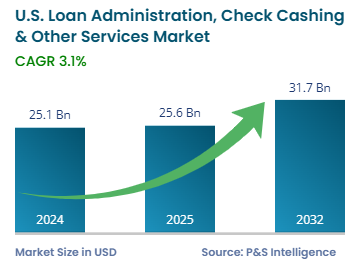
Market Size in 2024
USD 25.1 Billion
Market Size in 2025
USD 25.6 Billion
Market Size by 2032
USD 31.7 Billion
Projected CAGR
3.1%
Largest Region
South
Fastest Growing Region
West
Market Structure
Fragmented
Market Size
Major Companies
Important Takeaways
Market Size and Forecast
Industry Trend
Regulatory Landscape
Demand Trend Analysis
Companies Recent Strategical Developments
Key Stakeholders
Voice of Industry Experts/KOLs
Future Opportunity
Explore the market potential with our data-driven report
U.S. Loan Administration, Check Cashing & Other Services Market Overview
The size of the U.S. loan administration, check cashing, & other services market in 2024 was USD 25.1 billion, and it will reach USD 31.7 billion by 2032 at a CAGR of 3.1% during 2025–2032. The market is growing due to the increasing use of digital finance platforms, the expanding gig economy, and increasing demand for these solutions in service sectors. The rising investment of the government and private sector in financial inclusion has broadened the scope for service providers.
Technical advancements and new regulations drive the demand for financial solutions that are adaptable and effortless for users. The enhanced efficiency of digital platforms makes loan management easy and provides check-cashing and money transfer services on an immediate basis.
Other significant market drivers include the large population underserved by banking services, fluctuating interest rates, volatility of income and employment rates, high demand for alternative credit solutions and short-term liquidity, rampant urbanization, and changing demographics.
U.S. Loan Administration, Check Cashing & Other Services Market Dynamics
Evolution of Customer Demands Is Major Trend in Market
The key trend in the market is the changes in consumers’ demand, reflected in the increase in the volume of mobile deposits, decline in check cashing, rise in the popularity of alternative credit scoring approaches, and surge in the demand for services that are tailored to specific cultures, including being available in more than one language.
As per reports, over 60% of the bank account holders in the country use their bank’s mobile app for check depositing and other services.
Loan providers in the country are using credit scoring models that look at a lot more than just an applicant’s credit report, including financial transactions and digital footprint.
This enables these agencies to better judge someone’s worthiness for a loan. As per estimates, more than 19 million adults in the country could be assessed for loan eligibility using alternative scoring models.
The U.S. Census Bureau says that nearly 80 million people in the U.S. have English as their second language.
This has been driving the demand for bilingual banking services, encouraging the BFSI sector to also offer ethnically oriented solutions.
Uncertain Economic Conditions Are Biggest Market Drivers
The key driver for the market is the uncertain economic conditions, such as fluctuating interest rates and volatility in employees’ income, apart from the need for liquidity in the short term, urbanization, and changing demographics.
In 2020, mortgage rates for a fixed 30-year period had dropped to a historic low of 2.7%, but in 2025, they have reached 5.6%.
The Federal Reserve has had to increase its federal funds rate to a 23-year high, in order to combat inflation.
These factors have made home, credit, auto, credit card, and commercial loans costlier.
As per the National Realtors Association, the fewest owned homes in the U.S. were sold in March 2025 since the economic recession of 2009 due to the high mortgage rates.
This reduction came in spite of a 20% increase in inventory compared to March 2024.
This economic uncertainty drives the demand for alternative banking services in the U.S., such as non-bank check cashing.
This is also resulting in a rising demand for short-term credit solutions, with the Consumer Financial Protection Bureau saying that over 20% of the people in the country use buy now, pay later options for pay-in-4 schemes.
U.S. Loan Administration, Check Cashing & Other Services Market Segmentation Analysis
Insights by type
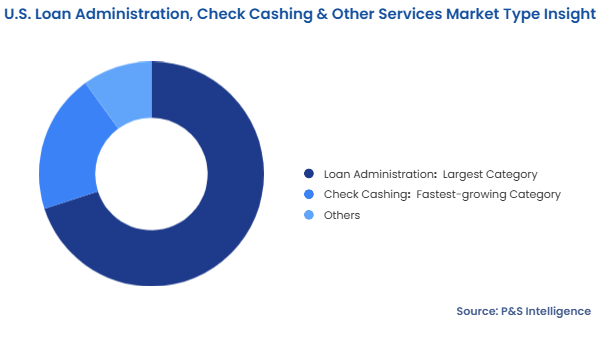
Loan administration services lead the market with a share of 70%. This is because of the stringent compliance requirements when buying homes, the complexity of the whole process, and high loan and mortgage rates. Fintech firms are improving service delivery through AI-powered customer support, automated collections, and predictive analytics. In 2023, Fiserv invested over USD 600 million to digital servicing platforms, operations, and customer engagement.
The types analyzed here are:
Loan Administration (Largest Category)
Mortgage
Auto loan
Student loan
Personal loan
Business loan
Debt collection & recovery
Check Cashing (Fastest-growing Category)
Payroll check cashing
Government check cashing
Personal check cashing
Money order cashing
Others
Money transfer & remittance
Bill payment
Credit repair & financial counseling
Payday & installment loans
Pawn shop loans & title lending
Notary & tax preparation
Insights by Service Provider
Traditional financial institutions hold the major market share, of 60%. Banks, credit unions, mortgage lenders, and investment firms possess advanced platforms and an extensive North American customer base. Moreover, they operate extensive branch networks, with comprehensive product offers for diverse loans. Their usage of advanced technologies and knowledge of regulatory requirements make them popular among customers.
The service providers analyzed here are:
Traditional Financial Institutions (Leading Category)
Banks
Credit unions
Mortgage lenders
Investment firms
Alternative Financial Service Providers (AFSPs)
Payday lenders
Pawn shops
Title loan companies
Check cashing stores
Fintech & Digital Platforms (Fastest-growing Category)
Online loan servicers
Digital lending platforms
Mobile banking & payment apps
Peer-to-peer (P2P) lending platforms
Retail & Third-Party Financial Service Providers
Supermarkets & convenience stores
Retail chains with financial service kiosks
Money transfer operators (Western Union, MoneyGram)
Insights by End User
The market is led by banked individuals with a share of 35%. Financial institutions provide banked individuals with several loan options, such as mortgages, auto loans, and personal loans, because of their existing member relationships. People with traditional banking access gain easy and fast access to loans, favorable interest rates, and customized assistance.
Drive strategic growth with comprehensive market analysis
U.S. Loan Administration, Check Cashing & Other Services Market Regional Outlook
The Southern region had the largest share, of 40%, because of its large population, a lot of which is underbaked or unbanked. A large number of payday lending services operate in regional states because of their weak regulations. The financial environment in Texas poses risks of potential predatory lending activities and other financial challenges, which increases the need for loan administration, check cashing and other services.
The regions analyzed here are:
Northeast
Midwest
West (Fastest-Growing Region)
South (Largest Region)
U.S. Loan Administration, Check Cashing & Other Services Market Share
The market is fragmented because it includes many small-to-medium-sized enterprises and established financial institutions. The biggest reason for the fragmented market is the presence of both traditional and alternative financial institutions that provide loans and other services. Moreover, a huge number of local businesses and community providers cater to consumers in their respective geographical territories, thus effectively competing with the financial industry stalwarts.
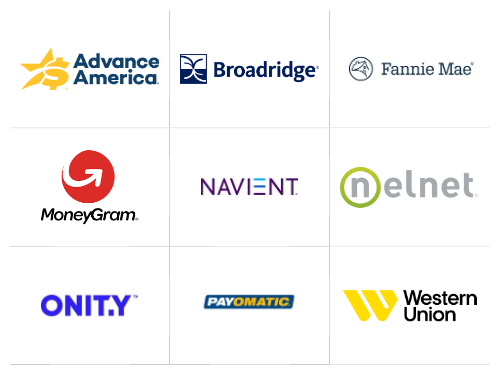
Key U.S. Loan Administration, Check Cashing & Other Services Companies:
Federal National Mortgage Association
Navient Corporation
Nelnet, Inc.
Onity Group
Broadridge Financial Solutions, Inc.
PAYOMATIC
The Western Union Company
MoneyGram International, Inc.
Advance America, Cash Advance Centers, Inc.
U.S. Loan Administration, Check Cashing & Other Services Market News
In May 2024, Navient Corporation transferred its student loan service operations to MOHELA. A total of 899 Navient workers were expected to join MOHELA as the organization planned to execute the borrower transition from October 2024 onward.
In February 2025, Gallant Capital Partners acquired the government services business of Navient Corporation.
Want a report tailored exactly to your business need?
Leading companies across industries trust us to deliver data-driven insights and innovative solutions for their most critical decisions. From data-driven strategies to actionable insights, we empower the decision-makers who shape industries and define the future. From Fortune 500 companies to innovative startups, we are proud to partner with organisations that drive progress in their industries.
Client Testimonials
Working with P&S Intelligence and their team was an absolute pleasure – their awareness of timelines and commitment to value greatly contributed to our project's success. Eagerly anticipating future collaborations.
McKinsey & Company
India
Unmatched Standards
Our insights into the minutest levels of the markets, including the latest trends and competitive landscape, give you all the answers you need to take your business to new heights
Complete Data Security
We take a cautious approach to protecting your personal and confidential information. Trust is the strongest bond that connects us and our clients, and trust we build by complying with all international and domestic data protection and privacy laws