U.S. Computer Peripheral Market Size & Share Analysis - Emerging Trends, Growth Opportunities, Competitive Landscape, and Forecasts (2025 - 2032)
This Report Provides In-Depth Analysis of the U.S. Computer Peripheral Market Report Prepared by P&S Intelligence, Segmented by Product Type (Input Devices, Output Devices, Storage Devices, Networking Devices, Gaming Peripherals), Connectivity (Wired, Wireless), Distribution Channel (Online, Offline), Price Range (Low Range, Mid-Range, Premium Range), End User (Individual/Residential, IT & Telecom, BFSI, Healthcare, Education, Retail, Government), and Geographical Outlook for the Period of 2019 to 2032
Explore the market potential with our data-driven report
U.S. Computer Peripheral Market Future Outlook
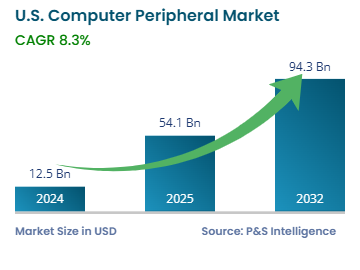
The value of the U.S. computer peripheral market is calculated to be approximately USD 12.5 billion in 2024. It is estimated to grow at a CAGR of 8.3% from 2025 to 2032, reaching USD 94.3 billion by 2032.
The growth results from the increasing demand for advanced computing devices from various industries. The advent of remote and hybrid work models has increased the use of computer peripherals such as Keyboards, webcams, and monitors, as workers require good equipment to improve productivity and maintain seamless communication. Additionally, the growing education sector and the rising popularity of online learning platforms, especially after COVID-19, increased demand for these devices.
As per the Census Bureau, the population of the U.S. continues to grow and is currently 333 million. Moreover, over 80% of the households in the country have a PC or laptop, and 50% of adults aged 20–64 use computers for personal tasks at least one hour daily. The Bureau of Labor Statistics says that the number of employed people in the country grew from 273,385,000 in May 2025 to 273,585,000 in June 2025. Additionally, up to 80% use a PC at work, as per the National Telecommunications and Information Administration. More than 80% of adults and parents believe computer skills are crucial for future success.
Technological innovations including wireless connectivity, ergonomic designs, and AI-based peripherals improve functionality and drive market innovation. The expanding availability of peripherals on online retail platforms increases product accessibility and adds to the overall market growth. Rising demand for external storage with growing data volumes will also propel market growth.
U.S. Computer Peripheral Market Trends & Drivers
Wireless Peripherals Are Biggest Trend
The increasing use of remote working and flexible workspaces is driving the adoption of wireless peripherals like keyboards, mice, printers, and headsets.
It allows users to create a portable and clutter-free workstation.
Bluetooth and Wi-Fi-enabled devices provide high-speed data transfer, seamless connectivity, and a multi-device connection.
This drives the demand for them, especially among professionals and gamers who are looking for more convenient and advanced solutions.
Even more focus on ergonomic wireless peripherals that have abilities like programmable knobs, noise suppression, and adjustable style to meet the rising demand for health awareness and comfort by users.
Constant technological developments of wireless peripherals are providing a longer battery life, wireless charging, low latency performance, and improved data encryption technologies to elevate security and allow perfection in the user experience.
A significant portion of the workforce now favors wireless mice, keyboards, and headsets for their portability and reduced cable clutter.
Over 60% of PC users in the U.S. reportedly use at least one wireless peripheral, with the trend especially prominent among professionals and students.
This shift is also fueled by a growing preference for minimalist and ergonomic workspaces across both home and office environments.
Increasing Remote and Hybrid Work Culture is a Growth Driver
Rapidly increasing adoption of remote and hybrid work models in sectors like IT, BFSI, and education are fueling up the need for wireless peripherals with which fast and convenient workspaces can be set up at home.
This includes the increasing demand for tools like video conference webcams, wireless headsets, and microphones to enable teams to conduct meetings and collaborate effectively.
Preference for portable and compact wireless devices such as keyboards, mice, and printers allow employees to work from various places without disturbing productivity.
Increasing corporate investments in home office equipment reimbursement programs are motivating employees to purchase efficient wireless peripherals to better set up their work-from-home offices.
As millions of professionals transitioned to home-based or flexible work setups, there has been a sharp increase in the need for ergonomic, high-performance accessories such as wireless keyboards, mice, webcams, headsets, and docking stations.
As per studies, well over 40% of employed Americans report some degree of remote work, with almost 20% working from home daily.
Studies show that over 30% of U.S. workers now operate in hybrid roles, prompting employers and individuals to invest in technology that supports productivity outside traditional office environments.
This shift has led to sustained demand for versatile, wireless, and compact peripherals designed to enhance workflow, comfort, and connectivity in home workspaces.
U.S. Computer Peripheral Market Segmentation and Category Analysis
Product Type Insights
Input devices are the largest category with 40% share in 2024. This is because input devices such as mice, keyboards, and webcams are basic accessories of any computer, whether it is personal, professional, or for gaming. For every computer user, it is almost mandatory to possess at least a keyboard and a mouse for his computer, making those the most widely adopted peripherals across all sectors. In addition, the high demand for webcams on account of remote work and virtual meetings further adds to the strength of this segment.
Gaming peripherals have the highest CAGR in the market, of 9.1%. There is a rise in the number of gaming enthusiasts and gaming tournaments, which require high-tech gaming keyboards, mice, headsets, and many more gaming equipment. As per the Entertainment Software Association, over 190 million people in the U.S. between the ages of 5 and 90 play video games.
Product types studied in the report:
Input Devices (Largest Category)
Keyboards
Mice
Webcams
Scanners
Output Devices
Printers
Monitors
Speakers
Storage Devices
External Hard Drives
USB Flash Drives
Memory Cards
Networking Devices
Routers
Modems
Network Adapters
Gaming Peripherals (Fastest-Growing Category)
Gaming Keyboards
Gaming Mice
Game Controllers
VR Headsets
Connectivity Analyses
Wireless is the faster-growing category, with a CAGR of 9.8% during the forecast period. The success of Bluetooth and Wi-Fi wireless technologies has elevated the dependability and performance level of wireless devices, thus allowing a wider audience to appreciate them. The increasing adoption of remote and hybrid working styles has fueled further demand for wireless peripherals because of their added flexibility and convenience. The increasing popularity of gaming and streaming also serves to further boost demand for wireless gaming accessories, growing this segment at a fast pace.
Connectivity studied in the report:
Wired (Largest Category)
Wireless (Fastest-Growing Category)
Distribution Channel Insights
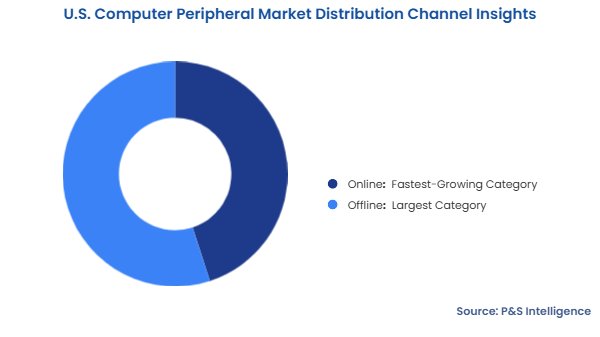
The offline category is dominant with a market share of 55%. U.S. consumers prefer buying computer peripherals offline due to immediate availability, hands-on testing, and personalized assistance. Physical stores allow users to assess comfort and compatibility—especially for items like keyboards, mice, and headsets. In-person shopping also offers convenience in returns, clearer promotional bundles, and trust in established retailers like Best Buy. For time-sensitive purchases or those requiring technical guidance, brick-and-mortar stores provide a more reassuring experience. While online sales are growing, the tactile nature of peripherals and the value of direct support keep offline channels popular, especially among older buyers and those seeking quick, reliable solutions.
The online category is expected to witness the higher CAGR, of 9.2%, during the forecast period, driven by convenience, broader product selection, and competitive pricing. Consumers increasingly prefer online platforms for their ability to compare models, read user reviews, and access exclusive discounts. Fast shipping and flexible return policies offered by major retailers like Amazon, Walmart, and Newegg enhance buyer confidence. The growth of hybrid work and digital learning has further fueled online demand for peripherals such as webcams, headsets, and wireless keyboards. Younger, tech-savvy consumers especially favor e-commerce for its ease, while subscription models and seasonal sales boost recurring online purchases.
Distribution Channels analyzed in the report:
Online (Fastest-Growing Category)
Offline (Largest Category)
Price Range Insights
The mid-range category is both the largest and fastest-growing, with a share of 45% in 2024, and it is expected to grow at a CAGR of 9.3% during the forecast period. The mid-range segment is the largest and fastest-growing in the consumer market for computer peripherals in the United States because of its increasing use by professionals, students, and casual users, all of whom want reasonably-priced devices that offer features such as wireless connectivity, ergonomic designs, and durability. This is further accentuated by the general trend toward working from home and hybrid work models. The increase in online educational platforms further boosts this demand. As manufacturers offer many features for a moderate price, they will maintain their dominance to fulfill both utility and budget-conscious buyers.
Price ranges analyzed:
Low
Mid (Largest and Fastest-Growing Category)
Premium
End User Analyses
The IT & telecom category is the largest with a share of 30% in 2024. The vast majority of consumables used in organizations during daily operations, scanners, and external storage provide the chief attraction for this segment. These peripheral goods will continue to witness an increase in their market demand due to the continual rise experienced by service demands in these sectors.
Healthcare is the fastest-growing category with a CAGR of 9.5%, due to the rising demand for computer peripherals in hospitals, clinics, and telehealth environments. As electronic health records (EHRs) are nearly universal in acute care hospitals, hygienic, durable keyboards and mice—often antimicrobial and waterproof—are essential. As per studies, over 90% of the hospitals in the country use EHRs.
Approximately 38% of medical keyboards in North America are wireless, reflecting the need for mobility at point-of-care stations. On average, U.S. hospitals deploy around 120 keyboards and 80 mice per 1,000 beds. Additionally, about 80% of healthcare professionals prefer wireless devices for comfort and productivity. As telemedicine and remote patient monitoring expand, demand grows for ergonomic, high-performance peripherals that support virtual consultations and home health setups.
End users studied in the report:
Individual/Residential
IT & Telecom (Largest Category)
BFSI
Healthcare (Fastest-Growing Category)
Education
Retail
Government
Drive strategic growth with comprehensive market analysis
U.S. Computer Peripheral Market Geographical Analysis
West is the dominant region in this category in 2024. This is because of its notable technology sector, which includes the Silicon Valley technological nerve center. The concentration of tech companies, the rise of start-ups, and technological affluents provide enormous demand for computer peripherals. The presence of big corporations and an early adopter culture ensure that the West assumes pole position in the computer peripheral market.
The South has the highest CAGR in the market, of 9.8%. The southern U.S. states are witnessing growing demand for computer peripherals driven by expanding businesses, educational institutions, and remote work adoption. Texas, Florida, and Georgia have seen significant investments in tech infrastructure, boosting sales of keyboards, mice, webcams, and monitors. The rise of hybrid work models and virtual learning in the region increases the need for reliable, ergonomic peripherals to support home offices and classrooms. Competitive pricing and expanding retail networks also make peripherals more accessible to consumers in these states.
Regions covered in the report:
Northeast
Midwest
West (Largest Region)
South (Fastest-Growing Region)
U.S. Computer Peripheral Market Competitive Landscape
The market is fragmented because the scope includes a huge variety of devices, not all of which are provided by all companies.
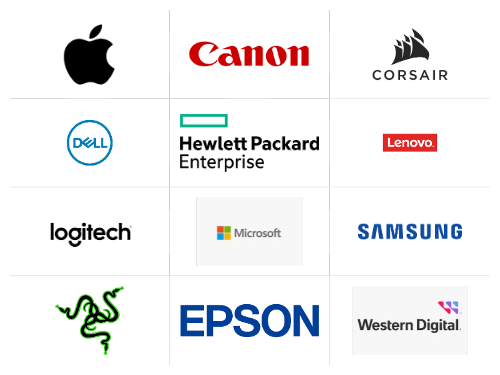
Some of the major companies in the market include Apple, Dell, Logitech, HP, and Canon, each with a strong foothold in competing product segments, thus keeping a single company off the entire market.
Presence of specialist companies like Razer Inc. and Corsair Gaming, Inc. targeting gaming peripherals, while others, such as Canon and Epson, provide printing solutions; thus, exposing the very nature of market diversity.
Continuous technological advancement and new product ideas provide a stimulus for entry into a market by new players offering niche products that further intensify competition.
Key U.S. Computer Peripheral Companies:
Apple, Inc.
Canon Inc.
Dell, Inc.
Seiko Epson Corporation
Hewlett-Packard Enterprise
Logitech International S.A.
Microsoft Corporation
Samsung Electronics Co., Ltd.
Lenovo Group Limited
Razer Inc.
Western Digital Corporation
Corsair Gaming, Inc.
U.S. Computer Peripheral Market News & Updates
In May 2025, Seiko Epson Corporation launched three new models of its inkjet printheads compatible with UV inks for industrial and commercial applications: S3200-U1-2, S3200-U3-2, and D3000-U1R.
In February 2025, Logitech International S.A. introduced the Powerplay 2 mouse pad, an update to its original 2017 version.
In February 2025, Plugable Technologies released a 10-port USB-C hub designed to prioritize power delivery without data transfer support, catering to users needing multiple charging options.
In February 2025, Apple Inc. announced plans to invest USD 500 billion to boost manufacturing capabilities, teams, and other facilities in the U.S., including plans for a new factory in Texas.
In January 2025, Dell Inc. introduced three new brands for its AI PCs: Play, Pro, and Pro Max.
In September 2024, HP Inc. launched HP Print AI, a new software program for its printers.
Want a report tailored exactly to your business need?
Leading companies across industries trust us to deliver data-driven insights and innovative solutions for their most critical decisions. From data-driven strategies to actionable insights, we empower the decision-makers who shape industries and define the future. From Fortune 500 companies to innovative startups, we are proud to partner with organisations that drive progress in their industries.
Client Testimonials
Working with P&S Intelligence and their team was an absolute pleasure – their awareness of timelines and commitment to value greatly contributed to our project's success. Eagerly anticipating future collaborations.
McKinsey & Company
India
Unmatched Standards
Our insights into the minutest levels of the markets, including the latest trends and competitive landscape, give you all the answers you need to take your business to new heights
Complete Data Security
We take a cautious approach to protecting your personal and confidential information. Trust is the strongest bond that connects us and our clients, and trust we build by complying with all international and domestic data protection and privacy laws