Truck as a Service Market Size & Share Analysis - Emerging Trends, Growth Opportunities, Competitive Landscape, and Forecasts (2026 - 2032)
This Report Provides In-Depth Analysis of the Truck as a Service Market Report Prepared by P&S Intelligence, Segmented by Service Type (Vehicle Subscription & Pay-Per-Use, Freight Capacity-as-a-Service, Fleet Management, Telematics & Connectivity, Maintenance & Repair Services, Digital Freight Brokerage), Truck Type (Heavy-Duty Trucks, Medium-Duty Trucks, Light-Duty Trucks, Tractor), Propulsion (ICE, Hybrid Electric, Battery Electric, Fuel Cell Electric), Industry (Logistics & Transportation, Manufacturing & Industrial, E-commerce & Retail, Construction & Mining, Pharmaceuticals & Healthcare, Food & Beverage), and Geographical Outlook for the Period of 2021 to 2032
Explore the market potential with our data-driven report
Truck as a Service Market Key Insights
The vehicle subscription and pay-per-use category has the largest share, of 35%.
Medium-duty trucks are the fastest-growing category, at a CAGR of approximately 21.6%.
ICE trucks accounted for the largest share, of 45%, in 2025.
North America holds the largest share, of 40%.
Asia-Pacific is the fastest-growing region, registering a CAGR of approximately 21.9%.
Truck as a Service Market Overview
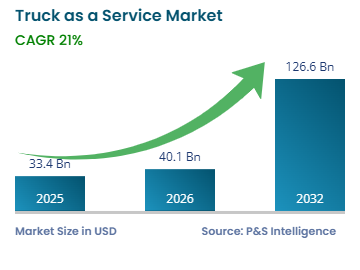
The global truck-as-a-service (TaaS) market stood at USD 33.4 billion in 2025 and is projected to reach USD 126.6 billion by 2032, expanding at a compound annual growth rate of 21.0% over 2026–2032.
Fleet digitization and the accelerating shift toward asset-light logistics models are reshaping the structural economics of freight capacity. TaaS platforms bundle vehicle access, fleet management software, predictive maintenance, telematics, and compliance management into unified subscription or pay-per-use contracts, restructuring the traditional truck ownership model at its foundation. Logistics operators, manufacturers, e-commerce fulfillment companies, and industrial enterprises are deploying flexible freight capacity without the capital burden of outright fleet ownership.
Regulatory decarbonization pressure is adding a distinct and compulsory dimension to this structural shift. Global electric truck sales stood at 135,632 units in 2023 and are projected to reach 1,074,084 units by 2030. According to the International Energy Agency (IEA), 40 countries have signed the Global Memorandum of Understanding on Zero-Emission Medium- and Heavy-Duty Vehicles. This regulatory and technological momentum is compelling fleet operators globally to adopt TaaS models as an operationally and financially efficient pathway to fleet decarbonization.
Truck as a Service Market Trends and Drivers
Subscription-Based Fleet Models Are Major Trends in Market
Fleet owners are transitioning from outright truck ownership to subscription and pay-per-use service models as a route to more economical access to commercial vehicles. Traditionally, logistics operators, manufacturers, and retailers committed significant capital to purchase and maintain proprietary truck fleets, locking that capital into depreciating assets while bearing the full burden of maintenance, insurance, compliance management, and driver coordination. TaaS platforms are dismantling this model by bundling vehicle access, telematics, predictive maintenance, and fleet management software into unified monthly or usage-based contracts. Fleet operators are recognizing that service-based models allow them to scale capacity dynamically in response to demand fluctuations, and this recognition is accelerating the structural transition away from ownership.
Volatile freight markets add further urgency to this shift. Seasonal surges, e-commerce growth cycles, and supply chain disruptions create freight demand patterns that owned fleets cannot efficiently absorb. The high upfront cost of battery-electric trucks, combined with the complexity of charging infrastructure management, makes ownership prohibitive for many mid-sized operators. These economics create strong incentives to access electric capacity through subscriptions rather than outright purchase, and TaaS providers are positioned to meet this demand by amortizing acquisition and infrastructure costs across larger subscriber bases. As OEMs including AB Volvo, Daimler Truck AG, and Einride AB expand their direct TaaS offerings, the shift from transactional vehicle sales to recurring service revenue models will hasten.
E-Commerce Expansion and Asset-Light Logistics Strategies Drive Market
The sustained global expansion of e-commerce is generating demand for flexible, scalable trucking capacity that traditional fleet ownership cannot efficiently provide. Logistics operators face persistent pressure to expand delivery capacity rapidly during peak periods while avoiding the fixed cost burden of underutilized owned fleets during slower cycles. UN Trade and Development (UNCTAD) reports that business-to-business e-commerce sales grew nearly 60% between 2016 and 2022, reaching USD 27 trillion. This scale of digital commerce growth is reshaping freight and last-mile delivery demand across every major geography.
Logistics companies, retailers, and third-party providers are responding by adopting asset-light strategies centered on TaaS platforms that deliver on-demand truck access without fleet ownership obligations. Growing e-commerce order volumes are increasing delivery frequency requirements, and flexible freight capacity is the operationally efficient answer to that pressure — one TaaS is specifically engineered to provide. Across emerging markets, where traditional logistics infrastructure is being built around digital-first models from the outset, e-commerce penetration is deepening in ways that structurally favor service-based freight over owned-fleet models.
Emission Mandates and Sustainability Regulations Offer Opportunities
Tightening regulatory frameworks governing commercial vehicle emissions are creating direct, compliance-driven demand for TaaS models, particularly those offering electric and hybrid truck access. In the European Union, the heavy-duty vehicle sector accounts for over 25% of road transport greenhouse gas emissions. The revised CO₂ standards for heavy-duty vehicles mandate a 45% emissions reduction from new trucks by 2030, a 65% reduction by 2035, and a 90% reduction by 2040. Regulation (EU) 2024/1610 expanded the scope of these standards to cover nearly all new heavy-duty vehicles, including smaller trucks, buses, coaches, and trailers, widening the compliance obligations that fleet operators must now meet.
Fleet operators unable to absorb the high purchase price of electric trucks are increasingly turning to TaaS providers who bundle electric vehicles with charging infrastructure, compliance monitoring, and maintenance management. This mechanism transforms emission mandates from a cost burden on individual fleet owners into a demand catalyst for TaaS providers capable of managing fleet electrification at scale. Similar regulatory frameworks are advancing across North America, China, and India, extending this demand catalyst well beyond the European market.
Infrastructure Gaps and High Capital Requirements Constraining Market Penetration
The truck-as-a-service market faces structural constraints rooted in infrastructure limitations and capital intensity. TaaS platforms dependent on electric truck fleets require extensive charging infrastructure to deliver reliable service across long-haul and regional freight routes, and this infrastructure remains unevenly distributed across geographies. In emerging markets, inadequate EV charging networks, limited digital logistics infrastructure, and fragmented regulatory environments raise the operational cost and complexity of deploying TaaS solutions at scale.
The International Energy Agency (IEA) indicates that the majority of markets have yet to commit to coordinated zero-emission trucking frameworks that would support TaaS infrastructure investment. High capital requirements to acquire, insure, and maintain truck fleets also limit new provider entry and constrain service expansion into lower-density freight markets. Both constraints are expected to moderate gradually as governments increase infrastructure investment and TaaS providers develop asset-light partnership models to reduce capital intensity.
Truck as a Service Market Segmentation Analysis
Service Type Analysis
The vehicle subscription and pay-per-use category accounted for the largest share, of 35%, in the global truck-as-a-service market in 2025. Flexible vehicle access contracts are foundational to the broader TaaS ecosystem, and this structural position reflects how thoroughly the category has become the default commercial entry point for fleet operators. Logistics operators, manufacturers, and e-commerce fulfillment companies increasingly prefer subscriptions over truck ownership to convert fixed expenditures into predictable variable costs. Residual value risk is eliminated, and capacity can be scaled directly with freight demand — without requiring additional owned assets.
OEM-led TaaS programs are reinforcing the category's dominance by bundling vehicle access with maintenance, telematics, and charging support under single monthly invoices. The Volvo on Demand initiative offers Class 8 Volvo VNR Electric trucks on subscription terms as short as 12 months, with integrated charging support and Gold Contract maintenance included. This structure removes the operational complexity that previously discouraged adoption among mid-sized fleet operators. The International Energy Agency (IEA) reports that electric truck sales grew by nearly 80% globally in 2024, reaching close to 2% of total truck sales. Subscription models are emerging as the primary mechanism for reducing the upfront cost barrier that continues to limit electric fleet adoption among operators unwilling or unable to commit to outright purchase.
The freight capacity-as-a-service category is the fastest-growing segment over 2026–2032, at a CAGR of approximately 21.4%. Digital freight networks that match available truck capacity to shipper demand in real time are the structural engine behind this growth. Empty miles are reduced as a direct consequence, and logistics operators gain the ability to monetize idle capacity across flexible contract structures. Platforms in this space convert physical freight assets into software-orchestrated service layers. Einride AB's AI-powered Freight-Capacity-as-a-Service platform manages electric and autonomous truck deployments for enterprise customers across markets, illustrating how this conversion operates at commercial scale. Cloud-based fleet orchestration platforms and IoT-connected vehicle networks make real-time capacity matching operationally viable at scale, providing the technical foundation that underpins the category's projected expansion.
The market segments into the following service types:
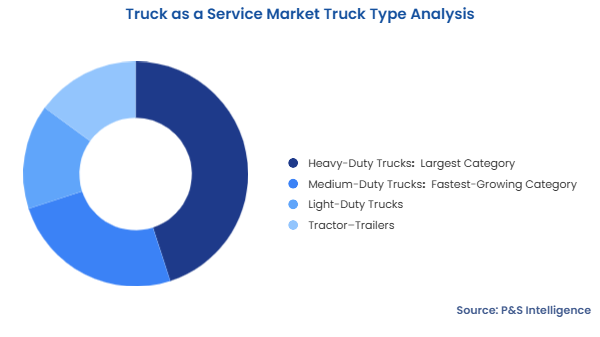
Heavy-duty trucks accounted for the largest share, of 45%, in the global TaaS market in 2025. Their centrality to long-haul freight and intermodal logistics across North America, Europe, and Asia-Pacific underpins this position. Bulk goods transportation across these routes depends on HDTs as the primary load-bearing workhorses of high-volume operations, including retail distribution, manufacturing supply chains, and commodity transport.
The acquisition cost of modern HDTs reinforces the economic case for subscription-based access. The International Energy Agency (IEA) confirms that the purchase price of battery-electric heavy-duty trucks remains two to three times higher than equivalent diesel trucks in major markets. Fleet operators facing this cost differential are adopting subscription structures as the operationally rational alternative.
Medium-duty trucks are the fastest-growing category over 2026–2032. Urban freight expansion and the growth of last-mile and e-commerce logistics are generating demand that medium-duty vehicles are structurally positioned to serve. As cities implement low-emission zones and urban delivery restrictions targeting older diesel HDTs, logistics operators are transitioning to cleaner medium trucks. TaaS platforms are the preferred adoption pathway, bundling vehicle access with compliance management and removing the regulatory complexity that would otherwise fall on individual operators.
The market segments into the following truck types:
Heavy-Duty Trucks (Largest Category)
Medium-Duty Trucks (Fastest-Growing Category)
Light-Duty Trucks
Tractor–Trailers
Propulsion Analysis
ICE trucks accounted for the largest share, in the global TaaS market in 2025. The installed base of diesel-powered commercial vehicles remains dominant across every major geography, and the majority of existing TaaS fleet contracts in North America, Latin America, and the Middle East & Africa are structured around ICE vehicles as a direct consequence. In markets where EV charging infrastructure is limited, long-haul route requirements exceed current battery range, or electric truck prices remain prohibitive, fleet operators continue to depend on ICE models. Mature diesel drivetrain technology and widely available refueling infrastructure have cemented this position over decades of commercial freight operation.
Hybrid trucks are the fastest-growing category over 2026–2032, at a CAGR of approximately 21.7%. They offer fleet operators a practical bridge between ICE propulsion and full electrification, delivering measurable fuel and emissions reductions without the range limitations or charging infrastructure dependence of battery-electric vehicles. The International Energy Agency (IEA) indicates that electric truck sales remain concentrated in markets with mature charging infrastructure. HEV adoption is accelerating in markets where electrification infrastructure has not yet reached the density required to support full battery-electric deployment at commercial scale.
The market segments into the following propulsion types:
ICE (Largest Category)
Hybrid Electric (Fastest-Growing Category)
Battery Electric
Fuel Cell Electric
Industry Analysis
The logistics and transportation category accounted for the largest share, of 35%, in the global TaaS market in 2025. Third-party logistics providers, freight forwarders, and contract carriers lead TaaS adoption. Their core business model depends on flexible capacity management and cost-per-mile efficiency, making service-based fleet access a structural fit rather than an operational experiment. Deep freight technology integration across logistics operators has further entrenched this position. Telematics, route optimization, and digital freight matching capabilities are already embedded in how these operators manage fleets, and TaaS platforms extend that infrastructure rather than replace it. Global B2B e-commerce sales growth is generating sustained demand for scalable last-mile and middle-mile logistics capacity. TaaS models are designed to fulfill this demand without requiring operators to expand owned fleet footprints.
The manufacturing and industrial category is the fastest-growing end-user segment over 2026–2032. Manufacturers are reducing the capital and operational burden of fleet ownership by outsourcing inbound raw material transport and outbound finished goods distribution to TaaS providers. Just-in-time and lean manufacturing principles require predictable, on-demand freight access without fleet ownership overhead, and TaaS platforms are the operationally rational answer to that requirement. Adoption is accelerating across automotive, electronics, steel, and chemical manufacturing verticals as operators seek to align freight capacity with production schedules rather than fixed fleet commitments. The European Commission's revised CO₂ emission standards for heavy-duty vehicles mandate a 45% reduction in emissions from new trucks by 2030, with further thresholds of 65% by 2035 and 90% by 2040. These compliance obligations are compelling industrial fleet operators to exit owned diesel fleets, and TaaS has emerged as the preferred decarbonization pathway for manufacturing logistics across the region.
The market segments into the following industries:
Drive strategic growth with comprehensive market analysis
Truck as a Service Market Geographical Analysis
North America Truck as a Service Market Analysis
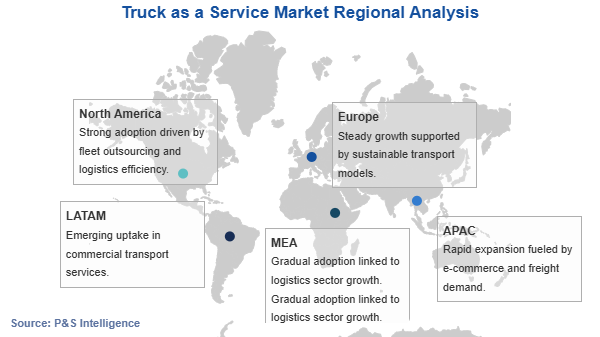
North America holds the largest share, of 40%, in the global truck-as-a-service market. Advanced logistics infrastructure and a mature fleet leasing ecosystem provide the commercial foundation for this position. High telematics adoption and a strong regulatory framework governing commercial vehicle operations have built the digital layer on top of that foundation. The U.S. Federal Motor Carrier Safety Administration's (FMCSA) Electronic Logging Device (ELD) mandate has accelerated digital fleet management adoption across the country, establishing a technology-ready environment for TaaS platforms to deliver subscription-based services on top of existing connected vehicle infrastructure. The American Trucking Associations reports that approximately 3.58 million truck drivers were employed in the United States in 2024. Canada contributes additional demand through its growing e-commerce logistics networks and expanding zero-emission vehicle incentive programs.
United States Truck as a Service Market Share
The United States is both the largest and fastest-growing TaaS country market globally. Regulatory compliance mandates, OEM-led fleet electrification programs, and rising demand for asset-light logistics models have converged to produce this dual position. The country's vast freight network spanning interstate highways, intermodal corridors, and dense last-mile urban delivery zones generates high-volume demand for subscription-based truck access. OEM-led initiatives are establishing commercial viability for TaaS models across drayage, regional haul, and last-mile applications.
Europe Truck as a Service Market Future
The EU's stringent commercial vehicle emission regulations are the primary structural force shaping Europe's TaaS market, compelling a large number of logistics operators to actively decarbonize their fleets. Road Freight accounts for approximately 27% of road transport CO₂ emissions in the EU, while road transport itself contributes about 73% of total transport emissions, underscoring the regulatory urgency driving fleet electrification investment.Germany holds the largest share within Europe, anchored by its manufacturing scale and the depth of its logistics and distribution networks serving Central European supply chains. France is the fastest-growing country market in the region. The French government's Objectif Bas-Carbone framework is generating compliance-driven demand for flexible electric truck access, and e-commerce logistics operators are accelerating that uptake.
Asia-Pacific Truck as a Service Market Scenario
Asia-Pacific is the fastest-growing region over 2026–2032, registering a CAGR of approximately 21.9%. China's large-scale electric truck deployment programs are the most significant volume contributor to this trajectory. India's infrastructure modernization agenda and rapid e-commerce growth across Southeast Asia are providing the demand base that sustains the region's expansion beyond China's electric transition. China is the largest country market within Asia-Pacific, accounting for the majority of global electric truck sales. Domestic OEMs are expanding battery-electric heavy-duty vehicle model availability, while government scrappage incentives are accelerating fleet renewal. India is the fastest-growing country in the region. The government's PM GatiShakti National Master Plan for logistics is generating organized freight demand, and the manufacturing and e-commerce sectors are expanding that base as subscription-based capacity access gains commercial traction.
China Truck as a Service Market Future
China's TaaS demand is expanding rapidly amid large-scale logistics modernization and strong government support for smart freight solutions. The country's freight volumes and growing e-commerce ecosystem are leading fleet operators to adopt subscription-based and digital service models that improve operational efficiency and reduce the ownership burden of fleet management. Regulatory policies emphasizing emissions reduction and smart logistics integration are providing the policy framework that underpins this transition. Advanced telematics and 5G connectivity are making scalable TaaS service platforms operationally viable at the coverage levels China's freight geography demands, establishing the country as one of the most dynamic markets within the global TaaS landscape.
India Truck as a Service Market Insights
Demand for truck-as-a-service is accelerating in India as logistics operators and small and medium enterprises seek flexible, asset-light solutions to manage growing freight requirements without heavy capital expenditure. Rapid e-commerce expansion and improving infrastructure are broadening the addressable market. Fleet digitalization, national logistics reforms, and rising adoption of subscription and pay-per-use models are reducing upfront costs and improving cash flows for small and medium carriers. Partnerships between global TaaS providers and local logistics firms are scaling service offerings across geographies that individual providers could not efficiently reach alone.
Latin America Truck as a Service Market Growth
Latin America is an emerging market for TaaS, with adoption currently concentrated in Brazil and Mexico, the two largest freight economies in the region. Brazil holds the largest share within Latin America. The scale of its agricultural export logistics, mining supply chains, and growing e-commerce fulfillment networks provide the freight volume base that makes TaaS commercially viable at the country level. Mexico is the fastest-growing country market in the region. Near-shoring activity along the U.S.–Mexico manufacturing corridor is generating organized freight demand from automotive and electronics manufacturers, and technology-enabled freight access is the model that corridor requires. Infrastructure constraints and limited EV charging deployment moderate the pace of electric TaaS adoption across the region, though digital freight brokerage and fleet telematics adoption are expanding the addressable market.
Middle East & Africa Truck as a Service Market Forecast
The Middle East & Africa is an expanding TaaS market, with the UAE, Saudi Arabia, and South Africa leading adoption across the region. Dubai's ambition to become a global smart logistics hub, extensive government investment in digital freight infrastructure, and high-volume freight activity at free trade zones are collectively driving UAE market growth. South Africa is the fastest-growing country market in the region. Its role as the primary logistics gateway for sub-Saharan Africa is generating demand from mining, manufacturing, and retail sectors for organized freight services, and that structural position is proving durable. Saudi Arabia's Vision 2030-aligned logistics modernization programs are prioritizing digital freight platforms and fleet management technology across the Kingdom, establishing the regulatory and infrastructure conditions for sustained TaaS adoption.
The market is analyzed across the following regions and countries:
North America (Largest Region)
U.S. (Largest and Fastest-Growing Country Market)
Canada
Europe
Germany (Largest Country Market)
U.K.
France (Fastest-Growing Country Market)
Italy
Spain
Rest of Europe
Asia-Pacific (Fastest-Growing Region)
China (Largest Country Market)
India (Fastest-Growing Country Market)
Japan
South Korea
Australia
Rest of Asia-Pacific
Latin America
Brazil (Largest Country Market)
Mexico (Fastest-Growing Country Market)
Rest of Latin America
Middle East & Africa
Saudi Arabia
UAE (Largest Country Market)
South Africa (Fastest-Growing Country Market)
Rest of MEA
Truck as a Service Market Share Analysis
The global truck-as-a-service market is moderately fragmented, reflecting the breadth and diversity of its value chain. The market encompasses truck manufacturers offering proprietary TaaS platforms, specialized fleet management and telematics technology providers, third-party logistics companies deploying subscription-based capacity models, and TaaS startups operating fully digital, asset-light freight networks. Competition is organized across distinct capability dimensions. Vehicle manufacturing scale, software and telematics integration depth, and fleet financing capacity each confer structural advantages that no single player has consolidated across all three. Operational logistics expertise adds a fourth dimension that pure-technology entrants and pure-OEM players alike struggle to replicate. The high cost of truck procurement and the breadth of capabilities required to deliver end-to-end TaaS solutions restrict new entrant viability, sustaining the positions of established players across the market's core segments.
Leading Companies in the Truck as a Service Market:
AB Volvo
Daimler Truck AG
PACCAR Inc.
Ashok Leyland Ltd.
Tata Motors Limited
TRATON SE
Nikola Corporation
Volta Trucks
Robert Bosch GmbH
Continental AG
Trimble Inc.
Omnitracs LLC
Tive Inc.
Verizon Communications Inc.
Microlise Group Plc
Fleet Advantage LLC
Ryder System Inc.
Einride AB
Truck as a Service Market Developments
In June 2025, AB Volvo and Daimler Truck AG launched Coretura, a 50/50 joint venture headquartered in Gothenburg, Sweden. The venture is developing a common software-defined vehicle platform and dedicated truck operating system for heavy-duty commercial vehicles.
In November 2025, Einride AB announced a definitive business combination agreement with Legato Merger Corp. III to pursue a U.S. public listing, valuing the company at USD 1.8 billion (pre-money). The transaction was supported by approximately USD 100 million in crossover funding raised in 2025 from institutional investors including EQT Ventures and NordicNinja. The listing, expected in the first half of 2026, is intended to accelerate Einride’s Freight-Capacity-as-a-Service and autonomous electric freight operations across its base of more than 25 enterprise customers.
In April 2025, AB Volvo's North American arm secured R&M Trucking as its first paying customer for the Volvo on Demand TaaS program.
Frequently Asked Questions About This Report
Want a report tailored exactly to your business need?
Leading companies across industries trust us to deliver data-driven insights and innovative solutions for their most critical decisions. From data-driven strategies to actionable insights, we empower the decision-makers who shape industries and define the future. From Fortune 500 companies to innovative startups, we are proud to partner with organisations that drive progress in their industries.
Client Testimonials
Working with P&S Intelligence and their team was an absolute pleasure – their awareness of timelines and commitment to value greatly contributed to our project's success. Eagerly anticipating future collaborations.
McKinsey & Company
India
Unmatched Standards
Our insights into the minutest levels of the markets, including the latest trends and competitive landscape, give you all the answers you need to take your business to new heights
Complete Data Security
We take a cautious approach to protecting your personal and confidential information. Trust is the strongest bond that connects us and our clients, and trust we build by complying with all international and domestic data protection and privacy laws