Explore the market potential with our data-driven report
Time-Sensitive Networking Market Overview
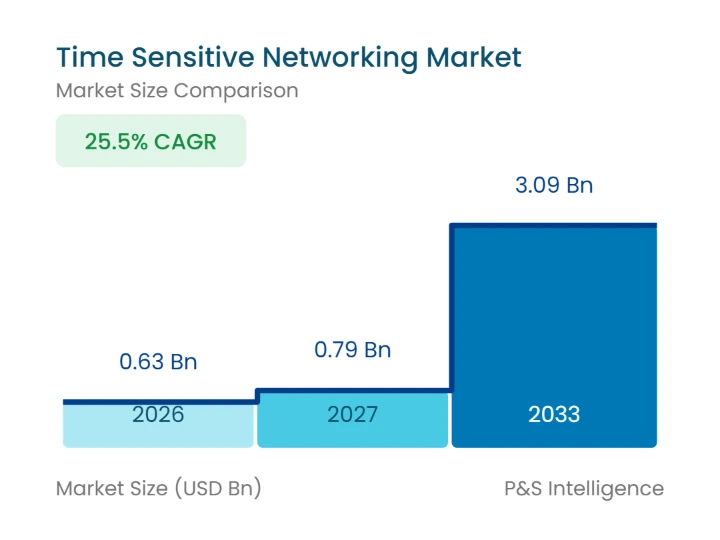
The global time-sensitive networking market size is estimated at USD 0.63 Billion in 2026 and is projected to reach USD 0.79 Billion in 2027. Revenue is projected to climb to USD 3.09 Billion by 2033, advancing at a CAGR of 25.5% during 2027-2033. Machine builders, automakers, and their Tier-1 suppliers place most orders, because they are moving motion control, camera, and safety traffic onto one deterministic Ethernet backbone in place of separate fieldbuses and vehicle buses. Each new controller, servo drive, and zonal gateway design therefore becomes a socket decision for switch and silicon vendors.
Factory automation lines generate the largest volume of new TSN orders, because robot cells and multi-axis machines need motion control, vision, and plant data to share one network without timing loss. International Federation of Robotics (IFR) data show more than 600,000 industrial robots installed worldwide in 2025, up 11%. That count sizes the automation base, not TSN adoption, but each robot cell built around a TSN-capable controller adds managed switch ports and processor sockets to the order. Machine builders that standardize on one converged backbone can then buy network hardware in larger, repeatable lots.
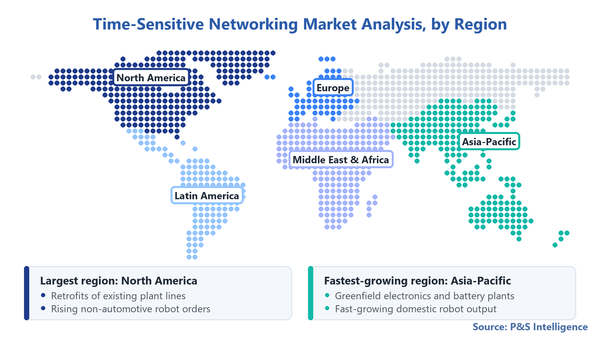
North America accounts for 35.5% of time-sensitive networking market revenue in 2026, led by the United States, where industrial plants, automakers, and aerospace programs are upgrading existing control networks and vehicle platforms. Asia-Pacific is projected to expand at a 28.1% CAGR during 2027-2033, the quickest pace of any region, as electronics, battery, and vehicle plants in China, Japan, South Korea, and Taiwan specify TSN at construction. Upgrades carry North American spending while new builds carry Asian orders, which could favor suppliers that make switches and modules close to Asian plant sites.
Key market insights
By offering and component, hardware accounts for 68.5% in 2026, and software & firmware is set to expand at a 28.2% CAGR during 2027-2033.
By IEEE standard and protocol, IEEE 802.1AS (timing & synchronization / gPTP) holds 34.0% in 2026, and IEEE 802.1Qbv (time-aware shaper / scheduled traffic) is forecast to advance at a 27.4% CAGR during 2027-2033.
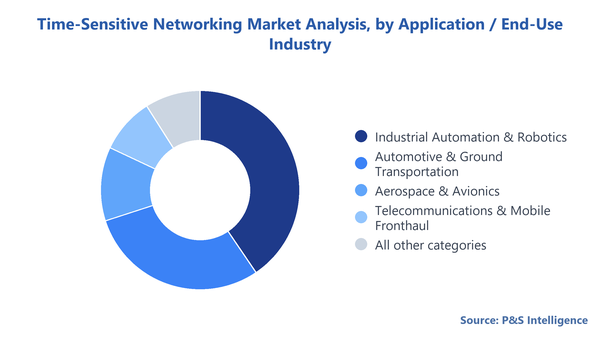
By application and end-use industry, industrial automation & robotics represents 40.5% in 2026, while automotive & ground transportation is expected to post a 31.8% CAGR during 2027-2033.
By transmission speed and bandwidth, 1 Gbps (Gigabit TSN) captures 54.0% in 2026, with Multi-Gigabit (2.5 Gbps, 5 Gbps, 10 Gbps) projected to rise at a 33.5% CAGR during 2027-2033.
By geography, North America leads with 35.5% in 2026, and Asia-Pacific is anticipated to record a 28.1% CAGR during 2027-2033.
Time-Sensitive Networking Market Trends & Drivers
Centralized configuration software is redefining how plant-wide TSN networks are bought
Plant engineers taking TSN beyond a single machine cell can no longer set gate schedules and stream reservations switch by switch. Centralized configuration engines now compute those schedules for the whole network and load them into every bridge and end station, so each added machine changes a software model before it changes any cabling. Buyers therefore pay for configuration licenses, simulation suites, and integration hours alongside switches, and the software portion of a project is likely to grow as a network spans more cells.
The shift changes how vendors compete for plant-wide orders. Switch makers that ship their own configuration tool can tie follow-on purchases to their hardware, while independent software vendors such as TTTech sell scheduling engines that work across several switch brands. Machine builders running mixed fleets are likely to prefer the vendor-neutral route, because one scheduling tool spares their engineers from learning a new tool for each switch brand. For hardware suppliers, proven compatibility with third-party configuration software is likely to become a standard line on the qualification checklist.
A finished industrial profile is accelerating multi-vendor factory deployments
Factory owners have held many plant-wide TSN projects at the pilot stage because automation vendors implemented the base IEEE features in different ways, which made mixed-brand cells hard to commission. A common industrial profile removes much of that risk by fixing which timing, scheduling, and management functions every compliant bridge and end station must carry. The groups behind PROFINET, EtherNet/IP, CC-Link IE TSN, and OPC UA FX can then map their traffic onto the same Layer 2 rules, and plant engineers can buy switches from one vendor and drives from another.
According to the International Electrotechnical Commission (IEC), edition 1.0 of the dual-logo IEC/IEEE 60802 profile for industrial automation carries a June 2026 date, and the document also defines YANG modules that serve as a digital data sheet for each device. Machine builders that had confined TSN to pilot lines now have a fixed reference to write into tender specifications, which is likely to turn pilots into series machine orders from 2027 onward. Switch and controller suppliers that align firmware with the profile early are better positioned when those tenders open.
Zonal vehicle architectures are opening a high-volume silicon pathway
Automakers moving to zonal electrical architectures replace many point-to-point CAN and FlexRay links with a few Ethernet backbones that must carry brake, steering, camera, and radar data on fixed timing. Each zone controller and central gateway needs TSN switch silicon and automotive PHYs, so one vehicle platform can call for several switch ICs. For semiconductor vendors, a win on a high-volume platform usually secures shipments across that model's full production run, which makes each sourcing decision unusually valuable.
The IEEE Standards Association approved IEEE 802.1DG-2025, the TSN profile for automotive in-vehicle Ethernet, on May 28, 2025 and published it on June 6, 2025. Without a common profile, automakers could select different TSN options, which pushes silicon vendors toward customer-specific firmware. A shared profile lets one validated switch configuration serve several OEM programs, which lowers design cost for Tier-1 suppliers and widens the number of platforms where TSN silicon can be designed in.
A large installed fieldbus base is limiting the pace of brownfield migration
Most plants that could use TSN already run working fieldbus or first-generation industrial Ethernet networks, and owners rarely replace a functioning control network before the machines it serves reach retirement. TSN therefore enters mainly through new lines and major retrofits, which ties near-term demand to plant capital budgets. Brownfield sites also carry the cost of gateways and requalification whenever TSN equipment must exchange data with older devices on the same line.
Figures from PROFIBUS & PROFINET International (PI) put the installed PROFIBUS base at 71 million devices after another 1 million were commissioned in 2025, and PI describes the decline in new PROFIBUS installations as gradual. Each new fieldbus device installed today can extend the life of a network that TSN would otherwise replace. Chip suppliers are answering part of the integration burden with switch silicon that already carries third-party conformance certification, though the replacement cycle of installed lines still sets the pace of brownfield adoption.
Segmentation Outlook
Offering and Component
Hardware accounts for 68.5% of time-sensitive networking market revenue in 2026, because every deterministic link needs a physical switch port, a TSN-capable MAC, and a processor or controller to terminate it. Semiconductor vendors now build these functions into industrial processors, which count toward this market only when a design specifies their TSN capability. Texas Instruments lists its active AM64x processor family as supporting TSN alongside PROFINET and EtherNet/IP through two gigabit industrial communication subsystems built for motor drives and PLCs. Hardware revenue therefore scales with the number of TSN-specified controllers, drives, and switches shipped.
Software & Firmware is projected to post the highest growth in this dimension, at a 28.2% CAGR during 2027-2033. Larger networks push plant engineers and vehicle architects toward configuration engines, protocol stacks, and simulation suites that compute schedules and verify timing before any hardware is installed. Firmware updates also let installed TSN switches gain new functions without a hardware swap, which can create recurring license and maintenance revenue. Software vendors whose tools work across several switch brands can capture value from each network expansion, even when the switch order goes to a competitor.
IEEE Standard and Protocol
IEEE 802.1AS (Timing & Synchronization / gPTP) holds 34.0% of 2026 revenue, the largest share among the standards, because clock synchronization is the base layer that every other TSN function depends on. Scheduled traffic, preemption, and redundancy all assume that each bridge and end station shares one time reference, so gPTP support is a baseline requirement in TSN switch, PHY, and processor designs. Industrial, automotive, aerospace, and audio-video networks all specify it, which spreads its revenue across every application.
IEEE 802.1Qbv (Time-Aware Shaper / Scheduled Traffic) is set to record the quickest gains among the standards, with a 27.4% CAGR during 2027-2033. Time-aware shaping is the function that lets motion control frames share a cable with camera and IT traffic without being delayed, which is a main reason plants and automakers converge networks at all. As industrial and in-vehicle profiles settle which shaping options to use, designs that relied on synchronization alone are adding scheduled traffic, and suppliers with hardware-based gate control are better positioned for these design-ins.
Application and End-Use Industry
Industrial Automation & Robotics accounts for 40.5% of 2026 revenue, the largest application share, because factories were the first to replace separate motion and plant networks with one converged backbone. Machine builders buy TSN switches, I/O couplers, and drive controllers in volume each time a production line is built or retooled, and the protocol groups behind PROFINET, EtherNet/IP, and CC-Link IE TSN have all mapped their traffic onto TSN. Industrial installations also stay in service for many years, which supports steady spending on firmware and support contracts.
Automotive & Ground Transportation is projected to expand fastest, at a 31.8% CAGR during 2027-2033, as automakers move software-defined vehicles onto zonal Ethernet backbones. As per the International Energy Agency (IEA), global electric car sales exceeded 20 million in 2025, a quarter of all new cars sold. That figure sizes the new-vehicle platform base, not TSN adoption, since TSN content depends on whether a given platform uses a zonal architecture. Each platform that does adopt zonal networking ships TSN switch ICs and PHYs in every unit built, which makes automotive design wins large and long-lasting.
Copyright P&S Intelligence. Reuse requires attribution under CC BY 4.0.
Transmission Speed and Bandwidth
1 Gbps (Gigabit TSN) holds 54.0% of 2026 revenue, because gigabit links can carry machine vision, motion control, and plant data together at a cost that most factory and vehicle backbones can absorb. Most current TSN switch silicon and industrial controllers are built around gigabit ports, which makes gigabit the default choice when a design must reuse existing cabling, connectors, and qualified components. For OEMs, staying at gigabit keeps validation work and bill-of-materials cost predictable across product generations.
Multi-Gigabit (2.5 Gbps, 5 Gbps, 10 Gbps) is expected to show the fastest growth in this dimension, at a 33.5% CAGR during 2027-2033. Zonal vehicle backbones aggregate raw camera, radar, and lidar streams, and factory networks are adding high-resolution inspection cameras, and both loads can exceed a single gigabit link. Uplinks between zones and between machine cells move first, so multi-gigabit ports enter networks at the backbone before they reach end devices. Suppliers with multi-gigabit TSN switch silicon could capture the higher-value backbone ports in these designs.
The following segments are analysed in this report.
Other Standards & Domain Profiles (IEEE 802.1Qci, 802.1Qcr, 802.1CM, 802.11be)
Application / End-Use Industry
Industrial Automation & Robotics
Automotive & Ground Transportation
Aerospace & Avionics
Telecommunications & Mobile Fronthaul
Power & Energy Utilities
Professional Audio/Video & Media Broadcasting
Transmission Speed / Bandwidth
1 Gbps (Gigabit TSN)
100 Mbps (Fast Ethernet TSN)
Multi-Gigabit (2.5 Gbps, 5 Gbps, 10 Gbps)
10 Mbps (Single Pair Ethernet TSN)
Geographical Outlook
North America time-sensitive networking market outlook
North America accounts for 35.5% of global revenue in 2026, the largest regional share. Spending here depends mainly on upgrades, as food and beverage, semiconductor, life-sciences, and automotive plants refit existing lines with TSN-capable controllers and switches when they add robot cells. The United States is the region's largest market and hosts automakers, aerospace primes, and chip designers that specify and test TSN for vehicle platforms, aircraft programs, and industrial products. ODVA's work on mapping EtherNet/IP onto TSN is intended to give plants already running the protocol a migration path that keeps their existing application layer.
The Association for Advancing Automation (A3) recorded orders for 36,766 robots from North American companies in 2025, 6.6% more units than in 2024, with food and consumer goods, semiconductors and electronics, and life sciences outpacing automotive demand. These orders size robot purchases, not TSN content, yet they show where new motion networks are being installed. North America's share is likely to ease gradually as Asian greenfield capacity grows faster, while its revenue keeps rising through retrofit cycles and vehicle and aircraft platform programs. Suppliers with EtherNet/IP-conformant TSN products and local integration teams are better placed for these retrofit orders.
Asia-Pacific is on course for a 28.1% CAGR during 2027-2033, faster than any other region. Growth here depends on new capacity, as electronics, battery, and electric-vehicle plants in China, South Korea, Taiwan, and Southeast Asia are designed with TSN networks from the start and avoid the migration costs that slow brownfield sites elsewhere. China is the region's fastest-growing market, supported by rising domestic robot output and the scale of its vehicle manufacturing base. Japan adds a second source of demand, where CC-Link IE TSN gives domestic automation supply chains a native TSN protocol.
According to the National Bureau of Statistics of China (NBS), the value-added output of industrial robots rose 28% in 2025. Locally built robots and controllers create domestic demand for TSN switch silicon, PHYs, and controller modules close to where machines are assembled. Asia-Pacific's lead in growth rate is likely to persist through 2033 as factory construction continues across the region. Chinese, Taiwanese, and Japanese switch and module makers could gain a widening home customer base, while global chip vendors with regional application support compete for the same sockets.
Copyright P&S Intelligence. Reuse requires attribution under CC BY 4.0.
Europe market analysis
Europe trails North America and Asia-Pacific in revenue but is where much of the industrial TSN standards work began, with automation vendors in Germany, Austria, and Switzerland backing PROFINET over TSN and OPC UA FX. European demand depends heavily on machine builders that export TSN-equipped equipment, so orders placed in Germany or Italy often end up in plants abroad. Automakers in Germany, Sweden, and France add a second channel through zonal vehicle programs that source TSN silicon for global platforms.
The machinery sector faces weaker near-term spending. VDMA Robotics + Automation expects German robotics and automation sales to fall 5% in 2026. Fewer new machines delay some TSN orders, so European demand in the short term leans on retrofits and on machine builders preparing profile-conformant product lines for when investment recovers. Suppliers with long-standing machine-builder relationships are likely to keep their design wins through the slowdown, because builders rarely requalify network components mid-cycle.
Latin America market analysis
Latin America contributes a smaller share of global revenue, with demand concentrated in Mexico's export-oriented vehicle and electronics plants and in Brazil's automotive, food, and mining operations. Most TSN equipment in the region arrives inside machinery and production lines specified by multinational parent companies, so purchasing decisions are often made in the United States, Europe, or Asia. Local integrators earn their revenue mainly from installation, commissioning, and support work on those lines.
Mexico's National Institute of Statistics and Geography (INEGI) counted 3.95 million light vehicles produced in 2025, of which 3.38 million were exported, so the figure measures manufacturing activity, not domestic demand or TSN adoption. Automakers retooling Mexican plants for new platforms are the most likely route for TSN-equipped lines into the region. Continued nearshoring of North American supply chains would add more greenfield plants built to the same network specifications as their U.S. counterparts.
Middle East & Africa market analysis
Middle East & Africa holds the smallest regional share, with demand tied more to utilities, oil and gas operators, and telecom carriers than to discrete manufacturing. Grid operators modernizing substations in Saudi Arabia and the United Arab Emirates can use time-synchronized Ethernet for protection traffic, and Israel's aerospace and defense electronics makers form a smaller potential buyer group for deterministic onboard networks. Industrial diversification programs in the Gulf add new factories, although volumes remain small compared with Asia.
The GSMA projects that 5G will rise from 9% of mobile connections across the Middle East and North Africa in 2025 to 40% by 2030. Operators extending 5G coverage need fronthaul links between radio units and baseband equipment, where switched Ethernet built to TSN fronthaul profiles lets several radio units share one transport link in place of a dedicated fiber per radio. Carrier network buildouts are therefore the region's most visible near-term route for TSN switches, with industrial demand following as Gulf manufacturing projects come online.
The following geographies are analysed in this report.
The time-sensitive networking market is moderately fragmented, with competition spread across three layers that rarely sit inside one company. Switch and controller silicon depends on design wins that last for a product's full life, which rewards chip vendors that already hold automotive and industrial qualifications. Industrial switches and controllers are sold through automation vendors' own control platforms, where plant engineers commonly specify network hardware alongside the controller. Software and test tools form a third, specialist layer. The structure is evolving, because published profiles lower the cost of mixing vendors and can open plant networks to more switch makers.
In silicon, NXP Semiconductors, Microchip Technology, Analog Devices, and Texas Instruments compete on integrated TSN switches, processors, and PHYs, with automotive functional safety and certified industrial protocol support as the main points of difference. In equipment, Siemens, Rockwell Automation, Moxa, and Belden, through its Hirschmann brand, sell managed TSN switches tied to their control or networking platforms. TTTech and Keysight Technologies supply the configuration software and conformance testing that switch and device makers use during network design and qualification.
New entrants face long qualification cycles at both ends of the value chain. Automotive silicon must pass functional safety and automotive-grade qualification before a carmaker commits a platform, and industrial devices need conformance certification from the relevant protocol organization before machine builders will list them. For buyers, this narrows practical choice at the silicon layer while leaving more room to negotiate on switches and integration services, where a wider group of vendors offers certified products.
Major Companies in Time-Sensitive Networking Market:
Siemens AG
Cisco Systems Inc.
NXP Semiconductors N.V.
Analog Devices Inc.
Texas Instruments Incorporated
Belden Inc.
Rockwell Automation Inc.
Microchip Technology Inc.
Marvell Technology Inc.
Broadcom Inc.
TTTech Computertechnik AG
Moxa Inc.
Phoenix Contact GmbH & Co. KG
Keysight Technologies Inc.
Vector Informatik GmbH
Recent Developments in the Market
In May 2026, NXP Semiconductors N.V. announced a collaboration with Quanta on a deterministic zonal networking solution that pairs S32 automotive processors and MotionWise middleware with TSN-enabled networking on SJA1110 switches, available now to OEMs. Packaging TSN switching with zonal compute shortens integration work for automakers moving to Ethernet backbones.
In May 2026, Microchip Technology Inc. introduced the LAN878x and LAN888x Single Pair Ethernet PHY families for 100BASE-T1 and 1000BASE-T1 links, combining native TSN support, IEEE 802.1AE-2018 MACsec, and ISO 26262 ASIL-B functional safety, in limited sampling. Placing security and TSN in the PHY targets ADAS and zonal gateway designs.
In February 2026, TTTech Computertechnik AG, through its TTTech North America unit, won a U.S. Army contract to supply a 10 Gigabit TSN platform of switches and end points meeting the IEEE 802.1DP aerospace profile for the HADES reconnaissance aircraft. The award moves aerospace TSN into a funded airborne program.
In December 2025, Analog Devices Inc. secured CC-Link IE TSN switch certification, Class A and Class B, for its six-port ADIN6310 and three-port ADIN3310 TSN switch ICs at 100 Mbps and 1 Gbps, its first products to pass this test. Pre-certified switch silicon can reduce conformance testing for automation device makers.
Last Updated: November 2026
Frequently Asked Questions About This Report
How big is the time-sensitive networking market?+
The global time-sensitive networking market size is estimated at USD 0.63 Billion in 2026 and is projected to reach USD 0.79 Billion in 2027.
What is driving growth in the time-sensitive networking market?+
Machine builders, automakers, and their Tier-1 suppliers place most orders, because they are moving motion control, camera, and safety traffic onto one deterministic Ethernet backbone in place of separate fieldbuses and vehicle buses.
Which region dominates the time-sensitive networking market?+
North America accounts for 35.5% of time-sensitive networking market revenue in 2026, led by the United States, where industrial plants, automakers, and aerospace programs are upgrading existing control networks and vehicle platforms.
Which region is growing fastest in the TSN market?+
Asia-Pacific is projected to expand at a 28.1% CAGR during 2027-2033, the quickest pace of any region, as electronics, battery, and vehicle plants in China, Japan, South Korea, and Taiwan specify TSN at construction.
Which component holds the largest share of the TSN market?+
Hardware accounts for 68.5% of time-sensitive networking market revenue in 2026, because every deterministic link needs a physical switch port, a TSN-capable MAC, and a processor or controller to terminate it.
Which application of time-sensitive networking is growing fastest?+
Automotive & Ground Transportation is projected to expand fastest, at a 31.8% CAGR during 2027-2033, as automakers move software-defined vehicles onto zonal Ethernet backbones.
What is holding back TSN adoption in existing factories?+
Most plants that could use TSN already run working fieldbus or first-generation industrial Ethernet networks, and owners rarely replace a functioning control network before the machines it serves reach retirement.
Who are the key companies in the time-sensitive networking market?+
In silicon, NXP Semiconductors, Microchip Technology, Analog Devices, and Texas Instruments compete on integrated TSN switches, processors, and PHYs, with automotive functional safety and certified industrial protocol support as the main points of difference.
Want a report tailored exactly to your business need?
Leading companies across industries trust us to deliver data-driven insights and innovative solutions for their most critical decisions. From data-driven strategies to actionable insights, we empower the decision-makers who shape industries and define the future. From Fortune 500 companies to innovative startups, we are proud to partner with organisations that drive progress in their industries.
Client Testimonials
Working with P&S Intelligence and their team was an absolute pleasure – their awareness of timelines and commitment to value greatly contributed to our project's success. Eagerly anticipating future collaborations.
McKinsey & Company
India
Unmatched Standards
Our insights into the minutest levels of the markets, including the latest trends and competitive landscape, give you all the answers you need to take your business to new heights
Complete Data Security
We take a cautious approach to protecting your personal and confidential information. Trust is the strongest bond that connects us and our clients, and trust we build by complying with all international and domestic data protection and privacy laws