Thyroid Cancer Diagnostics Market Size & Share Analysis - Emerging Trends, Growth Opportunities, Competitive Landscape, and Forecasts (2026 - 2032)
This Report Provides In-Depth Analysis of the Thyroid Cancer Diagnostics Market Report Prepared by P&S Intelligence, Segmented by Cancer Type (Papillary carcinoma, Follicular carcinoma, Medullary carcinoma, Anaplastic carcinoma, Thyroid lymphoma), Diagnostic Technique (Imaging, Biopsy & Cytopathology, Molecular Diagnostics), End Use (Hospital Laboratories, Cancer Diagnostic Centres, Research Institutes), Sample Type (Solid, Liquid), Patient Age Group (Below 30 years, 30–50 years, Above 50 years), Patient Gender (Female, Male), and Geographical Outlook for the Period of 2019 to 2032
Explore the market potential with our data-driven report
Thyroid Cancer Diagnostics Market Overview
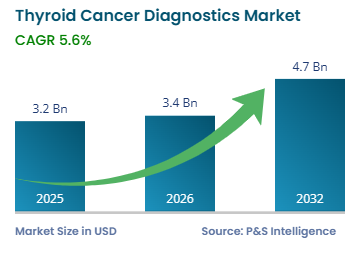
The thyroid cancer diagnostics market size will be an estimated USD 3.2 billion for 2025, and it will grow by 5.6% during 2026–2032, to reach USD 4.7 billion by 2032.
The major factors responsible for the growth of the market include rising incidence of thyroid cancer globally, technological advancements in diagnostic imaging and molecular testing, growing awareness about early detection, and increasing healthcare expenditure across regions. The global thyroid cancer incidence is projected to rise from 233,847 cases in 2019 to 305,078 by 2030, representing an approximate 30.46% increase, which directly drives demand for advanced diagnostic solutions.
The integration of artificial intelligence in ultrasound imaging and molecular diagnostic platforms has revolutionized the assessment of thyroid nodules. Approximately 20% of thyroid fine needle aspirations yield indeterminate results, creating substantial demand for molecular testing to guide clinical management. Recent developments in ultrasound elastography and multiparametric ultrasound combine B-mode, Doppler, and elastography to provide comprehensive nodule assessments, enhancing diagnostic accuracy significantly.
Thyroid Cancer Diagnostics Market Emerging Trends
Technological Advancements in Diagnostic ModalitiesAre Key Trends
Rapid technological innovation in imaging and molecular diagnostics represents a transformative trend reshaping the thyroid cancer diagnostics landscape.
The integration of AI-assisted diagnostic tools has significantly improved accuracy in identifying malignant nodules and reducing unnecessary biopsies.
For example, a multicenter study in Thailand using an AI model achieved 95% accuracy in diagnosing thyroid nodules, outperforming less-experienced radiologists.
Recent advancements include the development of AI-powered image analysis platforms that enhance interpretation accuracy and reduce inter-observer variability.
In China, a multimodal deep-learning model for TI-RADS 4 nodules achieved AUCs of 0.937 and 0.927 on external validation.
Ultrasound elastography measures thyroid nodule stiffness to better differentiate benign from malignant lesions.
Molecular diagnostics platforms have evolved substantially.
Three main commercially available molecular cytology platforms in the U.S. are Afirma GSC, Thyroseq GC, and ThyGeNEXT + ThyraMIR, with sequential improvements increasing positive and negative predictive values, sensitivity, and specificity.
These platforms analyze gene expression profiles, mutations, and chromosomal rearrangements to provide detailed genomic information for nodules with indeterminate cytology results.
The development of liquid biopsy techniques and next-generation sequencing panels specifically designed for thyroid cancer further enhances diagnostic precision and enables personalized treatment strategies.
Rising Global Incidence of Thyroid CancerIs Biggest Driver
The increasing prevalence of thyroid cancer worldwide serves as the primary driver for the diagnostics market expansion.
According to the International Agency for Research on Cancer (GLOBOCAN 2022), the age-standardized incidence rate (ASIR) for thyroid cancer was approximately 13.6 per 100,000 women and 4.6 per 100,000 men globally.
With over 821,000 cases reported globally in 2022, thyroid cancer has emerged as the seventh-most-common cancer.
This represents a significant health burden that necessitates enhanced diagnostic capabilities.
The ASIR in high Human Development Index (HDI) countries was about 10 times higher than in low-HDI countries for both sexes.
Eastern Asia exhibits the highest incidence rates, with the rate approximately two times higher than that of the second-ranking Northern America.
China alone accounts for over one-half of the global incidence burden with 466,000 new cases.
This geographic concentration creates substantial demand for diagnostic services in the Asia Pacific region. The disease burden escalates with advancing age, particularly affecting adults aged 30-60 years.
According to the American Cancer Society, about 44,020 new cases of thyroid cancer (12,670 men; 31,350 women) and 2,290 deaths (1,090 men; 1,200 women) are estimated for 2025.
Thyroid Cancer Diagnostics Market Segmentation Analysis
Cancer Type Analysis
The papillary carcinoma category holds the largest market share, of 80%, in 2025, as it stands out as the predominant form of thyroid cancer. This dominance stems from the cancer type's relatively favorable prognosis when detected early, high incidence rates globally, and well-established diagnostic protocols that have been refined over decades. The availability of standardized imaging guidelines, molecular testing options, and targeted treatment protocols, such as thyroidectomy and radioiodine therapy, further reinforces its prominence in the diagnostic market.
The follicular carcinoma category will have the highest CAGR, of 6.0%, due to the advancements in molecular diagnostic technologies specifically designed to differentiate this cancer type from benign follicular adenomas. The development of mutation panels targeting NRAS, HRAS, and PAX8-PPARG rearrangements has improved preoperative diagnosis accuracy. The growing recognition of follicular variant papillary thyroid carcinoma as a distinct entity requiring tailored diagnostic approaches further drives demand for specialized testing in this segment.
The cancer types analyzed in this report are:
Papillary Carcinoma (Largest Category)
Follicular Carcinoma (Fastest-Growing Category)
Medullary Carcinoma
Anaplastic Carcinoma
Thyroid Lymphoma
Others
Diagnostic Technique Analysis
The imaging category holds the largest market share, of 65%, in 2025. Ultrasound serves as the first-line diagnostic modality due to its non-invasive nature, wide availability, cost-effectiveness, and absence of radiation exposure. The integration of advanced imaging technologies, including ultrasound elastography, computed tomography, magnetic resonance imaging, and positron emission tomography, provides a comprehensive anatomical and functional assessment of thyroid lesions. Ultrasound is not only used for imaging but also for guided fine-needle aspirations.
The molecular diagnostics category will have the highest CAGR, of 5.8%, owing to the increasing adoption of precision medicine approaches and the need to reduce unnecessary surgeries for indeterminate thyroid nodules. The development of next-generation sequencing platforms, gene expression classifiers, and mutation panels has revolutionized the diagnostic workflow. These tests provide actionable genomic information that informs treatment decisions and risk stratification. Molecular diagnostics enable clinicians to differentiate benign from malignant nodules more accurately, reducing patient exposure to invasive procedures and optimizing surgical planning. Advances in liquid biopsy and circulating tumor DNA (ctDNA) analysis further support non-invasive monitoring and early detection of recurrence.
The diagnostic techniques analyzed in this report are:
Imaging (Largest Category)
Ultrasound
CT
MRI
PET
Scintigraphy
Others
Molecular Diagnostics (Fastest-Growing Category)
Others
Sample Type Analysis
The solid category holds the larger market share, of 70%, in 2025, driven by the widespread use of fine-needle aspiration biopsy as the gold standard for evaluating thyroid nodules. Solid tissue samples obtained through biopsy provide cellular material for cytological examination and molecular testing, enabling accurate diagnosis and risk stratification. The procedure's minimally invasive nature, high diagnostic yield, and ability to provide material for ancillary testing ensure its continued dominance.
The liquid category will have the higher CAGR during the forecast period, due to emerging applications of liquid biopsy technology. Blood-based testing offers several advantages, including non-invasiveness, ability to perform serial monitoring, and detection of circulating tumor markers. Research into cell-free DNA, circulating thyroid cancer cells, and thyroid-specific biomarkers in blood and other body fluids shows promise for early detection and disease monitoring applications.
The sample types analyzed in this report are:
Solid (Larger Category)
Liquid (Faster-Growing Category)
Blood
Saliva
Urine
Pleural/Peritoneal Effusions
End User Analysis
The hospital laboratories category holds the largest market share in 2025, as it serves as the primary center for thyroid cancer diagnosis, equipped with advanced imaging equipment, cytopathology departments, and molecular diagnostic capabilities. Their integration within comprehensive cancer care centers enables seamless coordination between diagnostic and therapeutic services. The high volume of thyroid evaluations performed in hospital settings, combined with access to multidisciplinary tumor boards and specialized endocrinologists, ensures their market leadership.
The cancer diagnostics centers category will have the highest CAGR, during the forecast period, driven by substantial funding for thyroid cancer research, clinical trials evaluating novel diagnostic biomarkers, and the development of next-generation diagnostic platforms. Academic medical centers and dedicated cancer research institutions play a crucial role in validating emerging technologies before their widespread clinical adoption. Collaborations between research institutes and diagnostic companies accelerate the translation of scientific discoveries into commercially available diagnostic tests.
The end users analyzed in this report are:
Hospital Laboratories (Largest Category)
Cancer Diagnostic Centers (Fastest-Growing Category)
Research Institutes
Others
Patient Age Group Analysis
The largest category is above 50 years, with 45% share, as this cancer incidence peaks in adults above 50, particularly between 55–59 years. This group accounts for the majority of new diagnoses and mortality due to more aggressive disease subtypes and comorbidities. Diagnostic demand is high, with routine imaging, cytology, and molecular testing commonly employed for timely detection.
The fastest‑growing category is 30–50 years, with a CAGR during the forecast period. Incidence is rising most rapidly in adults aged 30–50, especially women, driven by hormonal, genetic, and environmental risk factors. Early detection through ultrasound, fine-needle aspiration, and molecular panels is increasingly emphasized. This demographic shows growing demand for preventive screening and personalized diagnostic approaches, reflecting global trends in younger adult thyroid cancer cases.
These age groups are analyzed:
Below 30 years
30–50 years (Fastest-Growing Category)
Above 50 years (Largest Category)
Patient Gender Analysis
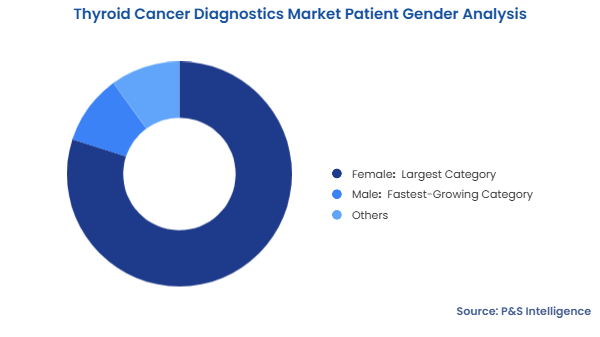
Women lead the market with 80% share as they are diagnosed with thyroid cancer about three times more often than men. They dominate diagnostic demand for imaging, cytology, and molecular panels, particularly in their reproductive years when incidence peaks.
Males are the faster-growing category, with a CAGR of 5.9%. One global study found a higher age‑standardized incidence annual growth for men (EAPC ~1.59) than for women (EAPC ~0.68). Men also tend to present with more aggressive disease, thus boosting more advanced diagnostic work‑ups.
These patient genders are considered:
Female (Largest Category)
Male (Fastest-Growing Category)
Others
Drive strategic growth with comprehensive market analysis
Thyroid Cancer Diagnostics Market Geographical Analysis
North America Thyroid Cancer Diagnostics Market Size
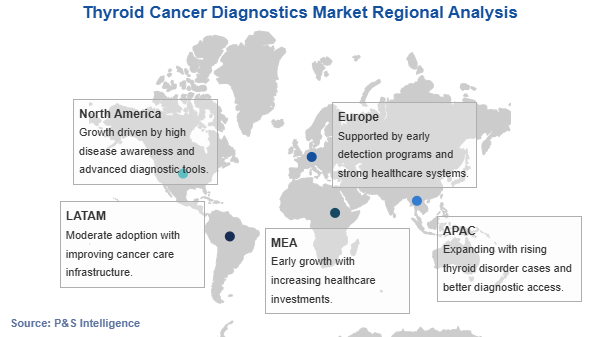
North America holds the largest market share, of 45%, in 2025. This dominance is attributed to advanced healthcare infrastructure, high healthcare expenditure, widespread availability of cutting-edge diagnostic technologies, favorable reimbursement policies, and strong emphasis on early cancer detection.
U.S. Thyroid Cancer Diagnostics Market Size
In 2025, there will be about 44,020 fresh diagnoses of thyroid cancer in the U.S., making it the ninth most common cancer in women. The American healthcare system's focus on precision medicine and personalized treatment approaches has accelerated the adoption of molecular diagnostic platforms. The presence of leading diagnostic technology companies, research institutions, and comprehensive cancer centers creates an ecosystem conducive to innovation and rapid technology adoption.
Canada Thyroid Cancer Diagnostics Market Size
In Canada, thyroid cancer is the seventh most common cancer in women, with 6,600 recent cases in 2024, as per the Canadian Cancer Society. Canadian healthcare authorities have implemented systematic thyroid screening programs and invested in upgrading diagnostic infrastructure. Radiation exposure is associated with increased thyroid cancer incidence in Canada, driving demand for advanced diagnostic services. Both countries benefit from well-established clinical guidelines, trained healthcare professionals specializing in thyroid disorders, and patient advocacy groups promoting awareness and early detection.
Asia-Pacific Thyroid Cancer Diagnostics Market Size
Asia-Pacific will have the highest CAGR, of 5.7%, driven by rapidly expanding healthcare infrastructure, increasing healthcare expenditure, growing disease awareness, large patient populations, and rising adoption of advanced diagnostic technologies.
South Korea Thyroid Cancer Diagnostics Market Size
South Korea represents another high-incidence country in the region, implementing comprehensive thyroid cancer screening programs that have dramatically increased detection rates. Japan's aging population and advanced healthcare system contribute to sustained demand for thyroid diagnostics.
Japan Thyroid Cancer Diagnostics Market Size
Japan’s Pharmaceuticals and Medical Devices Agency (PMDA) also mandates rigorous clinical validation and post-market reporting for thyroid diagnostic devices, supporting reliable adoption of advanced imaging and molecular testing technologies. As per GLOBACAN, thyroid cancer accounted for 16,419 new cases and 2,193 deaths in Japan in 2024.
India Thyroid Cancer Diagnostics Market Size
India's large population, improving healthcare access, and growing middle class with increasing health insurance coverage present substantial growth opportunities. As per the Press Information Bureau, the occurrence of thyroid cancer is consistently rising on a global scale, whereas the death rate has stayed constant. In India, the incidence of thyroid cancer is 5.4 per hundred thousand individuals.
Europe Thyroid Cancer Diagnostics Market Size
Europe has a significant market, supported by well-established healthcare systems, comprehensive cancer registries, and robust medical device regulations ensuring quality standards. The region's emphasis on evidence-based medicine and adherence to clinical practice guidelines drives appropriate utilization of thyroid diagnostics. Germany, France, the U.K., Italy, and Spain maintain sophisticated healthcare infrastructure with universal health coverage, facilitating access to diagnostic services. The European Union's medical device regulations ensure that only high-quality, clinically validated diagnostic technologies reach the market.
Germany serves as a major market within Europe, characterized by its advanced medical technology sector, strong research institutions, and high healthcare spending. The country's tumor centers provide comprehensive multidisciplinary care, including advanced diagnostic capabilities. France and the U.K. similarly maintain robust thyroid cancer diagnostic programs integrated within national healthcare systems. The region's collaborative research networks facilitate rapid dissemination of diagnostic innovations and standardization of clinical approaches.
The countries of the market are as follows:
North America (Largest Regional Market)
U.S. (Larger Country)
Canada (Faster-Growing Country)
Europe
Germany (Largest and Fastest-Growing Country)
U.K.
France
Italy
Spain
Rest of Europe
Asia-Pacific (Fastest-Growing Regional Market)
China (Largest and Fastest-Growing Country)
India
Japan
South Korea
Australia
Rest of APAC
Latin America
Brazil (Largest Country)
Mexico (Fastest-Growing Country)
Rest of LATAM
Middle East and Africa
Saudi Arabia (Largest Country)
South Africa
U.A.E. (Fastest-Growing Country)
Rest of MEA
Thyroid Cancer Diagnostics Market Share
The market is semi-consolidated due to the presence of several major multinational diagnostic companies alongside regional players and emerging biotechnology firms specializing in molecular diagnostics. The market dynamics reflect a balance between established imaging and laboratory diagnostic giants and innovative molecular diagnostic companies introducing next-generation testing platforms. Major diagnostic companies leverage their extensive distribution networks, established relationships with healthcare providers, comprehensive product portfolios spanning imaging systems to molecular tests, and substantial R&D budgets to maintain competitive positions. However, specialized molecular diagnostic companies have carved significant market share through innovative testing platforms that address unmet clinical needs. Leading players maintain market positions through continuous product innovation, strategic collaborations with healthcare institutions, geographical expansion into emerging markets, and comprehensive service offerings.
Key Thyroid Cancer Diagnostics Companies:
F. Hoffmann-La Roche Ltd.
Abbott Laboratories
Thermo Fisher Scientific Inc.
Siemens Healthineers
Bio-Rad Laboratories, Inc.
GE HealthCare
Koninklijke Philips N.V.
Agilent Technologies, Inc.
Illumina, Inc.
Hologic, Inc.
Toshiba Corporation
Quest Diagnostics Incorporated
QIAGEN N.V.
Veracyte, Inc.
Interpace Biosciences, Inc.
Thyroid Cancer Diagnostics Market News
In September 2025, Pulse Biosciences Inc. unveiled the first successful procedures in a multicenter study using its nanosecond pulsed field ablation technology for the treatment of benign thyroid nodules.
In August 2025, UNC Hospital initiated a clinical trial aimed at enhancing treatment outcomes for patients with BRAF wild-type anaplastic thyroid cancer.
In October 2024, the Apollo Cancer Centre in Hyderabad, launched a noninvasive thermal ablation procedure for managing both benign and malignant thyroid nodules.
In May 2024, GE HealthCare Technologies Inc. introduced Revolution RT, an advanced radiation therapy CT system designed to improve imaging precision and streamline simulation workflows for enhanced personalized oncology care.
Want a report tailored exactly to your business need?
Leading companies across industries trust us to deliver data-driven insights and innovative solutions for their most critical decisions. From data-driven strategies to actionable insights, we empower the decision-makers who shape industries and define the future. From Fortune 500 companies to innovative startups, we are proud to partner with organisations that drive progress in their industries.
Client Testimonials
Working with P&S Intelligence and their team was an absolute pleasure – their awareness of timelines and commitment to value greatly contributed to our project's success. Eagerly anticipating future collaborations.
McKinsey & Company
India
Unmatched Standards
Our insights into the minutest levels of the markets, including the latest trends and competitive landscape, give you all the answers you need to take your business to new heights
Complete Data Security
We take a cautious approach to protecting your personal and confidential information. Trust is the strongest bond that connects us and our clients, and trust we build by complying with all international and domestic data protection and privacy laws