This Report Provides In-Depth Analysis of the Thermal Management Technologies Market Report Prepared by P&S Intelligence, Segmented by Material Type (Adhesive Materials, Non-Adhesive Materials), Device Type (Convection Cooling, Conduction Cooling, Advanced Cooling, Hybrid Cooling), Service (Installation & Calibration, Optimization & Post-Sale Support), End User (Automotive, Data Centers and Servers, Consumer Electronics, Healthcare, Enterprise, Aerospace and Defense, Telecom, Renewable Energy, Food and Beverages), and Geographical Outlook for the Period of 2019 to 2032
Explore the market potential with our data-driven report
Thermal Management Technologies Market Overview
The global thermal management technologies market size was USD 11.3 billion in 2024, which is predicted to reach USD 28.9 billion by 2032, growing at a CAGR of 12.6% during 2025–2032.
This is mainly attributed to the growing demand for electronic devices in various sectors, such as healthcare, and the rising need for temperature control solutions in them. Moreover, the increasing demand for miniaturized electronic devices is a key factor driving the adoption of thermal management solutions.
Thermal management is a method that utilizes the principle of heat transfer and thermodynamics to maintain appreciable levels of noise and the temperature in a circuit. In order to minimize failure, improve device reliability, and expel the excess heat from the components to the environment, all electronic devices and circuits need such technologies.
The income of the population is rising, which is allowing it to spend more on its lifestyle, innovative household equipment, and smart communication devices. Similarly, wrist wearables, such as smartwatches and smart bands, are widely popular. The heat generated in these devices due to power consumption may cause circuit malfunctions. In these products, the integration of passive thermal management techniques on to the circuit or motherboard, along with the usage of circuit optimization, is important to protect critical components from overheating. Moreover, the surging investments by the market players in research and development are resulting in new heat dissipation module launches.
Moreover, in recent years, the adoption of artificial intelligence across industries has increased rapidly. Major technology companies have started investing heavily in the AI technology in order to enhance cloud services, search engines, and voice assistants. With the integration of artificial intelligence into the everyday life, the rise in the processing power and bandwidth in use increases the demand for better and more-efficient cooling solutions, with a view to ensuring maximum performance and reliability in these advanced systems.
In the coming years, the use of 5G smartphones will increase by leaps and bounds, which will generate a massive opportunity for thermal management system providers. Such devices contain a greater density of high-power components in smaller spaces. This leads to more energy consumption, which, in turn, results in the generation of more heat. Overheated devices can witness performance degradation or loss, which may result in network problems, outages, and downtimes. Therefore, the deployment of heat dissipation materials between heat sinks and components results in control on the movement of heat, which prevents the overheating of the devices and, in turn, network failure.
Thermal management interface products are materials that conduct heat between two or more solid surfaces. They are considered an essential element of a thermal management system and mainly used in consumer electronics to ensure efficient internal temperature reduction. Thus, the increasing integration of these interfaces into the automated assembly is expected to increase the demand for efficient temperature control technologies.
Thermal Management Technologies Market Dynamics
Rising Electric Vehicle Adoption Is Major Trend
The growing EV adoption is among the biggest trends in the market.
According to Bloomberg New Energy Finance, Global electric vehicle (EV) sales are projected to reach 30% of total vehicle sales by 2030.
EVs require sophisticated cooling solutions for batteries, power electronics, and motor systems to maintain optimal performance and safety.
Effective thermal management can increase battery life by up to 40% and improve driving range by 15-20%, as per the U.S. Department of Energy.
Fast-charging applications require cooling capacities exceeding 10 kilowatts to ensure safe and efficient charging.
In September 2024, Advanced Cooling Technologies Inc. (ACT) was awarded a USD 1.1-million in funding through two subcontracts under the U.S. Department of Energy's Advanced Research Projects Agency-Energy (ARPA-E) COOLERCHIPS program.
The program aims to develop high-performance, energy-efficient cooling solutions for data centers.
Autonomous driving technologies, including advanced driver assistance systems, high-performance computing, and sensor arrays, generate significant heat and intensify thermal management needs.
The Society of Automotive Engineers estimates that autonomous vehicles may require 3–4 times the thermal management capacity of conventional vehicles due to the additional heat generated by these systems.
Rising Requirements in Data Centers and Edge Computing Is Driving Market Growth
Global data center power consumption is projected to cross 1,000 Terawatt-hours by 2030, representing 8% of global electricity demand.
High-performance computing, artificial intelligence workloads, and cryptocurrency mining are creating unprecedented thermal loads in data centers, requiring innovative cooling solutions.
Liquid cooling technologies are being rapidly adopted in hyperscale data centers, with the Uptime Institute reporting that liquid cooling can improve energy efficiency by 20–40% compared to traditional air-cooling systems.
In March 2024, Schneider Electric SE announced the opening of a new facility cooling factory in Bangalore, India, covering 6.5 acres.
This USD 10-million facility focuses on innovative data center cooling solutions with 85% of products designated for export markets.
Direct-to-chip cooling solutions are becoming the standard for high-performance computing applications, with some installations requiring cooling capacities exceeding 300 kilowatts per rack.
Edge computing deployment is creating new thermal management requirements at distributed locations, with predictions for 75% of the enterprise-generated data being processed at the edge by 2025.
These edge deployments require compact, efficient cooling solutions for smaller facilities, often operating in challenging environments without dedicated cooling infrastructure, driving demand for self-contained thermal management systems.
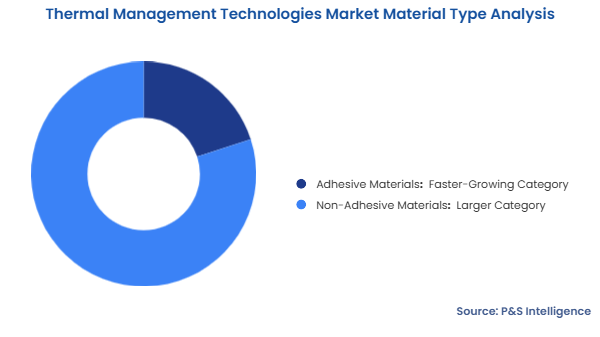
The non-adhesive materials category held the larger market share, of 80%, in 2024. This is because non-adhesive materials, especially metals, such as copper and aluminum, are widely used in heat sinks, thermal interface materials, and cooling systems in various industries. Their high thermal conductivity and cost-effectiveness make them essential in thermal management systems.
The adhesive materials category will grow at the higher CAGR during the forecast period. Thermally conductive adhesives are increasingly being used in the electronics and automotive industries due to their ability to bond components, while allowing heat dissipation. The growth is driven by the increasing use of compact electronics and miniaturized devices, which require efficient thermal management and reliable bonding solutions.
The material types analyzed here are:
Adhesive Materials (Faster-Growing Category)
Non-Adhesive Materials (Larger Category)
Device Type Analysis
The convection cooling category held the largest market share, of 45%, in 2024. This is because convection cooling systems are simpler, more cost-effective, and widely used in applications ranging from the consumer electronics to the automotive industry. They are effective for devices that generate moderate amounts of heat.
The advanced cooling category will grow at the higher CAGR, of 13.5%, during the forecast period. This is due to the increasing power density in data centers, high-performance computing, and electric vehicles, which require more efficient cooling solutions to manage higher thermal loads. The shift toward liquid cooling and advanced solutions is driven by the need for better efficiency in cooling systems.
The applications analyzed here are:
Convection Cooling (Largest Category)
Conduction Cooling
Advanced Cooling (Fastest-Growing Category)
Hybrid Cooling
Service Analysis
The optimization & post-sale support category will grow at the higher CAGR during the forecast period, as industries increasingly adopt complex cooling solutions, post-installation services, such as optimization, maintenance, and support. This is driven by the need for continuous performance monitoring, system upgrades, and troubleshooting to ensure long-term operational efficiency, especially in data centers and electric vehicles.
The services analyzed here are:
Installation & Calibration (Larger Category)
Optimization & Post-Sale Support (Faster-Growing Category)
End User Analysis
The consumer electronics category held the largest market share, of 30%, in 2024. With the growing level of miniaturization of the installed components, consumer electronics, such as tablets, smart home products, smartwatches, and smartphones, are becoming more powerful. These devices use processors with millions of semiconductors circuits, displays that offer a high resolution and brightness, batteries with a high energy density, high-performance LEDs, and many more complex components. These components generate a lot of heat, which must be dissipated. To ensure the devices and components work properly, thermal management tools are used.
Moreover, the rising adoption of the internet of things (IoT), which enables communication between ‘things’, or electronic devices and sensors, using the internet, has driven the usage of connected devices in recent years. This is because electronics & semiconductor companies are focusing on developing smart devices and machines equipped with IoT capabilities.
The automotive category will grow at the highest CAGR during the forecast period. This is due to the rising popularity of electric vehicles with zero emissions, itself on account of the surging need to reduce the usage of fossil fuels. Additionally, consumers and governments are more concerned than ever about climate change. Thus, according to the International Energy Agency, around 10.1 million electric cars were sold in 2022 globally.
Temperature is considered one of the major factors that govern the performance and life of batteries. Hence, vehicles that run on an electric or hybrid powertrain require a battery thermal control system. Therefore, the rise in the usage of electric vehicles will, such as drive the demand for efficient heat dissipation systems. Moreover, auto component companies are actively investing in making more-efficient battery solutions for upcoming BEVs.
The services analyzed here are:
Automotive (Fastest-Growing Category)
Data Centers and Servers
Consumer Electronics (Largest Category)
Healthcare
Enterprise
Aerospace and Defense
Telecom
Renewable Energy
Food and Beverages
Drive strategic growth with comprehensive market analysis
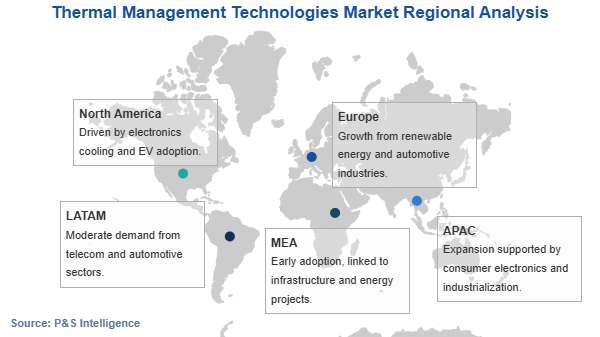
APAC held the largest share, of 35%, in 2024, due to the rising application of heat dissipation solutions in the healthcare sector, specifically in electronic medical devices. In addition to this, the increasing industrialization and urbanization rates, presence of key market players in the region, and government initiatives for installing EV charging stations are the major factors driving the growth of the market.
China Thermal Management Technologies Market Size
China is the largest market in the region for thermal management technologies, due to rapid industrialization and electrification. Electric vehicles (EVs), data centers, and consumer electronics are primary drivers, all requiring efficient heat dissipation to ensure performance and longevity. In EVs, battery thermal control is critical to safety and range. Data centers, expanding with cloud and AI growth, need advanced cooling systems to prevent overheating. High-performance computing, 5G infrastructure, and LED lighting also fuel demand. Additionally, China's push for energy efficiency and carbon neutrality is encouraging the adoption of innovative cooling solutions across manufacturing and power electronics, making thermal management a vital enabling technology.
Europe Thermal Management Technologies Market Size
Europe is also expected to witness significant growth over the forecast period, due to the rising demand for electronic gadgets. In addition, the increasing awareness among the regional population regarding the environment is predicted to boost the adoption of eco-friendly heat management solutions across various applications. Moreover, the rising number of advanced electronics R&D facilities in the U.K. and Germany boosts the adoption of these technologies in the region.
The regions and countries analyzed in this report are:
North America (Fastest-Growing Regional Market)
U.S. (Larger Country Market)
Canada (Faster-Growing Country Market)
Europe
Germany (Largest Country Market)
U.K. (Fastest-Growing Country Market)
France
Italy
Spain
Rest of Europe
Asia-Pacific (Largest Regional Market)
Japan
China (Largest Country Market)
India (Fastest-Growing Country Market)
Japan
South Korea
Australia
Rest of APAC
Latin America
Brazil (Largest Country Market)
Mexico (Fastest-Growing Country Market)
Rest of LATAM
Middle East and Africa
Saudi Arabia (Largest Country Market)
South Africa
U.A.E. (Fastest-Growing Country Market)
Rest of MEA
Thermal Management Technologies Market Share
The thermal management technologies market is characterized by a consolidated competitive structure, with the leading companies holding a significant portion of the market. This concentration is driven by the technical expertise and substantial capital investments required to develop advanced thermal management solutions. The top companies have established strong market positions through research and development capabilities, an extensive product portfolio, and strategic partnerships with major end-users.
Market consolidation has accelerated through strategic acquisitions and partnerships, aimed at expanding technological capabilities and increasing market reach. The industry requires substantial investments in research and development, manufacturing facilities, and specialized expertise, creating barriers to entry for smaller players. Established companies benefit from economies of scale, solid intellectual property portfolios, and long-term customer relationships to maintain competitive advantages.
The competitive landscape is marked by intense innovation competition, with companies allocating a significant portion of their revenues to research and development efforts. Patent portfolios are becoming valuable assets, with top companies maintaining strong intellectual property positions in key thermal management technologies. This emphasis on innovation addresses the rapidly evolving thermal challenges across electronics, automotive, and industrial applications.
In May 2025, Fabric8Labs Inc. revealed that its innovative manufacturing technology has been chosen by AEWIN Technologies to provide advanced thermal management solutions for the upcoming generation of Edge AI systems.
In February 2025, Carrier Global Corporation introduced the Carrier QuantumLeap suite of solutions thermal management in data centers.
In June 2024, Delta Electronics Inc. unveiled advanced energy-efficient solutions for AI applications under the initiative Discovering Delta's Cloud to Edge AI. This initiative highlighted Delta's commitment to enhancing energy efficiency across AI-driven data centers, from cloud to edge infrastructures.
In April 2024, Naxnova, a subsidiary of Astarc Group; announced the acquisition of Advanced Thermal Technologies (ATT), a thermal management solution provider based in Austria. This strategic move enhances Naxnova's capabilities in European markets and expands its product portfolio for industrial applications.
In March 2024, Laird Thermal Systems acquired Tark Inc., a U.S.-based supplier specializing in pumps and complete cooling packages for medical and industrial CT and X-ray tube applications.
Want a report tailored exactly to your business need?
Leading companies across industries trust us to deliver data-driven insights and innovative solutions for their most critical decisions. From data-driven strategies to actionable insights, we empower the decision-makers who shape industries and define the future. From Fortune 500 companies to innovative startups, we are proud to partner with organisations that drive progress in their industries.
Client Testimonials
Working with P&S Intelligence and their team was an absolute pleasure – their awareness of timelines and commitment to value greatly contributed to our project's success. Eagerly anticipating future collaborations.
McKinsey & Company
India
Unmatched Standards
Our insights into the minutest levels of the markets, including the latest trends and competitive landscape, give you all the answers you need to take your business to new heights
Complete Data Security
We take a cautious approach to protecting your personal and confidential information. Trust is the strongest bond that connects us and our clients, and trust we build by complying with all international and domestic data protection and privacy laws