Key Highlights
| Study Period | 2019 - 2032 |
| Market Size in 2024 | USD 5.7 Billion |
| Market Size in 2025 | USD 6.0 Billion |
| Market Size by 2032 | USD 8.6 Billion |
| Projected CAGR | 5.4% |
| Largest Region | Europe |
| Fastest Growing Region | APAC |
| Market Structure | Fragmented |

| Study Period | 2019 - 2032 |
| Market Size in 2024 | USD 5.7 Billion |
| Market Size in 2025 | USD 6.0 Billion |
| Market Size by 2032 | USD 8.6 Billion |
| Projected CAGR | 5.4% |
| Largest Region | Europe |
| Fastest Growing Region | APAC |
| Market Structure | Fragmented |
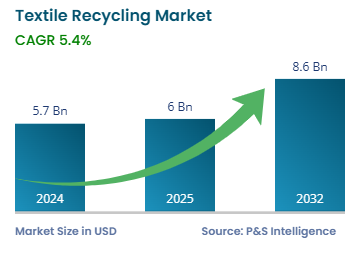
Explore the market potential with our data-driven report
The textile recycling market size was USD 5.7 billion in 2024, which is predicted to reach USD 8.6 billion by 2032, growing at a CAGR of 5.4% during 2025–2032.
The market growth is primarily driven by the increasing environmental awareness, stringent government regulations promoting circular economy principles, and the mounting pressure on fashion brands to adopt sustainable practices in response to the environmental impact of textile waste.
The textile industry is one of the most-resource-intensive sectors globally, with the fashion industry alone generating substantial waste volumes annually. The growing recognition of textile waste as a critical environmental challenge has catalyzed significant investments in recycling infrastructure and technology development across developed and emerging markets. Major fashion retailers and brands are increasingly integrating recycled fibers into their product lines, driven by consumer demand for sustainable fashion and regulatory frameworks such as extended producer responsibility programs implemented across European and North American markets.
The technological advancement in recycling processes has been particularly significant, with chemical recycling methods evolving from laboratory-scale experiments to pilot commercial operations. These innovations enable the recovery of high-quality fibers from complex blended textiles that were previously considered non-recyclable, opening new opportunities for circular fashion initiatives.
The cotton category held the largest share in the textile recycling market in 2024, of 35%, primarily due to its widespread use in apparel manufacturing and favorable recycling characteristics. Cotton's natural fiber composition enables more straightforward mechanical recycling processes compared to synthetic materials, making it economically viable for recyclers to process. The abundance of cotton in post-consumer waste streams, combined with established collection and processing infrastructure, sustains its dominant position in the recycling market.
The polyester & polyester fiber category is experiencing the fastest growth, during 2025–2032. This rapid expansion is driven by technological advances in chemical recycling that enable high-quality fiber recovery from both post-consumer textiles and PET bottles. The widespread availability of polyester waste from fast fashion consumption, combined with industry commitments to increase recycled polyester content, fuels this growth trajectory. According to Textile Exchange, the fashion industry has committed to increasing recycled polyester usage from 14% in 2019 to 45% by 2025 through the 2025 Recycled Polyester Challenge.
These materials are covered:
The post-consumer category dominated the market in 2024 with a share of 80%, reflecting the substantial volume of textile waste generated by households globally. The continuous flow of discarded clothing, driven by fast fashion consumption patterns and shortened garment lifespans, provides abundant feedstock for recycling operations. Collection infrastructure improvements, including textile take-back programs and separate collection systems mandated by regulations, enhance the accessibility of post-consumer waste for recyclers.
The pre-consumer category is witnessing the higher CAGR, during the forecast period, attributed to the superior quality and consistency of production waste. Pre-consumer waste, including cutting scraps and production overruns, offers cleaner and more homogeneous materials that simplify sorting and processing requirements. Manufacturers increasingly recognize the economic benefits of recycling production waste internally, establishing closed-loop systems that reduce raw material costs while meeting sustainability targets.
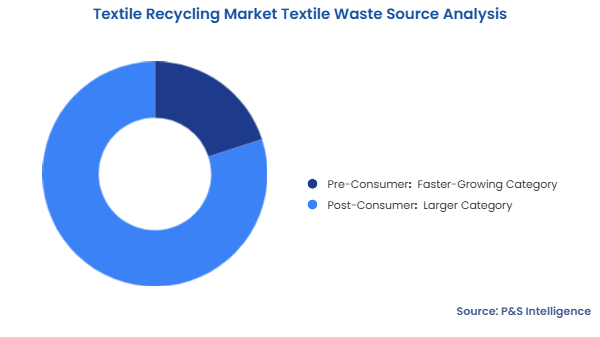
These textile waste sources are covered:
The mechanical category held the larger market share in 2024, of 75%, due to its established infrastructure and lower operational complexity compared to chemical methods. Mechanical recycling technologies have been operational since the Industrial Revolution and continue to dominate the market through cost-effectiveness and proven scalability. The process is particularly suitable for single-fiber textiles and provides immediate solutions for textile waste diversion from landfills.
Chemical recycling is expected to witness the higher CAGR, during 2025–2032, driven by breakthrough technologies that address the limitations of mechanical methods. Chemical processes enable the recycling of blended fabrics and maintain fiber quality through multiple recycling cycles, addressing key challenges in textile circularity. Investment in chemical recycling infrastructure is accelerating as companies recognize its potential to handle complex textile waste streams and produce virgin-quality outputs.
These recycling processes are covered:
The apparel category commanded the largest share, of 40%, in 2024, driven by the fashion industry's substantial waste generation and growing commitments to circular fashion. Major apparel brands are incorporating recycled fibers into their collections as part of sustainability strategies, creating consistent demand for recycled textiles. The category benefits from established supply chains and consumer acceptance of recycled content in clothing products.
The industrial and institutional category is projected to grow at the highest CAGR, during the forecast period, as industries recognize the performance characteristics and cost advantages of recycled textiles. Applications in automotive interiors, insulation materials, and industrial wiping cloths are expanding rapidly, driven by corporate sustainability mandates and regulatory requirements for recycled content in industrial products.
These end-use industries are covered:
Drive strategic growth with comprehensive market analysis
Europe held the largest share in the global textile recycling market in 2024, of 40%, primarily driven by the comprehensive regulatory frameworks and advanced recycling infrastructure. The region's leadership position is reinforced by the European Union's circular economy initiatives and the impending implementation of mandatory Extended Producer Responsibility schemes for textiles, which will require producers to finance collection, sorting, and recycling operations across member states. According to McKinsey, Europe could achieve fiber-to-fiber recycling at scale by 2030, with the potential to process 18% to 26% of gross textile waste through existing and emerging technologies. In the long term, as these technologies mature and infrastructure expands, up to 70% of textile waste could potentially be recycled through fiber-to-fiber systems. France, the Netherlands, and Sweden have already implemented national EPR schemes, establishing blueprints for other European nations to follow in developing comprehensive textile waste management systems.
Asia-Pacific is expected to be the fastest-growing regional market, with a CAGR of approx. 5.5% during 2025–2032, driven by the region's position as the global textile manufacturing hub and rapidly increasing waste generation. The region produces and processes the majority of the world's textiles, creating substantial volumes of both pre-consumer and post-consumer waste. The rapid economic growth and urbanization across Asia-Pacific countries have led to increased textile consumption and correspondingly higher waste generation rates. Rising environmental awareness among consumers and governments, particularly in developed markets like Japan and South Korea, drives investment in recycling infrastructure and technology. The presence of established textile recycling hubs, such as Panipat in India, Asia's largest textile recycling center, provides existing infrastructure that can be scaled and modernized to meet growing demand.
China commanded the largest share within Asia-Pacific. The country's dominance stems from its position as the world's largest textile manufacturer and exporter, generating substantial industrial waste suitable for recycling. Chinese companies are investing heavily in chemical recycling technologies to move beyond traditional mechanical methods, aiming to produce higher-quality recycled fibers that meet international standards.
Government initiatives promoting circular economy principles and stricter environmental regulations have accelerated the development of textile recycling infrastructure across major manufacturing provinces. The challenge of managing increasing domestic consumption alongside export-oriented production creates dual waste streams that require sophisticated recycling solutions. Chinese textile recyclers benefit from proximity to manufacturing facilities, reducing transportation costs and enabling efficient closed-loop systems within industrial clusters.
North America held a substantial share of 25% in the global textile recycling market in 2024. The region's growth is driven by increasing regulatory pressures, heightened consumer consciousness regarding textile sustainability, and rapid advancement of the circular fashion economy. According to the U.S. Environmental Protection Agency, Americans generate 17 million tonnes of textile waste annually, with only 14.7% being recycled, highlighting significant growth potential.
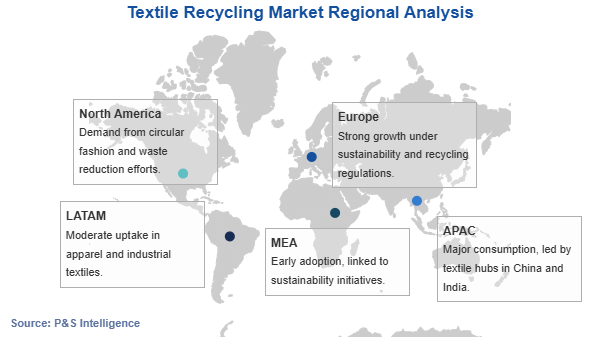
The regions and countries analyzed in this report are:
The global textile recycling market exhibits a fragmented competitive landscape characterized by the presence of numerous regional players alongside emerging technology companies. This fragmentation creates opportunities for specialized players to establish leadership positions in specific recycling technologies or geographic markets. The competitive dynamics are evolving rapidly as traditional waste management companies expand into textile recycling while fashion brands establish backward integration through investments in recycling infrastructure. Strategic partnerships between technology developers, waste collectors, and fashion brands have become increasingly common, creating integrated value chains that enhance operational efficiency and ensure consistent feedstock supply.
The market has witnessed significant consolidation activity, with larger players acquiring innovative startups to access proprietary technologies and expand their recycling capabilities. The market leaders have established their positions through combinations of technological innovation, strategic partnerships, and geographical expansion. Companies that successfully navigate the complex regulatory landscape while maintaining cost competitiveness are best positioned to capture market share as the industry scales toward commercial viability.
Want a report tailored exactly to your business need?
Request CustomizationLeading companies across industries trust us to deliver data-driven insights and innovative solutions for their most critical decisions. From data-driven strategies to actionable insights, we empower the decision-makers who shape industries and define the future. From Fortune 500 companies to innovative startups, we are proud to partner with organisations that drive progress in their industries.

Working with P&S Intelligence and their team was an absolute pleasure – their awareness of timelines and commitment to value greatly contributed to our project's success. Eagerly anticipating future collaborations.
McKinsey & Company
India
Our insights into the minutest levels of the markets, including the latest trends and competitive landscape, give you all the answers you need to take your business to new heights

We take a cautious approach to protecting your personal and confidential information. Trust is the strongest bond that connects us and our clients, and trust we build by complying with all international and domestic data protection and privacy laws


Customize the Report to Align with Your Business Objectives

Request the Free Sample Pages