This Report Provides In-Depth Analysis of the Terminal Tractor Market Report Prepared by P&S Intelligence, Segmented by Propulsion (Diesel, CNG, Hybrid, Electric), Type (Manual, Automated), Tonnage (Less than 50 Tonnes, 50-100 Tonnes, More than 100 Tonnes), Axle (4x2, 4x4, 6x4), Model (On-Road, Off-Road), Application (Airport, Marine, Oil & Gas, Warehouse & Logistics, Food & Beverages, Rail Logistics), and Geographical Outlook for the Period of 2019 to 2032
Explore the market potential with our data-driven report
Terminal Tractor Market Future Outlook
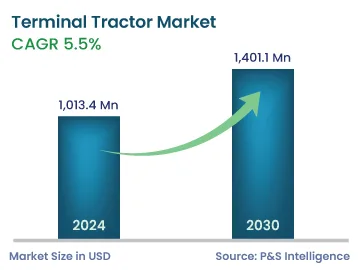
The global terminal tractor market was valued at USD 1,013.4 million in 2024 and is projected to reach USD 1,537.5 million by 2032, expanding at a compound annual growth rate (CAGR) of 5.5% during the forecast period (2025–2032).
The terminal tractor market is driven primarily by the increasing demand for efficient cargo handling and logistics solutions. Terminal tractors, also known as yard trucks or shunt trucks, are specialized vehicles used in ports, warehouses, and intermodal terminals to move semi-trailers and containers over short distances. As global trade volumes rise and supply chains become more complex, the need for efficient and reliable terminal tractors has become more critical. This growth is particularly evident in regions with expanding port infrastructure and industrial hubs.
A significant driver of market growth is the surge in e-commerce and the need for faster, more reliable delivery systems. The increase in online retail has led to a higher volume of shipments, which in turn requires optimized terminal operations. Modern terminal tractors are designed to enhance operational efficiency, reduce turnaround times, and lower labor costs. This efficiency is further amplified by technological advancements such as automation and telematics, which allow operators to monitor vehicle performance, manage fleets, and improve safety.
Another key trend in the market is the shift toward electrification and sustainable technologies. Electric and hybrid terminal tractors are gaining popularity due to stricter environmental regulations and the growing focus on reducing carbon emissions in port and logistics operations. Some manufacturers are also experimenting with hydrogen fuel cell-powered tractors, which offer zero-emission solutions while maintaining high operational performance. This trend aligns with the broader push toward greener logistics and corporate sustainability initiatives.
Terminal Tractor Market Trends & Drivers
Growing Adoption of Electric Terminal Tractors Is Major Trend
Electric tractors are growing in demand due to the rise in environmental concerns and increase in the price of fuels. The transportation sector is a significant contributor to the worldwide greenhouse gas emissions. According to the U.S. Environmental Protection Agency, the transportation sector holds the largest share of greenhouse gas emissions in the country, of 29%. The primary source of transportation-related greenhouse gas emissions is the combustion of fossil fuels in cars, trucks, ships, trains, and airplanes.
As the global efforts to combat climate change intensify, industries are seeking ways to reduce their carbon footprint; hence, these alternatives hold a high demand growth potential. Electric tractors offer a cleaner alternative to traditional diesel-powered variants, as the former produce zero tailpipe emissions.
Furthermore, EVs typically have lower operating costs compared to their diesel counterparts. Electric tractors have fewer moving parts, require less maintenance, and benefit from the lower electricity costs compared to those of diesel fuel. Over their lifespan, these cost savings can be significant. Therefore, they are being actively used by a number of businesses, such as ports, freight transporters, and supermarkets, to support their specific use cases and cut carbon emissions. For instance, in April 2023, Autocar LLC, which is a manufacturer of severe-duty vocational trucks, announced that it has begun supplying Walmart with a fleet of battery-electric terminal tractors.
Kalmar, Terberg, and BYD are at the forefront of developing electric terminal tractors. Kalmar's Ottawa T2E electric terminal tractor is designed for heavy-duty applications, offering zero-emission solutions without compromising performance. Terberg's YT203-EV model is tailored for port operations, providing high torque and extended battery life to meet the demands of container handling. These innovations highlight the industry's commitment to sustainability and operational efficiency.
E-Commerce & Logistics Demand Is Key Market Driver
The rapid expansion of e-commerce is significantly influencing the demand for terminal tractors, particularly in logistics hubs and urban distribution centers. The U.S. International Trade Administration forecasts global B2B e-commerce sales value to reach USD 36 trillion by 2026. As consumer expectations shift to faster deliveries, the efficiency of last-mile logistics becomes paramount. Terminal tractors, designed for short-distance container and trailer movement, are increasingly integral to operations in ports, warehouses, and intermodal terminals. Their ability to streamline intra-facility transportation enhances overall supply chain efficiency, directly impacting the speed and reliability of e-commerce deliveries.
Government initiatives play a crucial role in supporting this growth. Government programs such as Made in China 2025 and Make in India bolster digital infrastructure and manufacturing capabilities, respectively. Additionally, the development of logistics parks and multimodal hubs, such as the 364-acre logistics park in Greater Noida and the 825-acre hub in Dadri, are enhancing the efficiency of goods movement across the country.
Intra-city logistics is also evolving to meet the needs of e-commerce. Innovations such as freight pooling models are optimizing delivery routes and reducing underutilization of vehicles. These models, which include electric mini-trucks, are contributing to more sustainable and efficient urban logistics operations.
The growth of quick commerce further emphasizes the need for agile logistics solutions. Platforms delivering products within minutes are becoming increasingly popular, with projections indicating a 40% annual growth rate until 2030. This rapid delivery model necessitates efficient intra-facility transportation, where terminal tractors play a vital role in ensuring timely movement of goods within warehouses and distribution centers.
High Capital Initial Investment Is Key Market Challenge
High initial capital investment remains one of the most significant challenges restraining the growth of the terminal tractor market, especially for electric and hybrid variants. Traditional diesel-powered tractors have long dominated the sector due to their relatively low upfront cost and wide availability. In contrast, electric terminal tractors require a much larger initial outlay, primarily because of the high cost of advanced lithium-ion batteries and supporting charging infrastructure. This cost disparity often discourages small and medium-sized enterprises (SMEs) from transitioning to sustainable alternatives despite their long-term benefits.
The battery system alone accounts for a substantial portion of the purchase price of an electric terminal tractor. While battery costs have been declining over the past decade, they still represent a major expense compared to the engine systems of diesel tractors. In many cases, the purchase price of an electric tractor can be nearly double that of its diesel counterpart. For companies operating on tight budgets or with limited access to financing, this upfront expense becomes a major barrier to adoption, even when the long-term operational savings are factored in.
Terminal Tractor Market Segmentation Analysis
Propulsion Analysis
The diesel category held the largest market share, of 65%, in 2024. Diesel-powered terminal tractors continue to dominate the global market, accounting for the largest share among propulsion types. Their market leadership is largely due to their proven performance, reliability, and the widespread availability of diesel refueling infrastructure.
The electric category will grow at the highest CAGR, of 5.6%, during the forecast period, driven by tightening emissions regulations, corporate sustainability goals, and advancements in battery technology.
Based on propulsion, the market has the following categories:
Diesel (Largest Category)
CNG
Hybrid
Electric (Fastest-Growing Category)
Type Insights
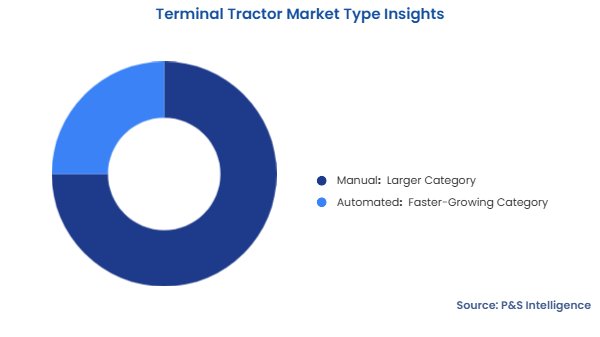
The manual category dominates the market with a share of 75% in 2024. Manually driven terminal tractors are widely used in all major ports worldwide. In addition, they are the conventional kind and have been in use for a long time. As human operators can work around each piece of equipment's flaws or deal with exceptions in operational procedures, manual terminal tractors can function even when their machines are not in perfect working order.
The automated bifurcation is expected to witness the faster growth over this decade. An autonomous tractor is a specialized vehicle that is used to transport containers within a terminal. It uses a variety of software and sensors to navigate its environment and avoid obstacles.
Based on type, the market has the following categories
Manual (Larger Category)
Automated (Faster-Growing Category)
Tonnage Analysis
The 50–100 tonnes category is the largest in the terminal tractor market, with an approximately 55% share in 2024. This category strikes an ideal balance between capacity, versatility, and efficiency, making it the preferred choice for most container-handling operations in ports, intermodal yards, and logistics centers. Its adaptability across diverse operating conditions, lower maintenance requirements, and cost-effectiveness further contribute to its widespread adoption and dominance in the global market.
The more than 100 tonnes category is projected to achieve the highest compound annual growth rate (CAGR) of around 5.7% through 2032. This is primarily due to the increasing demand for high-capacity terminal tractors in heavy-duty industrial applications such as mining, port operations, and large-scale logistics hubs, where durability, efficiency, and high load-bearing capabilities are critical. The expansion of global trade, coupled with rising infrastructure investments and port automation, further fuels this segment’s rapid growth. Additionally, advancements in drivetrain technology and emission regulations are prompting fleet upgrades toward more robust, high-tonnage models, particularly in regions with expanding bulk cargo throughput.
Based on tonnage, the market has the following categories:
Less than 50 Tonnes
50–100 Tonnes (Largest Category)
More than 100 Tonnes (Fastest-Growing Category)
Axle Analysis
The 4X2 category holds the largest share, of 55%, in the market in 2024. This is mainly due to the rising demand for two-wheel-drive vehicles at ports and terminals, as they are more fuel-efficient than 4X4 variants. In addition to this, they are easier to use and require less maintenance than others. Therefore, their usage is rapidly increasing in developing countries, such as Brazil, India, and China.
The 6x4 category will grow at the highest CAGR, of 5.9%, during the forecast period. This strength is driven by increasing demand for higher axle load capacity and improved traction, especially in heavy-duty logistics applications such as major ports, rail yards, and industrial terminals.
Based on axle, the market has the following categories:
4x2 (Largest Category)
4x4
6x4 (Fastest-Growing Category)
Model Insights
The off-road category held the larger market share, of 60%, in 2024. Off-road terminal tractors remain the dominant category in terms of sheer volume. These models, designed specifically for operations within confined environments like ports, warehouses, and distribution yards (rather than public roads), do not need to meet stringent road regulations.
The on-road category will grow at the higher CAGR, of 5.8%, during the forecast period. On-road tractors are adapted for public-road use and must comply with Department of Transportation (DOT) rules, including emission standards, safety features like ABS, VIN titling, and annual inspections.
Based on model, the market has the following categories:
On-Road (Faster-Growing Category)
Off-Road (Larger Category)
Application Analysis
The warehouse & logistics category held the largest market share, of 35%, in 2024, and it will grow at the higher CAGR of 5.7%, during the forecast period. This dominance stems from the explosion of e-commerce, which has dramatically increased the need for rapid and efficient trailer handling within distribution centers. Additionally, the rising adoption of automation, just-in-time inventory models, and the expansion of fulfillment centers near urban hubs are driving sustained investment in terminal tractors. These vehicles enhance operational efficiency, reduce turnaround times, and support the high throughput requirements of modern logistics networks, making them indispensable in this sector.
Based on application, the market has the following categories:
Airport
Marine
Oil & Gas
Warehouse & Logistics (Largest and Fastest-Growing Category)
Food & Beverages
Rail Logistics
Drive strategic growth with comprehensive market analysis
Terminal Tractor Market Geographical Analysis
North America Terminal Tractor Market Insights
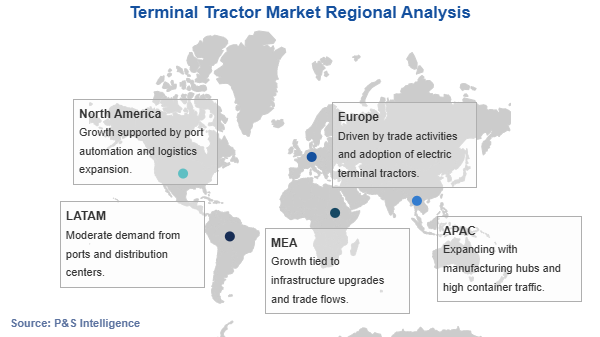
North America held the largest market share over the historical period due to the presence of large industries on the continent. According to the North American Council for Freight Efficiency’s report, approximately 25,242 terminal tractors are operational in the U.S. and Canada. Additionally, if all the terminal tractors in the U.S. and Canada were electrified, emissions would reduce by 929,687 metric tons of CO2 each year.
Moreover, a rising number of manufacturers in the U.S. are actively investing in new equipment, as many countries are facing labor shortages in the logistics and transportation industry. These automobiles help address this issue by reducing the need for human laborers for moving and positioning trailers and containers. For instance, Orange EV is expanding into the Canadian market, driven by the claimed strong financial and operational benefits of its electric yard truck fleets.
Europe Terminal Tractor Market Insights
Europe will witness the fastest growth over the forecast years, with a CAGR of 5.9%. The market in the continent is mainly driven by the presence of numerous players who operate through expansive dealer and distribution networks, including Konecranes, MAFI Transport-Systems GmbH, and MOL CY.
Moreover, with the rise in the adoption of technologies such as automation and the expansion of automated terminals across Europe, productivity will increase. For instance, the Netherlands' ECT Delta, which has been in use since the early 1990s, was the first automated terminal in the world. The HHLA CTA Terminal in Hamburg, Germany, is another such facility in this region.
With the rising rate of urbanization, cities are seeing increasing congestion and limited space for maneuvering large vehicles. These freight carriers are well-suited for these environments due to their compact size and easy maneuvering. According to an article, 85% of the people in Europe live in urban areas. In addition to this, since they offer access to trade and transportation, natural resources, and recreational activities, coastal areas have long been major contributors to economic prosperity. Therefore, the maritime industry continues to be crucial to the economy and society at large, with high hopes for future expansion.
Furthermore, due to these tractors' usefulness in logistics and distribution handling, OEMs have a tremendous opportunity, as the growth of the e-commerce sector has increased the demand for warehouses and distribution centers.
These regions and countries are covered:
North America (Largest Regional Market)
U.S. (Larger Country)
Canada (Faster-Growing Country)
Europe (Fastest-Growing Regional Market)
Germany (Largest Country)
U.K. (Fastest-Growing Country)
France
Italy
Spain
Rest of Europe
Asia-Pacific
China (Largest Country)
India (Fastest-Growing Country)
Singapore
Japan
South Korea
Rest of APAC
Latin America
Brazil (Largest Country)
Mexico (Fastest-Growing Country)
Rest of LATAM
Middle East and Africa
U.A.E. (Largest Country)
Saudi Arabia (Fastest-Growing Country)
Rest of MEA
Terminal Tractor Market Share
The terminal tractor market is generally considered fragmented, with a mix of global leaders and numerous regional players competing for share. Unlike industries dominated by a few giants, this market features several established manufacturers such as Kalmar (Cargotec), Terberg Group, TICO, Autocar, and Konecranes, along with many smaller companies serving regional or niche demand. This competitive landscape prevents any single firm from holding a dominant market share, leading to fragmentation where multiple companies offer similar solutions tailored to specific geographies or applications.
One of the main reasons for fragmentation is the diverse application base of terminal tractors. They are used across ports, airports, warehouses, rail logistics, and oil & gas facilities, each requiring customized solutions in terms of tonnage, axle configuration, or propulsion type. This diversity encourages regional manufacturers to thrive, as they can adapt quickly to local customer needs, regulatory standards, and pricing sensitivities. For example, European companies often emphasize electrification due to stricter emission laws, while Asian firms may focus on cost-effective diesel-powered models to cater to price-sensitive markets.
Key Terminal Tractor Companies:
Terberg Special Vehicles
TICO Tractors
MAFI Transport-Systems GmbH
Mol CY NV
REV Group Inc.
Autocar LLC
Orange EV LLV
Konecranes
Hoist Material Handling Inc.
Autocar LLC
SANY Group
Volvo Group
Global Terminal Tractor Companies News
In March 2025, Kalmar Corporation introduced its third-generation electric terminal tractor, the OT2 EV, produced at its Ottawa, Kansas, facility. The vehicle is intended for operations at container ports, terminals, and distribution facilities in North America.
In February 2025, SANY Heavy Industry Co. Ltd. released a new electric terminal tractor that lowers energy usage by 15%, with a consumption rate of 1.6 kWh per kilometer.
In May 2025, MAFI Transport-Systeme GmbH announced that in collaboration with Arnold NextG GmbH, it will implement a system to retrofit all MAFI vehicle platforms with a multi-redundant drive-by-wire system.
In July 2024, TICO Manufacturing Inc. introduced the next generation of its Pro-Spotter electric terminal tractor. The updated model includes additional battery and driveline options from multiple suppliers.
In March 2024, Kalmar Corporation entered into a partnership with Robotic Research OpCo LLC (d.b.a. Forterra) to develop the AutoTT, an autonomous terminal tractor, with production expected to begin by late 2026.
Want a report tailored exactly to your business need?
Leading companies across industries trust us to deliver data-driven insights and innovative solutions for their most critical decisions. From data-driven strategies to actionable insights, we empower the decision-makers who shape industries and define the future. From Fortune 500 companies to innovative startups, we are proud to partner with organisations that drive progress in their industries.
Client Testimonials
Working with P&S Intelligence and their team was an absolute pleasure – their awareness of timelines and commitment to value greatly contributed to our project's success. Eagerly anticipating future collaborations.
McKinsey & Company
India
Unmatched Standards
Our insights into the minutest levels of the markets, including the latest trends and competitive landscape, give you all the answers you need to take your business to new heights
Complete Data Security
We take a cautious approach to protecting your personal and confidential information. Trust is the strongest bond that connects us and our clients, and trust we build by complying with all international and domestic data protection and privacy laws