This Report Provides In-Depth Analysis of the Terminal Sterilization Services Market Report Prepared by P&S Intelligence, Segmented by Method (Ethylene Oxide Sterilization, Irradiation, Moist Heat), End User (Hospitals & Clinics, Pharmaceutical & Biotechnology Companies, Medical Device Manufacturing, Academic & Research Institutes), and Geographical Outlook for the Period of 2019 to 2032
Explore the market potential with our data-driven report
Terminal Sterilization Services Market Outlook
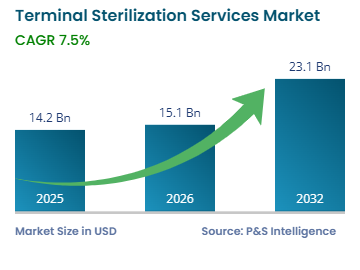
The global terminal sterilization services market size will be USD 14.2 billion in 2025, which is predicted to reach USD 23.1 billion by 2032, growing at a CAGR of 7.5% during 2026–2032.
The key factors driving market expansion include the rising prevalence of hospital-acquired infections, increasing outsourcing of sterilization processes by medical device manufacturers and pharmaceutical companies, and stringent regulatory requirements for ensuring product sterility and safety. The growing burden of HAIs represents a critical driver for terminal sterilization services adoption across healthcare facilities worldwide. According to the WHO, an average of 7 out of every 100 patients in acute-care hospitals in high-income countries will acquire at least one HAI during their hospital stay. This alarming infection rate has compelled healthcare institutions to prioritize comprehensive sterilization protocols for medical devices, surgical instruments, and pharmaceutical products. Terminal sterilization, which involves sterilizing products in their final packaging, provides the highest sterility assurance level and minimizes contamination risks throughout the supply chain.
The medical device industry's robust growth trajectory further amplifies demand for specialized sterilization services. As medical device manufacturers increasingly focus on core competencies, outsourcing non-core functions like terminal sterilization to specialized service providers has become a strategic imperative. This trend enables manufacturers to reduce capital expenditure, access advanced sterilization technologies, and maintain compliance with complex regulatory standards without establishing in-house capabilities.
Many medical device and pharmaceutical companies are outsourcing their sterilization processes to specialized contract sterilization service providers.
In October 2024, AptarGroup Inc. (ATR) won a contract from the U.S. federal government to advance development of its ActivShield sterilization technology for medical devices.
Outsourcing helps companies reduce operational costs, avoid expensive equipment investments, and focus on core manufacturing activities.
Contract sterilization providers offer advanced technologies, such as ethylene oxide, gamma, and e-beam sterilization, ensuring compliance with global regulatory standards.
Rising complexity and volume of medical devices have increased the need for reliable and large-scale sterilization partners.
Contract service providers often maintain multiple sterilization methods, giving manufacturers flexibility to choose the most suitable process for their products.
Growing regulatory scrutiny and the need for validated, traceable sterilization processes are driving companies to depend on certified contract facilities.
Expansion of healthcare infrastructure and medical device production, especially in emerging economies, is fueling demand for outsourced sterilization services.
Strategic collaborations and capacity expansions by contract sterilization companies are strengthening their market position and accelerating industry growth.
Growing Prevalence of Hospital-Acquired Infections Drives Market Expansion
The rising number of hospital-acquired infections (HAIs) has increased the demand for effective sterilization of medical instruments and devices.
The CDC says that on any particular day, approximately 1 in 31 patients in hospitals is affected by at least one healthcare-associated infection.
Hospitals and healthcare facilities are prioritizing terminal sterilization to prevent the spread of infections caused by bacteria, viruses, and fungi.
The Centers for Disease Control and Prevention (CDC) announced a USD 2.1 billion investment to improve infection prevention, control, and surveillance across U.S. healthcare settings (hospitals, nursing homes, dialysis clinics, ambulatory surgery centers), under the American Rescue Plan Act.
Of that amount, roughly USD 1.25 billion was to be issued over three years to 64 state/local/territorial health departments for prevention/control in healthcare settings.
Regulatory bodies like the WHO and CDC emphasize strict infection control protocols, pushing healthcare providers to adopt reliable sterilization practices.
Terminal sterilization ensures that medical devices are completely free from viable microorganisms before patient use, reducing infection risks.
The growing use of invasive procedures and complex medical devices further increases the need for sterilization services.
The global rise in hospital admissions and surgeries contributes directly to the need for large-scale sterilization capacity.
Healthcare-associated infection control programs in both developed and emerging markets are boosting the utilization of terminal sterilization services.
Stringent Government Policies Could Pose Market Challenges
Governments and health authorities impose strict regulations on sterilization processes to ensure patient safety and prevent contamination of medical products.
Regulatory bodies such as the U.S. FDA, European Medicines Agency (EMA), and ISO set specific guidelines for sterilization validation, process control, and documentation.
The U.S. Environmental Protection Agency (EPA) requires nearly 90 commercial sterilization facilities to reduce their ethylene oxide emissions by more than 90% through the installation of upgraded abatement and pollution-control technologies, continuous emissions monitoring, and more-stringent oversight.
Many medical device manufacturers choose to outsource sterilization to contract service providers who already comply with these regulations.
Frequent updates in safety and environmental rules, especially around ethylene oxide emissions, are driving facilities to invest in upgraded sterilization technologies.
Stringent auditing and quality assurance procedures push smaller manufacturers toward professional sterilization partners with proven regulatory compliance.
Service providers that maintain regulatory certifications gain a competitive advantage, fueling demand for contract sterilization services.
These evolving compliance requirements globally contribute to sustained market growth for terminal sterilization service providers.
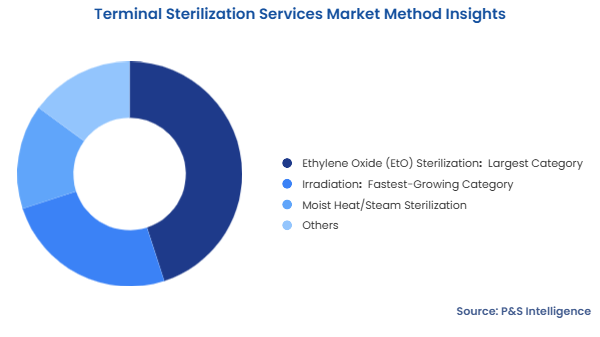
The ethylene oxide sterilization category holds the largest share in 2025, of approximately 45%, driven by its versatility in sterilizing heat-sensitive and moisture-sensitive medical devices within final packaging. Ethylene oxide remains the preferred method for sterilizing complex medical devices that cannot withstand high temperatures or moisture exposure, including catheters, surgical kits, implantable devices, and electronic medical equipment. This gas sterilization process effectively penetrates porous materials and device lumens, ensuring comprehensive microbial elimination throughout product configurations. The method's compatibility with a wide range of materials, including plastics, electronics, and combination products, makes it indispensable for modern medical device manufacturing.
However, environmental and regulatory concerns regarding ethylene oxide emissions have prompted service providers to implement advanced emission control technologies and explore alternative sterilization modalities. Despite these challenges, ethylene oxide sterilization maintains its dominant position due to the absence of viable alternatives for many temperature-sensitive and complex medical devices.
Irradiation will witness the highest CAGR during the forecast period, driven by growing adoption of gamma, electron beam, and X-ray sterilization technologies. Irradiation sterilization offers several compelling advantages, including room temperature processing, deep penetration capabilities, and the ability to sterilize pre-sealed packages without compromising packaging integrity. Gamma sterilization using Cobalt-60 isotopes provides uniform dose distribution and has established a strong track record in medical device sterilization. Electron beam sterilization delivers rapid processing times and precise dose control, making it attractive for high-volume manufacturing operations. X-ray sterilization represents an emerging technology offering similar benefits to electron beam with enhanced penetration depth and material compatibility.
The hospitals & clinics category holds the largest share in 2025, of approximately 45%, as these facilities maintain extensive inventories of reusable medical devices, surgical instruments, and equipment requiring routine terminal sterilization between patient uses. According to a report from the Centers for Disease Control and Prevention (CDC), more than 38,000 active hospitals, long-term care facilities, and other healthcare facilities supply data to the National Healthcare Safety Network (NHSN). Healthcare facilities face stringent infection control requirements and quality standards mandating comprehensive sterilization protocols for all reusable medical devices and instruments. Terminal sterilization services enable hospitals to maintain consistent sterility assurance while minimizing capital investment in sterilization equipment and infrastructure.
The growing volume of surgical procedures worldwide amplifies sterilization service requirements in hospital settings. Each surgical procedure generates substantial quantities of instruments and devices requiring terminal sterilization before reuse, creating continuous demand for sterilization capacity. Hospitals are increasingly outsourcing sterilization services to specialized providers offering validated processes, rapid turnaround times, and comprehensive traceability systems that support infection control programs and regulatory compliance.
Medical device manufacturing & packaging will experience the fastest CAGR during the forecast period, as manufacturers increasingly outsource terminal sterilization processes to specialized contract service providers. The medical device industry's shift toward outsourcing reflects several strategic considerations, including capital efficiency, technology access, and regulatory compliance. Establishing in-house sterilization capabilities requires substantial capital investment in equipment, facility infrastructure, process validation, and ongoing quality management systems. Contract sterilization services eliminate these fixed costs while providing access to multiple sterilization modalities, advanced process controls, and specialized expertise.
These end users are covered:
Hospitals & Clinics (Largest Category)
Pharmaceutical & Biotechnology Companies
Medical Device Manufacturing/Packaging Companies (Fastest-Growing Category)
Academic & Research Institutes
Others
Drive strategic growth with comprehensive market analysis
North America Terminal Sterilization Services Market Share
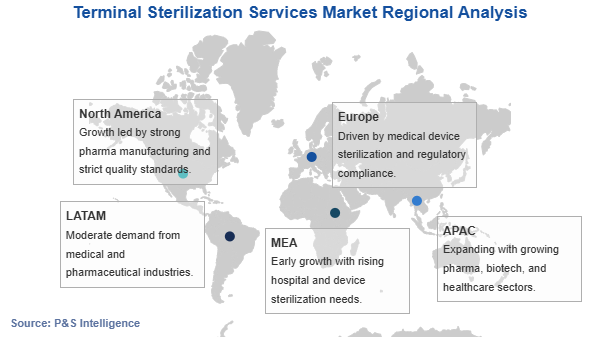
North America holds the largest share in 2025, of approximately 40%, and is expected to maintain its position in the coming years. This dominance stems from the region's advanced healthcare infrastructure, stringent regulatory environment, and strong presence of major medical device manufacturers and pharmaceutical companies. The region maintains the highest concentration of contract sterilization facilities globally, with established service providers operating extensive networks of ethylene oxide, gamma radiation, and electron beam sterilization centers.
U.S. Terminal Sterilization Services Market Share
The United States represents the dominant country market within North America, driven by several factors, including high surgical procedure volumes, advanced medical technology adoption, and comprehensive infection control programs. The FDA's rigorous regulatory requirements for medical device sterilization ensure consistent demand for validated terminal sterilization services that meet stringent quality standards. Healthcare facilities across the United States implement mandatory sterilization protocols for reusable medical devices, generating continuous service requirements for specialized sterilization providers. The region's emphasis on patient safety, combined with substantial liability risks associated with inadequate sterilization, drives healthcare institutions to partner with specialized service providers offering validated processes and comprehensive quality assurance programs.
Asia-Pacific is expected to witness the highest CAGR of approx. 8.0% during 2026–2032, driven by rapid healthcare infrastructure expansion, growing medical device manufacturing capabilities, and increasing awareness of infection control practices. The region's pharmaceutical and medical device industries are experiencing robust growth as multinational corporations establish manufacturing operations to serve both domestic and export markets. This industrial expansion creates substantial demand for terminal sterilization services to meet international quality standards and regulatory requirements.
China Terminal Sterilization Services Market Share
China represents the largest country market in Asia-Pacific, supported by its position as a global medical device manufacturing hub and rapidly expanding healthcare system. The Chinese government's healthcare reforms and increased public health investments are driving the modernization of healthcare facilities and adoption of international infection control standards. Medical device manufacturers in China increasingly require terminal sterilization services to access export markets where stringent sterilization validation and documentation are mandatory. Service providers are expanding gamma radiation and electron beam sterilization capacity across China to support the country's growing medical device industry and pharmaceutical sector.
India Terminal Sterilization Services Market Forecast
India is emerging as the fastest-growing country market within Asia-Pacific, driven by expanding healthcare infrastructure, growing medical tourism, and increasing domestic pharmaceutical production. The Indian government's initiatives to strengthen healthcare delivery and expand access to quality medical care are creating substantial opportunities for sterilization service providers. India's pharmaceutical industry, which serves both domestic and global markets, requires comprehensive terminal sterilization capabilities for product packaging, components, and finished goods. The country's cost-competitive manufacturing environment attracts international medical device companies seeking efficient sterilization solutions that meet global regulatory standards while maintaining economic efficiency.
The regions and countries analyzed in this report are:
North America (Largest Regional Market)
U.S. (Larger and Faster-Growing Country)
Canada
Europe
Germany (Largest Country Market)
U.K. (Fastest-Growing Country Market)
France
Italy
Spain
Rest of Europe
Asia-Pacific (Fastest-Growing Regional Market)
Japan
China (Largest Country Market)
India (Fastest-Growing Country Market)
South Korea
Australia
Rest of APAC
Latin America
Brazil (Largest Country Market)
Mexico (Fastest-Growing Country Market)
Rest of LATAM
Middle East and Africa
Saudi Arabia (Largest Country Market)
South Africa
U.A.E. (Fastest-Growing Country Market)
Rest of MEA
Terminal Sterilization Services Market Share
The global terminal sterilization services market is consolidated, reflecting the substantial capital investment, technical expertise, and strict regulatory compliance needed to operate sterilization facilities. Consolidation has increased in recent years through strategic acquisitions, with major providers expanding their service portfolios, geographic networks, and technology capabilities to support global pharmaceutical, medical device, and healthcare clients. These larger companies typically run multiple sterilization facilities and offer a broad range of methods, including ethylene oxide, gamma radiation, e-beam, and steam sterilization, enabling them to maintain consistent quality and meet rigorous regulatory standards.
Smaller regional providers often lack the financial resources necessary for equipment upgrades, process validation, and compliance with evolving safety and environmental regulations, which limits their ability to scale or compete effectively. This market structure supports efficiency and standardization, yet can reduce price competition and narrow the range of service choices available to customers.
Key Terminal Sterilization Services Companies:
STERIS plc
Sotera Health, Inc.
Getinge AB
3M Company
Johnson & Johnson
Belimed AG
Matachana S.A.
Sterigenics U.S., LLC
Ecolab Inc.
Nelson Labs, LLC
Olympus Corporation
Cantel Medical Corporation
Advanced Sterilization Products
Steelco S.p.A.
BGS Beta-Gamma-Service GmbH & Co. KG
Terminal Sterilization Services Market News
In November 2024, Vance Street Capital announced a partnership with Prince Sterilization Services to assist in the company's ongoing expansion within the pharmaceutical and medical device sterilization markets, aimed at bolstering service capacity and geographic reach.
In August 2023, STERIS plc completed the acquisition of surgical instrumentation, laparoscopic instrumentation, and sterilization container assets from Becton, Dickinson and Company (BD). This acquisition strengthened STERIS’s capabilities in surgical instrument processing and expanded its portfolio of sterilization solutions used across hospitals and medical device reprocessing facilities.
In March 2023, Getinge AB announced the complete acquisition of Ultra Clean Systems Inc., a U.S.-based manufacturer of ultrasonic cleaning technologies widely used in hospitals and surgery centers for the decontamination of surgical instruments prior to sterilization.
Want a report tailored exactly to your business need?
Leading companies across industries trust us to deliver data-driven insights and innovative solutions for their most critical decisions. From data-driven strategies to actionable insights, we empower the decision-makers who shape industries and define the future. From Fortune 500 companies to innovative startups, we are proud to partner with organisations that drive progress in their industries.
Client Testimonials
Working with P&S Intelligence and their team was an absolute pleasure – their awareness of timelines and commitment to value greatly contributed to our project's success. Eagerly anticipating future collaborations.
McKinsey & Company
India
Unmatched Standards
Our insights into the minutest levels of the markets, including the latest trends and competitive landscape, give you all the answers you need to take your business to new heights
Complete Data Security
We take a cautious approach to protecting your personal and confidential information. Trust is the strongest bond that connects us and our clients, and trust we build by complying with all international and domestic data protection and privacy laws