This Report Provides In-Depth Analysis of the Telecom Application Programming Interface Market Report Prepared by P&S Intelligence, Segmented by API (Messaging & Communication APIs, Voice & Video APIs, Payment & Billing APIs, ID/SSO and Subscriber, Location & Data APIs), Enterprise Size (Large Enterprises, Small & Medium Enterprises), User (Enterprise Developers, Partner Developers, Internal Developers), Industry (BFSI, IT & Telecom, Healthcare, Retail & E-commerce, Media & Entertainment, Transportation & Logistics), and Geographical Outlook for the Period of 2021 to 2032
Explore the market potential with our data-driven report
Telecom Application Programming Interface Market Future Outlook
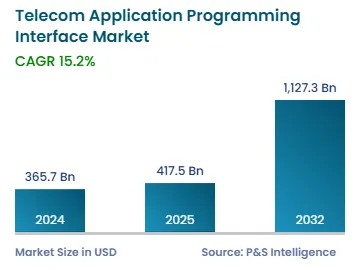
The telecom API market size was USD 417.6 billion for 2025, and it will grow by 15.3% during 2026–2032, to reach USD 1,129.2 billion by 2032.
The market is expanding because telecom operators are increasingly exposing core network capabilities through APIs, enabling developers to integrate messaging, authentication, and connectivity features directly into digital applications. This shift allows businesses to deploy communication services without building complex telecom infrastructure. According to the International Telecommunication Union, global 5G population coverage reached 51% in 2024, reflecting the rapid expansion of advanced network infrastructure. The growing availability of high-speed connectivity continues to drive the demand for scalable and standardised telecom API integration across digital platforms.
Key Market Insights
Messaging & communication APIs are the largest category, holding a market share of 35%, because developers widely integrate real-time communication features across applications.
Voice & video APIs are the fastest-growing category, registering a CAGR of approximately 16.0%, as demand rises for real-time interaction across digital platforms.
Enterprise developers are the largest category, holding a market share of 60%, due to their need for scalable and secure communication integration across systems.
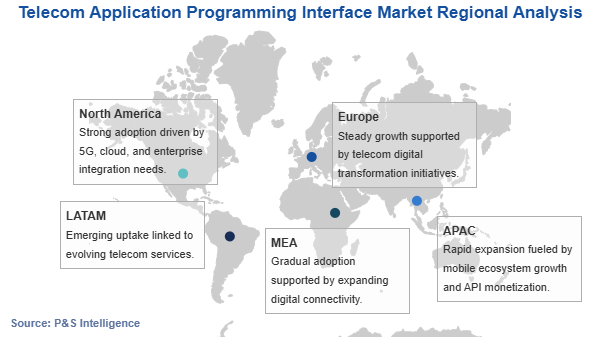
North America holds the largest share of 40%, due to strong telecom infrastructure and early adoption of network API platforms across enterprises.
Asia-Pacific is the fastest-growing region, registering a CAGR of approximately 16.2%, driven by rapid digital adoption, expanding telecom infrastructure, and a growing mobile-first user base.
Telecom Application Programming Interface Market Trends and Drivers
Shift Towards Network Exposure and Open API Platforms Is Major Trend
The market is shifting toward open network access as telecom operators expose core network functions through standardised APIs. This approach enables developers to integrate advanced services such as location tracking and quality management directly into applications. Consequently, telecom providers are increasingly partnering with cloud platforms to deliver scalable and consistent API access for developers worldwide. In 2024, the European Commission supported interoperable digital services and data-sharing frameworks under its Digital Decade programme, encouraging open and standardised network environments that facilitate API-driven service innovation.
Rising Demand for Embedded Communication in Digital Applications Drives Market
The market is growing because businesses increasingly integrate communication features such as messaging and voice services directly into digital applications to enhance real-time user engagement. Telecom APIs enable companies to deliver notifications, alerts, and authentication services without building and maintaining complex telecom infrastructure. According to the International Telecommunication Union, global mobile-cellular subscriptions reached 9.1 billion in 2024. Additionally, an estimated 5.5 billion people used the Internet globally in 2024. This expanding base of connected users continuously drives the demand for scalable and embedded telecom API solutions across digital service platforms.
Data Privacy Risks and Complex Telecom Regulations Hamper Market Growth
The market faces challenges because telecom APIs handle sensitive user data, increasing the complexity of privacy and security compliance across digital platforms. Companies must operate within fragmented regulatory frameworks and legacy telecom systems, which complicate large-scale API deployment and integration across multiple regions. According to the United Nations Conference on Trade and Development, 79% of countries globally enforced data protection and privacy legislation in 2024. These stringent compliance requirements increase operational and integration costs while also slowing the adoption of telecom APIs among businesses expanding across regulated global markets.
Expansion of 5G-Enabled Use Cases Offers New Revenue Streams
The market is expanding because 5G networks enable telecom APIs to support advanced use cases beyond basic communication services. Developers are building applications for smart cities, connected vehicles, and industrial automation that require real-time data exchange and low-latency connectivity. This rapidly expanding connected infrastructure allows telecom operators to monetise network capabilities through premium APIs while creating long-term revenue opportunities across enterprise and digital ecosystems. According to the Government of India, 5G services were available in 779 districts across the country as of October 2024, supporting the expansion of advanced digital use cases across sectors.
Messaging & communication APIs are the largest category, holding a market share of 35%, because developers integrate them extensively across digital platforms to enable real-time interactions. Businesses rely on these APIs to deliver transaction alerts, service notifications, and customer engagement features without building dedicated communication systems. According to the International Telecommunication Union, global active mobile-broadband subscriptions reached 7.7 billion in 2024. The large base of connected devices continues to drive demand for scalable and automated communication solutions.
Voice & video APIs are the fastest-growing category, registering a CAGR of approximately 16.0%, because more platforms are adding real-time interaction features. Apps now include calling, video support, and virtual meetings as standard functions. The rise of remote work, online consultations, and digital collaboration is pushing this demand further. These APIs help companies offer rich communication without building full systems, which is why their adoption is increasing quickly.
The APIs analysed in this report are:
Messaging & Communication APIs (Largest Category)
SMS, MMS, and RCS
Content Delivery
Voice & Video APIs (Fastest-Growing Category)
IVR/Voice Store and Voice Control
WebRTC
Payment & Billing APIs
ID/SSO and Subscriber
Location & Data APIs
Location
M2M and IoT
Others
Enterprise Size Analysis
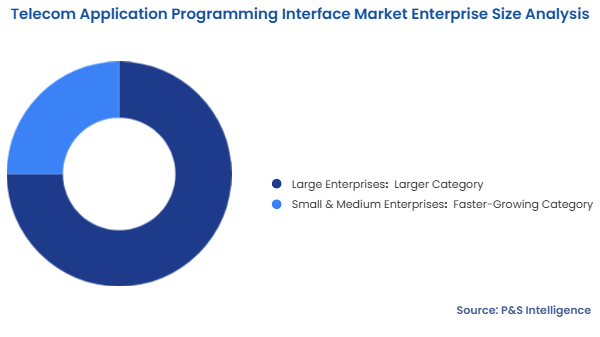
Large enterprises are the larger category, holding a market share of 75%, because they have the resources and scale to invest in advanced API integration. These organisations handle high volumes of users and require reliable communication systems. They also focus more on automation and customer experience, which increases API usage. Their early adoption and ability to deploy across multiple operations keep them dominant.
Small and medium enterprises are the faster-growing category, because these businesses increasingly adopt digital tools to manage customer communication and operations. Telecom APIs allow SMEs to integrate messaging, notifications, and support services without investing in complex infrastructure. According to the World Bank, small and medium enterprises accounted for 90% of businesses globally in 2024. The large base of SMEs continues to drive demand for flexible, cost-effective, and easy-to-integrate telecom API solutions.
The enterprise sizes analysed in this report are:
Large Enterprises (Larger Category)
Small & Medium Enterprises (Faster-Growing Category)
User Analysis
Enterprise developers are the largest category, holding a market share of 60%, because large organisations build and manage complex digital applications that require direct control over communication integration. These teams use telecom APIs to embed messaging, authentication, and connectivity features securely within enterprise systems. The growing volume of connected devices and automated interactions drives enterprise demand for scalable and high-performance telecom API solutions.
Partner developers are the fastest-growing category, registering a CAGR of approximately 15.7%, because companies are opening their platforms to external innovation. Businesses now collaborate with third-party developers to expand services quickly without building everything in-house. APIs make this process easier by offering ready access to telecom features. This shift toward partnerships and ecosystem growth is increasing their role in the market.
The users analysed in this report are:
Enterprise Developers (Largest Category)
Partner Developers (Fastest-Growing Category)
Internal Developers
Industry Analysis
IT & telecom is the largest category, holding a market share of 35%, because this sector directly builds and manages digital communication systems. Companies in this space use APIs to improve service delivery, manage networks, and support large user bases. Since they already operate in a tech-driven environment, adoption is faster and deeper. Continuous upgrades in network technologies also keep demand high within this industry.
Banking, financial services, and insurance (BFSI) is the fastest-growing category, because financial institutions are rapidly digitising payments, customer communication, and identity verification processes. Banks and fintech companies use telecom APIs to enable real-time transaction alerts, authentication, and secure user interactions across digital platforms. According to the World Bank, 79% of adults globally owned a formal financial account in 2024. The expanding base of digital financial users continues to drive demand for secure and scalable telecom API solutions.
North America holds the largest share, of 40%, because telecom operators in this region have already built strong API platforms and developer ecosystems. Companies here focus on monetising network capabilities rather than just providing connectivity. There is also high demand from large enterprises that integrate communication features into customer-facing apps. The presence of advanced cloud infrastructure and early rollout of network exposure initiatives supports this growth. Strong partnerships between telecom firms and technology providers further improve API accessibility and usage across industries.
U.S. Telecom API Market Analysis
The United States leads the market because telecom and technology firms actively develop and deploy advanced API platforms for enterprise applications. Businesses demand high-performance communication tools to support use cases such as real-time data exchange and edge-enabled services. Additionally, the country supported 259 million active 5G devices in 2024, according to CTIA. The widespread adoption of advanced connectivity accelerates standardised and scalable telecom API integration across industries.
Canada Telecom API Market Analysis
Canada is growing steadily because telecom providers are expanding high-speed connectivity across urban and remote regions, enabling broader digital service adoption. Businesses and public services increasingly use telecom APIs to support customer communication and service delivery across distributed populations. According to the International Telecommunication Union, 94.4% of individuals in Canada used the Internet in 2024. Additionally, 96.4% of households had access to high-speed broadband in 2024, according to Statistics Canada. The widespread connectivity continues to drive the integration of telecom APIs across digital platforms.
Asia-Pacific Telecom API Market Analysis
Asia-Pacific has the highest CAGR, of approximately 16.2%, because telecom markets here are expanding quickly with rising digital platforms and mobile-first users. Many countries are building new network infrastructure, which allows operators to design API strategies from the start. Local businesses are adopting APIs to support large user bases and real-time services like payments and logistics. Governments are also pushing digital programs, which increases usage. The mix of growing demand and ongoing network development is driving rapid expansion in this region.
China Telecom API Market Analysis
China drives the market because large-scale digital platforms require seamless communication and real-time integration across services. Telecom operators collaborate with technology firms to deploy standardised APIs that support super apps, e-commerce, and digital ecosystems at scale. According to government data, China recorded 851 million active 5G mobile subscribers in 2024. The high concentration of connected users and platform-based services accelerates the adoption of structured and scalable telecom API integration across digital applications.
India Telecom API Market Analysis
India is expanding rapidly due to its large mobile user base and growing digital ecosystem driven by startups and online services. Businesses use telecom APIs to build scalable applications that support high transaction volumes and real-time user interactions. According to PIB data, India registered 1.16 billion active wireless telecommunication subscribers in 2024. The widespread connectivity and the adoption of digital payment platforms continue to drive strong demand for secure authentication and communication APIs.
Europe Telecom API Market Analysis
Europe’s market is shaped by strict data protection rules and a strong push for digital sovereignty. Telecom operators here are focusing on standardised API frameworks to ensure secure and consistent service delivery across countries. Regional initiatives are encouraging collaboration between operators, which helps reduce fragmentation. Enterprises are careful in adopting APIs, but demand is steady due to digital public services and enterprise communication needs. The focus remains on compliance, interoperability, and building trusted platforms for cross-border digital services.
The regions and countries analysed in this report are:
The market is fragmented, with a large number of telecom operators, platform providers, and API solution companies competing across regions. No single player has full control, as services are often customised and tied to local networks and regulations. Many firms offer similar communication and integration features, which increases competition. At the same time, new entrants and niche providers keep entering the space with specialised solutions. This wide presence of players and lack of dominance by a few companies keep the market structure highly distributed.
Leading Companies in the Telecom Application Programming Interface Market:
In March 2026, GMS partnered with Shabodi to support the deployment and aggregation of network APIs, focusing on enabling telecom operators to manage and expose network functions through unified platforms.
In August 2025, Bharti Airtel launched a cloud-based platform through its digital unit, enabling telecom operators and enterprises to manage services and integrate digital capabilities, including API-driven functions, within their existing infrastructure.
In April 2026, Twilio Inc. introduced an embeddable version of Twilio Flex along with a new Flex SDK that enables businesses to integrate contact-center capabilities directly into existing web applications and custom CRM systems. The launch also included Salesforce Voice integration and enhanced reporting data access, strengthening Twilio’s positioning within enterprise customer-service and workflow management environments rather than as a standalone contact-center platform.
In March 2026, Infobip integrated T-Mobile network APIs into its platform to support enterprise fraud prevention and user verification use cases. The integration enables enterprises to access T-Mobile APIs through Infobip’s omnichannel platform, while leveraging CAMARA-based GSMA Open Gateway standards to simplify telecom-network identity verification and authentication workflows.
Frequently Asked Questions About This Report
What are telecom APIs and how do they work in applications+
Telecom APIs allow developers to integrate messaging, voice, authentication, and connectivity features into applications using standard interfaces without building telecom infrastructure from scratch
Why is the telecom API market growing rapidly worldwide+
The market is expanding due to rising digital transformation, increasing mobile usage, and growing demand for embedded communication services across applications and platforms globally
Which industries use telecom APIs the most today+
Industries such as information technology, telecommunications, banking, healthcare, and retail use telecom APIs to enable communication, authentication, and real-time service delivery across digital platforms
What are the key types of telecom APIs available+
Key telecom APIs include messaging, voice and video, payment and billing, identity verification, and location-based services used for various digital communication and service functions
How does 5G impact the telecom API market growth+
The expansion of 5G networks enables low-latency communication, supports advanced use cases, and increases demand for telecom APIs to power real-time and connected digital applications
Leading companies across industries trust us to deliver data-driven insights and innovative solutions for their most critical decisions. From data-driven strategies to actionable insights, we empower the decision-makers who shape industries and define the future. From Fortune 500 companies to innovative startups, we are proud to partner with organisations that drive progress in their industries.
Client Testimonials
Working with P&S Intelligence and their team was an absolute pleasure – their awareness of timelines and commitment to value greatly contributed to our project's success. Eagerly anticipating future collaborations.
McKinsey & Company
India
Unmatched Standards
Our insights into the minutest levels of the markets, including the latest trends and competitive landscape, give you all the answers you need to take your business to new heights
Complete Data Security
We take a cautious approach to protecting your personal and confidential information. Trust is the strongest bond that connects us and our clients, and trust we build by complying with all international and domestic data protection and privacy laws