Key Highlights
| Study Period | 2019 - 2032 |
| Market Size in 2025 | USD 3.5 Billion |
| Market Size in 2026 | USD 3.7 Billion |
| Market Size by 2032 | USD 4.9 Billion |
| Projected CAGR | 5.3% |
| Largest Region | APAC |
| Fastest Growing Region | APAC |
| Market Structure | Consolidated |

| Study Period | 2019 - 2032 |
| Market Size in 2025 | USD 3.5 Billion |
| Market Size in 2026 | USD 3.7 Billion |
| Market Size by 2032 | USD 4.9 Billion |
| Projected CAGR | 5.3% |
| Largest Region | APAC |
| Fastest Growing Region | APAC |
| Market Structure | Consolidated |
Explore the market potential with our data-driven report
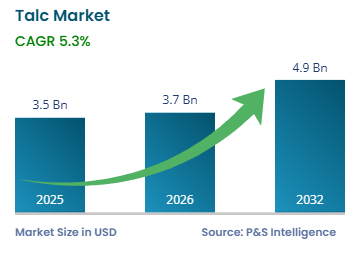
The global talc market size was USD 3.5 billion in 2025, which is predicted to reach USD 4.9 billion by 2032, growing at a CAGR of 5.3% during 2026–2032.
The market growth is primarily driven by increasing demand for plastics, paints & coatings, and personal care & cosmetic products, technological advancements in talc processing, and the automotive industry's growing adoption of lightweight materials. The automotive industry's shift toward lightweight components represents a significant growth catalyst for the talc market. The continuous advancements in the technologies used in car manufacturing and increasing demand for lightweight auto parts are driving vehicle manufacturers to replace metal parts in cars with plastic and composite parts.
These lightweight plastic parts, made from talc-reinforced polypropylene, not only reduce vehicle weight and improve fuel efficiency but also enhance durability and provide resistance to wear and corrosion. This trend aligns with global emissions reduction targets and the automotive industry's commitment to sustainability, positioning talc as a critical material in modern vehicle manufacturing.
The rapid industrialization in emerging economies, particularly in Asia-Pacific, continues to fuel market expansion. The rising construction activities and expanding manufacturing capabilities in China, India, and Southeast Asian nations create a substantial demand for talc across multiple applications. Furthermore, the cosmetics and personal care industry's robust growth, driven by increasing consumer awareness about personal grooming and hygiene, has significantly contributed to market development, with talc remaining a fundamental ingredient in various beauty and skincare formulations.
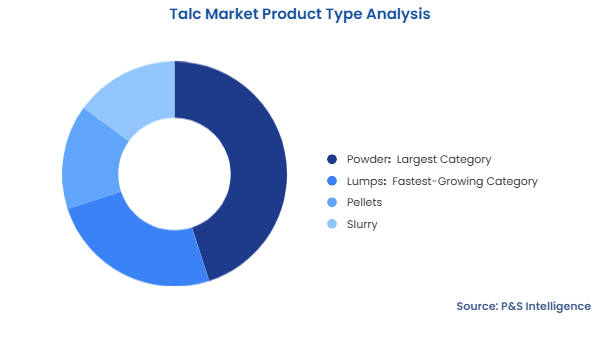
The powder category dominates the market, accounting for 45% share in 2025, driven by its versatility and widespread applications across industries. Talc powder's fine particle size and excellent dispersion properties make it ideal for cosmetics, pharmaceuticals, and high-performance plastic compounds. The category benefits from continuous technological advances in milling processes that produce increasingly fine and uniform particle sizes, meeting the evolving requirements of end-use industries. Growing demand for micronized and ultrafine talc grades in specialty applications further strengthens this category's market position.
Lumps represent the fastest-growing category during the forecast period. Talc lumps or granules are usually used in several industrial applications such as the production of ceramics, plastics, and paints. These larger forms of talc undergo further processing into finer forms depending upon the demands of the product. The category's growth is supported by its cost-effectiveness for bulk industrial applications and the increasing establishment of processing facilities near end-use industries that can handle raw talc conversion on-site.
These product types are covered:
The talc carbonate category commands the largest market share, of 65%, in 2025, attributed to its superior purity and physical properties. Talc carbonate ores, primarily composed of talc and carbonates like magnesite or dolomite, are typically found in metamorphosed ultramafic rocks. These deposits yield talc with a specific gravity of up to 2.86 and a density of up to 2.8 g/cm³, making them highly desirable for industrial applications. The processing of these ores produces pure talc concentrate, which is extensively utilized across industries due to its softness, chemical inertness, and hydrophobic nature.
Talc chlorite is the fastest-growing category through 2032. Talc chlorite deposits, comprising a mixture of talc and chlorite minerals, are known for their softness and organophilic nature. These properties make talc chlorite particularly valuable in ceramics, paints, cosmetics, pharmaceuticals, and food processing industries. The category benefits from its ability to enhance thermal shock resistance in ceramics and provide superior corrosion protection in coatings applications.
These deposit types are covered:
The plastics category maintains its dominance with 35% market share in 2025, driven by talc's role as a reinforcing filler in thermoplastics. Talc is normally used to modify several polymeric matrices used in automobile production. Whenever a stiffness increase is required in combination with good aesthetic and dimensional stability, talc is used. Besides polypropylene, talc is also used in polyamides, polyesters, and other thermoplastic polymers. The automotive industry's growing adoption of talc-filled polymers for interior and exterior components continues to drive category growth. As per studies, global plastic sales will touch USD 993 billion in value by 2032.
The personal care & cosmetics category exhibits the highest growth rate during the forecast period. This robust growth stems from increasing consumer focus on personal grooming and the expanding beauty industry in emerging markets. The rising disposable incomes, urbanization, and growing awareness about skincare and hygiene products in developing regions further accelerate category expansion.
These applications are covered:
Drive strategic growth with comprehensive market analysis
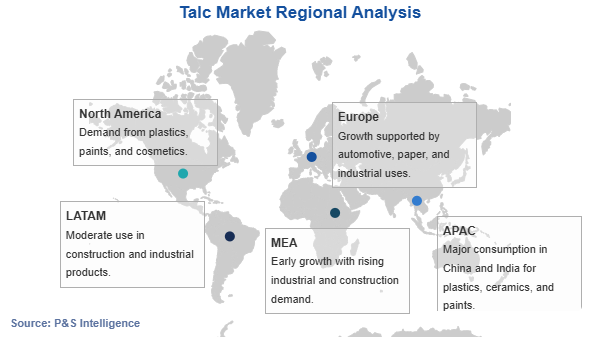
Asia-Pacific dominates the global talc market with a commanding 40% share in 2025, exhibiting a CAGR of approx. 5.5% during the forecast period. China, India, and Japan have a high demand for talc across various end-use sectors such as plastics, automotive, construction, cosmetics, paper, and pharmaceuticals. The rapid pace of industrialization and urbanization, particularly in China and India, has led to significant growth in construction and manufacturing, both of which heavily consume talc in products like paints, coatings, ceramics, and polymers.
Additionally, the automotive industry in Asia-Pacific is expanding quickly, including the growing production of EVs, which use talc-reinforced plastics for lightweighting and thermal insulation. The cosmetics and personal care market is also flourishing in the region due to rising disposable income, increased consumer awareness, and lifestyle changes, further boosting talc demand.
The North American talc market holds a moderate share of the global talc industry, of around 25%. The market is well-established and driven by consistent demand from plastics, paints & coatings, cosmetics, pharmaceuticals, and ceramics industries. The United States is the largest contributor within the region, with limited but ongoing talc mining operations in states like Montana, Texas, and Vermont.
In North America, talc is primarily used in industrial applications, especially in plastic manufacturing, where it improves stiffness and heat resistance in automotive parts. Paints and coatings also represent a key category, supported by residential and commercial construction activity. Additionally, the expanding pharmaceutical and personal care industries drive the demand for high-purity, asbestos-free talc for use in tablets, powders, and skincare products.
The regions and countries analyzed in this report are:
The global talc market exhibits a moderately consolidated structure, reflecting a balance between established multinational corporations with extensive mining operations and regional players serving specific geographic markets. The competitive landscape is characterized by vertical integration strategies, with major players controlling the entire value chain from mining to processing and distribution. Market leaders maintain their positions through continuous investments in mining technology, processing capabilities, and product quality improvements.
Companies focus on developing high-purity and specialty talc grades to serve premium applications in pharmaceuticals and cosmetics, where product quality and consistency are paramount. Strategic partnerships with end-use industries, particularly in the automotive and plastics sectors, provide stable demand and foster collaborative product development initiatives.
The competitive dynamics are further shaped by increasing emphasis on sustainable mining practices and regulatory compliance. Leading players invest significantly in environmental management systems and obtain certifications to meet stringent safety and quality standards, particularly for cosmetic and pharmaceutical applications. Regional players compete by leveraging proximity to raw material sources and end-use industries, offering competitive pricing and customized solutions for local market requirements.
Want a report tailored exactly to your business need?
Request CustomizationLeading companies across industries trust us to deliver data-driven insights and innovative solutions for their most critical decisions. From data-driven strategies to actionable insights, we empower the decision-makers who shape industries and define the future. From Fortune 500 companies to innovative startups, we are proud to partner with organisations that drive progress in their industries.

Working with P&S Intelligence and their team was an absolute pleasure – their awareness of timelines and commitment to value greatly contributed to our project's success. Eagerly anticipating future collaborations.
McKinsey & Company
India
Our insights into the minutest levels of the markets, including the latest trends and competitive landscape, give you all the answers you need to take your business to new heights

We take a cautious approach to protecting your personal and confidential information. Trust is the strongest bond that connects us and our clients, and trust we build by complying with all international and domestic data protection and privacy laws


Customize the Report to Align with Your Business Objectives

Request the Free Sample Pages