This Report Provides In-Depth Analysis of the Synthetic Graphite Market Report Prepared by P&S Intelligence, Segmented by Product Type (Graphite Electrodes, Battery-Grade Graphite, Specialty Graphite, Carbon Fibers, Graphite Powder), Application (Batteries, Steel Manufacturing, Electronics & Semiconductors, Refractories, Lubricants), and Geographical Outlook for the Period of 2019 to 2032
Explore the market potential with our data-driven report
Synthetic Graphite Market Overview
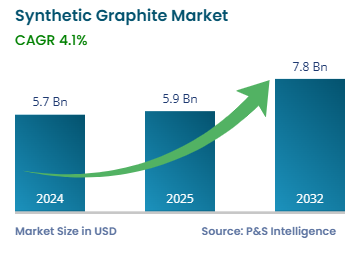
The global synthetic graphite market size was USD 5.7 billion in 2024, which is predicted to reach USD 7.8 billion by 2032, growing at a CAGR of 4.1% during 2025–2032.
The market expansion is primarily driven by the surging demand for electric vehicles (EVs) and energy storage systems, which require high-performance synthetic graphite for lithium-ion battery anodes. The rapid growth in steel production across developing economies and the increasing adoption of synthetic graphite in specialized industrial applications further contribute to market growth.
The escalating transition toward sustainable energy solutions has positioned synthetic graphite as a critical material in the global supply chain. Unlike natural graphite, synthetic graphite offers superior purity levels exceeding 99.9%, making it indispensable for high-tech applications requiring consistent performance and reliability. The material's exceptional thermal conductivity, chemical inertness, and electrical properties have expanded its adoption across diverse industries, from semiconductor manufacturing to nuclear reactors.
According to the International Energy Agency (IEA), electric car sales topped 17 million worldwide in 2024, rising by more than 25%, with the electric vehicle fleet representing a transformative shift in transportation and energy storage requirements. This accelerating EV adoption directly impacts synthetic graphite demand, as each electric vehicle battery requires approximately 50-70 kilograms of graphite for its anode components, significantly more than any other battery material by weight.
The rising demand for renewable energy integration has become a cornerstone of synthetic graphite market growth. According to the International Energy Agency, electric car sales exceeded 17 million globally in 2024, reaching a sales share of more than 20%. Meanwhile, the global energy storage systems market was estimated at USD 668.7 billion in 2024, highlighting the massive scale of energy infrastructure transformation underway. These developments directly impact synthetic graphite demand, as both EVs and stationary energy storage systems rely heavily on graphite anodes for their lithium-ion batteries.
Synthetic Graphite Market Dynamics
Advanced Manufacturing Technologies Are Key Trends
The adoption of advanced manufacturing technologies is improving the efficiency and consistency of synthetic graphite production.
Anovion is investing USD 800 million to build a new synthetic graphite anode material manufacturing facility in Decatur County, Georgia.
This facility aims to produce 40,000 metric tonnes of synthetic graphite annually, supporting the growing EV and energy storage sectors.
Technologies such as automation, precision machining, and high-temperature processing reduce defects and enhance material quality.
Additive manufacturing (3D printing) enables customized graphite shapes and complex designs for batteries and industrial applications.
Advanced thermal treatment and graphitization processes increase the conductivity and performance of graphite used in lithium-ion batteries.
The U.S. DoE’s Loan Programs Office has conditionally committed up to USD 754.8 million to NOVONIX for a synthetic graphite facility in Chattanooga, Tennessee, producing 31,500 metric tonnes annually to supply 325,000 EV batteries per year, with full capacity expected by 2028.
Digital monitoring and AI-assisted process control optimize production parameters, reducing waste and energy consumption.
Enhanced production techniques contribute to lower costs, higher purity, and better structural uniformity of synthetic graphite.
In the Indian state of Maharashtra, Graphite India Ltd. plans to invest USD 570 million (INR 4,761 crore) to manufacture synthetic graphite anode material for lithium-ion batteries.
This project is expected to create over 1,100 jobs and bolster India's position in the global EV supply chain.
These trends help meet stricter performance requirements in high-tech applications, including electronics, aerospace, and energy storage.
Surging Electric Vehicle Adoption Is Accelerating Market Growth
The global shift from internal combustion vehicles to EVs is a major factor driving the rapid growth of the synthetic graphite market.
The rapid increase in electric vehicle (EV) sales worldwide is creating strong demand for lithium-ion batteries, which are essential for EVs.
In September 2024, the U.S. DoE awarded SKI US Inc. a USD 150 million grant to establish a synthetic graphite production facility in Orangeburg County, South Carolina.
This facility aims to produce approximately 25,000 metric tonnes of synthetic graphite annually, catering to the growing demands of the electric vehicle and energy storage markets.
Synthetic graphite is a key material used in the anodes of lithium-ion batteries, so more EVs mean higher consumption of synthetic graphite.
The DoE announced a USD 3-billion funding initiative to support domestic manufacturing and recycling capabilities for EV batteries, enhancing the U.S. battery supply chain.
As automakers expand battery production to meet EV demand, the need for high-quality synthetic graphite rises proportionally.
The government policies, subsidies, and incentives promoting EV adoption in China, the U.S., and Europe are offering enhanced prospects to the market for synthetic graphite.
The consumer interest in clean and sustainable transportation is boosting EV sales, indirectly increasing synthetic graphite usage.
The development of EV charging infrastructure supports faster adoption of EVs, further strengthening demand for battery materials.
Companies are investing in secure graphite supply chains to ensure consistent production for growing battery requirements.
Epsilon Advanced Materials plans to build its first U.S. synthetic graphite facility in Brunswick County, North Carolina, with an investment of USD 649.9 million.
The project is expected to create 500 jobs and produce 50,000 metric tonnes of synthetic graphite annually.
Synthetic Graphite Market Segmentation Analysis
Product Type Analysis
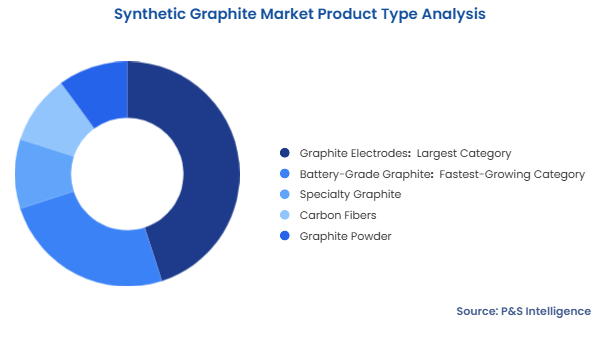
The graphite electrodes category held the largest share in the synthetic graphite market in 2024, of 45%, primarily driven by the global steel industry's continued reliance on electric arc furnace technology. The shift toward sustainable steel production methods has accelerated EAF adoption, with these furnaces requiring high-quality synthetic graphite electrodes capable of withstanding temperatures exceeding 3,000 °C. The ultra-high power (UHP) electrode category dominates this category, offering superior electrical conductivity and thermal shock resistance essential for modern steelmaking operations. As per the World Steel Association, global steel production stood at 1,885 million tonnes in 2024.
The battery-grade synthetic graphite category will witness the highest CAGR, during the forecast period, propelled by the exponential growth in lithium-ion battery production for electric vehicles and energy storage systems. This category requires exceptional purity levels and specific particle size distributions to optimize battery performance, cycle life, and charging speeds. Advanced coating technologies and surface modifications are enhancing the electrochemical properties of synthetic graphite anodes, enabling higher energy densities and faster charging capabilities that meet evolving market demands.
These product types are covered:
Graphite Electrodes (Largest Category)
Battery-Grade Graphite (Fastest-Growing Category)
Specialty Graphite
Carbon Fibers
Graphite Powder
Application Analysis
The batteries category dominated the synthetic graphite market in 2024 with a 40% share, reflecting the critical role of synthetic graphite as the primary anode material in lithium-ion batteries. Each electric vehicle battery requires 50–70 kilograms of graphite, approximately twice the amount of lithium needed, establishing synthetic graphite as the single largest component by weight in EV battery systems.
The superior consistency, purity, and performance characteristics of synthetic graphite compared to natural alternatives make it indispensable for achieving the energy density and cycle life requirements of modern battery applications. As per studies, EV battery sales will fetch USD 77.9 billion globally by 2032.
The electronics & semiconductor industries represent the fastest-growing application category, through 2032, driven by increasing demand for high-purity synthetic graphite in thermal management solutions, semiconductor processing equipment, and advanced electronic components requiring exceptional electrical and thermal conductivity properties. These properties make high-purity synthetic graphite indispensable in the manufacture of advanced electronic components, such as electrodes, heat spreaders, and battery anodes. As devices become smaller and more powerful, effective heat dissipation and electrical performance are critical, further driving demand.
Moreover, the semiconductor industry relies on synthetic graphite for its stability and precision in wafer processing equipment. With ongoing innovation in electronics, including electric vehicles, 5G technology, and IoT devices, the need for synthetic graphite is expected to grow significantly, reinforcing its role as a key material in this dynamic market.
Drive strategic growth with comprehensive market analysis
Synthetic Graphite Market Geographical Analysis
Asia-Pacific Synthetic Graphite Market Size
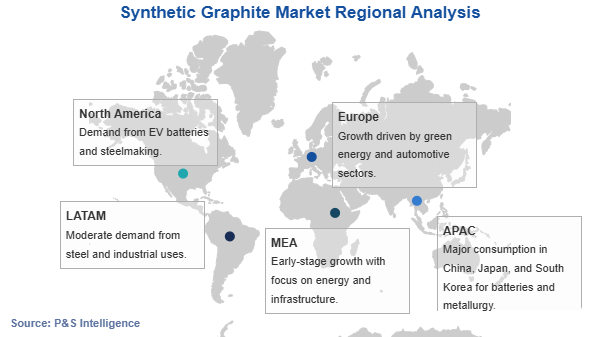
Asia-Pacific held the largest market share of 40% in 2024, driven by China's dominant position in both production and consumption of synthetic graphite. The region's massive electric vehicle manufacturing base, combined with the world's largest steel production capacity, creates unparalleled demand for synthetic graphite products.
China Synthetic Graphite Market Size
China alone accounts for over 70% of global synthetic graphite production capacity, leveraging abundant raw materials, established infrastructure, and significant government support for battery and EV industries. The integration of synthetic graphite production with downstream battery manufacturing creates substantial cost advantages and supply chain efficiencies.
Japan Synthetic Graphite Market Size
Japan represents the technological leader within the region, specializing in ultra-high purity synthetic graphite for advanced applications. Japanese manufacturers have developed proprietary technologies achieving purity levels exceeding 99.99%, essential for semiconductor and specialty battery applications.
South Korea Synthetic Graphite Market Size
In May 2024, South Korea's Ministry of Trade, Industry and Energy announced a commitment to invest approximately USD 7.1 billion (9.7 trillion Korean won) to bolster its electric vehicle (EV) battery supply chain. This initiative aims to reduce dependence on Chinese sources for critical materials and align with U.S. trade regulations, particularly the Inflation Reduction Act (IRA). The funding will support domestic EV battery manufacturers in diversifying their supply chains and securing minerals from countries with U.S. free trade agreements. Additionally, the government plans to assist in the development of alternative technologies, such as lithium metal batteries.
North America Synthetic Graphite Market Growth
North America is expected to be the fastest-growing regional market, with a CAGR of approx. 4.5% during 2025–2032, catalyzed by aggressive electrification targets and substantial government investments in domestic battery supply chains. The Inflation Reduction Act has allocated billions in funding for domestic battery material production, including synthetic graphite manufacturing facilities. Multiple projects are under development, with companies establishing integrated facilities spanning from petroleum coke processing through to battery-grade anode material production, aiming to reduce dependency on Asian imports.
U.S. Synthetic Graphite Market Size
The U.S. synthetic graphite market is experiencing rapid transformation as domestic production capacity expands to meet growing demand from EV manufacturers establishing North American production facilities. Major automotive companies have announced investments exceeding USD 100 billion in EV manufacturing capacity through 2030, creating substantial demand for locally-sourced battery materials. The development of a complete domestic supply chain from raw materials to finished batteries represents a strategic priority, with synthetic graphite production capacity expected to increase tenfold by 2030.
In September 2024, the U.S. Department of Energy (DOE) announced that Urbix Inc. would receive up to USD 125 million in funding to construct a commercial-scale graphite processing facility in Muscle Shoals, Alabama. This grant, provided under the Bipartisan Infrastructure Law, aims to bolster domestic manufacturing of lithium-ion batteries for electric vehicles and other applications.
Europe Synthetic Graphite Market Outlook
Europe accounts for 20% of global synthetic graphite demand, driven by stringent environmental regulations and ambitious electrification targets across the European Union. The region's commitment to achieving carbon neutrality by 2050 has accelerated the transition to electric vehicles and renewable energy systems, creating sustained demand growth for battery-grade synthetic graphite. European manufacturers are focusing on developing sustainable production processes, including the use of bio-based precursors and renewable energy in graphitization processes, differentiating their products in an increasingly environmentally-conscious market.
The regions and countries analyzed in this report are:
North America (Fastest-Growing Regional Market)
U.S. (Larger Country Market)
Canada (Faster-Growing Country Market)
Europe
Germany (Largest Country Market)
U.K. (Fastest-Growing Country Market)
France
Italy
Spain
Rest of Europe
Asia-Pacific (Largest Regional Market)
Japan
China (Largest Country Market)
India (Fastest-Growing Country Market)
South Korea
Australia
Rest of APAC
Latin America
Brazil (Largest Country Market)
Mexico (Fastest-Growing Country Market)
Rest of LATAM
Middle East and Africa
Saudi Arabia (Largest Country Market)
South Africa
U.A.E. (Fastest-Growing Country Market)
Rest of MEA
Synthetic Graphite Market Share
The synthetic graphite market is partially consolidated, meaning that a few large companies control a significant portion of global production and have a strong influence over pricing and supply. This consolidation is driven by the high cost and technical complexity of producing synthetic graphite, which requires specialized equipment, energy-intensive processes, and strict quality control to meet the demands of applications such as electric vehicle batteries and industrial electrodes.
Large companies benefit from economies of scale, established supply chains, and advanced technology, which allow them to produce high volumes efficiently and maintain consistent product quality. Additionally, most of the global production is concentrated in a few countries, giving leading companies a geographic advantage and stronger control over the market. As demand continues to grow, particularly in battery applications, these factors further reinforce the dominance of major players and the consolidated nature of the market.
Key Synthetic Graphite Companies:
GrafTech International Ltd.
SGL Carbon SE
Showa Denko K.K.
Tokai Carbon Co., Ltd.
Imerys Graphite & Carbon
BTR New Material Group Co., Ltd.
Shanshan Technology Co., Ltd.
Lianyungang Jinli Carbon Co., Ltd.
HEG Limited
Mersen S.A.
Superior Graphite Co.
Fangda Carbon New Material Co., Ltd.
Graphite India Limited
Nippon Carbon Co., Ltd.
Asbury Carbons Inc.
Synthetic Graphite Market News
In October 2024, Talga Group secured environmental permits for its integrated graphite anode project in Sweden, covering the Nunasvaara South mine and Luleå Anode Refinery. The Luleå facility is planned to produce 19,500 tonnes per year of low-emission Talnode-C, supported by a €70 million EU Innovation Fund grant, positioning Talga among Europe’s first fully integrated battery anode producers.
In June 2024, Syrah Resources Limited commenced production of active anode material (AAM) at its Vidalia facility in Louisiana, with an initial production capacity of 11,250 tonnes per year.
In January 2024, Asbury Carbons Inc. announced a price adjustment for its graphite product lines, effective for orders shipping. The increases, ranging from 3% to 10%, were attributed to ongoing inflationary pressures impacting raw materials, labor, energy, and packaging costs.
In June 2023, Superior Graphite Co. announced plans to build a new facility in the U.S. and Sweden, aiming to produce 24,000 tonnes per year of active anode material for lithium-ion batteries. The company intends to commence production in 2026, leveraging existing infrastructure and appointing Accelerate Capital and Stanhope Capital to manage the capital raise.
Want a report tailored exactly to your business need?
Leading companies across industries trust us to deliver data-driven insights and innovative solutions for their most critical decisions. From data-driven strategies to actionable insights, we empower the decision-makers who shape industries and define the future. From Fortune 500 companies to innovative startups, we are proud to partner with organisations that drive progress in their industries.
Client Testimonials
Working with P&S Intelligence and their team was an absolute pleasure – their awareness of timelines and commitment to value greatly contributed to our project's success. Eagerly anticipating future collaborations.
McKinsey & Company
India
Unmatched Standards
Our insights into the minutest levels of the markets, including the latest trends and competitive landscape, give you all the answers you need to take your business to new heights
Complete Data Security
We take a cautious approach to protecting your personal and confidential information. Trust is the strongest bond that connects us and our clients, and trust we build by complying with all international and domestic data protection and privacy laws