This Report Provides In-Depth Analysis of the Synthetic Dyes Market Report Prepared by P&S Intelligence, Segmented by Product Type (Reactive Dyes, Disperse Dyes, Acid Dyes, Direct Dyes, Vat Dyes, Basic Dyes, Other Dyes), End Use (Textile & Apparel, Leather, Pulp & Paper, Building & Construction, Personal Care, Food & Beverage), Form (Powder, Liquid, Paste), and Geographical Outlook for the Period of 2021 to 2032
Explore the market potential with our data-driven report
Synthetic Dyes Market Analysis
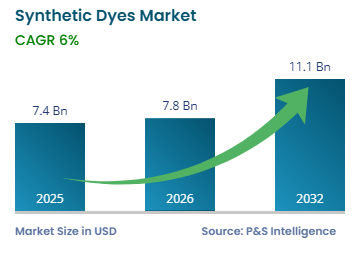
The synthetic dyes market size was USD 7.4 billion for 2025, and it will grow by 6.0% during 2026–2032, to reach USD 11.1 billion by 2032.
This growth is supported by expanding integration of synthetic colorants across textiles, leather processing, and specialty applications, positioning reactive and disperse dye technologies as critical enablers of industrial-scale coloration systems.
The transition toward liquid and powder formulations is reinforcing market dynamics, with powder-based dyes maintaining dominance due to cost efficiency and storage advantages, while liquid formulations accelerate adoption in digital printing and automated dyeing systems. India Brand Equity Foundation data indicates that India's textile and apparel industry contributed approximately 2% to GDP and employed over 45 million workers as of 2024, demonstrating the scale at which textile-dependent dye consumption operates in major manufacturing economies.
Regulatory frameworks are simultaneously driving innovation in low-impact and biodegradable dye chemistries, particularly in North America and Europe, where environmental compliance standards mandate reduced wastewater discharge and restricted use of hazardous intermediates, including 22 aromatic amines restricted under EU REACH Annex XVII for consumer textile articles, influencing dye selection and formulation strategies.
Synthetic Dyes Market Emerging Trends
Digital Textile Printing Adoption Is Key Trend Accelerating Specialized Dye Formulation Demand
Rapid expansion of digital textile printing technologies is driving structural changes in synthetic dyes demand patterns, creating growth opportunities for specialized inkjet-compatible formulations while challenging traditional batch dyeing economics and supply chain models. Digital printing enables on-demand production, customized designs, short production runs, and reduced setup costs compared to conventional screen printing and rotary dyeing systems, fundamentally altering manufacturing workflows in fashion apparel, home textiles, soft signage, and sportswear segments.
Digital printing adoption is reinforcing synthetic dyes market growth through multiple mechanisms including enabling mass customization that increases total dye consumption per garment through complex multi-color designs, supporting nearshoring strategies that reduce inventory carrying costs and lead times by facilitating domestic production. The technology also advances sustainability objectives while minimizing chemical waste through precise ink application, which reduces excess dye liquor generation compared to conventional exhaust dyeing processes governed by the U.S. Textile Mills Effluent Guidelines, 40 CFR Part 410, administered by the U.S. Environmental Protection Agency. Manufacturers are responding by developing specialized product lines for digital printing applications, investing in pigment dispersion technologies that improve color gamut and lightfastness, and creating formulations compatible with emerging printing platforms including single-pass systems and hybrid technologies combining digital and analog processes.
Sustainability and Environmental Compliance Is Biggest Driver
The global synthetic dyes market is undergoing fundamental transformation as manufacturers shift toward sustainable chemistry platforms, biodegradable formulations, and closed-loop production systems in response to environmental pressures and evolving customer requirements. The industry is witnessing accelerating development of low-impact dye chemistries that maintain performance characteristics while reducing ecological footprints, including higher-fixation reactive dyes designed to reduce unfixed dye release, low-salt dyeing systems aimed at lowering total dissolved solids in effluent, and metal-free dye formulations that avoid chromium- and copper-based components in wastewater streams.
The World Bank reports that textile dyeing and treatment contribute up to 20% of global industrial water pollution, a statistic that underpins wastewater discharge regulations and effluent treatment requirements across major textile-producing regions. In 2025, Archroma launched AVITERA RASPBERRY SE dye featuring deeper red tones while reducing water and energy consumption by up to 50% compared to conventional reactive dyeing processes. The product launch addresses growing textile industry demand for sustainable dyeing solutions that maintain color performance while reducing environmental impact.
Bio-Based and Fermentation-Derived Dye Technologies Represent Key Market Opportunity
Emerging bio-based dye synthesis platforms using industrial fermentation, enzymatic processes, and agricultural waste valorization are creating market opportunities for differentiated products addressing both environmental compliance requirements and performance specifications beyond conventional petroleum-derived chemistries. In 2024, Archroma unveiled Super Systems+ integrating fiber-specific processing solutions with intelligent effects empowering textile brands, retailers, and mills to enhance economic and environmental sustainability performance.
Bio-based dyes offer measurable environmental advantages including lower lifecycle greenhouse gas emissions due to renewable feedstock substitution, reduced reliance on aromatic amines and heavy-metal-containing intermediates, and improved wastewater profiles during dyeing and finishing operations. These attributes align with environmental compliance requirements enforced by regulators such as the European Chemicals Agency, where hazardous dye substances are subject to restriction or authorization. The technology faces commercialization challenges including achieving cost parity with conventional dyes that benefit from established production infrastructure and economies of scale, matching color consistency and batch-to-batch reproducibility required for industrial applications, expanding color palette coverage particularly for blue and black shades that currently require heavy metal catalysts, and scaling production capacity to meet commercial order volumes.
Synthetic Dyes Market Segmentation and Category Analysis
Product Type Analysis
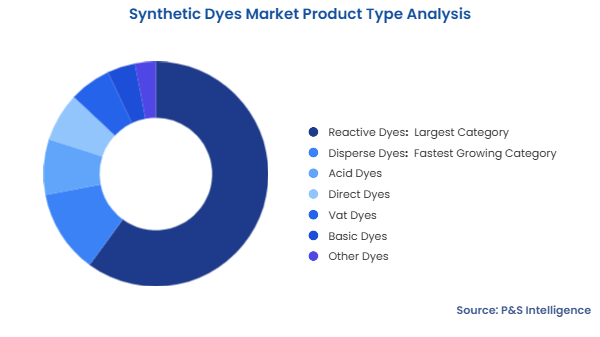
The reactive category holds the largest market share, of 60%, in 2025, driven by its superior performance characteristics in cellulosic fiber applications and established dominance across cotton textile manufacturing operations globally. Reactive dyes form strong covalent bonds with cellulose fibers such as cotton, rayon, and viscose, enabling exceptional color fastness properties that resist fading during washing and exposure to sunlight compared to alternative dye chemistries.
The disperse dyes category will have the highest CAGR, of 6.2%, reflecting accelerating global polyester fiber production and expanding applications across synthetic fiber-based textiles in fashion, technical textiles, and home furnishing segments. Disperse dyes represent the optimal chemistry for coloring hydrophobic synthetic fibers, including polyester, nylon, and acetate that cannot be effectively dyed using water-soluble reactive or direct dye systems, positioning the segment for expansion alongside polyester's rising market share in global fiber production. According to the U.S. Department of Agriculture (USDA), global cotton mill use in the 2025/26 marketing year is projected at around 118 million bales, reflecting ongoing textile demand patterns.
The product types analyzed in this report are:
Reactive Dyes (Largest Category)
Disperse Dyes (Fastest Growing Category)
Acid Dyes
Direct Dyes
Vat Dyes
Basic Dyes
Other Dyes
End-Use Analysis
The textile & apparel category holds the largest market share, of 65%, in 2025, and it will have the highest CAGR, of 6.3%, driven by sustained global demand for clothing, home textiles, and fashion products consuming the majority of synthetic dyes production across cotton, polyester, and blended fabric applications. The segment's dominant position reflects clothing's essential nature as a basic human need, fashion industry dynamics driving continuous product refreshment cycles that maintain dye demand despite economic fluctuations, and expanding middle-class populations in emerging markets increasing per capita textile consumption particularly across Asia Pacific economies. The global cotton production supports substantial dye demand, with OECD-FAO Agricultural Outlook data indicating that global cotton consumption in 2024/25 increased slightly for a second consecutive year, with cotton use rising in India, Bangladesh, Turkey, and Vietnam despite competition from synthetic fibers.
The end uses analyzed in this report are:
Textile & Apparel (Largest and Fastest Growing Category)
Leather
Pulp & Paper
Building & Construction
Personal Care
Food & Beverage
Others
Form Analysis
The powder category holds the largest market share in 2025, driven by advantages in storage stability, transportation economics, handling convenience in industrial dyeing operations, and compatibility with established manufacturing infrastructure across global textile facilities. The dominant position reflects lower transportation costs per unit of active dye content, ease of weighing and dosing in batch dyeing processes, and compatibility with existing mixing and storage systems in textile mills.
The liquid category will have the highest CAGR, driven by digital textile printing proliferation, automated dyeing system adoption requiring pre-dispersed formulations, and user convenience preferences among small-scale textile processors and fashion designers pursuing rapid prototyping capabilities. Liquid dyes eliminate dispersion and dissolution steps required for powder formulations, reducing labor requirements and minimizing errors in dye bath preparation particularly valuable in operations employing less-skilled workers or pursuing just-in-time production schedules.
The forms analyzed in this report are:
Powder (Largest Category)
Liquid (Fastest Growing Category)
Paste
Drive strategic growth with comprehensive market analysis
Synthetic Dyes Market Regional Market Performance
Asia-Pacific Synthetic Dyes Market Size
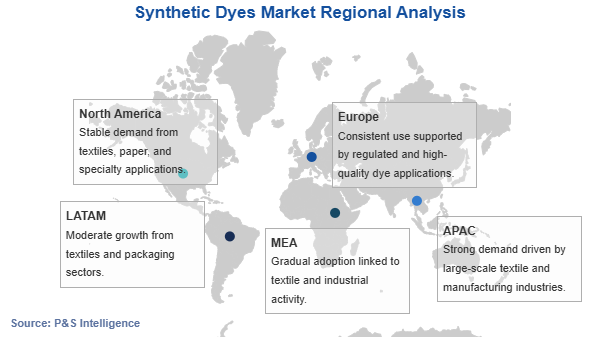
Asia-Pacific holds the largest market share, of 45%, in 2025, and it will have the highest CAGR, of 6.1%, due to the region's position as the global epicenter for textile manufacturing, integrated chemical production infrastructure, and cost-advantaged access to dye intermediates and petrochemical feedstocks. Government policies in major producing countries actively support chemical sector modernization through production-linked incentive schemes, technology upgrade funds, and regulatory frameworks that balance environmental compliance with manufacturing competitiveness.
The region benefits from vertically integrated supply chains linking raw material producers, dye manufacturers, and textile mills, creating operational efficiencies that reduce lead times and inventory costs compared to geographically dispersed production models. Additionally, environmental regulations in key textile-producing countries, such as strengthened wastewater discharge standards in China and expanded enforcement of Zero Liquid Discharge (ZLD) systems in parts of India, are increasing compliance requirements for textile dyeing operations.
China Synthetic Dyes Market Size
China held the largest country market share within Asia Pacific in 2025, supported by the country's dominance in global textile production, established chemical manufacturing base, and government initiatives promoting high-quality chemical production under the Made in China 2025 strategic framework. The nation's textile sector benefits from mature infrastructure spanning spinning, weaving, dyeing, and finishing operations, creating concentrated demand for reactive dyes in cotton processing and disperse dyes in polyester applications. The country's chemical industry infrastructure provides access to critical dye intermediates including H-acid, vinyl sulfone, and aromatic amines at competitive pricing relative to international markets.
Moreover, China's market trajectory faces moderating growth rates compared to historical expansion, influenced by rising labor costs in coastal manufacturing zones, stricter environmental enforcement on wastewater discharge, and gradual textile production migration toward Vietnam and Bangladesh.
India Synthetic Dyes Market Size
India emerged as the fastest-growing country market within Asia Pacific in 2025, driven by expanding textile manufacturing capacity under government industrial policy frameworks, growing domestic consumption across apparel and home textiles segments, and increasing competitiveness in global export markets following free trade agreements with the UAE and Australia. Government initiatives, including seven PM MITRA integrated textile parks, are accelerating capacity additions and modernization across dyeing and finishing infrastructure. Under the Production Linked Incentive (PLI) scheme, the Indian government allocated INR 10,683 crore to support capacity expansion and modernization in the textile sector, strengthening domestic manufacturing capabilities and export competitiveness.
The regions and countries of the market are as follows:
North America
U.S. (Larger Country Market)
Canada (Faster-Growing Country Market)
Europe
Germany (Largest Country Market)
U.K.
France
Italy (Fastest-Growing Country Market)
Spain
Rest of Europe
Asia-Pacific (Latest and Fastest-Growing Region)
China (Largest Country Market)
India (Fastest-Growing Country Market)
Japan
South Korea
Australia
Rest of Asia-Pacific
Latin America
Brazil (Largest Country Market)
Mexico (Fastest-Growing Country Market)
Rest of Latin America
Middle East & Africa
Saudi Arabia (Largest Country Market)
South Africa
U.A.E. (Fastest-Growing Country Market)
Rest of MEA
Synthetic Dyes Market Competitive Landscape
The market exhibits semi-consolidation, with leading multinational chemical companies and specialized dye manufacturers collectively accounting for substantial market share through established production infrastructure, comprehensive product portfolios spanning multiple dye chemistries, and global distribution networks serving textile hubs across Asia Pacific, Europe, and Americas. Market structure reflects significant economies of scale in chemical production, substantial research and development investment requirements for new formulation development, regulatory expertise necessary to navigate complex environmental frameworks, and technical service capabilities supporting customer color matching and process optimization that create competitive advantages for larger integrated players. The industry demonstrates ongoing consolidation through strategic acquisitions that combine complementary product portfolios, expand geographic presence, and achieve cost synergies in production and distribution operations. The market demonstrates stable competitive dynamics with established players maintaining positions through technical capabilities, customer relationships, and production scale advantages, while facing pressures from environmental regulation compliance costs, raw material price volatility, and customer demand for sustainable alternatives that are reshaping product development priorities and investment allocation across the industry.
Top Synthetic Dyes Producers:
Archroma
BASF SE
LANXESS
Zhejiang Longsheng Group Co., Ltd. (DyStar)
Huntsman International LLC
Kiri Industries Ltd.
Atul Ltd.
Heubach GmbH
Bodal Chemicals Ltd.
Zhejiang Runtu Co., Ltd.
Zhejiang Jihua Group
Sudarshan Chemical Industries Ltd.
Synthetic Dyes Market News & Updates
In May 2025, BASF SE announced plans to power its entire amino-chemical portfolio in Europe with 100% renewable electricity covering production facilities in Ludwigshafen, Germany, and Antwerp, Belgium, projected to reduce approximately 188,000 tonnes of annual CO₂ emissions.
In April 2025, DyStar Group consolidated American manufacturing operations by ceasing production at DyStar Hilton Davis facility while integrating partial operations into Reidsville, North Carolina, and Cheyenne, Wyoming, plants to optimize manufacturing footprint and improve productivity.
In April 2024, Archroma Management GmbH declared USD 750,000 operational expansion investment in Allendale County, South Carolina, generating six new positions at the facility focused on dyes, chemicals, and optical brightening agents tailored to textile market applications.
In April 2024, Archroma Management GmbH and Cotton Inc. renewed partnership collaboration to develop sustainable dyes for the textile industry targeting cotton fiber applications. The partnership leverages Cotton Inc.'s agricultural expertise and Archroma's chemical innovation capabilities to advance eco-friendly dye formulations addressing market demand for sustainable cotton textiles.
Frequently Asked Questions About This Report
What is the growth forecast for the synthetic dyes market?+
The synthetic dyes market is growing at a CAGR of 6.0% over the forecast period.
Which product types are included in the synthetic dyes market?+
The synthetic dyes market includes reactive dyes, disperse dyes, acid dyes, direct dyes, vat dyes, basic dyes, and other specialty dyes formulated for specific fiber types and industrial applications.
Which end-use industries dominate the synthetic dyes market?+
The textile and apparel industry dominates synthetic dye consumption.
What are the key segments and applications in the synthetic dyes market?+
Key segments are categorized by product type, form, and end-use industry, with major applications concentrated in fabric dyeing, printing, leather finishing, polymer coloration, coatings, and packaging inks.
Who are the major players in the synthetic dyes market?+
The market is led by globally established chemical manufacturers and dye producers with strong portfolios in textile and industrial dyes, supported by regional players in Asia specializing in cost-competitive, high-volume dye production.
Want a report tailored exactly to your business need?
Leading companies across industries trust us to deliver data-driven insights and innovative solutions for their most critical decisions. From data-driven strategies to actionable insights, we empower the decision-makers who shape industries and define the future. From Fortune 500 companies to innovative startups, we are proud to partner with organisations that drive progress in their industries.
Client Testimonials
Working with P&S Intelligence and their team was an absolute pleasure – their awareness of timelines and commitment to value greatly contributed to our project's success. Eagerly anticipating future collaborations.
McKinsey & Company
India
Unmatched Standards
Our insights into the minutest levels of the markets, including the latest trends and competitive landscape, give you all the answers you need to take your business to new heights
Complete Data Security
We take a cautious approach to protecting your personal and confidential information. Trust is the strongest bond that connects us and our clients, and trust we build by complying with all international and domestic data protection and privacy laws