This Report Provides In-Depth Analysis of the Surface Computing Market Report Prepared by P&S Intelligence, Segmented by Display Type (Flat, Curved), Vision (2D, 3D), Application (Retail, Healthcare, Entertainment, Hospitality, Advertisement, Automotive, Education), and Geographical Outlook for the Period of 2021 to 2032
Explore the market potential with our data-driven report
Surface Computing Market Key Insights
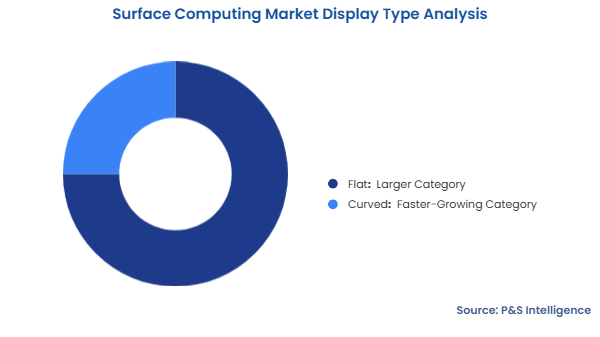
Flat display is the larger category with 75% share, favored for compatibility with standard wall-mounted and kiosk formats in commercial settings.
2D vision holds the larger share at 70%, sufficient for standard touch and gesture interactions in most real-world scenarios.
Retail leads application adoption with 30% share, driven by demand for interactive product exploration and self-service terminals in stores.
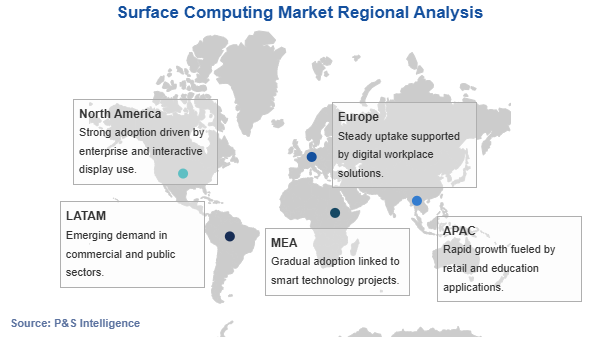
Asia-Pacific is the fastest-growing region with 35.9% CAGR, fueled by the rapid mass rollout of interactive surfaces across retail and entertainment.
North America remains the largest market with 40% share, supported by established commercial demand from retail chains and corporate offices.
Surface Computing Market Analysis
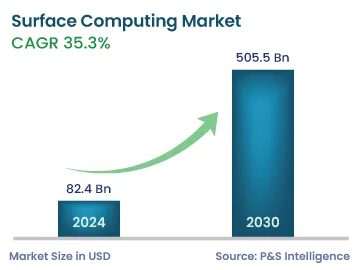
The surface computing market size was USD 110.7 billion for 2025, and it will grow by 35.8% during 2026-2032, to reach USD 941.4 billion by 2032.
The surface computing market is growing as touch-based and interactive displays become a normal part of how people work, learn, shop, and receive services. Organizations are looking for screens that feel natural to use, enable multiple users to use them at once, and eliminate the need for keyboards and/or mice. Retail and hospitality businesses, medical facilities, educational institutions and shared public spaces are implementing large interactive surfaces to enhance user interaction and perform tasks faster.
Simultaneously, the improved display quality, touch sensitivity, and software integration are providing users with a better experience and making the implementation of these systems much easier. As digital experiences become more similar to physical experiences, surface computing has transformed from being perceived as a novelty to being adopted as an alternative interface. Digital channels such as self-order kiosks and mobile apps accounted for over 40% of systemwide sales across six major markets in 2023, showing how interactive interfaces have become a common way for people to place orders and use digital services in everyday settings.
Advanced Touch, Gesture, and Multimodal Interaction Are Major Trends
The integration of advanced interaction technologies is driving the growth of the surface computing market. Vendors are incorporating touch, gesture recognition, and multimodal interfaces to enable real-time collaboration, data visualization, and interactive decision-making across enterprise and public environments. These systems rely on seamless data processing and low-latency connectivity to support dynamic user interaction and synchronized digital content. According to the International Telecommunication Union, global 5G network coverage reached 51% of the world population in 2024, enabling high-speed and low-latency data transmission. As a result, improved network infrastructure is supporting the deployment of surface computing solutions that require real-time responsiveness and continuous data integration.
Demand for Interactive and Collaborative Digital Interfaces Drives Market
One major factor fueling the surface computing market growth is the communication and interaction needs between users and digital content. This, in turn, has a great impact on the layout of digital interfaces in retail spaces, corporate workspaces, healthcare, and education. Besides that, organizations are looking for solutions that help them with user engagement, intuitive information access, and seamless task workflow and reduce the use of the keyboard and mouse. As a result, applications focused on consumers' experiences and customers, such as interactive signage, product exploration through touch, and visual collaboration tools, encourage investment in surface computing technologies.
Additionally, surface computing integration into smart building ecosystems and digital transformation initiatives enables a key interaction point between users and digital content. In September 2025, Samsung received an expanded order for its smart signage products from Toyota, having already shipped 23,000 units to the Japanese automaker for its worldwide showrooms.
Surface Computing Market Segmentation Analysis
Display Type Analysis
Flat is the larger category, holding a market share of 75%, because it is extensively used in commercial, retail, and enterprise settings, where the traditional planar interaction method proves to be the most convenient. It fits well with standard installation form factors, like wall-mounted screens, tabletop interfaces, and kiosk formats, easily integrating into existing space without major structural changes. Besides, flat displays can effectively support multi-touch and gesture inputs while at the same time, they provide a sense of familiarity to users who are transitioning from regular touchscreens. Due to these features, flat technology has been adopted across numerous sectors where surface computing is applied for accessing information, wayfinding, digital signage, and collaborative interfaces. More than 2 million digital signage units were sold globally in 2023, reflecting the wide commercial use of flat-panel displays for information delivery and public-facing interaction in retail, transport, and service locations.
Curved is the faster-growing category, registering a CAGR of 36.0%, as several enterprises are on the lookout for deeper and highly engaging experiences through interaction. Curved screens not only offer enhanced peripheral vision but also better viewing angles. Hence, they can be used in collaborative settings, control rooms, or in experiential installations, where the degree of user immersion is a key factor.
Manufacturing advances, coupled with lowering production costs, have made curved display availability not just for specialized contexts but also for mainstream applications. This increased accessibility is inspiring integrators and solution designers to try out the curved form factor, thus facilitating the evolution of surface computing closer to natural, visually appealing installations that are not limited to flat, traditional designs only.
The display types analyzed in this report are:
Flat (Larger Category)
Curved (Faster-Growing Category)
Vision Analysis
2D is the larger category, as it mainly fits the majority of the real-world scenarios where simple touch, gesture, and object interactions are enough. 2D vision systems have been around for a long time, are highly supported by existing software ecosystems, and can work with various content types, such as maps, dashboards, and catalogue browsing. Their presence in retail kiosks, collaborative tables, and information terminals demonstrates the way users usually interact with digital surfaces.
3D is the faster-growing category, registering a CAGR of 36.1%, as various entities are discovering more immersive and spatially dynamic modes of interaction. 3D vision systems provide depth sensing, gesture recognition, as well as layered visualizations, which offer new experiences in design review, simulation, virtual product interaction, and spatial analytics. The growing usage of AR/VR hybrid interfaces and projection-based surface systems is facilitating the use of 3D technologies since they allow for more-engaging contextual interaction compared to 2D surfaces. This is notable in innovation hubs, product configurators, luxury retail displays, and collaborative design studios, where the addition of depth greatly enhances the experiential value.
The visions analyzed in this report are:
2D (Larger Category)
3D (Faster-Growing Category)
Application Analysis
Retail is the largest category, holding a market share of 30%, as surface computing opens up various new ways for customers to engage with the brand, find products more quickly, and self-serve. Interactive surface displays allow customers to browse product catalogs, access detailed information, and receive personalized recommendations without staff assistance. These systems also support store navigation, promotional displays, and immersive brand experiences, improving overall customer interaction. According to Kiosk Industry, the global installed base of self-service kiosks reached between 8 million and 15 million units worldwide in 2025, reflecting the rapid adoption of customer self-service technologies across retail environments. As a result, the large-scale deployment of self-service systems is driving the adoption of surface computing solutions across retail environments.
Healthcare is the fastest-growing category, as providers are adopting surface computing solutions for clinical visualization, patient engagement, and collaborative diagnostics. Clinicians can use interactive screens to better understand imaging, plan a treatment together, and inform patients through the simple use of pictures and diagrams. Besides that, surface computing is being used in clinical simulation, training labs, and telehealth, where practitioners need to work with complicated data in real time. The growing list of such healthcare uses mirrors the industry's overall digital transformation strategy, which focuses on using data efficiently, making decisions together, and communicating with patients effectively.
The applications analyzed in this report are:
Retail (Largest Category)
Healthcare (Fastest-Growing Category)
Entertainment
Hospitality
Advertisement
Automotive
Education
Others
Drive strategic growth with comprehensive market analysis
Surface Computing Market Geographical Analysis
North America Surface Computing Market Analysis
North America dominates the surface computing market with 40% share, as the adoption here is mainly driven by commercial demand rather than experimentation. Retail chains, airports, corporate offices, and healthcare facilities are among the sectors that nowadays integrate large interactive surfaces in their daily operations. Customers in this area mainly require the products to be reliable, compatible with their existing IT systems, and supported for a long lifecycle, which is in favor of the well-established vendors. In addition, the region enjoys the advantages of a mature ecosystem of display manufacturers, software providers, and system integrators collaborating on customized deployments. Procurement cycles are well-organized, budgets are more transparent, and decision-making is quicker.
USA Surface Computing Market Forecast
The U.S. lead is mainly because it has large-scale commercial deployments in retail, corporate collaboration spaces, and public venues. Enterprises are keen on changing old traditional displays with interactive surfaces, which they believe will help in customer engagement and workplace collaboration. Surface computing in the USA is widely used to enhance human–computer interaction through touch-based interfaces. Retailers use interactive tables for product exploration and customer engagement.
Hospitals apply surface systems for medical imaging, collaboration, and training. In education, smart tables support collaborative learning. Museums, airports, and government agencies deploy surface computing for wayfinding, data visualization, and public information services across industries, improving efficiency, accessibility, decision-making, innovation, usability, and digital experiences nationwide.
Canada Surface Computing Market Size
Canada is expanding at a quicker pace since surface computing usage is no longer limited to just major cities, but now also includes healthcare facilities, education campuses, and municipal projects. This is being facilitated by the rising investments in digital infrastructure and the presence of public-private technology partnerships. According to the Government of Canada, the digital adoption assistance has reached more than 53,000 SMEs. This has been made possible through a USD 4-billion Canada Digital Adoption Program (CDAP), which has helped to roll out interactive systems far beyond the major metropolitan areas.
Asia-Pacific Surface Computing Market Analysis
The Asia-Pacific market has the highest CAGR, of 35.9%, as surface computing is just transitioning from early adoption to mass rollout. Companies in retail, entertainment, transportation, and education are changing their physical spaces into digital-first ones. A lot of organizations are bypassing the old display systems and jumping straight to interactive surfaces. The combined manufacturing power of the region also reduces the deployment costs and accelerates the customization process. Demand here, unlike in North America, is driven by scale and speed rather than by replacement cycles. Local vendors and global brands are fiercely competing, which results in quick innovation and greater availability.
China Surface Computing Market Scenario
China leads the regional market as the nation with the largest deployment of interactive surfaces in retail complexes, transportation hubs, and smart city projects. It is also backed by strong domestic manufacturing capabilities and fast commercial rollout across urban infrastructure. As per the Ministry of Industry and Information Technology that the creation of more than 4.39 million 5G base stations has resulted in the high, speed digital infrastructure necessary for large, scale deployment of smart city terminals, as well as interactive urban interfaces.
India Surface Computing Market Analysis
India's market growth is mainly led by a subsequent increase in the use of e-learning, healthcare facilities, and modern retail formats. Here, interactive surfaces are increasingly being used to back digital services and enhance customer and patient interaction. More than 79.9 crore digital health accounts with 4.18 lakh registered health facilities have been integrated into a national digital framework, as per the Ministry of Health and Family Welfare. This integration is fueling the demand for interactive clinical and patient, facing surface systems.
Europe Surface Computing Market Analysis
Europe's surface computing market is driven by organized adoption and regulatory knowledge. Companies are more concerned with the practical use, accessibility, and sustainability of the systems than with speed in expansion. Interactive surfaces have become a standard feature in public transportation, museums, retail, and corporate collaboration areas. European users prefer high-grade displays that are energy efficient and meet the standards for data and safety. The strong presence of technology integrators and design-oriented deployments makes Europe quite a stable place, even if the growth is somewhat slow compared to the Asia-Pacific.
Germany Surface Computing Market Growth
Germany is at the forefront because surface computing is well established in industrial facilities, corporate environments, and public infrastructure projects. This technology is widely used for collaboration, visualization, and operational control in a surface computing environment. Surface computing in Germany is used to support innovation, precision, and efficiency across sectors. Manufacturing industries apply interactive surfaces for design visualization and smart factory control.
Hospitals use touch-based systems for diagnostics and collaborative planning. Universities and research institutes adopt surface computing for interactive learning and simulations. Public spaces, museums, and transport hubs use it for information displays, navigation, and enhanced user engagement nationwide.
UK Surface Computing Market Trends
The U.K. is speeding up as surface computing is receiving higher acceptance in retail experience design, transportation hubs, and education spaces, which are being driven by the desire for interactive digital systems facing the public. The Greater London Authority has indicated that long-term commercial partnerships, with a total value of GBP 2.5 billion, are facilitating the support of transport, related advertising and information networks which are using digital and interactive surface displays to engage the public.
The regions and countries analyzed in this report are:
North America (Largest Regional Market)
U.S. (Larger Country)
Canada (Faster-Growing Country)
Europe
Germany (Largest Country)
U.K. (Fastest-Growing Country)
France
Italy
Spain
Rest of Europe
Asia-Pacific (Fastest-Growing Regional Market)
China (Largest Country)
India (Fastest-Growing Country)
Japan
South Korea
Australia
Rest of APAC
Latin America
Brazil (Largest Country)
Mexico (Fastest-Growing Country)
Rest of LATAM
Middle East and Africa
Saudi Arabia (Largest Country)
U.A.E. (Fastest-Growing Country)
South Africa
Rest of MEA
Surface Computing Market Competitive Landscape
The surface computing market is very fragmented due to the presence of numerous global technology companies, specialized hardware manufacturers, software developers, and system integrators. They focus on different use cases and industries. No single player controls the market’s end to end because surface computing solutions differ greatly in form, software requirements, and deployment environment. Some vendors are dedicated to providing display hardware, others are investing in touch and vision technologies. While many are primarily competing through custom integration projects rather than through product standardization. Entry barriers are moderate, which means that new players can enter the market with niche solutions for retail, healthcare, or entertainment. Customer demand is also highly project-specific, which inhibits large-scale standardization.
Top Surface Computing Companies:
Microsoft Corporation
Apple Inc.
Samsung Electronics Co., Ltd.
Dell Technologies Inc.
Lenovo Group Limited
Planar Systems, Inc.
3M Company
LG Electronics Inc.
ViewSonic Corporation
Samsung Flip
TouchMagix Media Private Limited
Nvision Solutions Inc.
SensyTouch, Inc.
Ideum Inc.
Vertigo Systems GmbH
Surface Computing Market News & Updates
In January 2026, ASUS presented the Zenbook DUO at CES 2026, showing a laptop design with two integrated touchscreens. The device was displayed as part of ASUS’s computing portfolio and demonstrated the company’s work on multi-screen surface computing formats.
In July 2025, Samsung Electronics released its Galaxy Z Fold 7 foldable smartphone to the market following its official unveiling at the company’s Galaxy Unpacked event in New York.
In March 2025, Microsoft expanded the availability of its Surface for Business Copilot+ PCs across additional commercial markets. This marked a wider distribution phase for the Surface hardware lineup intended for professional and enterprise customers.
In January 2025, AUO Corporation and its subsidiary BHTC showcased their Smart Cockpit display solution at CES 2025. The presentation focused on integrated human-machine interface displays developed for automotive and interactive surface computing use cases.
Frequently Asked Questions About This Report
What are the primary benefits of adopting surface computing technology?+
Surface computing enables intuitive, direct interaction with digital content through touch and gestures, enhancing collaboration by allowing multiple users to work simultaneously.
Which industries are the biggest adopters of surface computing technology?+
The retail and healthcare sectors are major adopters, utilizing interactive displays for customer engagement, self-service kiosks, and collaborative medical diagnostics.
What is the difference between surface computing and traditional touchscreens?+
Unlike standard single-touch screens, surface computing supports multi-touch and multi-user interaction, recognizing dozens of simultaneous contact points and even physical objects placed on the screen.
What are the main challenges hindering the widespread adoption of surface computing?+
High implementation costs, lack of software standardization, and technical complexity in integrating these systems with existing IT infrastructure are significant barriers to growth.
How does surface computing improve customer experience in the retail sector?+
It allows customers to explore products interactively, customize orders, and checkout via self-service tables, streamlining the shopping process and increasing engagement.
Want a report tailored exactly to your business need?
Leading companies across industries trust us to deliver data-driven insights and innovative solutions for their most critical decisions. From data-driven strategies to actionable insights, we empower the decision-makers who shape industries and define the future. From Fortune 500 companies to innovative startups, we are proud to partner with organisations that drive progress in their industries.
Client Testimonials
Working with P&S Intelligence and their team was an absolute pleasure – their awareness of timelines and commitment to value greatly contributed to our project's success. Eagerly anticipating future collaborations.
McKinsey & Company
India
Unmatched Standards
Our insights into the minutest levels of the markets, including the latest trends and competitive landscape, give you all the answers you need to take your business to new heights
Complete Data Security
We take a cautious approach to protecting your personal and confidential information. Trust is the strongest bond that connects us and our clients, and trust we build by complying with all international and domestic data protection and privacy laws