This Report Provides In-Depth Analysis of the Supply Chain Visibility Software Market Report Prepared by P&S Intelligence, Segmented by Component (Software, Services), Deployment Mode (Cloud-Based, On-Premises), Enterprise Size (Large Enterprises, Small & Medium-Sized Enterprises), Application (Shipment Tracking, Inventory Management, Order Management, Asset Tracking, Supply Chain Planning), End Use Industry (Manufacturing, Transportation & Logistics, Retail & Consumer Goods, Healthcare & Pharmaceuticals, Automotive, Aerospace & Defense, Food & Beverage), and Geographical Outlook for the Period of 2021 to 2032
Explore the market potential with our data-driven report
Supply Chain Visibility Software Market Future Outlook
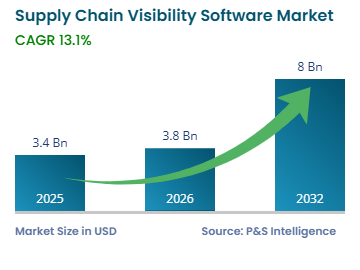
The supply chain visibility software market size was USD 3.4 billion for 2025, and it will grow by 13.1% during 2026–2032, to reach USD 8.0 billion by 2032.
The market is driven by the deepening integration of artificial intelligence (AI), Internet of Things (IoT) sensors, and cloud-native architectures, which are transforming shipment tracking, inventory management, and supplier collaboration, positioning supply chain visibility platforms as core infrastructure for resilient, data-driven supply networks. Enterprises increasingly view end-to-end transparency as a strategic necessity rather than an operational option. Rising supply chain complexity, expanding cross-border trade, and heightened exposure to disruptions have made transparency a boardroom priority.
The market's trajectory reflects a structural shift toward predictive, real-time intelligence. Persistent freight volatility, port congestion, and supplier concentration risks exposed during recent global disruptions have accelerated boardroom-level investment in visibility solutions. These solutions consolidate fragmented carrier, warehouse, supplier, and enterprise data into a unified, actionable view. Regulatory momentum reinforces this demand. Frameworks such as the U.S. Uyghur Forced Labor Prevention Act (UFLPA) and the European Union's Corporate Sustainability Due Diligence Directive (CSDDD) require multinational organizations to strengthen supply chain traceability, due diligence, and supplier transparency across multiple tiers. These obligations embed supply chain visibility software into compliance, risk management, and operational resilience initiatives.
Key Market Insights
The software category holds the larger market share, of 75%, in 2025, driven by demand for real-time visibility, predictive analytics, and supplier collaboration.
The small & medium-sized enterprises category will have the higher CAGR, of approximately 13.6%, driven by the increasing adoption of affordable cloud-based solutions.
The asset tracking category will have the highest CAGR, of approximately 13.8%, driven by the increasing adoption of IoT-enabled asset monitoring and connected devices.
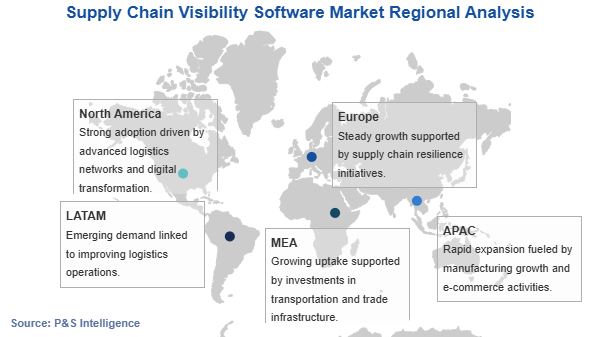
North America holds the largest market share, of 40%, in 2025, driven by advanced logistics infrastructure and widespread cloud adoption.
Asia-Pacific will have the highest CAGR, of approximately 14.0%, driven by rapid industrialization, manufacturing growth, and expanding e-commerce.
Supply Chain Visibility Software Market Dynamics
Predictive Intelligence and Control-Tower Architectures Are Key Trends
The supply chain visibility software market is shifting from descriptive tracking toward predictive, decision-centric visibility, redefining what buyers expect from these platforms. Early solutions primarily confirmed where a shipment was, whereas contemporary systems forecast arrival times, quantify delay probabilities, and recommend corrective actions through control-tower interfaces that orchestrate responses across planning and execution. Machine learning models trained on large volumes of historical shipment data and IoT telemetry from connected assets power this transformation, alongside deepening integration with transportation management systems (TMS) and warehouse management systems (WMS). Recent product innovations reflect this transformation. In January 2025, FourKites launched its AI-powered Intelligent Control Tower, which leverages real-time visibility, digital twins, and AI agents to automate decision-making and orchestrate supply chain workflows across more than 3.2 million shipments tracked daily in over 200 countries and territories.
As artificial intelligence becomes more deeply embedded in visibility workflows, the market is converging with supply chain planning and execution, prompting vendors to introduce AI platforms capable of orchestrating enterprise systems with real-world supply chain intelligence. FourKites' February 2026 launch of Loft illustrates this shift by enabling organizations to unify disparate enterprise systems through a single AI-driven orchestration layer. This convergence enables concurrent scenario modeling, predictive risk assessment, and automated exception handling. The trend is accelerating as vendors compete on predictive accuracy, real-time data integration, and network breadth rather than basic shipment tracking. This competition is raising the analytical sophistication that enterprises expect from supply chain visibility platforms.
Rising Supply Chain Complexity and Cross-Border Trade Volumes Are Biggest Drivers
Escalating global trade volumes and complex multi-tier supplier networks are compelling enterprises to adopt supply chain visibility software as a core operational requirement. As goods traverse fragmented networks of carriers, ports, customs authorities, and warehouses, the absence of real-time transparency directly contributes to stockouts, missed delivery commitments, and higher buffer inventory costs. According to the World Trade Organization (WTO), the volume of world merchandise trade grew 4.9% year over year in the first half of 2025, while the United Nations Conference on Trade and Development (UNCTAD) estimated that global trade expanded by approximately USD 300 billion during the first half of 2025. These figures point to the growing scale and complexity of international commerce.
Visibility platforms address these operational complexities by integrating carrier, customs, warehouse, and logistics data into a unified, real-time view, enabling predictive estimated arrival times (ETAs), proactive exception management, and data-driven decision-making. As enterprises continue to expand nearshoring strategies and diversify supplier networks, supply chain visibility software is evolving from a discretionary operational tool into critical digital infrastructure for managing interconnected global supply chains.
Integration Complexity and Data Fragmentation Are Key Restraints
Persistent difficulty in unifying data from disparate systems and trading partners continues to limit the pace and depth of supply chain visibility software deployment. Achieving genuine end-to-end transparency requires reconciling inconsistent data formats, incomplete carrier event feeds, and legacy enterprise systems that were never designed to exchange information seamlessly. Many implementations encounter delays when partner networks provide fragmented, inconsistent, or low-quality data, reducing the accuracy of predictive analytics and eroding user confidence in visibility platforms. Data security, interoperability, and privacy requirements further increase deployment complexity, particularly for multinational organizations integrating data across multiple jurisdictions. These challenges often extend implementation timelines, increase integration costs, and raise the total cost of ownership. However, the restraint is gradually easing as standardized APIs, cloud-native architectures, and pre-built integrations with transportation management systems (TMS), warehouse management systems (WMS), and major logistics providers continue to improve interoperability across supply chain ecosystems.
Mid-Market Digitization and SME Adoption Are Biggest Opportunities
A wide gap in visibility adoption among small and medium-sized enterprises (SMEs) is creating untapped market potential for supply chain visibility software providers. High implementation costs, complex system integration, and lengthy deployment cycles have traditionally confined advanced visibility platforms to large multinational organizations, leaving many SMEs reliant on manual tracking and spreadsheet-based coordination. The proliferation of software-as-a-service (SaaS) delivery, pre-configured industry-specific templates, and subscription-based pricing models is lowering these barriers, allowing smaller businesses to deploy visibility capabilities with minimal upfront investment and faster implementation. This access unlocks a broad, underpenetrated customer base at a time when SMEs face the same supply chain disruptions, customer transparency expectations, and regulatory compliance requirements as large enterprises.
Reflecting this industry focus, in February 2025, project44 introduced six new AI-powered capabilities for its Movement Platform, including AI Data Quality Agents and supply chain optimization tools that automate workflows and simplify deployment, making advanced visibility solutions more accessible to organizations with limited IT resources. Vendors capable of delivering rapid onboarding, seamless integration, and outcome-focused functionality are well positioned to capitalize on this expanding customer segment as SME digital transformation accelerates. This shift represents a long-term growth opportunity and is reshaping go-to-market strategies across the supply chain visibility software market.
The software category holds the larger market share, of 75%, in 2025. This dominance reflects the central role of software platforms in enabling real-time shipment tracking, predictive analytics, supplier collaboration, and control-tower operations across complex supply chain networks. Enterprises prioritize investment in software because platform capabilities directly determine operational efficiency and business value, including data-network coverage, predictive accuracy, AI-driven insights, and seamless integration with transportation management systems (TMS), warehouse management systems (WMS), and enterprise resource planning (ERP) platforms. The growing adoption of cloud-native, software-as-a-service (SaaS) deployment models reinforces the software segment's market leadership, while continuous feature updates and API-based connectivity further strengthen this position.
The services category will have the higher CAGR, of approximately 13.4%, driven by the increasing complexity of supply chain visibility deployments and their expansion across multi-tier supplier ecosystems, which is raising demand for consulting, implementation, system integration, training, and support and maintenance services to ensure successful deployment and long-term performance. Enterprises rely on specialized service providers to integrate fragmented data sources, customize visibility platforms, optimize AI-driven predictive models, and manage organizational change across trading-partner networks. The growing need for seamless interoperability, continuous platform optimization, and faster return on investment is expected to accelerate demand for professional and managed services throughout the forecast period.
The components analyzed in this report are:
Software (Larger Category)
Services (Faster-Growing Category)
Consulting
Implementation
Support & Maintenance
Deployment Mode Analysis
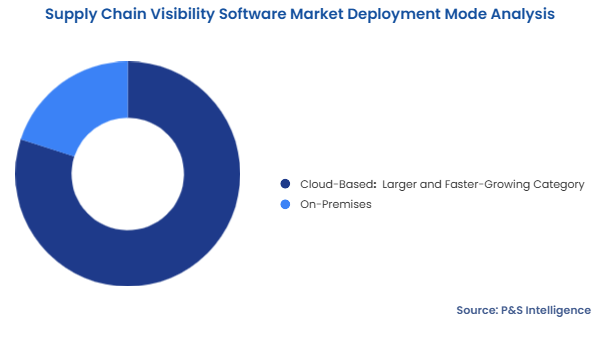
The cloud category holds the larger market share, of 80%, in 2025, and it will have the higher CAGR, driven by its ability to underpin the real-time, cross-partner data exchange required by visibility platforms. This deployment model enables continuous ingestion of carrier, warehouse, and IoT event streams across geographically dispersed networks. According to Eurostat, 45.2% of EU enterprises purchased cloud computing services in 2023, supporting enterprise software deployment through broader adoption of cloud-based digital infrastructure. Its scalability enables enterprises to onboard new suppliers and carriers without major infrastructure expansion, while subscription-based pricing lowers entry barriers for mid-sized organizations. Cloud deployment continues to dominate the market and register the fastest growth. On-premises deployment remains limited to organizations with stringent data-sovereignty or legacy integration requirements.
The deployment modes analyzed in this report are:
Cloud-Based (Larger and Faster-Growing Category)
On-Premises
Enterprise Size Analysis
The large enterprises category holds the larger market share, in 2025, driven by the need to manage high shipment volumes, complex global operations, and extensive supplier networks through centralized, real-time visibility platforms. These organizations operate expansive, multi-tier supply chains spanning numerous carriers, suppliers, and jurisdictions, generating acute demand for end-to-end transparency and control-tower orchestration. Their scale justifies substantial platform investment, and their exposure to disruption, regulatory compliance, and customer-service commitments makes visibility a strategic priority.
The small & medium-sized enterprises category will have the higher CAGR, of approximately 13.6%, driven by the proliferation of affordable, cloud-based solutions with pre-configured templates and consumption-based pricing, thereby reducing the cost and complexity barriers that limited SME adoption. According to the OECD, SMEs account for approximately 99% of all businesses across OECD countries, highlighting a large addressable market for scalable cloud-based enterprise software solutions. As smaller firms face the same transparency expectations and disruption risks as larger peers, SME adoption is expected to accelerate faster than that of the mature large-enterprise segment.
The enterprise sizes analyzed in this report are:
Large Enterprises (Larger Category)
Small & Medium-Sized Enterprises (Faster-Growing Category)
Application Analysis
The shipment tracking category holds the largest market share, of 35%, in 2025, driven by the need for real-time tracking of goods across road, rail, ocean, and air, which remains the primary use case for enterprises deploying supply chain visibility platforms. According to the International Air Transport Association (IATA), approximately 35% of global trade by value is transported by air, highlighting the critical need for real-time shipment visibility for high-value and time-sensitive cargo. Broad applicability across virtually every industry reinforces shipment tracking as the core application anchoring most deployments.
The asset tracking category will have the highest CAGR, driven by the proliferation of IoT sensors and connected devices that enable granular monitoring of returnable assets, containers, and high-value or sensitive cargo. This monitoring extends visibility beyond in-transit shipments to the physical assets themselves. Rising demand for condition monitoring, location, temperature, and tamper status, in pharmaceutical, electronics, and cold-chain segments accelerates asset-tracking adoption faster than other applications.
The applications analyzed in this report are:
Shipment Tracking (Largest Category)
Inventory Management
Order Management
Asset Tracking (Fastest-Growing Category)
Supply Chain Planning
Others
End Use Industry Analysis
The manufacturing category holds the largest market share, of 30%, in 2025, driven by manufacturers' reliance on intricate, multi-tier supplier networks and just-in-time inbound flows, where a single delayed component can halt production. This dependency makes end-to-end visibility operationally essential, while the sector's global sourcing footprint, exposure to supply chain disruptions, and need to coordinate inbound materials with production schedules drive sustained investment in supply chain visibility platforms. Rising requirements for supplier traceability, operational resilience, and production efficiency continue to strengthen adoption across manufacturing operations.
The retail & consumer goods category will have the highest CAGR, driven by escalating e-commerce volumes, compressed delivery expectations, and omnichannel fulfillment, which are increasing the need for real-time visibility across inbound and outbound supply chains. Rising consumer expectations for accurate delivery updates, improved inventory availability, and seamless order fulfillment are accelerating investment in supply chain visibility solutions. To strengthen inventory visibility across omnichannel retail operations, vendors are expanding their cloud-based capabilities through both innovation and acquisitions. For instance, The Descartes Systems Group Inc.'s acquisition of Finale Inventory in August 2025 expanded its cloud-based, multi-channel inventory management capabilities for e-commerce sellers. Retailers are adopting AI-enabled visibility platforms to reduce stockouts, improve demand forecasting, optimize inventory management, and enhance customer experience.
The end-use industries analyzed in this report are:
Drive strategic growth with comprehensive market analysis
Supply Chain Visibility Software Market Regional Outlook
North America Supply Chain Visibility Software Market Size
North America holds the largest market share, of 40%, in 2025, driven by the region's advanced logistics and digital infrastructure, widespread cloud adoption, and high concentration of leading software vendors. Early enterprise deployment of AI-, IoT-, and analytics-enabled visibility solutions across manufacturing, retail, and third-party logistics reinforces regional leadership. Regulatory initiatives strengthen demand. Measures such as the U.S. Uyghur Forced Labor Prevention Act (UFLPA) and the FDA Food Safety Modernization Act (FSMA 204) require greater supply chain traceability and transparency, driving enterprise adoption of visibility software across regulated industries. Continued investment in logistics technology, predictive analytics, and supply chain control tower platforms supports ongoing innovation and enterprise adoption. As organizations prioritize resilience, operational agility, and end-to-end visibility, North America is expected to maintain its market leadership.
U.S. Supply Chain Visibility Software Market Size
The United States represents the largest country market in the region. Its expansive e-commerce sector, sophisticated freight and logistics networks, and widespread digital transformation initiatives provide the structural foundation, while the presence of major supply chain visibility software providers deepens the market. The country's emphasis on real-time shipment tracking, predictive analytics, and regulatory compliance continues to accelerate enterprise adoption. According to the U.S. Census Bureau, total U.S. retail e-commerce sales reached approximately USD 1.23 trillion in 2025, accounting for 16.4% of total retail sales. This scale of e-commerce activity is intensifying the need for real-time supply chain visibility, inventory synchronization, and end-to-end shipment tracking across complex fulfillment networks.
Asia-Pacific will have the highest CAGR, of approximately 14.0%, driven by rapid industrialization, the region's position as a global manufacturing hub, and accelerating e-commerce penetration, which is intensifying demand for real-time shipment and inventory visibility. China is the largest country market in the region, supported by its extensive manufacturing base, large-scale export activity, and rapid adoption of digital supply chain technologies across industrial sectors. According to the National Bureau of Statistics (NBS) of China, the country's online retail sales increased by 7.2% year over year to RMB 15.52 trillion in 2024. This expansion of digital commerce is deepening the need for real-time supply chain visibility and logistics technologies.
Moreover, India is the fastest-growing country market, driven by government-led digitalization initiatives, expanding logistics infrastructure, and rapid e-commerce growth. Programs, such as India's PM Gati Shakti National Master Plan, alongside expanding cross-border trade corridors and rising exposure to supply chain disruption, are driving enterprises toward advanced tracking and supply chain visibility platforms. The region's large base of small and medium-sized enterprises, served by affordable cloud-based solutions, broadens the addressable market and sustains elevated growth momentum through the forecast period.
The regions and countries analyzed in this report are:
The market is fragmented, with competition spread across global enterprise software companies, specialized visibility platform providers, logistics technology firms, and regional solution vendors. The diversity of customer requirements across industries such as manufacturing, retail, healthcare, automotive, and logistics enables multiple vendors to compete through differentiated capabilities, including multimodal shipment tracking, supplier collaboration, AI-powered predictive analytics, and control-tower solutions. Leading companies such as SAP SE, Oracle Corporation, project44, FourKites, Descartes Systems Group, Blue Yonder, Kinaxis, and e2open compete by enhancing AI capabilities, expanding carrier and ERP integrations, strengthening global logistics networks, and forming strategic partnerships rather than competing solely on price. Continuous technological innovation, cloud-based deployment models, and industry-specific solutions have lowered entry barriers for niche providers. Lower barriers are intensifying competition. As enterprises demand end-to-end visibility, predictive intelligence, and seamless interoperability across supply chain ecosystems, vendors continue to differentiate themselves through product innovation, ecosystem expansion, and customer-specific offerings rather than market dominance.
Key Players in the Supply Chain Visibility Software Market:
In July 2026, The Descartes Systems Group Inc. acquired Drivin, a last-mile delivery management provider across Latin America, for upfront consideration of approximately USD 30 million plus a performance-based earn-out of up to USD 5 million. The acquisition expands Descartes' route optimization and real-time execution visibility capabilities in high-density Latin American urban markets.
In October 2025, Kinaxis Inc. launched Maestro Agents, AI-powered decision-intelligence agents embedded natively in its Maestro platform, alongside a limited-availability Maestro Agent Studio and a planned 2026 agent marketplace. The launch advances Kinaxis' move from concurrent planning toward autonomous, explainable supply chain orchestration.
In June 2025, project44, Inc. launched its Decision Intelligence Platform, evolving its Movement platform across four AI-powered layers, Connect, See, Act, and Automate, to move customers from real-time visibility toward automated execution. The release reframes project44's positioning from a visibility provider toward supply chain decision automation.
In May 2025, Blue Yonder Group, Inc. introduced AI-infused Cognitive Solutions and supply chain AI agents, targeting faster long-range and intraday decision-making under disruption. The launch reflects Blue Yonder's push toward an autonomous, agent-driven supply chain platform.
In January 2025, FourKites, Inc. launched its Intelligent Control Tower, an AI-agent-powered platform that autonomously acts across supply chain workflows while processing more than 3.2 million supply chain events daily across road, rail, ocean, and air. The launch marked a shift from descriptive visibility toward autonomous exception management and prescriptive action.
Frequently Asked Questions About This Report
Why is supply chain visibility software becoming increasingly important?+
It enables organizations to monitor shipments, inventory, suppliers, and logistics operations in real time, helping reduce disruptions, improve delivery performance, enhance operational efficiency, and strengthen supply chain resilience.
What factors are driving the growth of the supply chain visibility software market?+
The market is driven by increasing supply chain complexity, rising demand for real-time shipment tracking, expanding e-commerce, digital transformation initiatives, and the adoption of AI, IoT, cloud computing, and predictive analytics.
How does supply chain visibility software improve supply chain performance?+
It provides end-to-end visibility, predictive ETAs, exception alerts, inventory monitoring, and actionable analytics, enabling businesses to optimize logistics, reduce delays, lower costs, and improve customer satisfaction.
How does artificial intelligence enhance supply chain visibility software?+
AI improves demand forecasting, predicts shipment delays, identifies supply chain risks, automates exception management, optimizes routing, and provides data-driven insights for faster and more informed decision-making.
Why are cloud-based supply chain visibility solutions gaining popularity?+
Cloud-based solutions offer scalability, lower deployment costs, faster implementation, seamless integration with enterprise systems, automatic software updates, and secure access to real-time supply chain data from any location.
Want a report tailored exactly to your business need?
Leading companies across industries trust us to deliver data-driven insights and innovative solutions for their most critical decisions. From data-driven strategies to actionable insights, we empower the decision-makers who shape industries and define the future. From Fortune 500 companies to innovative startups, we are proud to partner with organisations that drive progress in their industries.
Client Testimonials
Working with P&S Intelligence and their team was an absolute pleasure – their awareness of timelines and commitment to value greatly contributed to our project's success. Eagerly anticipating future collaborations.
McKinsey & Company
India
Unmatched Standards
Our insights into the minutest levels of the markets, including the latest trends and competitive landscape, give you all the answers you need to take your business to new heights
Complete Data Security
We take a cautious approach to protecting your personal and confidential information. Trust is the strongest bond that connects us and our clients, and trust we build by complying with all international and domestic data protection and privacy laws