This Report Provides In-Depth Analysis of the Supply Chain Security Market Report Prepared by P&S Intelligence, Segmented by Component (Software, Services, Hardware), Deployment (Cloud, Hybrid, On-Premises), Organization Size (Large Enterprises, Small & Medium Enterprises), Security Type (Data Protection, Data Visibility & Governance), Application (Risk Management, Supply Chain Visibility, Incident Management, Compliance Management, Fraud Detection), End-User (Manufacturing, Retail & E-Commerce, Transportation & Logistics, Healthcare & Pharmaceuticals, Government), and Geographical Outlook for the Period of 2021 to 2032
Explore the market potential with our data-driven report
Supply Chain Security Market Overview
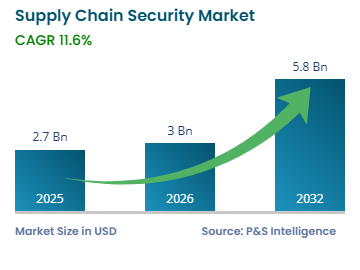
The supply chain security market size was USD 2.7 billion in 2025, and it will grow by 11.6% during 2026-2032 to reach USD 5.8 billion by 2032.
The market is expanding as supply chains become increasingly complex, globally distributed, and digitally connected across procurement, manufacturing, transportation, warehousing, and distribution activities. Organizations depend on extensive supplier ecosystems, third-party service providers, cloud platforms, and cross-border trade networks to maintain operational efficiency and meet customer demand. This interconnected environment increases exposure to cyber threats, supplier disruptions, counterfeit goods, cargo theft, and compliance-related challenges that can affect business continuity and financial performance. According to the United Nations Conference on Trade and Development, global trade in goods reached approximately US$25 trillion in 2024, highlighting the scale of international merchandise flows and the growing complexity of cross-border trade networks.
Furthermore, organizations are under pressure to improve traceability, supplier oversight, shipment visibility, and operational transparency across multiple jurisdictions. Additionally, increasing reliance on digital platforms and data exchange is encouraging broader adoption of risk monitoring, threat detection, and supply chain security technologies. These investments help organizations strengthen resilience, improve response capabilities, protect critical business processes, and maintain visibility across increasingly interconnected global supply chain operations.
Key Market Insights
Software is the largest component, holding a market share of 60% due to its role in managing end-to-end supply chain risk and data security.
Services are the fastest-growing component, registering a CAGR of approximately 11.7% driven by rising demand for managed security, integration support, and compliance expertise.
Risk management is the largest application, holding a market share of 40% due to the increasing need to identify, assess, and mitigate supplier and operational risks.
North America is the largest region, holding a market share of 40% due to strict regulatory compliance, advanced enterprise adoption, and strong cybersecurity investment across industries.
Asia-Pacific is the fastest-growing region, registering a CAGR of approximately 12.5% driven by rapid industrial expansion, export-oriented manufacturing growth, and rising cross-border trade complexities.
Supply Chain Security Market Trends and Drivers
Adoption of Real-Time Supply Chain Visibility Platforms Is a Major Trend
The industry is evolving toward real-time visibility solutions that provide continuous insight into goods movement, supplier activity, data flows, and logistics performance across supply chain networks. Organizations are deploying cloud platforms, Internet of Things sensors, blockchain technologies, analytics tools, and IoT in logistics solutions to improve shipment tracking, product authentication, and operational coordination. According to the Ericsson Mobility Report published by Telefonaktiebolaget LM Ericsson, global cellular Internet of Things connections reached around 4.5 billion at the end of 2025. Furthermore, global container port throughput exceeded 900 million twenty-foot equivalent units in 2024, according to the United Nations Conference on Trade and Development, reflecting the scale of goods moving through international trade routes. Additionally, companies are integrating monitoring, analytics, and risk intelligence into unified platforms. Moreover, these technologies support faster disruption detection, improved supply chain transparency, and stronger decision-making across global logistics operations.
Rising Supply Chain Disruptions and Security Breaches Drive Market
The market is expanding as organizations face growing operational and security challenges across increasingly interconnected global supply networks. Businesses are dealing with cargo theft, counterfeit products, supplier disruptions, cyber intrusions, and transportation bottlenecks that can affect procurement, manufacturing, inventory management, and delivery performance. According to SeaVantage, citing the United Nations Conference on Trade and Development, disruptions associated with the Red Sea crisis contributed to a 35% increase in supply chain lead times in 2024. Furthermore, Microsoft Corporation reported that organizations experienced over 600 million cybercriminal and nation-state attacks daily in 2024, highlighting the scale of threats targeting digital infrastructure. Additionally, these risks are encouraging companies to strengthen supplier oversight, shipment monitoring, and threat detection capabilities. Moreover, investments in integrated security platforms are increasing as businesses seek greater resilience, operational continuity, and protection across complex supply chain ecosystems.
High Implementation Complexity and Integration Challenges Limit Adoption
The market faces constraints as organisations encounter difficulties integrating new security solutions into existing supply chain infrastructures. Companies operate multiple systems across logistics, inventory, and vendor management, making integration complex and resource-intensive. This process often requires specialised skills, system upgrades, and operational adjustments that slow implementation timelines. Furthermore, approximately 6 billion people used the internet in 2025, according to the International Telecommunication Union, expanding the number of connected endpoints across global networks. This growth increases the integration burden as organisations must secure and manage a wider digital environment. These factors limit adoption speed and reduce the efficiency gains expected from supply chain security solutions.
Expansion of Digital Supply Networks and Emerging Market Adoption Creates New Growth Paths
The market presents strong growth potential as developing regions establish modern and digitally enabled supply chain networks. Organisations are increasingly adopting secure platforms from the outset, avoiding legacy system constraints and enabling faster deployment of advanced security tools. Growing e-commerce activity, cross-border trade, and third-party logistics expansion are creating new operational scenarios that require enhanced protection and monitoring capabilities. In 2025, 5G networks covered 55 per cent of the global population, according to the International Telecommunication Union, supporting high-speed connectivity across supply chain ecosystems. This infrastructure expansion enables real-time tracking, data exchange, and risk monitoring. Vendors are leveraging this shift by offering scalable, cloud-based solutions tailored to emerging markets and smaller enterprises.
Software is the largest category, holding a market share of 60%, as it provides the main operating layer for supply chain security across risk management, data protection, visibility, and governance workflows. Organizations use software platforms to connect supplier data, track logistics activity, monitor access, and identify anomalies across cloud, hybrid, and enterprise systems. Furthermore, the digital economy is projected to reach approximately US$ 24 trillion in 2025, according to the Digital Cooperation Organisation, showing the rising dependence on software-led business processes. This reliance is increasing demand for scalable security platforms that protect digital supply chain ecosystems while supporting real-time monitoring and compliance.
Services are the fastest-growing category, because organizations need expert support to deploy, integrate, and manage supply chain security solutions across complex operating environments. Many businesses use cloud, hybrid, and legacy systems together, which creates integration challenges and requires specialized skills in monitoring, compliance, incident response, and vendor risk control. Service providers help configure software platforms, maintain security policies, and support continuous assessment across suppliers and logistics partners. This demand is expanding as large enterprises and smaller businesses seek managed security, consulting, and technical support without adding heavy internal workload.
The components analysed in this report are:
Software (Largest Category)
Services (Fastest-Growing Category)
Hardware
Deployment Analysis
Cloud is the largest category, holding a market share of 55%, as organizations prefer scalable deployment models that support software-based security, supplier collaboration, real-time supply chain visibility, and cloud supply chain management. Cloud platforms allow teams to monitor shipments, vendor performance, data access, and risk signals across multiple locations from a centralized interface. They also support faster updates, analytics integration, and easier adoption by retail, e-commerce, and manufacturing users managing distributed operations. This model strengthens the link between data visibility, risk management, and supply chain monitoring, making cloud deployment a practical foundation for modern security programs.
Hybrid is the fastest-growing category, because organizations need cloud flexibility while retaining control over sensitive systems, production data, and existing enterprise infrastructure. Large enterprises often connect on-premises security tools with cloud platforms to improve visibility, analytics, supplier coordination, and risk management across global operations. In 2024, approximately 73% of enterprises utilized a hybrid cloud model, according to International Business Machines Corporation, showing broad adoption of combined infrastructure strategies. This approach supports gradual modernization while helping companies protect legacy systems, manage compliance, and extend security across digital supply chain networks.
The deployments analysed in this report are:
Cloud (Largest Category)
Hybrid (Fastest-Growing Category)
On-Premises
Organisation Size Analysis
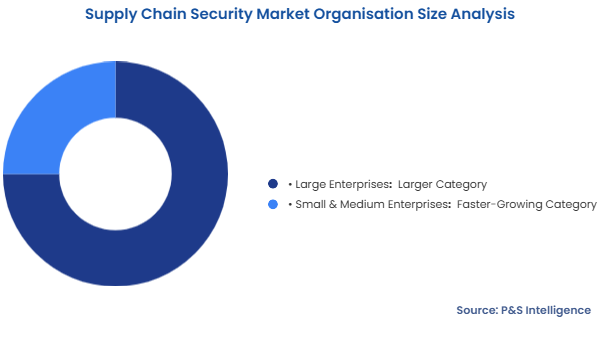
Large Enterprises are the larger category, holding a market share of 75%, due to the scale of their supplier networks, procurement systems, production flows, and cross-border logistics operations. These organizations manage thousands of vendors, multiple distribution channels, and high volumes of operational, transactional, and compliance data across regions. According to the Organization for Economic Co-operation and Development and the United Nations Statistics Division, the 500 largest multinational enterprises maintained subsidiaries across an average of 27 jurisdictions in 2024, while the most globally dispersed company operated in 157 jurisdictions. This reach increases demand for integrated platforms covering supplier oversight, data protection, governance, and risk monitoring.
Small and Medium Enterprises are the faster-growing category, registering a CAGR of approximately 11.8%, as smaller businesses become more connected to larger procurement, manufacturing, and e-commerce supply networks. These companies must meet partner requirements for secure data exchange, supplier documentation, shipment tracking, and compliance reporting, even with limited internal resources. Cloud-based software and managed services make adoption more affordable by reducing infrastructure needs and supporting faster deployment. This shift is increasing demand for practical supply chain security tools that help smaller firms protect customer data, verify suppliers, monitor logistics activity, and build trust with enterprise buyers.
The organization sizes analysed in this report are:
Large Enterprises (Larger Category)
Small & Medium Enterprises (Faster-Growing Category)
Security Type Analysis
Data Protection is the larger category, holding a market share of 80%, because supply chain security depends on protecting sensitive information exchanged across suppliers, logistics partners, manufacturers, and customers. Organizations handle procurement records, shipment details, product specifications, payment data, and intellectual property that must remain secure across cloud and hybrid systems. Strong data protection supports risk management by reducing exposure to unauthorized access, fraud, and operational disruption. This priority is increasing adoption of encryption, access control, identity management, and monitoring tools that help enterprises maintain secure information flows while supporting compliance and supplier collaboration.
Data Visibility and Governance is the faster-growing category, as organizations need clearer control over information movement across digital supply chains, cloud platforms, and external partners. Businesses require visibility into data origin, access permissions, usage patterns, and transfer activity to support compliance, risk management, and supplier accountability. According to research cited by the Centre for International Governance Innovation, cross-border data transfers are estimated to contribute approximately US$11 trillion to global GDP by 2025. This dependence on data flows is increasing demand for governance tools that enforce policies, audit activity, and secure shared supply chain information.
The security types analysed in this report are:
Data Protection (Larger Category)
Data Visibility & Governance (Faster-Growing Category)
Application Analysis
Risk Management is the largest category, due to its role in identifying supplier, logistics, cybersecurity, compliance, and operational threats before they disrupt supply chain performance. Organizations use risk management tools to assess vendor reliability, monitor shipment exposure, evaluate system vulnerabilities, and support business continuity planning. These tools connect closely with software platforms, data protection controls, and supply chain visibility systems to provide a wider view of enterprise risk. This capability is especially important for manufacturing and large enterprises, where delays, counterfeit inputs, data breaches, or supplier failures can directly affect production and customer commitments.
Supply Chain Visibility is the fastest-growing category, registering a CAGR of approximately 12.0%, because organizations need real-time insight into supplier activity, shipment movement, inventory status, and logistics disruptions across distributed networks. Visibility platforms connect with cloud software, risk management systems, data governance tools, and track and trace capabilities to help teams detect delays, route changes, and performance issues quickly. Maritime trade traveled longer distances in 2024, with the average voyage haul reaching 5,245 miles, according to the United Nations Conference on Trade and Development, reflecting greater logistics complexity. This complexity is increasing the demand for monitoring tools that improve response speed and operational coordination.
Manufacturing is the largest category, holding a market share of 35%, due to its dependence on extensive supplier ecosystems, global sourcing networks, and continuous movement of materials, components, and finished goods. Manufacturers require secure supply chains to protect production schedules, intellectual property, product quality, and operational continuity across plants and logistics partners. According to the United Nations Industrial Development Organization, manufactured goods represented nearly 79 percent of total global exports in 2024. This trade scale increases requirements for supplier verification, product traceability, cargo monitoring, and risk management solutions that protect industrial operations across connected production and distribution networks.
Retail and E-Commerce are the fastest-growing category, registering a CAGR of approximately 12.2%, because online sellers and omnichannel retailers manage high order volumes, multiple fulfillment partners, and fast-changing customer demand. These businesses depend on cloud platforms, supply chain visibility tools, data protection controls, and fraud detection systems to secure transactions and monitor product movement. Global sourcing and last-mile delivery create exposure to counterfeit goods, shipment delays, payment fraud, and customer data misuse. This environment is increasing investment in security solutions that verify suppliers, protect digital transactions, track inventory, and maintain trust across fast-moving retail supply networks.
The end-users analysed in this report are:
Manufacturing (Largest Category)
Retail & E-Commerce (Fastest-Growing Category)
Transportation & Logistics
Healthcare & Pharmaceuticals
Government
Others
Drive strategic growth with comprehensive market analysis
Supply Chain Security Market Regional Outlook
North America Supply Chain Security Market Analysis
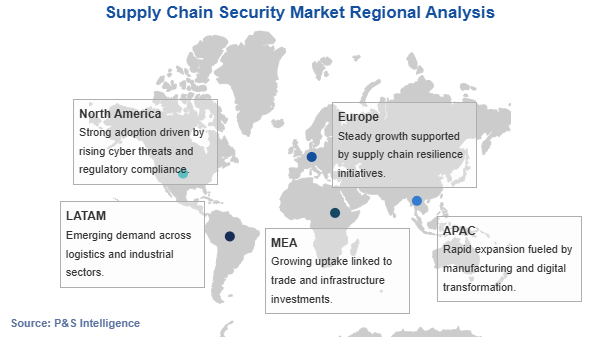
North America holds the largest share of 40% due to widespread adoption of supply chain security technologies across manufacturing, retail, healthcare, transportation, and critical infrastructure sectors. Organizations in the region manage extensive supplier ecosystems and complex procurement networks, creating significant demand for solutions that enhance visibility, traceability, and risk management. Additionally, regulatory requirements related to cybersecurity, product integrity, and operational governance encourage investments in supplier assessment platforms, threat monitoring tools, and secure information-sharing systems. Furthermore, enterprises are integrating supply chain security capabilities with broader risk management and cybersecurity strategies to strengthen oversight across vendors and logistics partners. Similarly, advanced adoption of analytics, artificial intelligence, and automation technologies supports more proactive identification of operational and supplier-related risks. Moreover, continuous investments in digital transformation initiatives reinforce the region’s leadership in deploying comprehensive supply chain security solutions.
U.S. Supply Chain Security Market Analysis
The U.S. represents a leading market for supply chain security due to its highly digitalized commercial environment, extensive supplier networks, and strong emphasis on operational resilience across critical industries. Organizations invest in supplier risk management, shipment visibility, cybersecurity integration, and traceability platforms to maintain secure and efficient movement of goods. According to the United States Census Bureau, U.S. retail e-commerce sales reached US$ 1,233.7 billion in 2025, highlighting the scale of digital transactions supported by complex logistics and fulfillment operations. Additionally, enterprises are strengthening oversight of vendors, distribution channels, and third-party service providers. Furthermore, growing transaction volumes and interconnected supply ecosystems are driving broader adoption of monitoring, authentication, and risk intelligence solutions across supply chain operations.
Canada Supply Chain Security Market Analysis
Canada is experiencing steady adoption as organisations strengthen supply chain resilience against disruptions and external risks. Businesses focus on improving visibility and securing cross-border trade flows, particularly with key international partners. Canadian merchandise exports reached US$ 721.1 billion in 2024, according to Global Affairs Canada, highlighting the large volume of goods moving across borders. This growing trade activity is encouraging organisations to deploy integrated platforms that combine monitoring, compliance, and risk management to support secure and efficient logistics operations across expanding international supply networks.
Asia-Pacific is the fastest-growing region, registering a CAGR of approximately 12.5%, supported by expanding manufacturing activity, rising international trade volumes, and increasing digitalization of supply chain operations. Organizations across the region are strengthening supply network visibility to manage supplier performance, shipment tracking, inventory movement, and operational continuity more effectively. Additionally, investments in smart logistics infrastructure, cloud-based platforms, and connected industrial systems are enabling broader deployment of security and monitoring solutions. Furthermore, major export-oriented economies require enhanced product authentication, traceability, and risk management capabilities to support complex cross-border supply networks. Similarly, growing adoption of e-commerce and digitally integrated logistics systems is increasing the importance of real-time monitoring and secure data exchange. Moreover, businesses are prioritizing resilience planning and supply chain transparency, creating strong opportunities for advanced security technologies throughout the Asia-Pacific region.
China Supply Chain Security Market Analysis
China represents a significant market driven by its extensive manufacturing capacity, large supplier base, and central role in global trade networks. Organizations prioritize product authentication, supplier oversight, logistics visibility, and operational continuity across complex production ecosystems. According to the General Administration of Customs of China, total goods imports and exports reached 43.85 trillion yuan in 2024. This substantial trade volume increases requirements for tracking technologies, supply chain monitoring platforms, and risk management systems that support the efficient movement of goods. Furthermore, manufacturers and exporters are enhancing transparency across sourcing, production, and distribution processes, creating strong demand for advanced supply chain security solutions throughout industrial networks.
India Supply Chain Security Market Analysis
India is emerging as a high-growth market as organizations modernize supply chain operations and expand digital capabilities across manufacturing, logistics, and trade activities. Businesses are improving supplier visibility, inventory management, and operational transparency to support growing domestic and international commerce. According to the Department of Commerce, Ministry of Commerce and Industry, Government of India, total exports of merchandise and services reached US$ 825.25 billion in 2024–25. This growth is encouraging wider adoption of supply chain monitoring, compliance management, and risk assessment solutions. Furthermore, expanding industrial activity and increasing participation in global value chains are strengthening demand for scalable security technologies across supplier and logistics networks.
Europe Supply Chain Security Market Analysis
Europe demonstrates strong adoption of supply chain security solutions due to comprehensive regulatory frameworks governing product traceability, supplier accountability, and operational transparency across multiple industries. Regulations covering pharmaceuticals, food products, industrial goods, and critical materials encourage organizations to implement technologies that provide continuous visibility from sourcing through final delivery. Additionally, companies are investing in supplier verification, compliance monitoring, and chain-of-custody management to support regulatory requirements and quality assurance objectives. Furthermore, the region’s established manufacturing, automotive, aerospace, and pharmaceutical sectors depend on secure supply networks to maintain operational continuity and product integrity. Similarly, increasing emphasis on sustainability reporting and responsible sourcing is accelerating the deployment of monitoring platforms that validate environmental and social compliance throughout supplier ecosystems. Moreover, businesses continue to strengthen procurement oversight and logistics transparency, supporting consistent demand for advanced supply chain security capabilities across Europe.
The regions and countries analysed in this report are:
The market is fragmented, with participation from cybersecurity software providers, logistics technology companies, risk intelligence firms, and supply chain visibility specialists offering solutions across procurement, transportation, warehousing, and supplier management functions. Organizations increasingly adopt integrated platforms that combine threat detection, supplier assessment, cargo tracking, and compliance monitoring to strengthen operational resilience. Additionally, vendors continue to enhance their portfolios through strategic partnerships, technology integration, and service expansion to address evolving security requirements. Furthermore, growing demand for real-time risk visibility encourages innovation in analytics, artificial intelligence, and monitoring capabilities. Similarly, specialized providers contribute advanced expertise in areas such as third-party risk management, counterfeit detection, and secure data exchange. Moreover, diverse customer requirements across industries support a broad competitive landscape with multiple solution providers serving different operational priorities and security objectives.
Key Players in the Supply Chain Security Market:
International Business Machines Corporation
Cisco Systems Incorporated
Oracle Corporation
Microsoft Corporation
SAP Societas Europaea
Palo Alto Networks Incorporated
Fortinet Incorporated
Check Point Software Technologies Limited
CrowdStrike Holdings Incorporated
Broadcom Incorporated
Zscaler Incorporated
Honeywell International Incorporated
Accenture Public Limited Company
Synopsys Incorporated
Supply Chain Security Market News
In February 2026, Overhaul launched SecureBOL, a tool that creates a digital copy of a bill of lading and links it to a tamper-evident QR code. At delivery, receivers can verify the document through a PIN-protected page, compare it with the paper version, and record acceptance, rejection, discrepancies, and proof of delivery within the shipment timeline.
In February 2026, FourKites launched Loft, an AI orchestration platform that operates across enterprise systems. The platform combines internal data with external supply chain intelligence, records how operational decisions are made, and converts that logic into reusable workflows supporting supplier coordination, approvals, and logistics execution processes.
In August 2025, Descartes released Visual Compliance AI Assist for denied party screening. The update applies AI to identify and filter low-risk false-positive matches while maintaining human review, configurable risk controls, and integrated audit and reporting functions for export, financial, and trade compliance processes.
In June 2025, project44 launched Decision Intelligence as an expansion of its Movement platform. The release organizes capabilities across four layers Connect, See, Act, and Automate and includes features for connected data, shipment visibility, workflow execution, and automated responses across transport and supply chain operations.
Frequently Asked Questions About This Report
What is driving demand for Supply Chain Security solutions today?+
Demand is rising as organizations depend on global suppliers, software providers, cloud services, logistics partners, and third-party vendors that can introduce operational or cyber risks.
Why are companies investing in stronger supply chain security platforms?+
Companies invest to identify supplier risks, prevent disruptions, protect sensitive data, improve visibility, strengthen compliance, and reduce exposure from third-party weaknesses.
How do supply chain attacks affect business cybersecurity risk today?+
Supply chain attacks can exploit trusted vendors, software components, or service providers, allowing attackers to reach many organizations through one compromised source.
Which industries need Supply Chain Security solutions the most today?+
Manufacturing, healthcare, retail, banking, government, logistics, energy, and technology sectors need supply chain security because they rely heavily on connected partners.
What challenges slow adoption of supply chain security programs globally?+
Common challenges include limited supplier visibility, complex vendor networks, weak data sharing, legacy systems, compliance pressure, and difficulty monitoring third-party security practices.
Want a report tailored exactly to your business need?
Leading companies across industries trust us to deliver data-driven insights and innovative solutions for their most critical decisions. From data-driven strategies to actionable insights, we empower the decision-makers who shape industries and define the future. From Fortune 500 companies to innovative startups, we are proud to partner with organisations that drive progress in their industries.
Client Testimonials
Working with P&S Intelligence and their team was an absolute pleasure – their awareness of timelines and commitment to value greatly contributed to our project's success. Eagerly anticipating future collaborations.
McKinsey & Company
India
Unmatched Standards
Our insights into the minutest levels of the markets, including the latest trends and competitive landscape, give you all the answers you need to take your business to new heights
Complete Data Security
We take a cautious approach to protecting your personal and confidential information. Trust is the strongest bond that connects us and our clients, and trust we build by complying with all international and domestic data protection and privacy laws