This Report Provides In-Depth Analysis of the Supply Chain Analytics Market Report Prepared by P&S Intelligence, Segmented by Component (Software, Services), Deployment Mode (Cloud, On-Premise, Hybrid), Enterprise Size (Large Enterprises, Small & Medium Enterprises), Analytics Type (Descriptive Analytics, Prescriptive Analytics, Diagnostic Analytics, Predictive Analytics), Technology (Artificial Intelligence & Machine Learning, Digital Twin, Big Data Analytics, Internet of Things, Cloud Computing, Blockchain, Robotic Process Automation), End User (Retail & E-commerce, Healthcare & Life Sciences, Manufacturing, Transportation & Logistics, Automotive, Food & Beverage, Consumer Goods, Aerospace & Defense, Energy & Utilities, High-Tech & Electronics), and Geographical Outlook for the Period of 2021 to 2032
Explore the market potential with our data-driven report
Supply Chain Analytics Market Overview
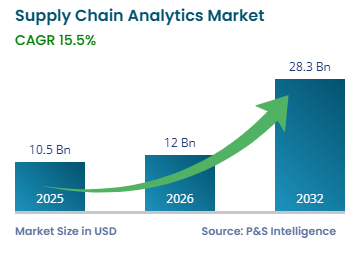
The supply chain analytics market size was USD 10.5 billion in 2025, and it will grow by 15.5% during 2026–2032 to reach USD 28.3 billion by 2032.
The market is expanding as businesses face growing pressure to improve visibility across sourcing, procurement, inventory, warehousing, transportation, and supplier operations. Global trade volatility, changing customer expectations, e-commerce growth, and increasingly complex sourcing networks are making traditional planning methods less effective. Companies are therefore adopting analytics platforms to monitor performance in real time, improve demand forecasting, optimize inventory levels, identify delivery risks, and strengthen decision-making across interconnected supply chains.
According to the United Nations Conference on Trade and Development, ports worldwide handled 920 million twenty-foot equivalent units of containers in 2024. This statistic reflects the scale of global logistics activity, the resulting demand for supply chain analytics is market analysis, as enterprises managing large volumes of goods require stronger visibility across transportation flows, shipment status, inventory positioning, and supplier performance.
The growing use of cloud computing, artificial intelligence, connected devices, and enterprise resource planning integrations is further expanding platform capabilities. Predictive and prescriptive analytics help businesses identify potential supplier delays, raw material shortages, transport bottlenecks, and demand fluctuations earlier. Adoption is particularly strong among companies managing multi-region sourcing, omnichannel distribution, and time-sensitive fulfillment operations, where faster decisions can improve service reliability, reduce disruption exposure, and control operational costs.
Key Market Insights
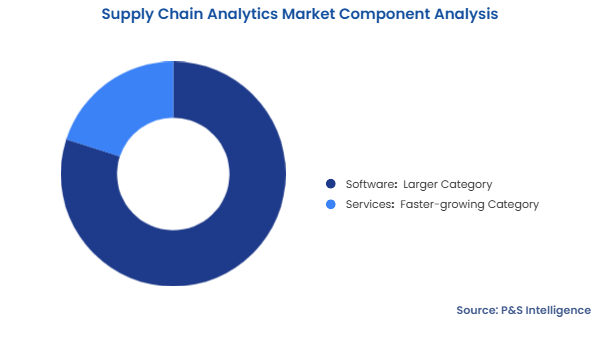
Software is the larger component, holding a market share of 80.0%, due to rising enterprise dependence on integrated supply chain planning platforms.
Artificial Intelligence & Machine Learning is the largest technology, holding a market share of 35.0%, due to increasing adoption of predictive operational intelligence systems.
Healthcare & Life Sciences is the fastest-growing end user, registering a CAGR of 17.0%, driven by rising demand for cold chain visibility.
The U.S. is the largest country market, holding a market share of 75.0%, due to extensive logistics networks and advanced enterprise analytics adoption.
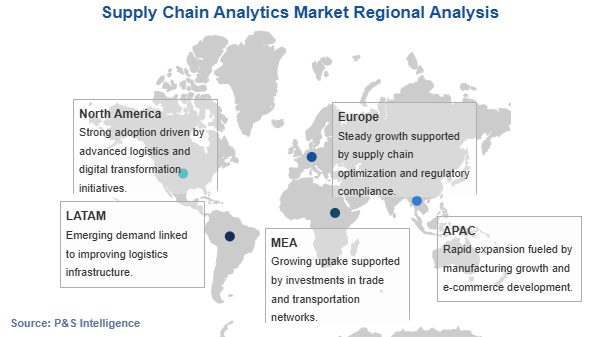
Asia-Pacific has the highest CAGR of approximately 17.5%, driven by rapid modernization of manufacturing, transportation, and retail supply chains.
Supply Chain Analytics Market Trends and Drivers
AI-Integrated Control Tower Platforms Are a Major Trend
Companies across the supply chain analytics market are increasingly adopting AI-enabled control tower platforms to improve visibility across procurement, inventory, logistics, and supplier operations. Businesses are moving beyond isolated dashboards toward connected environments that combine predictive analytics, automation, scenario modeling, and digital twin capabilities. AI is also strengthening demand sensing by identifying shifts in customer behavior, improving inventory optimization through more accurate stock recommendations, and supporting exception management by prioritizing disruptions that require immediate attention.
According to Oracle, in 2025, the company introduced AI agents within Oracle Fusion Cloud Supply Chain & Manufacturing for procurement, manufacturing, planning, inventory management, and product lifecycle management. Kinaxis also launched Maestro Agents in 2025 to support planners directly within live planning environments. These developments show how AI is becoming embedded in operational workflows, enabling faster forecasting, more responsive inventory decisions, and stronger disruption management across complex supply chain networks.
Rising Need for Real-Time Supply Chain Visibility Drives Market
The market is growing as enterprises face increasing pressure to improve visibility across sourcing, production, warehousing, transportation, and fulfillment activities. Supplier delays, shifting customer demand, trade route disruptions, and transportation bottlenecks are making traditional planning methods less effective for complex supply networks. Nearshoring and reshoring strategies are also changing supplier footprints, while supplier diversification is increasing the number of relationships and data points that companies must monitor. Geopolitical disruptions further raise uncertainty around sourcing costs, lead times, and route availability, encouraging greater investment in analytics platforms that support scenario modeling, risk monitoring, and faster decision-making.
According to the World Trade Organization, global merchandise trade volume grew 4.6% in 2025. The United Nations Conference on Trade and Development also reported that global seaborne trade reached 66,781 billion ton-miles in 2024, as Red Sea rerouting and Panama Canal restrictions increased transport distance and logistics complexity. These statistics support the scale and volatility of global trade; the resulting increase in analytics demand is market analysis. Enterprises are therefore prioritizing technologies that improve forecasting, supplier-risk visibility, inventory balance, and coordination across interconnected supply chain ecosystems.
Complex Data Integration and Legacy System Dependency Restrain Market Growth
The market faces challenges because many organizations still operate supply chains through disconnected legacy platforms that are difficult to integrate with modern analytics systems. Fragmented data across procurement, warehousing, transportation, inventory, and supplier management reduces the quality of real-time insights and limits predictive decision-making. Integration becomes more complex when enterprises attempt to connect analytics platforms with older ERP systems, on-premise infrastructure, third-party logistics networks, and multiple external data sources.
According to Salesforce’s 2025 Connectivity Benchmark research, 90% of IT leaders said data silos were creating business challenges in their organizations. This statistic directly supports the restraint, as supply chain analytics depends on consistent data exchange across operational functions. Legacy infrastructure, incompatible data formats, high customization requirements, and weak governance can extend implementation timelines and increase deployment costs. Limited integration expertise further slows adoption, particularly for organizations managing complex multi-vendor systems and sensitive operational data.
Expansion of AI-Driven Predictive Planning Creates Market Opportunities
The increasing adoption of AI-driven predictive planning tools is creating growth opportunities across the supply chain analytics market. Companies are investing in advanced platforms that improve inventory allocation, disruption forecasting, demand planning, and long-term decision-making across sourcing, warehousing, and logistics operations. Vendors are also developing solutions with machine learning, digital twin modeling, and scenario simulation capabilities to support more autonomous supply chain processes. According to IBM, 62% of supply chain leaders in 2025 said AI agents embedded in operational workflows accelerate speed to action, including decision-making, recommendations, and communications. This supports growing enterprise interest in AI-assisted planning and analytics. Cloud-based deployment models are also improving accessibility for mid-sized enterprises seeking scalable capabilities with lower infrastructure complexity.
Software is the larger category, holding a market share of 80.0%, because enterprises depend on software platforms to manage demand planning, procurement visibility, transportation monitoring, inventory control, and supplier performance analysis across integrated supply chain operations. According to the Statistical Office of the European Union, 96.44% of European Union enterprises using paid cloud services purchased at least one cloud Software-as-a-Service application in 2025, reflecting strong enterprise dependence on software-based operational tools.
Services is the faster-growing category, registering a CAGR of approximately 15.9%, because companies need consulting, implementation, integration, training, and ongoing support to use analytics platforms effectively. Many businesses still operate with fragmented supply chain data, so service providers help connect legacy systems, clean datasets, and customise analytics models for specific workflows. Demand is also rising as enterprises adopt AI, cloud, and control tower platforms that require expert configuration, managed monitoring, and continuous optimisation after deployment.
The component analysed in this report are:
Software (Larger Category)
Demand Planning and Forecasting
Procurement Analytics
Inventory and Warehouse Analytics
Logistics and Transportation Analytics
Sales and Operations Analytics
Supplier Performance Analytics
Risk and Compliance Analytics
Sustainability Analytics
Visualisation and Reporting
Services (Faster-growing Category)
Professional Services
Managed Services
Support and Maintenance Services
Deployment Mode Analysis
Cloud is the largest and fastest-growing category, holding a market share of 65% and registering a CAGR of approximately 16.6%, because organizations prefer flexible deployment models that reduce infrastructure burden and support faster rollout across multiple locations. Cloud platforms provide real-time access to data from plants, warehouses, suppliers, and logistics partners without major on-premise upgrades. According to the Organisation for Economic Co-operation and Development, cloud computing adoption averaged over 50% of businesses across member countries in 2024. This wider enterprise shift toward cloud environments supports demand for scalable supply chain analytics platforms with easier integration and lower deployment complexity.
The deployment mode analysed in this report are:
Cloud (Largest and Fastest-growing Category)
On-Premise
Hybrid
Enterprise Size Analysis
Large Enterprises is the largest category, holding a market share of 70.5%, because these organizations manage complex supplier networks, high transaction volumes, and multi-region distribution operations that require continuous operational visibility and coordinated planning. According to the Statistical Office of the European Union, 84.67% of large European Union enterprises used paid cloud computing services in 2025, compared with 66.78% of medium-sized enterprises and 49.3% of small enterprises. This higher level of digital infrastructure adoption is increasing the large-scale deployment of supply chain analytics platforms across multinational operations.
Small & Medium Enterprises (SMEs) are the fastest-growing category, registering a CAGR of approximately 15.7%, because cloud-based and subscription-based analytics platforms are making advanced supply chain capabilities more affordable and easier to deploy. Subscription models reduce upfront infrastructure costs, simplify access to predictive tools, and allow smaller businesses to scale usage according to changing operational needs. SMEs are under pressure to improve inventory planning, delivery reliability, demand visibility, and supplier coordination while working with limited resources.
The enterprise size analysed in this report are:
Large Enterprises (Larger Category)
Small & Medium Enterprises (SMEs) (Faster-growing Category)
Analytics Type Analysis
Descriptive Analytics is the largest category, holding a market share of 45.5%, because most organisations still depend on it as the foundation for supply chain visibility and performance tracking. It helps companies understand what is happening across procurement, inventory, warehousing, transportation, and order fulfilment through dashboards, reports, and historical data analysis. Businesses use descriptive analytics to monitor key operational patterns, identify recurring inefficiencies, and support routine planning decisions before moving toward more advanced predictive or prescriptive tools.
Prescriptive Analytics is the fastest-growing category, registering a CAGR of approximately 16.5%, because enterprises are increasingly adopting decision-support systems that recommend operational actions across inventory planning, transportation routing, supplier response management, and production scheduling. According to the Statistical Office of the European Union, 31.05% of European Union enterprises using AI technologies used AI software or systems for business administration or management in 2025, supporting enterprise adoption of AI-assisted operational decision tools.
The analytics type analysed in this report are:
Descriptive Analytics (Largest Category)
Prescriptive Analytics (Fastest-growing Category)
Diagnostic Analytics
Predictive Analytics
Technology Analysis
Artificial Intelligence & Machine Learning is the largest category, holding a market share of 35.0%, because these technologies are becoming central to demand forecasting, route optimisation, supplier risk analysis, disruption detection, and inventory planning across supply chain operations. According to the Statistical Office of the European Union, 19.95% of European Union enterprises used AI technologies in 2025, including machine learning systems for data analysis and operational decision support.
Digital Twin is the fastest-growing category, registering a CAGR of approximately 16.8%, because companies are increasingly using virtual supply chain models to test scenarios before making operational changes. Digital twins allow businesses to simulate supplier delays, demand shifts, inventory shortages, transportation disruptions, and production constraints in a controlled environment. This helps decision-makers compare outcomes and reduce risk.
Retail & E-commerce is the largest category, holding a market share of 25.0%, because the sector depends heavily on accurate demand forecasting, inventory availability, fast fulfilment, and efficient last-mile delivery. Retailers and online platforms use supply chain analytics to manage large product assortments, seasonal demand changes, warehouse operations, and omnichannel distribution. The need to reduce stockouts, avoid excess inventory, and improve customer delivery experience continues to support strong adoption across physical retail, online marketplaces, and consumer-focused distribution networks.
Healthcare & Life Sciences is the fastest-growing category, registering a CAGR of approximately 17.0%, because the sector operates highly regulated, time-sensitive, and temperature-controlled supply chains that require continuous monitoring across sourcing, warehousing, transportation, and distribution activities. According to the World Health Organisation, around 109 million infants worldwide received three doses of the DTP3 vaccine in 2024, highlighting the scale and operational sensitivity of global healthcare distribution systems.
The end user analysed in this report are:
Retail & E-commerce (Largest Category)
Healthcare & Life Sciences (Fastest-growing Category)
Manufacturing
Transportation & Logistics
Automotive
Food & Beverage
Consumer Goods
Aerospace & Defense
Energy & Utilities
High-Tech & Electronics
Others
Drive strategic growth with comprehensive market analysis
Supply Chain Analytics Market Regional Outlook
North America Supply Chain Analytics Market Analysis
North America holds the largest share, of 45.0%, because the region has a highly mature enterprise technology ecosystem and early adoption of AI-driven supply chain platforms across retail, manufacturing, healthcare, and logistics industries. Large organizations are focused on operational resilience, supplier risk monitoring, and real-time inventory visibility after repeated supply disruptions. Continued investment in AI-enabled logistics, warehouse automation, predictive planning, and digital supply chain transformation is further strengthening adoption across complex distribution networks. The presence of major cloud providers, enterprise software companies, and advanced logistics infrastructure supports integration across procurement, warehousing, transportation, and fulfillment functions. Businesses in the U.S. and Canada are also using connected enterprise systems and data-driven planning tools to reduce delays, improve inventory coordination, and strengthen end-to-end supply chain visibility.
U.S. Supply Chain Analytics Market Analysis
The U.S. market is the largest country, because enterprises across retail, healthcare, aerospace, and consumer goods industries operate highly complex supply chain networks requiring continuous operational visibility and coordinated logistics planning. Businesses are increasingly investing in predictive analytics, AI-enabled planning systems, warehouse intelligence platforms, and transportation visibility tools to improve fulfilment speed and reduce operational disruptions across omnichannel distribution models. According to the Bureau of Transportation Statistics, ships moved 1.7 billion tons of U.S.-international freight by weight in 2024, highlighting the scale of logistics activity requiring transportation visibility and planning analytics. Enterprises are therefore increasing the deployment of analytics platforms across procurement, warehousing, inventory, and transportation management functions.
Canada Supply Chain Analytics Market Analysis
Canada is the fastest-growing country, because transportation, retail, and natural resource industries are increasing investments in analytics-driven logistics coordination and inventory management systems. Businesses are modernising supply chain operations to manage long-distance freight movement, seasonal distribution fluctuations, and growing warehouse coordination requirements across geographically dispersed networks. Mid-sized enterprises are also adopting cloud-based analytics platforms to improve operational planning without large infrastructure investments. According to Statistics Canada, Canadian railways carried 377.1 million tonnes of freight in 2024, reflecting the scale of freight operations requiring analytics-led logistics coordination. Organisations are therefore expanding deployment of supply chain analytics platforms across warehousing, freight management, procurement, and transportation planning activities.
Asia-Pacific has the highest CAGR, of approximately 17.5%, because companies across the region are rapidly modernising manufacturing, transportation, and retail supply chains to support expanding industrial output and e-commerce activity. Countries such as China and India are seeing strong demand for analytics platforms that improve inventory planning, supplier coordination, and logistics efficiency across large-scale production and distribution networks. The region is also benefiting from increasing cloud adoption among mid-sized enterprises seeking cost-effective analytics capabilities without large infrastructure investments. Manufacturing-focused economies across the Asia-Pacific are prioritising digital supply chain transformation to improve export competitiveness and operational flexibility.
China Supply Chain Analytics Market Analysis
China is the largest country, because the country operates extensive manufacturing networks, large export operations, and rapidly expanding industrial automation infrastructure requiring coordinated operational intelligence systems. Enterprises are increasingly deploying analytics platforms to improve supplier management, warehouse efficiency, production scheduling, and logistics coordination across large-scale manufacturing ecosystems. Smart manufacturing initiatives and digitally connected logistics infrastructure are also accelerating demand for AI-driven planning technologies throughout the country. According to the National Bureau of Statistics of China, total freight traffic reached 59.7 billion tons in 2025, while port container shipping reached 354.47 million standard containers. Manufacturing and logistics enterprises are therefore increasing investments in analytics platforms supporting transportation visibility, inventory planning, and supply chain coordination.
India Supply Chain Analytics Market Analysis
India is the fastest-growing country, because enterprises across retail, manufacturing, pharmaceuticals, and e-commerce are modernizing fragmented supply chain operations through analytics-driven planning and logistics coordination systems. Businesses are investing in platforms that improve inventory visibility, demand forecasting, warehouse management, and transportation efficiency across expanding distribution networks. Government initiatives such as the National Logistics Policy and PM Gati Shakti are also supporting digital logistics integration, infrastructure coordination, and more data-driven movement of goods across the country. According to the Press Information Bureau of India, Indian Railways achieved around 1,617.38 million tonnes of originating freight loading during FY 2024–25, highlighting the scale of freight activity that businesses need to manage. These developments are strengthening demand for analytics technologies that support freight planning, inventory coordination, route visibility, and operational decision-making across complex supply chain ecosystems.
Europe Supply Chain Analytics Market Analysis
Europe is witnessing steady growth in the supply chain analytics market as businesses place greater emphasis on sustainability compliance, cross-border coordination, and supplier transparency. The Corporate Sustainability Reporting Directive is increasing pressure on companies to collect more detailed environmental and value-chain data, while Digital Product Passport initiatives are encouraging better traceability of materials, products, and lifecycle information. Broader ESG reporting requirements are also pushing enterprises to improve visibility into supplier performance, emissions exposure, and sourcing risks. These regulatory developments are strengthening demand for analytics tools that support supplier traceability, inventory optimization, emissions monitoring, and compliance reporting.
The regions and countries analysed in this report are:
The market is fragmented, with competition spread across global enterprise software providers, cloud platform companies, logistics technology vendors, and specialized analytics firms. Vendors compete across demand forecasting, transportation analytics, warehouse optimization, supplier management, control towers, and AI-driven planning. Leading providers maintain strong positions because they can integrate analytics directly with widely used ERP systems, combine data across multiple business functions, and deliver AI capabilities through established cloud ecosystems. Their end-to-end platforms also allow customers to manage planning, procurement, inventory, logistics, and supplier operations within connected environments. Regional and niche vendors continue to compete through industry-specific tools, faster customization, and flexible deployment models.
Top Companies in the Supply Chain Analytics Market:
SAP SE
Oracle Corporation
IBM Corporation
Microsoft Corporation
Kinaxis Incorporated
Manhattan Associates, Inc.
Infor, Inc.
SAS Institute Inc.
Teradata Corporation
QlikTech International AB
E2open Parent Holdings, Inc.
Anaplan, Inc.
Supply Chain Analytics Market News
In April 2026, SAP SE released supply chain AI updates within its Business AI portfolio. The update made AI-assisted MRO inventory analysis and AI-assisted planning in SAP Integrated Business Planning generally available, giving planners natural-language support for inventory analysis, planning formulas, and related supply chain decision workflows inside existing SAP applications.
In June 2025, Teradata launched Teradata AI Factory, integrating predictive, generative, and agentic AI capabilities with enterprise data and analytics infrastructure. The solution supports use cases including supply chain logistics and enables faster, AI-driven insights at scale
In January 2025, Oracle introduced new AI-powered capabilities and role-based AI agents in Oracle Fusion Cloud Supply Chain & Manufacturing (SCM), designed to improve supply chain visibility, automate routine workflows, support logistics and order management, and enable faster data-driven decision-making.
In June 2024, Qlik introduced Qlik Talend Cloud, combining advanced data integration with AI-augmented automation and data-quality capabilities. The platform helps organizations integrate and prepare trusted data for AI-driven analytics and decision-making
In April 2024, Microsoft introduced new AI-powered demand planning capabilities in Dynamics 365 Supply Chain Management Premium, enabling organizations to generate more reliable forecasts, gain actionable insights, and improve supply chain planning and decision-making.
Frequently Asked Questions About This Report
What does the supply chain analytics market include for organizations?+
It includes analytics tools that examine procurement, inventory, logistics, demand, supplier, and risk data across supply chains.
What factors are driving demand in the supply chain analytics market?+
Demand is driven by disruption risk, inventory pressure, logistics complexity, demand volatility, and need for greater supply chain visibility.
Why are organizations adopting supply chain analytics solutions across operations?+
Organizations adopt supply chain analytics to improve forecasting, track suppliers, optimize inventory, reduce delays, and manage risk.
How do supply chain analytics solutions improve decision making and efficiency?+
These tools improve operations by turning supply chain data into dashboards, alerts, scenarios, and recommendations for faster action.
What challenges affect adoption of supply chain analytics solutions today?+
Adoption is affected by data silos, poor master data, partner visibility, system integration, analytics skills, and process alignment.
Want a report tailored exactly to your business need?
Leading companies across industries trust us to deliver data-driven insights and innovative solutions for their most critical decisions. From data-driven strategies to actionable insights, we empower the decision-makers who shape industries and define the future. From Fortune 500 companies to innovative startups, we are proud to partner with organisations that drive progress in their industries.
Client Testimonials
Working with P&S Intelligence and their team was an absolute pleasure – their awareness of timelines and commitment to value greatly contributed to our project's success. Eagerly anticipating future collaborations.
McKinsey & Company
India
Unmatched Standards
Our insights into the minutest levels of the markets, including the latest trends and competitive landscape, give you all the answers you need to take your business to new heights
Complete Data Security
We take a cautious approach to protecting your personal and confidential information. Trust is the strongest bond that connects us and our clients, and trust we build by complying with all international and domestic data protection and privacy laws