Key Highlights
| Study Period | 2019 - 2032 |
| Market Size in 2024 | USD 27.5 Billion |
| Market Size in 2025 | USD 29.5 Billion |
| Market Size by 2032 | USD 50.8 Billion |
| Projected CAGR | 8.2% |
| Largest Region | Europe |
| Fastest Growing Region | APAC |
| Market Structure | Fragmented |

| Study Period | 2019 - 2032 |
| Market Size in 2024 | USD 27.5 Billion |
| Market Size in 2025 | USD 29.5 Billion |
| Market Size by 2032 | USD 50.8 Billion |
| Projected CAGR | 8.2% |
| Largest Region | Europe |
| Fastest Growing Region | APAC |
| Market Structure | Fragmented |
|
Explore the market potential with our data-driven report
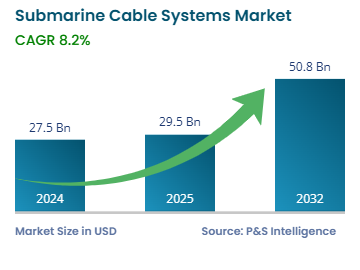
The global submarine cable systems market generated an estimated revenue of USD 27.5 billion in 2024, which is expected to witness a CAGR of 8.2% during 2025–2032, to reach USD 50.8 billion by 2032. This can be ascribed to the rising investments in offshore wind farms, growing data traffic, and increasing investments by OTT providers to meet demand.
Submarine cables are extensively used for both power and communication applications. Submarine power cables facilitate power transmission to oil rigs, from offshore wind farms to power stations, and for inter-country and island connections. The increasing demand for interconnecting national power grids is a key driver behind the growing need for low-power cables.
Moreover, the rise of undersea data centers has generated a need for seamless data transmission, which is expected to create growth opportunities for the global submarine cables systems market.
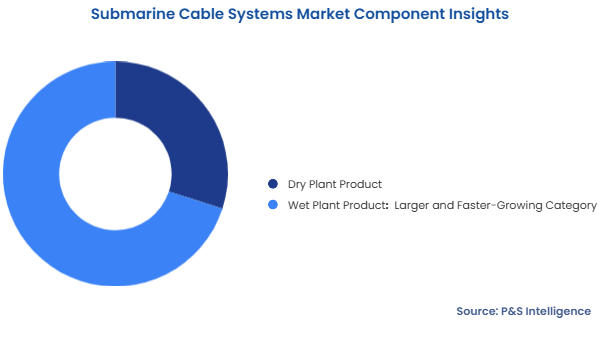
The wet plant product category is projected to grow at the higher CAGR, of 8.3%, during 2025–2032, since holding the larger market share, of 70%. The increasing demand for high-speed internet and data transmission across continents is driving significant investments in subsea cable infrastructure. As digital transformation accelerates, with rising internet traffic from cloud services, streaming, e-commerce, and IoT, the need for robust, high-capacity underwater cables become critical.
Submarine cables are the backbone of intercontinental communication, and they offer the only viable solution for transmitting vast amounts of data across oceans.
Moreover, the growing need for redundancy and global connectivity is encouraging the expansion of new submarine cable systems to ensure reliable data flow and mitigate risks of potential disruptions.
Additionally, advancements in fiber-optic technology and improved cable construction techniques are making the installation of new wet plant products more cost-effective, further stimulating growth. As a result, wet plant products dominate the market and will continue to experience rapid expansion, reflecting their central role in enabling global digital infrastructure.
During the study, we have analyzed the following components in the report:
The cable installation services category holds the largest market share, of 45%, in 2024. This is due to the significant demand for new submarine cable networks driven by global digital transformation. As the internet becomes more integral to business operations, entertainment, and communication, the need for high-capacity, reliable undersea cables to support increasing data traffic is critical.
New submarine cables are being laid to expand intercontinental connectivity, facilitate cloud services, and ensure redundancy in global communication systems. As emerging technologies like 5G, Internet of Things (IoT), and artificial intelligence continue to grow, there is a rising requirement for upgraded and expanded submarine cable infrastructure to handle vast amounts of data traffic.
The upgrade services category is projected to witness the highest CAGR, of 8.4%, during 2025–2032 in the market. This is due to the increasing demand for higher data transmission capacities driven by global internet traffic, cloud computing, and emerging technologies like 5G. As data consumption grows exponentially, existing submarine cables need upgrades to meet these demands. Upgrading cables with advanced repeaters, amplifiers, and higher-capacity fiber optics allows for enhanced bandwidth, speed, and reliability, ensuring competitiveness.
Below are the offerings analyzed:
Based on voltage, the high voltage category accounts for the largest share in 2024. This is due to the increasing demand for higher capacity and longer-distance power transmission. High voltage submarine cables are essential for transmitting large amounts of electricity across vast distances, typically from offshore wind farms, hydroelectric plants, or intercontinental power grids.
As renewable energy sources like offshore wind power gain momentum, there is a growing need for high-voltage submarine cables to efficiently transport the generated power to onshore grids. Moreover, high-voltage direct current (HVDC) technology is increasingly being used in submarine cables because it is more efficient for long-distance transmission compared to traditional alternating current (AC) cables.
The medium-voltage category has the highest CAGR, of 8.9%, driven by growing inter-island electrification, offshore wind power development, and coastal infrastructure expansion. These cables are crucial for transmitting electricity between offshore platforms, islands, and coastal facilities over moderate distances.
Countries investing in offshore renewable energy and island connectivity projects—such as Indonesia, the Philippines, and parts of Europe—are key contributors to this demand. Additionally, coastal cities expanding smart grid systems and maritime industrial zones increasingly require medium-voltage subsea links for reliable power delivery. Their ability to withstand harsh marine environments while offering efficient energy transfer makes them indispensable for medium-range subsea transmission.
The following voltages are included in the report:
The communication cable category accounts for the larger share in 2024, due to the growing global demand for data transmission and internet connectivity. Submarine communication cables are the foundation of the world's digital infrastructure, enabling high-speed internet, telecommunications, cloud services, and international data exchange. As the world becomes more digitally connected, the demand for bandwidth and low-latency communication continues to rise, driven by the growth of internet services, video streaming, social media, e-commerce, and cloud computing.
The power bifurcation will have the higher CAGR, of 9.1%, driven by the need to integrate offshore renewables, expand cross-border grid connectivity, and electrify remote islands and industrial regions. One major initiative is the Viking Link between the UK and Denmark—a 765-km HVDC interconnector with a 1.4-GW capacity, completed in 2023. The Eastern Green Link project in the UK involves two 2 GW subsea HVDC links between Scotland and England, with GBP 3.4 billion in funding and commissioning expected by 2029. The ELMED interconnector between Tunisia and Italy is a planned 600-MW, 200-km HVDC link, with an investment of EUR 850 million and completion targeted for 2028.
During the study, we have analyzed the following applications in the report:
Drive strategic growth with comprehensive market analysis
Europe is the largest region, with 30% share, driven by a strong commitment to energy transition and regional grid integration. The rapid expansion of offshore wind farms—particularly in the North Sea, Baltic Sea, and Irish Sea—has created a growing need for reliable high-voltage submarine cables to transmit electricity to mainland grids. Additionally, Europe’s push for cross-border interconnectors, such as those linking the UK with Norway, Denmark, the Netherlands, and Germany, enhances grid stability and energy security while supporting electricity trade across borders.
Regulatory support from the European Union, including funding through mechanisms like the Connecting Europe Facility (CEF), has further accelerated project development. Countries like the UK, Germany, and France are also upgrading aging infrastructure to meet new efficiency and capacity standards. Combined with national commitments to phase out fossil fuels and adopt renewables, these factors have made Europe the most developed and strategically important region for submarine power transmission projects.
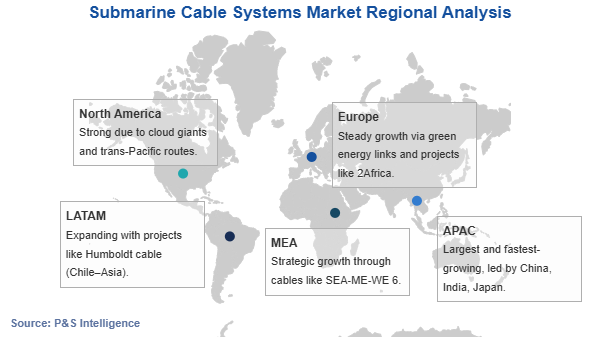
Asia-Pacific has the highest CAGR, of 9.3%, due to its rapidly growing digital economy, increasing internet penetration, and demand for high-speed, high-capacity data transmission. Asia-Pacific is home to some of the world's largest internet markets, including China, India, Japan, and South Korea, where the demand for data connectivity is growing exponentially.
The region is a hub for technology, e-commerce, cloud services, and data centers, all of which require robust, reliable submarine cable infrastructure to support the ever-increasing data traffic. Furthermore, the rise of emerging markets in Southeast Asia and the Pacific Islands is driving the need for better connectivity, as these regions work to bridge the digital divide and enhance access to high-speed internet. Several large-scale submarine cable projects are underway to connect these regions to global data networks, facilitating international trade, communication, and digital transformation.
Further, regions and countries analyzed for this report include:
The industry is fragmented in nature due to the presence of numerous players, from large telecommunications and technology companies to specialized cable manufacturers and installation service providers. While some large, well-established companies, such as Google, Microsoft, and AT&T, dominate in terms of ownership and operation of major submarine cable networks, there is a wide variety of other players involved in the design, manufacturing, installation, and maintenance of submarine cables. The company’s focus on various aspects of the submarine cable lifecycle, such as cable design and manufacturing, installation, and maintenance. Additionally, multiple regional players operate in different parts of the world, especially in emerging markets, where there is a growing demand for digital connectivity and power transmission.
Want a report tailored exactly to your business need?
Request CustomizationLeading companies across industries trust us to deliver data-driven insights and innovative solutions for their most critical decisions. From data-driven strategies to actionable insights, we empower the decision-makers who shape industries and define the future. From Fortune 500 companies to innovative startups, we are proud to partner with organisations that drive progress in their industries.

Working with P&S Intelligence and their team was an absolute pleasure – their awareness of timelines and commitment to value greatly contributed to our project's success. Eagerly anticipating future collaborations.
McKinsey & Company
India
Our insights into the minutest levels of the markets, including the latest trends and competitive landscape, give you all the answers you need to take your business to new heights

We take a cautious approach to protecting your personal and confidential information. Trust is the strongest bond that connects us and our clients, and trust we build by complying with all international and domestic data protection and privacy laws


Customize the Report to Align with Your Business Objectives

Request the Free Sample Pages