This Report Provides In-Depth Analysis of the Stucco Market Report Prepared by P&S Intelligence, Segmented by Product Type (Traditional Three-Coat Stucco, Newer One-Coat Stucco, Exterior Insulation and Finish Systems), Material Type (Cement-Based, Acrylic-Based, Lime-Based), Applications (Residential, Non-Residential), End User (Contractors, DIY Users, Architects, Institutional), Construction Type (New Construction, Renovation & Remodeling), Distribution Channel (Direct Sales, Retail Stores, Online Stores, Distributors), and Geographical Outlook for the Period of 2019 to 2032
Explore the market potential with our data-driven report
Stucco Market Analysis
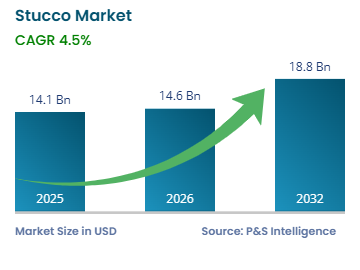
The stucco market size was USD 14.1 billion in 2025, which is predicted to reach USD 18.8 billion by 2032, growing at a CAGR of 4.5% during 2026–2032.
The market growth is primarily driven by increasing construction activities worldwide, rising awareness about the fire-resistant and energy-efficient properties of stucco, and growing demand for sustainable building materials in both residential and non-residential construction sectors.
The construction industry's robust expansion globally is significantly contributing to stucco market growth. The global construction output rose from USD 15.1 trillion in 2023 to USD 15.3 trillion in 2024, thereby creating substantial opportunities for stucco producers and suppliers. The material's versatility in application, durability, and aesthetic appeal has made it a preferred choice for exterior and interior wall finishes across various construction projects. Additionally, stucco's inherent fire-resistant properties, with most systems achieving a one-hour fire rating, are increasingly valued in regions prone to wildfires and areas with stringent building safety codes.
The market is witnessing significant technological advancements with the introduction of acrylic-based and synthetic stucco systems that offer enhanced flexibility, crack resistance, and improved weatherproofing capabilities. The growing emphasis on green building practices and energy-efficient construction is further propelling market growth, as stucco provides excellent thermal insulation properties that help reduce energy consumption in buildings.
Stucco Market Emerging Trends & Growth Drivers
Growing Demand for Fire-Resistant Building Materials Is Major Trend
The increasing focus on building safety and fire prevention has led architects and builders to choose materials that can withstand high temperatures and reduce fire spread, such as stucco.
The U.K. government supports the removal and replacement of unsafe aluminum composite material cladding on social housing buildings over 18 meters tall.
This initiative was a response to the Grenfell Tower fire tragedy of 2017 and aimed to ensure the safety of residents in high-rise social housing.
Stucco is naturally fire-resistant, making it a preferred exterior and interior finishing material in residential, commercial, and industrial buildings.
The U.K. government has committed GBP 5.1 billion to address life safety risks associated with cladding in residential buildings over 11 meters in height in England.
This funding is part of the Cladding Safety Scheme (CSS).
Regulatory bodies and building codes in many countries now require fire-resistant materials, which boosts the adoption of stucco in construction projects.
Urban areas with dense populations are particularly concerned with fire safety, leading to higher demand for stucco in apartments, high-rise buildings, and public facilities.
The U.K. government has committed GBP 5.1 billion to remediate fire safety risks from cladding on residential buildings over 11–18 meters.
Funded through government allocations and the Building Safety Levy, this initiative covers social and private housing, reflecting the government’s commitment to improving fire safety and protecting residents.
Stucco can be applied over different base materials, providing fire protection without compromising aesthetics, which makes it attractive for both new construction and renovation projects.
The growth in the adoption of eco-friendly and sustainable building practices further drives stucco demand, as it combines fire resistance with energy efficiency and low maintenance.
Regions prone to wildfires or extreme heat are increasingly specifying stucco in building designs, adding to market growth in such areas.
Rising Construction Activities and Urbanization Are Driving Market Growth
The rapid urbanization is increasing the demand for residential, commercial, and public buildings, which in turn drives demand for stucco as an exterior and interior finishing material.
As of 2024, approximately 57–59% of the global population lives in urban areas, and this share is projected to rise to around 68–70% by 2050, according to the United Nations and World Bank.
Governments in many regions are investing in infrastructure and housing projects, supporting the growth of construction-related materials like stucco.
The Indian government allocated USD 132.85 billion (INR 11,11,111 crore) for infrastructure development, marking a significant increase in capital expenditure to support urban growth and modernization.
New housing developments, high-rise apartments, and commercial complexes require durable and aesthetic wall coatings, making stucco a preferred choice for both protection and decorative purposes.
Stucco is increasingly used in energy-efficient and sustainable building designs, aligning with modern urban planning and green construction initiatives.
Rising construction activities in emerging economies, such as Asia-Pacific and Latin America, are contributing significantly to the expansion of the stucco market.
As of January 2025, under India’s Smart Cities Mission, 7,479 of 8,058 tendered projects have been completed, utilizing INR 150,002 crore out of INR 164,368 crore.
The mission’s focus on sustainable, citizen-friendly infrastructure has boosted demand for modern building materials.
Renovation and redevelopment projects in urban areas also create demand for stucco, as it is used to improve the look, durability, and weather resistance of existing structures.
The U.K. government's total estimated cost for remediating dangerous cladding on England's multistorey residential buildings ranges from GBP 12.6 billion to GBP 22.4 billion, with a central estimate of GBP 16.6 billion.
The trend supports manufacturers of cement-based, acrylic, and synthetic stucco products, as builders seek versatile and cost-effective finishing solutions.
Stucco Market Segmentation Analysis
Product Type Analysis
The traditional three-coat stucco category held the largest share in the stucco market in 2024, of approximately 65%. This category's leadership is attributed to its proven durability, superior fire resistance, and cost-effectiveness compared to newer systems. The three-coat system, consisting of a scratch coat, brown coat, and finish coat, provides exceptional strength and longevity, making it the preferred choice for both residential and commercial applications where long-term performance is prioritized.
Exterior insulation and finish systems (EIFS) have the highest CAGR due to the increasing emphasis on energy efficiency, thermal insulation, and sustainable building practices. EIFS offers superior moisture resistance, design flexibility, and cost-effectiveness, making it a preferred choice in both residential and commercial construction. Growing urbanization, stricter building codes, and the need for retrofitting older buildings further fuel its adoption across developed and emerging markets.
These product types are covered:
Traditional Three-Coat Stucco (Largest Category)
Newer One-Coat Stucco
Exterior Insulation and Finish Systems (EIFS) (Fastest-Growing Category)
Material Type Analysis
The cement-based category dominated the market in 2024 with a share of 60%, driven by its widespread availability, cost-effectiveness, and proven performance characteristics. Cement-based stucco offers excellent durability, fire resistance, and weather protection, making it suitable for various climate conditions. The material's compatibility with different substrates and its ability to be customized with various aggregates and pigments for different textures and colors contribute to its market leadership.
Acrylic-based stucco has the highest CAGR, driven by its superior durability, color retention, and resistance to cracking compared to traditional cement-based options. Its flexibility and weather-resistant properties make it ideal for diverse climates and modern architectural designs. Additionally, rising construction activity, preference for low-maintenance exteriors, and aesthetic versatility contribute to its increasing adoption in both residential and commercial sectors, especially in urban and coastal regions.
These material types are analyzed:
Cement-Based (Largest Category)
Acrylic-Based (Fastest-Growing Category)
Lime-Based
Applications Analysis
The residential category held the largest market value share in 2024, of 70%. This dominance is driven by the extensive use of stucco in single-family homes and multi-family residential buildings for both exterior and interior applications. The material's versatility in creating various architectural styles, from Mediterranean to contemporary designs, combined with its durability and low maintenance requirements, makes it a preferred choice among homeowners and builders. The growing trend of home renovations and the increasing construction of affordable housing units are further supporting category growth.
The commercial buildings category is projected to grow at the higher CAGR, during the forecast period. This rapid growth is attributed to increasing investments in office buildings, retail spaces, hotels, and mixed-use developments. Commercial projects increasingly specify stucco systems, particularly EIFS, for their energy efficiency benefits and ability to meet stringent building codes. The material's fire resistance, design flexibility, and contribution to achieving green building certifications are driving adoption in commercial construction projects globally.
These applications are covered:
Residential (Larger Category)
Single-Family Homes
Multi-Family Buildings
Non-Residential (Faster-Growing Category)
Commercial Buildings
Industrial Buildings
Institutional Buildings
End User Analysis
The contractors category held the largest market share in 2024, of 45%, as they play the leading role in residential construction, which holds the biggest share of the market. Stucco is widely used in housing projects because it is durable, cost-effective, and provides good insulation, making it the preferred choice for large-scale residential developments handled by contractors. This dominance is reflected in the fact that residential applications account for the majority of global market revenue.
The institutional category is projected to grow at the highest CAGR, during the forecast period, which corresponds to the rapid expansion of non-residential construction. The growing investments in commercial infrastructure, such as schools, hospitals, office spaces, and government buildings, are fueling demand for stucco in this category. Stucco’s fire resistance, energy efficiency, and design flexibility make it highly suitable for these large institutional projects, resulting in this category experiencing the highest growth rate in the coming years.
These end users are covered:
Contractors (Largest Category)
DIY Users
Architects
Institutional (Fastest-Growing category)
Construction Type Analysis
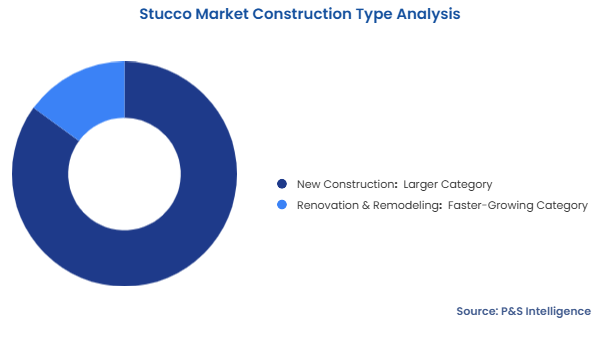
The new construction category held the larger market share in 2024, of 85%. This is because most demand for stucco comes from newly built residential and commercial buildings, especially in rapidly urbanizing areas where entire housing projects, apartments, and offices are being constructed. Developers and contractors prefer stucco for new buildings because it is durable, energy-efficient, and cost-effective, which makes it a go-to material for large-scale construction projects.
The renovation & remodeling category is projected to grow at the higher CAGR, during the forecast period, as older buildings are being upgraded. Homeowners and institutions are increasingly investing in remodeling projects to improve aesthetics, fire resistance, and energy efficiency. Renovation is also growing because many buildings in developed countries are aging and need modernization.
These construction types are covered:
New Construction (Larger Category)
Renovation & Remodeling (Faster-Growing Category)
Distribution Channel Analysis
The distributors category held the largest market share in 2024, of 45%. Most stucco products are supplied through distributor networks because they can handle bulk volumes, maintain strong relationships with contractors, and provide regional coverage. Distributors are especially important in construction markets, where large orders and technical support are often required.
The online stores category is projected to grow at the highest CAGR, during the forecast period. More contractors, DIY users, and even small businesses are turning to e-commerce platforms because of the convenience of quick ordering, competitive prices, product comparisons, and doorstep delivery. As digital adoption in construction materials grows, online channels are expected to see the highest growth rate.
These distribution channels are covered:
Direct Sales
Retail Stores
Online Stores (Fastest-growing category)
Distributors (Largest category)
Drive strategic growth with comprehensive market analysis
Stucco Market Regional Market Performance
Asia-Pacific Stucco Market Growth
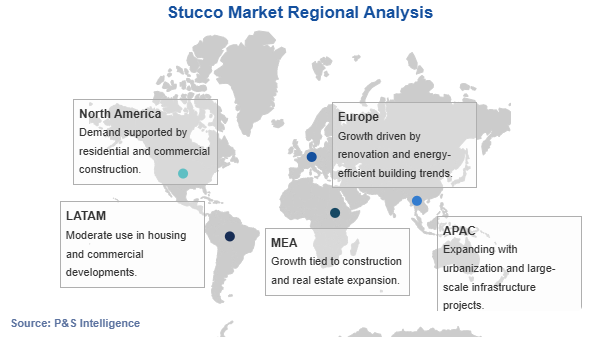
Asia-Pacific held the largest share of the global stucco market in 2024, of 40%, of the market value, and is expected to maintain its dominance during the forecast period. The region's leadership is primarily driven by massive infrastructure development and rapid urbanization across countries like China, India, and Southeast Asian nations.
The increasing focus on sustainable construction practices and energy-efficient buildings in the region is driving demand for advanced stucco systems. Government initiatives promoting green building standards in countries like Singapore, Japan, and South Korea are encouraging the adoption of high-performance stucco products. The region's vulnerability to natural disasters, including earthquakes and typhoons, has also increased demand for resilient building materials like stucco that can withstand extreme weather conditions while providing structural integrity.
China Stucco Market Growth
China continues to dominate the regional market, driven by its massive construction sector and ongoing urbanization efforts. The country's commitment to carbon neutrality by 2060 is pushing the construction industry toward more sustainable materials, benefiting the stucco market. India's rapidly growing construction sector, supported by government initiatives like the Smart Cities Mission and Housing for All program, is creating substantial opportunities for stucco manufacturers.
North America Stucco Market Value
North America is projected to be the fastest-growing regional market, with a CAGR of approx. 4.5% during 2025–2032. The growth is primarily attributed to the increasing adoption of stucco in residential construction, particularly in the southwestern U.S., where the material has traditionally been popular. The region's focus on energy-efficient construction and stringent building codes regarding fire resistance are key factors driving market expansion. The prevalence of wildfire-prone areas in California, Arizona, and other western states has made fire-resistant building materials like stucco increasingly important for both new construction and retrofitting projects.
The renovation and remodeling sector in North America is providing significant growth opportunities for the stucco market. Homeowners are increasingly choosing stucco for exterior renovations due to its ability to transform the appearance of buildings while providing long-lasting protection. The availability of various stucco finishes and colors, combined with the material's compatibility with modern architectural styles, is driving its adoption in both residential and commercial renovation projects across the U.S. and Canada.
The regions and countries analyzed in this report are:
North America (Fastest-Growing Regional Market)
U.S. (Larger Country Market)
Canada (Faster-Growing Country Market)
Europe
Germany (Largest Country Market)
U.K. (Fastest-Growing Country Market)
France
Italy
Spain
Rest of Europe
Asia-Pacific (Largest Regional Market)
Japan
China (Largest Country Market)
India (Fastest-Growing Country Market)
South Korea
Australia
Rest of APAC
Latin America
Brazil (Largest Country Market)
Mexico (Fastest-Growing Country Market)
Rest of LATAM
Middle East and Africa
Saudi Arabia (Largest Country Market)
South Africa
U.A.E. (Fastest-Growing Country Market)
Rest of MEA
Stucco Market Share Analysis
The global stucco market is fragmented, characterized by the presence of numerous regional and local manufacturers alongside several major international players. The market structure reflects the localized nature of construction practices and the importance of regional distribution networks in serving the construction industry. The competitive landscape is marked by continuous product innovation, with companies investing in developing advanced stucco formulations that offer improved performance characteristics such as enhanced flexibility, better adhesion, and faster curing times. Strategic partnerships between stucco manufacturers and construction companies are becoming increasingly common, aimed at securing long-term supply contracts for large-scale projects. Market leaders are also expanding their geographic presence through acquisitions of regional players and establishment of new manufacturing facilities in emerging markets.
Key Stucco Companies:
BASF SE
Sika AG
RPM International Inc.
The QUIKRETE Companies, LLC
CEMEX S.A.B. de C.V.
Sto SE & Co. KGaA
Mapei S.p.A.
Omega Products International, Inc.
Fosroc International Ltd.
GCP Applied Technologies Inc.
Holcim Limited
Saint-Gobain S.A.
Knauf Gips KG
Parex Group S.A.
LaHabra Stucco Products, Inc.
Stucco Market News
In February 2025, Quikrete Holding, Inc. completed its acquisition of Summit Materials Inc. for USD 52.50 per share in cash, totaling an enterprise value of approximately USD 11.5 billion, including debt.
In February 2025, Compagnie de Saint-Gobain S.A. completed its acquisition of FOSROC Inc. for approximately USD 1.025 billion. The aim of the acquisition is to expand Saint-Gobain’s presence in high-growth markets, enhance its construction chemicals portfolio, increase production capacity, and strengthen its position in the high-performance building material market, including stucco.
Want a report tailored exactly to your business need?
Leading companies across industries trust us to deliver data-driven insights and innovative solutions for their most critical decisions. From data-driven strategies to actionable insights, we empower the decision-makers who shape industries and define the future. From Fortune 500 companies to innovative startups, we are proud to partner with organisations that drive progress in their industries.
Client Testimonials
Working with P&S Intelligence and their team was an absolute pleasure – their awareness of timelines and commitment to value greatly contributed to our project's success. Eagerly anticipating future collaborations.
McKinsey & Company
India
Unmatched Standards
Our insights into the minutest levels of the markets, including the latest trends and competitive landscape, give you all the answers you need to take your business to new heights
Complete Data Security
We take a cautious approach to protecting your personal and confidential information. Trust is the strongest bond that connects us and our clients, and trust we build by complying with all international and domestic data protection and privacy laws