Sternal Closure Systems Market Size & Share Analysis - Trends, Drivers, Competitive Landscape, and Forecasts (2026 - 2032)
This Report Provides In-Depth Analysis of the Sternal Closure Systems Market Report Prepared by P&S Intelligence, Segmented by Product (Closure Devices, Bone Cement), Procedure (Median Sternotomy, Hemisternotomy, Bilateral Thoracosternotomy), Material (Titanium, Stainless Steel, Polyether Ether Ketone), and Geographical Outlook for the Period of 2021 to 2032
Explore the market potential with our data-driven report
Sternal Closure Systems Market Future Outlook
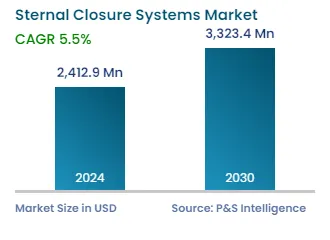
The sternal closure systems market size was USD 2,521.5 million for 2025, and it will grow by 5.6% during 2026–2032, to reach USD 3,685.1 million by 2032.
The growth of the sector can be attributed to the surge in the number of cardiothoracic surgeries, the rise in the adoption of innovative sternal closure systems, and the increase in the number of older people all around the world. On top of that, heart valves and blood vessels are easily and quickly accessible in a median sternotomy procedure, which is why it is one of the most-widely performed procedures for sternal closure. According to the World Health Organization (WHO), cardiovascular diseases caused 19.8 million deaths in 2022, representing approximately 32% of all global deaths. The rising global burden of cardiovascular disease continues to increase the demand for cardiac surgical procedures, thereby supporting the adoption of advanced sternal closure systems.
The accelerating technological improvements, including the use of biocompatible polymers, such as polyether ether ketone (PEEK) and Kryptonite bone cement, as well as pre-sternotomy plates, and the advent of minimally invasive median sternotomy operations, are also expected to fuel the expansion of the industry. Additionally, the supportive medical schemes and favorable reimbursement policies are expected to support market growth. The focus of governments on healthcare has increased over time, which has resulted in notable investments in medical facilities and therapies. There has been an expansion in the network of hospitals throughout the world, which will have a great positive impact on this domain.
Key Market Insights
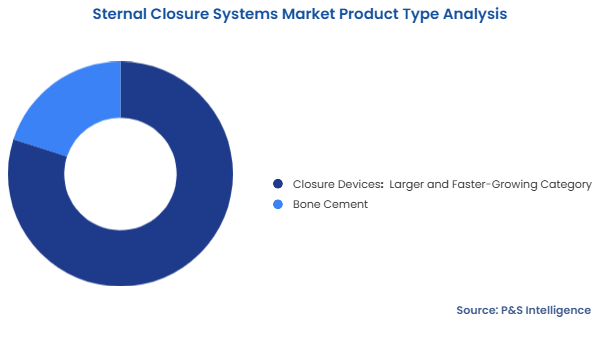
The closure devices category holds the largest market share, of 80%, in 2025, and it will have the highest CAGR, of approximately 5.7%, driven by increasing adoption for enhanced sternal stability.
The median sternotomy category holds the largest market share, of 55%, in 2025, driven by its excellent surgical access for complex cardiac procedures.
The titanium category holds the largest market share, of 60%, in 2025, driven by its superior strength and biocompatibility.
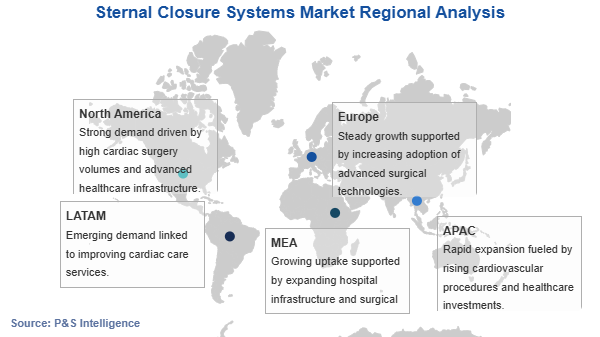
North America holds the largest market share, of 40%, in 2025, driven by advanced healthcare infrastructure and widespread adoption of sternal closure technologies.
Asia-Pacific will have the highest CAGR, of approximately 6.4%, driven by expanding hospital infrastructure and rising surgical volumes.
Sternal Closure Systems Market Trends & Drivers
Clinical Evidence and Surgeon Preference Are Key Trends
Surgeons are increasingly adopting rigid sternal fixation systems for high-risk patients with osteoporosis, obesity, diabetes, or reoperative sternotomies. Clinical evidence continues to demonstrate improved sternal stability and reduced postoperative complications compared with conventional wire cerclage. This shift is encouraging healthcare providers to incorporate titanium plate-and-screw fixation into selected cardiac procedures, thereby driving demand for premium sternal closure technologies.
A peer-reviewed comparative study indexed by the U.S. National Library of Medicine reports that patients treated with titanium plate fixation for deep sternal wound infection experienced no treatment failures, compared with a 42.3% treatment failure rate among patients treated with conventional wire closure. As clinical evidence supporting rigid fixation continues to grow, manufacturers are expanding their portfolios of titanium- and PEEK-based fixation systems, while hospitals increasingly adopt advanced sternal closure technologies for selected high-risk cardiac surgery patients.
Rising Cardiac Surgery Volumes and Aging Population Are Biggest Drivers
The increasing prevalence of cardiovascular diseases and the growth of the global aging population are driving demand for cardiac surgical procedures, including coronary artery bypass grafting (CABG), valve replacement, and other open-heart surgeries performed through median sternotomy. Since these procedures require secure sternal fixation to promote bone healing and reduce postoperative complications, rising surgical volumes are directly supporting demand for advanced sternal closure systems. The growing number of elderly patients with osteoporosis, diabetes, and other comorbidities is encouraging surgeons to adopt rigid fixation technologies that provide enhanced sternal stability.
A peer-reviewed analysis published in JTCVS Open reports that the World Health Organization recommends a benchmark of 400 open-heart surgeries per million population annually. However, fewer than 80 countries currently meet this benchmark. This gap points to considerable potential for growth in cardiac surgical capacity as healthcare systems continue expanding access to specialized cardiac care. The continued expansion of cardiac surgery infrastructure is broadening surgical capacity and patient access to specialized cardiac procedures, supporting sustained demand for advanced sternal closure systems.
Regulatory Complexity and Raw Material Cost Volatility Are Key Restraints
Extended regulatory review timelines and raw material cost volatility are constraining the pace at which new sternal closure technologies reach the market. Manufacturers introducing novel sternal fixation systems must comply with stringent regulatory requirements, which can delay product commercialization and increase development costs. According to the U.S. Food and Drug Administration (FDA), the Medical Device User Fee Amendments (MDUFA) establish a 90 FDA-day performance goal for reviewing 510(k) premarket notifications. However, submissions requiring additional information or multiple review cycles may take longer to reach a final decision, delaying the introduction of new sternal closure systems.
Moreover, titanium, one of the leading materials used in advanced sternal fixation systems, remains subject to raw material price fluctuations driven by energy-intensive production processes and geopolitical supply chain disruptions. Rising input costs are pressuring manufacturer profit margins, and this cost pressure is limiting the affordability of advanced sternal closure systems in price-sensitive markets.
Expanding Cardiac Surgery Infrastructure in Emerging Markets Is Biggest Opportunity
The expansion of cardiac surgery infrastructure across emerging economies presents growth opportunities for the sternal closure systems market. As governments increase investment in tertiary healthcare facilities and specialized cardiac centers, access to open-heart surgeries is improving in many low- and middle-income countries. This infrastructure expansion is expected to increase demand for both conventional wire cerclage systems and advanced rigid fixation technologies, as hospitals upgrade surgical capabilities.
According to the Lancet Commission on Global Surgery, approximately 5 billion people, representing nearly 70% of the global population, lack access to safe, affordable, and timely surgical care. This unmet need points to a long-term opportunity for expanding cardiac surgical services and the associated demand for sternal closure systems. As healthcare infrastructure continues to advance and access to specialized cardiac care improves, emerging markets are expected to become an increasingly important source of demand for both cost-effective and premium sternal closure solutions.
Sternal Closure Systems Market Segmentation Analysis
Product Type Analysis
The closure devices category holds the largest market share, of 80%, in 2025, and it will have the highest CAGR. This dual leadership reflects the increasing adoption of wires, plates and screws, cables, and clips that provide enhanced sternal stability for higher-risk patients with obesity, diabetes, or osteoporosis. Growing clinical acceptance of plate-and-screw fixation systems, combined with expanding manufacturer portfolios spanning multiple fixation formats, has reinforced this category's dominance across both routine and complex sternotomy closures.
According to the Society of Thoracic Surgeons (STS), the STS Adult Cardiac Surgery Database includes over 8.5 million procedure records from more than 3,500 physicians, representing over 95% of the groups performing adult cardiac surgery in the United States. This level of participation points to widespread adoption of, and continued demand for, advanced fixation systems across cardiac surgery centers.
The product types analyzed in this report are:
Closure Devices (Larger and Faster-Growing Category)
Wires
Plates & Screws
Cables
Clips
Bone Cement
Procedure Analysis
The median sternotomy category holds the largest market share, in 2025, driven by its ability to provide excellent surgical exposure to the heart, aorta, and great vessels during coronary artery bypass grafting (CABG), valve replacement, and other complex open-heart procedures. According to the Society of Thoracic Surgeons (STS), the STS Adult Cardiac Surgery Database includes participation from more than 3,500 physicians representing over 95% of the groups performing adult cardiac surgery in the United States, highlighting the widespread use of procedures commonly performed through median sternotomy.
The hemisternotomy category will have the highest CAGR, of 6.0%, driven by the increasing adoption of minimally invasive approaches for aortic and mitral valve procedures, reducing surgical trauma while preserving sternal integrity. A 2026 systematic review published in Life (MDPI), encompassing 42 studies and 15,328 patients, reports that ministernotomy offers broad anatomical applicability and a shorter learning curve, while achieving perioperative safety and long-term outcomes comparable to full sternotomy, supporting its growing adoption in cardiac surgery.
The procedures analyzed in this report are:
Median Sternotomy (Largest Category)
Hemisternotomy (Fastest-Growing Category)
Bilateral Thoracosternotomy
Material Analysis
The titanium category holds the largest market share, of 60%, in 2025, driven by its superior biocompatibility, corrosion resistance, high mechanical strength, and non-ferromagnetic properties. These characteristics enable patients with titanium implants to safely undergo magnetic resonance imaging (MRI) while providing the mechanical strength required for effective sternal fixation. Its widespread adoption is further supported by its ability to promote sternal healing and reduce postoperative instability in high-risk patients. These properties make titanium the preferred material for rigid sternal fixation in both routine and high-risk cardiac procedures.
The polyether ether ketone category will have the highest CAGR, driven by its radiolucency under standard imaging and an elastic modulus that closely approximates natural bone, reducing stress-shielding concerns associated with metallic fixation. According to a peer-reviewed review published by the U.S. National Institutes of Health (NIH), PEEK exhibits an elastic modulus of approximately 3–4 GPa, which is considerably closer to that of cortical bone than metallic implant materials, contributing to improved load sharing and increasing interest in orthopedic and cardiothoracic fixation applications.
Drive strategic growth with comprehensive market analysis
Sternal Closure Systems Market Regional Analysis
North America Sternal Closure Systems Market Size
North America holds the largest market share, of 40%, in 2025, driven by the presence of leading medical device manufacturers, continuous product innovation, and the widespread adoption of advanced sternal closure technologies across the region. The high prevalence of cardiac disease in North America is the key contributing factor. According to the U.S. Centers for Disease Control and Prevention (CDC), heart disease remained the leading cause of death in the United States in 2023, accounting for 680,909 deaths.
Moreover, according to Brown University Health, approximately 500,000 open-heart surgeries are performed annually in the United States, sustaining the demand for advanced sternal closure systems used in cardiac procedures. Furthermore, the considerable share of this region is mostly due to surgeons' growing demand for improved sternal fixation solutions, advanced healthcare infrastructure, favorable reimbursement policies, and the strong presence of leading sternal closure system manufacturers.
U.S. Sternal Closure Systems Market Size
The U.S. holds the largest country share within North America, driven by the high annual volume of open-heart surgeries, which sustains demand for sternal closure systems across the country. Well-established hospital infrastructure provides the capacity to support this procedural volume, and a regulatory environment under the Food and Drug Administration (FDA) supports the continuous introduction of advanced titanium- and PEEK-based fixation systems. According to the U.S. Centers for Disease Control and Prevention (CDC), almost 1 in every 4 deaths in the United States in 2023 was caused by heart disease. This burden signals continued demand for cardiac surgical procedures requiring sternal closure systems.
Asia-Pacific Sternal Closure Systems Market Size
Asia-Pacific will have the highest CAGR, of approximately 6.4%, driven by the expanding hospital infrastructure across China, Japan, and India, which is providing the physical capacity for higher procedural volumes. Rising cardiac surgery volumes and increasing healthcare expenditure across these markets are widening the addressable base for advanced fixation technologies. Investment in tertiary and specialty cardiac care centers is improving surgical capacity, while growing health insurance coverage and medical tourism in regional hubs are broadening access to advanced sternal closure technologies. According to the World Bank, China's current health expenditure increased from 4.49% of GDP in 2000 to 5.88% of GDP in 2022. This sustained investment in healthcare infrastructure is supporting broader adoption of advanced sternal closure systems across the country.
Furthermore, according to the Ministry of Health & Family Welfare, the number of medical colleges in India increased from 404 in 2014 to 780 by 2025, strengthening the country's healthcare infrastructure and expanding its capacity to perform complex cardiac surgeries. Continued government investment in healthcare infrastructure is reinforcing this trajectory across emerging economies, while expanding access to cardiac surgery and the increasing adoption of advanced fixation technologies are extending this momentum across the region.
China Sternal Closure Systems Market Size
China represents the largest and fastest-growing country market within Asia-Pacific, driven by rising healthcare expenditure, government initiatives to broaden access to advanced cardiac procedures, and a rapidly aging population that is increasingly susceptible to cardiovascular diseases. According to the National Bureau of Statistics of China, the country had over 223 million people aged 65 years or older by the end of 2025, accounting for approximately 15.9% of the total population. This demographic shift is contributing to a higher prevalence of cardiovascular diseases and supporting sustained demand for cardiac surgical procedures and advanced sternal closure systems.
The regions and countries analyzed in this report are:
North America (Largest Regional Market)
U.S. (Larger Country)
Canada (Faster-Growing Country)
Europe
Germany (Largest and Fastest-Growing Country)
U.K.
France
Italy
Spain
Rest of Europe
Asia-Pacific (Fastest-Growing Regional Market)
China (Largest and Fastest-Growing Country)
India
Japan
South Korea
Australia
Rest of APAC
Latin America
Brazil (Largest Country)
Mexico (Fastest-Growing Country)
Rest of LATAM
Middle East and Africa
Saudi Arabia (Largest Country)
South Africa
U.A.E. (Fastest-Growing Country)
Rest of MEA
Sternal Closure Systems Market Competitive Landscape
The market is semi-consolidated, with a limited number of established medical device manufacturers accounting for a significant share of global revenue, alongside several regional and specialized companies serving niche product segments and local markets. The market is characterized by moderate barriers to entry, including stringent regulatory requirements for implantable medical devices, high manufacturing costs associated with titanium and PEEK fixation systems, and the need for robust clinical evidence to gain surgeon acceptance. Leading companies such as Johnson & Johnson, Zimmer Biomet, Stryker Corporation, and KLS Martin benefit from broad product portfolios, established distribution networks, and long-standing relationships with cardiac surgery centers. Additionally, smaller manufacturers compete through specialized fixation technologies, product innovation, and strong regional market presence.
Key Players in the Sternal Closure Systems Market:
Zimmer Biomet Holdings Inc.
Johnson & Johnson
KLS Martin Group
B. Braun Melsungen AG
Kinamed Incorporated
Stryker Corporation
Teleflex Incorporated
A&E Medical Corporation
Acumed LLC
Jeil Medical Corporation
Able Medical Devices
Praesidia S.r.l.
Sternal Closure Systems Market Developments
In January 2026, Able Medical Devices announced the showcase of its Valkyrie Thoracic Fixation System, the industry's first commercially available PEEK-based sternal closure system, at the Society of Thoracic Surgeons (STS) 2026 Annual Meeting. The development highlights the growing adoption of advanced biomaterials and next-generation rigid fixation technologies for sternal closure.
In November 2025, ABYRX, Inc. completed a combined USD 450 million transaction with Kairuku, Inc. to form MedEdge Holdings LLC, a new entity intended to acquire 10 to 15 commercial-stage surgical product companies over the coming years. The transaction strengthens the company's biomaterials portfolio supporting cardiothoracic surgical applications.
In August 2024, DePuy Synthes, part of Johnson & Johnson MedTech, launched the MatrixSTERNUM Fixation System in the U.S., a plate-and-screw fixation system designed to stabilize the sternum following open-heart and thoracic surgeries. The system features enhanced locking strength, faster fixation, and low-profile plates that improve chest stability and support postoperative recovery.
Frequently Asked Questions About This Report
What is driving the growth of the sternal closure systems market?+
The market is driven by the rising number of cardiac surgeries, increasing prevalence of cardiovascular diseases, growing adoption of rigid fixation systems, and advancements in implant materials.
Why are rigid sternal fixation systems preferred over wire cerclage?+
They provide better sternal stability, lower complication rates, promote faster healing, and improve patient recovery compared to conventional wire cerclage.
Why is titanium widely used in sternal closure systems?+
Titanium is preferred because it is strong, lightweight, corrosion-resistant, biocompatible, and compatible with medical imaging.
Which patients are the primary users of rigid sternal closure systems?+
High-risk cardiac surgery patients, including elderly, obese, diabetic, and osteoporosis patients, are the primary users of rigid sternal closure systems.
How are technological advancements influencing the sternal closure systems market?+
Advancements in titanium and PEEK implants, low-profile plate designs, and improved fixation technologies are enhancing surgical outcomes and supporting market growth.
Want a report tailored exactly to your business need?
Leading companies across industries trust us to deliver data-driven insights and innovative solutions for their most critical decisions. From data-driven strategies to actionable insights, we empower the decision-makers who shape industries and define the future. From Fortune 500 companies to innovative startups, we are proud to partner with organisations that drive progress in their industries.
Client Testimonials
Working with P&S Intelligence and their team was an absolute pleasure – their awareness of timelines and commitment to value greatly contributed to our project's success. Eagerly anticipating future collaborations.
McKinsey & Company
India
Unmatched Standards
Our insights into the minutest levels of the markets, including the latest trends and competitive landscape, give you all the answers you need to take your business to new heights
Complete Data Security
We take a cautious approach to protecting your personal and confidential information. Trust is the strongest bond that connects us and our clients, and trust we build by complying with all international and domestic data protection and privacy laws