This Report Provides In-Depth Analysis of the Steam Trap Market Report Prepared by P&S Intelligence, Segmented by Product (Thermodynamic, Mechanical, Thermostatic), Application (Drip Application, Process Application, Tracing Application), Body Material (Steel, Iron), Industry (Chemicals, Energy and Power, Food & Beverages, Oil & Gas, Pharmaceuticals), and Geographical Outlook for the Period of 2019 to 2032
Explore the market potential with our data-driven report
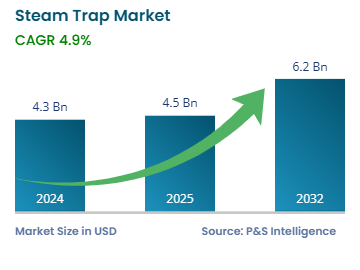
The global steam trap market will generate an estimated revenue of USD 4.3 billion in 2024, which is expected to witness a CAGR of 4.9% during 2025–2032, to reach USD 6.2 billion by 2032.
This is primarily driven by the increasing demand for energy efficiency and the rising need for optimized steam systems across various industries such as manufacturing, chemicals, oil and gas, and power generation. As industries continue to focus on reducing energy consumption and enhancing operational efficiency, steam traps play a crucial role in preventing energy loss, maintaining system pressure, and improving safety. Moreover, the growing trend of sustainable practices and stricter environmental regulations is driving the need for more reliable and efficient steam trap solutions, ensuring market growth.
Steam Trap Market Trends and Growth Drivers
Rising Demand for Energy-Efficient Steam and IoT-Integrated Systems Is Key Trend
The growing demand for energy efficiency is a significant trend in the market.
As businesses worldwide are increasingly focused on reducing operational costs and improving sustainability, energy efficiency has become a top priority.
Steam traps components help in eliminating condensate and non-condensable gases, preventing energy losses, and ensuring that the system operates at optimal efficiency.
The growing emphasis on energy conservation and cost reduction is prompting industries to adopt more advanced steam traps that are designed to minimize steam leakage and maximize thermal performance.
Additionally, the increasing adoption of automation and smart technologies in steam systems allows for real-time monitoring and management, optimizing steam trap performance.
As industries continue to prioritize energy efficiency to enhance productivity, while minimizing costs, the demand for high-performance steam traps is expected to rise.
With the increasing focus on automation and real-time data monitoring in industries, the combination of steam traps with IoT sensors offers substantial benefits.
IoT-enabled steam traps allow for continuous monitoring of steam system performance, enabling operators to detect potential issues such as leaks, blockages, or failures before they escalate into costly problems.
These smart steam traps provide real-time data on pressure, temperature, and condensate flow, which can be remotely accessed and analyzed, facilitating proactive maintenance and optimizing operational efficiency.
By integrating IoT sensors, companies can significantly reduce downtime, improve energy efficiency, and extend the lifespan of their steam systems.
Expanding Industrial Applications Drive Market
The rapid industrialization drives the market, as manufacturing accounts for roughly 16% of global GDP, with China and India possessing expanding heavy engineering, chemicals, and textiles industries.
Governments and private sectors in these countries are investing heavily in upgrading manufacturing infrastructure to improve energy efficiency and productivity, increasing the reliance on steam systems and thus steam traps for effective condensate management.
Thermal power continues to dominate the energy mix in many countries, especially in Asia and Africa, where it contributes up to 50% of the national electricity production.
Significant public investments in new coal, gas, and biomass plants aim to meet growing electricity demand, with governments prioritizing efficient steam cycle operations.
As of recent data, the global installed power generation capacity stands at over 8,000 GW, with thermal power (primarily coal and natural gas) accounting for roughly 4,800 GW.
Conventional thermal power dominates, especially in Asia, Africa, and parts of the Americas.
In addition to thermal, renewable thermal sources such as nuclear and geothermal contribute about 600 GW combined—nuclear power providing around 440 GW and geothermal roughly 160 GW globally.
These figures underscore the critical role of steam traps in optimizing efficiency and reducing energy losses across diverse thermal power plants.
The oil & gas sector contributes around 3–6% of GDP of Saudi Arabia, Russia, and the U.S. with investments into upstream exploration and downstream refining. Modernization projects and expansions focus on energy efficiency and environmental compliance, which require advanced steam trap technologies.
Growth in the HVAC sector is fueled by urbanization and infrastructure development, with the building sector contributing over 15% to the global GDP and commercial real estate expanding rapidly in major cities across North America, Europe, and Asia.
Government-led energy efficiency programs and green building certifications incentivize upgrading heating systems, often relying on steam in colder climates.
In sustainable HVAC solutions, steam traps play a key role in minimizing steam waste and improving system reliability.
High Maintenance Costs Pose Challenges
Steam traps, crucial for ensuring the efficiency of steam systems, require regular inspection and maintenance to function properly.
Over time, these components can experience wear and tear, leading to potential issues such as leakage, blockages, or complete failure, which demand costly repairs or replacements.
The need for routine checks and the maintenance of steam traps often involves specialized labor, further increasing the overall expenditure.
For industries operating with limited budgets, these recurring costs can be a major concern, particularly in large-scale operations where numerous steam traps are used.
Additionally, maintaining optimal steam system performance requires a systematic approach to troubleshooting, which can be time-consuming and expensive.
The complexity of identifying malfunctioning traps and the potential for extensive downtime while repairs are being made also leads to indirect costs, including lost productivity.
As a result, industries may hesitate to invest in high-quality steam traps or advanced monitoring systems that could reduce maintenance needs, as the upfront costs can appear prohibitive.
Steam Trap Market Segmentation Analysis
Product Insights
The thermodynamics product category is projected to grow at the highest CAGR during 2025–2032, since holding the largest market share. This is due to its simplicity and cost-effectiveness. Thermodynamic steam traps have no moving parts, making them highly reliable and less prone to mechanical failure compared to other types of steam traps. This feature reduces the maintenance costs and downtime, making them attractive to industries looking to optimize operational efficiency and reduce long-term costs.
Moreover, thermodynamic steam traps can function across a wide range of pressures and temperatures, making them versatile and suitable for diverse industrial applications, including power generation, oil and gas, chemical, and manufacturing industries. Additionally, their compact design allows for easy installation in tight spaces, further enhancing their appeal. The growing emphasis on energy efficiency and reducing carbon footprints is also fueling the demand for thermodynamic steam traps, as they help minimize energy waste and improve the overall performance of steam systems.
During the study, we have analyzed the following products in the report:
Thermodynamic (Largest and Faster-growing Category)
Mechanical
Thermostatic
Application Analysis
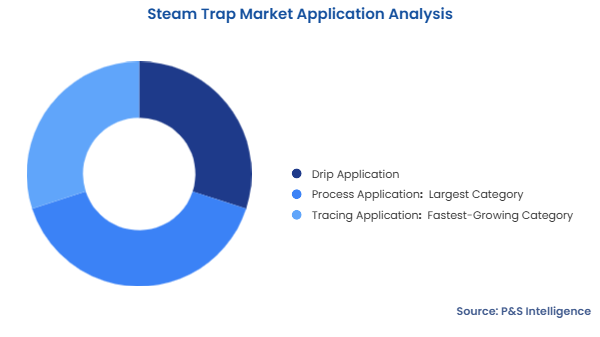
The process application category holds the largest market share, of around 40%, in 2024. This is due to the critical role steam plays in industries such as chemicals, pharmaceuticals, food processing, and oil and gas. In these sectors, steam is essential for various processes like heating, sterilization, and energy generation. Steam traps are crucial for managing steam flow, ensuring energy efficiency, and preventing system failures.
Whereas, the tracing application category is projected to witness the highest CAGR during 2025–2032 in the market. This is attributed to the increasing demand for maintaining consistent temperatures in industrial pipelines and vessels. Tracing applications, which involve heating steam systems to prevent freezing or maintain fluid flow, are critical in industries such as oil and gas, chemical processing, and energy. As these industries expand and adopt more advanced infrastructure, the need for efficient and reliable steam traps to regulate tracing systems is growing.
Below are the applications analyzed:
Drip Application
Process Application (Largest Category)
Tracing Application (Fastest-Growing Category)
Body Material Insights
Steel is projected to grow at the highest CAGR during 2025–2032, after holding the largest market share. This is primarily due to its superior properties, making it ideal for demanding industrial applications. Steel steam traps are known for their strength, durability, and resistance to high pressures and temperatures, which are crucial in industries like power generation, oil and gas, chemicals, and food processing. These industries require robust steam management systems capable of withstanding harsh conditions while ensuring reliable performance.
Additionally, steel steam traps offer better performance in high-pressure environments compared to alternatives like iron, making them more suitable for modern, high-demand applications.
The following body materials are included in the report:
Steel (Largest and Fastest-Growing Category)
Iron
Others
Industry Analysis
Energy & power is the largest category, with around 30% share, because steam systems are fundamental to electricity generation, especially in thermal power plants that rely heavily on steam turbines and boilers. Efficient steam management is crucial to maintaining plant performance, reducing energy loss, and ensuring operational safety, making steam traps indispensable.
The fastest-growing category in this segment is oil & gas. This growth is driven by ongoing investments in upstream exploration, refining capacity expansions, and modernization projects focused on improving energy efficiency and meeting stricter environmental regulations. The complex processes in oil and gas refining demand precise steam control, increasing the need for advanced steam trap technologies.
Below are the industries analyzed:
Chemicals
Energy and Power (Largest Category)
Food & Beverages
Oil & Gas (Faster-Growing Category)
Pharmaceuticals
Others
Drive strategic growth with comprehensive market analysis
Steam Trap Market Regional Growth Dynamics
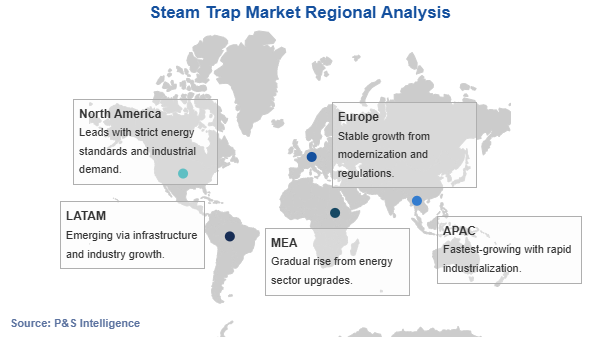
Geographically, Asia-Pacific holds the largest market share in 2024, and it also has the highest CAGR. This is due to the rapid industrialization and significant growth in manufacturing sectors across key countries such as China, India, Japan, and South Korea. The region's strong industrial base, including industries like chemicals, power generation, oil and gas, food processing, and pharmaceuticals, heavily relies on steam systems for various processes such as heating, sterilization, distillation, and energy generation.
Moreover, APAC countries are increasingly focusing on energy efficiency, sustainability, and reducing operational costs, which drives the demand for high-performance steam traps. The region’s vast infrastructure development, particularly in emerging economies, further accelerates the adoption of advanced steam management technologies.
Asia-Oceania provided over 49% of global manufacturing value added in 2023, with China alone accounting for nearly 29%, as per the UNIDO. This drives heavy deployment of steam systems in textiles, chemicals, and heavy industry. In energy, coal and gas-based thermal plants generate around 75% of China’s electricity as of early 2025 (IEA), sustaining steam demand. In India and China, refining output has expanded steadily: India’s refinery throughput rose 5.6% in FY 2022 to 5.1 mb/d capacity (EIA), and China continues to process over 15 mb/d, as per the OPEC. These major industrial, power, and refining sectors heavily rely on steam infrastructure, underpinning rising demand for efficient steam traps.
Further, regions and countries analyzed for this report include:
North America
U.S. (Larger and Faster-Growing Country Market)
Canada
Europe
Germany (Largest Country Market)
UK (Fastest-Growing Country Market)
France
Italy
Spain
Rest of Europe
Asia-Pacific (APAC) (Largest and Fastest-Growing Regional Market)
China (Largest Country Market)
Japan
India (Fastest-Growing Country Market)
South Korea
Australia
Rest of APAC
Latin America (LATAM)
Brazil (Largest and Fastest-Growing Country Market)
Mexico
Rest of LATAM
Middle East and Africa (MEA)
Saudi Arabia (Largest Country Market)
South Africa
U.A.E. (Fastest-Growing Country Market)
Rest of MEA
Steam Trap Market Share
The industry is fragmented by the presence of numerous players operating across various regions and industries. The market consists of a wide range of companies, from large multinational corporations to small and medium-sized enterprises, offering diverse steam trap solutions tailored to different industrial needs. Major players in the market include companies like Spirax Sarco, Velan Inc., and Armstrong International, which dominate the high-end, technologically advanced segment. However, many regional and local manufacturers cater to specific markets, contributing to the fragmented nature of the industry.
Key Steam Trap Companies:
Spirax Group plc
Emerson Electric Co.
Thermax Limited
Velan Inc.
Schlumberger Limited
Watts Water Technologies Inc.
Armstrong International Inc.
Watson McDaniel Company
MIYAWAKI Inc.
Yokogawa Electric Corporation
Xylem Inc.
Flowserve Corporation
Pentair plc
Kirloskar Brothers Limited
Eaton Corporation plc
Steam Trap Market News
In April 2025, American Plant Maintenance (APM Steam) launched steam trap survey services. These services can be utilized to compile a comprehensive inventory of steam traps within a facility's steam system, detect malfunctioning traps, and reveal issues related to steam trap stations that adversely affect the distribution of thermal energy throughout the steam system and ensure the effective removal of condensate.
In October 2024, Yokogawa Electric Corporation launched a new wireless steam trap monitoring device as part of the OpreXTM asset management and integrity family's Sushi Sensor solution line. This new product is now available in Malaysia, Singapore, Thailand, and Saudi Arabia and conforms with the ATEX guideline. In accordance with IECEx, FM, and other explosion-protected standards, it will subsequently be made available in the U.S., Europe, and India.
In January 2024, Watts Water Technologies, Inc. acquired Josam Company, a manufacturer of drainage and plumbing products for a diverse customer base across the commercial, industrial, and multi-family sectors.
In August 2023, Emerson Electric Co. signed an agreement to acquire FLEXIM, a developer of clamp-on ultrasonic flow measurement techniques for liquids, gases, and steam. This acquisition strengthens Emerson’s position in the flow measurement sector, expands its automation solution portfolio, and enhances its ability to offer precise measurement technologies.
In May 2023, Xylem Inc. acquired Evoqua Water Technologies Corp., which provides water treatment solutions and services, in an all-stock transaction valuing USD 7.5 billion.
Want a report tailored exactly to your business need?
Leading companies across industries trust us to deliver data-driven insights and innovative solutions for their most critical decisions. From data-driven strategies to actionable insights, we empower the decision-makers who shape industries and define the future. From Fortune 500 companies to innovative startups, we are proud to partner with organisations that drive progress in their industries.
Client Testimonials
Working with P&S Intelligence and their team was an absolute pleasure – their awareness of timelines and commitment to value greatly contributed to our project's success. Eagerly anticipating future collaborations.
McKinsey & Company
India
Unmatched Standards
Our insights into the minutest levels of the markets, including the latest trends and competitive landscape, give you all the answers you need to take your business to new heights
Complete Data Security
We take a cautious approach to protecting your personal and confidential information. Trust is the strongest bond that connects us and our clients, and trust we build by complying with all international and domestic data protection and privacy laws