South Africa Air Freight Market Size & Share Analysis - Trends, Drivers, Competitive Landscape, and Forecasts (2026 - 2032)
This Report Provides In-Depth Analysis of the South Africa Air Freight Market Report Prepared by P&S Intelligence, Segmented by Service (Freight Transport, Freight Forwarding, Express & Courier, Mail, Value-Added Services), Destination (International, Domestic), Carriage Type (Belly Cargo, Freighter), Cargo Type (General Cargo, Special Cargo), Industry (E-Commerce & Retail, Healthcare & Pharmaceuticals, Manufacturing & Automotive, Agriculture & Perishables), and Geographical Outlook for the Period of 2021 to 2032
Explore the market potential with our data-driven report
South Africa Air Freight Market Key Insights
Freight transport accounted for the largest share, of 40%, in 2025.
Domestic is the fastest-growing category, with approximately 6.8% CAGR.
Belly cargo accounts for the largest share with 75% share.
Special cargo is the fastest-growing category, with approximately 6.4% CAGR.
Western Cape is the fastest-growing provincial market, with approximately 7.2% CAGR.
South Africa Air Freight Market Overview
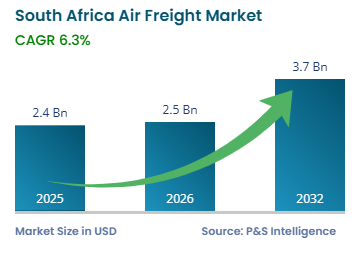
The South African air freight market stood at USD 2.4 billion in 2025 and is projected to reach USD 3.7 billion by 2032, expanding at a compound annual growth rate of 6.3% over 2026–2032. Key drivers of the South African air freight market include growth in e‑commerce, demand for perishable agricultural exports, temperature‑sensitive pharmaceutical shipments, high-value goods trade, and the need for fast, reliable delivery across domestic and international routes.
South Africa functions as the continent's primary logistics gateway. The OR Tambo International Airport in Johannesburg processes approximately 650,000 tonnes of cargo annually, serving as the dominant hub for both inbound and outbound air freight across Sub-Saharan Africa. Rising domestic e-commerce demand and pharmaceutical cold-chain requirements are reshaping the demand side. Intra-African trade flows enabled by the African Continental Free Trade Area (AfCFTA) framework are adding a further structural growth layer. South Africa's broader macroeconomic base provides structural support for freight volumes. This consumer-driven economic profile sustains demand for time-sensitive air cargo across retail, healthcare, and food categories.
South Africa Air Freight Market Trends and Drivers
Rising Demand for Specialized Cargo Transportation Is Key Trend
A substantial share of pharmaceutical products, particularly vaccines, biologics, and specialty therapeutics, requires 2–8°C temperature-controlled logistics throughout the supply chain, with demand expected to increase as advanced therapies, including mRNA-based treatments, continue to expand globally. In South Africa, the South African Health Products Regulatory Authority enforces regulatory frameworks aligned with Good Distribution Practices (GDP) to ensure the quality, safety, and traceability of pharmaceutical products across storage and transportation. These compliance obligations are compelling logistics operators to invest in active container power systems, apron-side cool rooms, and real-time temperature monitoring infrastructure.
Load-shedding-related temperature excursions have increased risks in pharmaceutical logistics, further driving demand for premium temperature-controlled air freight over less reliable alternatives. Airlines have responded by fitting wide-body holds with active container power supplies. Freight forwarders are pre-booking tarmac-side cold storage to maintain product integrity from collection through to final delivery.
E-Commerce Surge Drives Market Growth
The South African Reserve Bank records household final consumption expenditure at approximately 64.85% of GDP in 2024, underpinning robust consumer demand for rapid, reliable delivery across electronics, fashion, health, and grocery categories. Major platforms, including Takealot, Shoprite, Pick n Pay, and Amazon South Africa — launched in 2024 — have accelerated air parcel volumes by requiring next-day and same-day fulfilment windows that sea freight cannot support.
More than 10 million South Africans shopped online in 2024, with the number of digital buyers expected to continue growing in 2025 as internet penetration, smartphone adoption, and digital payment usage increase. Smartphone adoption and improved delivery networks are making online retail more accessible across the country, steadily expanding the digital consumer base. Internet access and digital payment infrastructure are the foundational enablers of this growth trajectory. Online retail has become a routine purchasing activity for a substantial share of South African consumers. Fashion accounts for the largest share of online retail revenue, followed by toys, hobbies, and DIY products; electronics & media, and furniture & appliances. Major e-commerce platforms operating in the South African market include Takealot, Shein, Temu, Amazon, Superbalist, Makro, Woolworths Online, and Bob Shop. Each platform serves a distinct consumer segment and product focus, giving South African online shoppers access to a broad spectrum of retail categories through competing digital storefronts. Standard delivery times across most South African e-commerce retailers run approximately 2–5 business days. Next-day and same-day delivery is available in major urban centres, including Johannesburg, Cape Town, and Durban. Click-and-collect pickup points and parcel lockers are also gaining adoption as complementary fulfilment options across the market.
Maritime Bottlenecks and AfCFTA Integration Creating Intra-African Air Freight Expansion Pathways
South Africa's position as a continental logistics anchor creates a structural opportunity to capture expanding intra-African air cargo flows as the AfCFTA framework reduces cross-border friction. The Department of Transport's Freight Logistics Roadmap identifies air freight as a strategic complement to road and rail corridors, particularly for time-sensitive and high-value goods moving between southern and west African markets. The May 2025 launch of a discounted Nigeria–South Africa air cargo corridor, offering freight rates up to 75% below standard market prices, demonstrates the commercial viability of dedicated intra-African air routes. OR Tambo and Cape Town are expanding cargo terminal capacity, positioning South Africa to serve as the primary redistribution hub for cargo entering and transiting the continent's southern and central trade corridors.
Infrastructure Constraints and Load-Shedding Limiting Operational Efficiency
Persistent electricity supply disruptions represent the most operationally significant restraint on South Africa's air freight market. Stage-10 load-shedding implemented by Eskom reduces grid availability by up to 12 hours per day, requiring cargo terminals and freight handlers to operate on diesel generators and directly inflating per-kilogram handling costs. Air traffic control failures at OR Tambo, including a six-hour ground stop in March 2025, cascaded into missed connections and charter diversions that undermined service reliability.
The World Bank records South Africa's GDP growth at 0.5% in 2024, reflecting the broader economic drag from energy and infrastructure deficiencies. This subdued growth environment continues to constrain trade volumes and limit expansion in air freight demand across both import and export segments.
South Africa Air Freight Market Segmentation Analysis
Service Analysis
Freight Transport accounted for the largest share, of 40%, in 2025. Expanding industrial and manufacturing exports and surging e-commerce parcel volumes requiring rapid inter-hub transit underpin this position. The Airports Company South Africa (ACSA) reports that OR Tambo International recorded a 14% year-on-year increase in cargo throughput, reflecting the centrality of traditional lift in the national logistics chain.
Value-Added Services is the fastest-growing segment over the forecast period, registering a CAGR of approximately 6.6%. SAHPRA's serialisation mandates under Traceability Roadmap HPA16-2025/26 and the rollout of South Africa's 2025 single-window customs platform are the primary compliance catalysts accelerating this growth. Shipper demand for end-to-end supply chain visibility, track-and-trace integration, and regulatory compliance management is structurally shifting outsourcing patterns toward specialised value-added providers, as traditional freight carriers do not offer these capabilities.
The market segments into the following services:
Freight Transport (Largest Category)
Freight Forwarding
Express & Courier
Mail
Value-Added Services (Fastest-Growing Category)
Destination Analysis
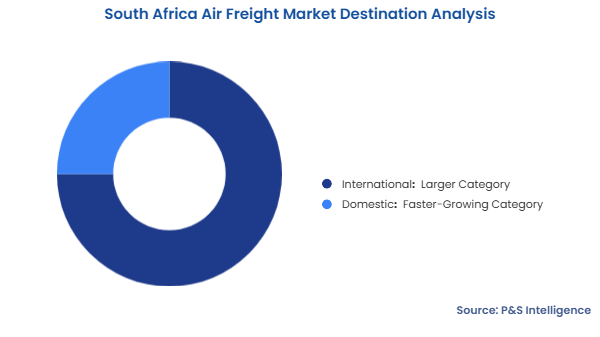
The International category accounted for the larger share in 2025, of 75%. South Africa's bilateral trade agreements with the European Union and preferential access to the United States under the African Growth and Opportunity Act provide the trade policy foundation, while high-value perishable exports, including table grapes, cut flowers, and pharmaceutical products, sustain consistent outbound cargo demand across global markets. Wide-body passenger routes to London, Frankfurt, Dubai, Hong Kong, and São Paulo provide belly-cargo lift capacity supporting these export lanes.
The domestic category is the faster-growing over the forecast period, with approximately 6.8% CAGR. The rapid expansion of last-mile e-commerce delivery is the primary structural driver. Amazon South Africa’s 2024 launch, Takealot’s fulfilment network, and Checkers Sixty60’s grocery delivery expansion are generating strong inter-provincial express parcel demand, supporting increased logistics activity across both road and air freight networks. The Department of Transport confirms this modal pressure is accelerating the shift toward domestic air express as the default fulfilment channel for time-sensitive consumer goods.
The market segments into the following destinations:
International (Larger Category)
Domestic (Faster-Growing Category)
Carriage Type Analysis
Belly cargo accounts for the larger share. South Africa's established wide-body passenger routes to London, Frankfurt, Dubai, Hong Kong, and São Paulo provide the lift capacity that makes this position structurally durable, moving general cargo, express parcels, and perishables across these lanes.
The freighter category is the faster-growing over the forecast period. Increasing pharmaceutical shipments requiring dedicated temperature-controlled holds are a primary demand driver, alongside oversized industrial cargo that exceeds belly-hold dimensions. The expansion of Emirates SkyCargo and Qatar Airways Boeing 777F freighter services into South African routes is adding dedicated lift capacity on the supply side.
The market segments into the following carriage types:
Belly Cargo (Larger Category)
Freighter (Faster-Growing Category)
Cargo Type Analysis
General cargo accounted for the larger share of the South African air freight market in 2025, of 70%. Manufactured goods, consumer electronics, automotive components, apparel, and retail merchandise constitute the majority of inbound and outbound commercial shipments through OR Tambo and Cape Town International. The high volume of general trade lanes connecting South Africa to Europe, Asia, and the Americas sustains the dominance of this category across both belly-cargo and freighter operations.
Special cargo is the faster-growing category over the forecast period. Pharmaceutical cold-chain expansion is the primary structural accelerant, compounded by perishable agricultural export growth and rising volumes of high-value items requiring enhanced security protocols. The International Air Transport Association (IATA) recorded an 8.5% year-on-year increase in air cargo demand among African carriers in 2024. Pharmaceutical and temperature-sensitive shipments were identified as the primary growth driver, reinforcing the structural shift toward special cargo categories within South Africa's logistics base.
The market segments into the following cargo types:
General Cargo (Larger Category)
Special Cargo (Faster-Growing Category)
Industry Analysis
E-Commerce & Retail accounted for the largest share of the South African air freight market in 2025. The rapid digitalisation of consumer purchasing is the primary demand foundation. Amazon South Africa's 2024 market entry, alongside established platforms, including Takealot, Checkers Sixty60, and Makro, has accelerated air parcel volumes by generating fulfilment expectations that sea and road freight cannot meet. The South African Revenue Service (SARS) introduced new cross-border e-commerce import regulations in 2025 to standardise customs duties on low-value shipments, reflecting the segment's systemic importance to national trade flows.
Healthcare & pharmaceuticals are the fastest-growing category over the forecast period, with approximately 7.0% CAGR. SAHPRA's serialisation mandates are the primary compliance driver, compelling logistics operators to invest in certified cold-chain infrastructure and documentation systems. Cold-chain compliance requirements and rising chronic disease burden are reinforcing South Africa's role as the sub-Saharan distribution hub for multinational pharmaceutical manufacturers, positioning this segment as the market's most dynamic growth vertical.
Drive strategic growth with comprehensive market analysis
South Africa Air Freight Market Geographical Analysis
Gauteng Air Freight Market Analysis
Gauteng is the largest provincial market, with 35% share. OR Tambo International Airport processes approximately 650,000 tonnes of cargo annually and accounts for the majority of the country's international air freight movements. The province contributes 34% of the national GDP, exceeding the combined output of KwaZulu-Natal and the Western Cape. This economic concentration generates a dense base of manufacturing exporters, pharmaceutical distributors, and retail importers that sustain consistent freight volumes.
Corporations co-locate distribution centres near OR Tambo to consolidate inbound electronics, apparel, and pharmaceuticals before regional dispatch.
Western Cape Air Freight Market Growth
Western Cape is the fastest-growing provincial market, with approximately 7.2% CAGR. Cape Town International Airport recorded a 42% increase in cargo volumes during the first ten months of 2025. The province's competitive advantage rests on its perishable export base. Table grapes, export-quality flowers, and pharmaceuticals depart through Cape Town International Airport’s cargo terminal, which operates with advanced temperature-controlled handling and real-time monitoring systems to support perishable and pharmaceutical shipments. Airports Company South Africa committed approximately ZAR 11.3 billion toward infrastructure upgrades at Cape Town International Airport, including runway development, terminal upgrades, expanded apron capacity, and improvements supporting future cargo and operational growth.
Provinces covered in this report include:
Gauteng (Largest)
Western Cape (Fastest-Growing)
KwaZulu-Natal
Mpumalanga
Eastern Cape
Rest of South Africa
South Africa Air Freight Market Share Analysis
The South African air freight market is moderately fragmented, with no single company fully dominating. Global integrators such as DHL, FedEx, UPS, and Aramex control a significant share of high-value and specialized cargo, including pharmaceuticals and perishables. International airlines like Emirates, Qatar Airways, Lufthansa, and British Airways provide long-haul freighter capacity, while domestic carriers such as South African Airways, CemAir, and Airlink handle regional and local cargo, including agricultural exports. Freight forwarders like Kuehne + Nagel, CEVA, and DSV also manage large volumes through partnerships with carriers. Overall, the market combines global and local operators, making it competitive but dispersed.
Barriers to new entry remain substantive. SAHPRA Good Distribution Practice compliance for pharmaceutical cargo adds a further regulatory layer that demands specialist operational capability. The capital cost of temperature-controlled apron infrastructure compounds these requirements, creating meaningful friction for smaller or undercapitalised entrants, leaving a competitive fringe of domestic specialists and regional forwarders serving niche cargo categories and secondary airport nodes.
Leading Companies in the South Africa Air Freight Market:
Deutsche Post AG
DSV A/S
Kuehne + Nagel International AG
CMA CGM S.A.
Rethmann SE & Co. KG
FedEx Corporation
The Emirates Group
United Parcel Service Inc.
Aramex PJSC
South African Airways
Mango Airlines
CemAir
Airlink
British Airways
Lufthansa
Qatar Airways
Emirates Airline
Turkish Airlines
South Africa Air Freight Market News
In April 2026, South Africa’s Department of Transport announced plans to expand midfield cargo infrastructure at OR Tambo International Airport to increase national air freight handling capacity, supporting the government’s target of approximately 1.2 million tonnes of air freight annually.
In February 2026, the Airports Company South Africa (ACSA) announced a ZAR 10.14 billion upgrade programme for Cape Town International Airport, encompassing runway realignment, expanded international apron stands, and increased cargo capacity.
In September 2025, the South African Department of Transport published the Draft Airfreight Strategy for South Africa (Government Gazette No. 53426), inviting public comment on a national framework covering on-airport infrastructure expansion, aerotropolis connectivity, and domestic, regional, and international cargo route development.
In April 2025, DSV A/S completed its acquisition of DB Schenker in a deal valued at approximately USD 15.5 billion. In South Africa, the integration is expected to strengthen DSV’s air freight capacity, operational scale, and sector-specific logistics solutions across e-commerce, automotive, and manufacturing sectors.
In July 2024, CEVA Logistics completed the integration of Bolloré Logistics, strengthening its air and ocean freight capabilities in South Africa. The combined operation enhanced local handling of e-commerce, automotive, and perishable cargo.
Frequently Asked Questions About This Report
Want a report tailored exactly to your business need?
Leading companies across industries trust us to deliver data-driven insights and innovative solutions for their most critical decisions. From data-driven strategies to actionable insights, we empower the decision-makers who shape industries and define the future. From Fortune 500 companies to innovative startups, we are proud to partner with organisations that drive progress in their industries.
Client Testimonials
Working with P&S Intelligence and their team was an absolute pleasure – their awareness of timelines and commitment to value greatly contributed to our project's success. Eagerly anticipating future collaborations.
McKinsey & Company
India
Unmatched Standards
Our insights into the minutest levels of the markets, including the latest trends and competitive landscape, give you all the answers you need to take your business to new heights
Complete Data Security
We take a cautious approach to protecting your personal and confidential information. Trust is the strongest bond that connects us and our clients, and trust we build by complying with all international and domestic data protection and privacy laws