This Report Provides In-Depth Analysis of the Solid-State Transformer Market Report Prepared by P&S Intelligence, Segmented by Product type (Distribution SST, Power/utility SST, Traction SST), Voltage level (MV/LV SST, HV/MV SST, LV/LV or application-specific SST), Component (Power electronic converters, High-frequency transformers, Semiconductor switches/modules, Controls, protection, cooling, and auxiliaries), Application (Power distribution and smart grids, EV charging infrastructure, Data centers and AI power infrastructure, Renewable energy and storage integration, Traction and railways, Industrial/microgrid and other uses), End user (Utilities and grid operators, Charging network/fleet operators, Data center operators, Renewable/storage developers, Rail and transport operators, Industrial/commercial facilities), and Geographical Outlook for the Period of 2021 to 2032
Explore the market potential with our data-driven report
Solid-State Transformer Market Overview
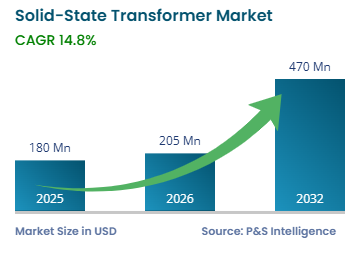
The global Solid-State Transformer Market size was USD 180.0 million in 2025 and is estimated at USD 205.0 million in 2026. Revenue is projected to reach USD 470.0 million by 2032, registering a CAGR of 14.8% during 2026–2032. Commercial demand is centered on infrastructure projects where controllable power conversion, electrical isolation, and integration with DC loads can justify a change in power architecture. The commercial case depends on the functions delivered across the complete installation, including equipment coordination, usable space, and compatibility with the connected load.
AI infrastructure provides a distinct source of power-delivery pressure. Global data-center electricity consumption is projected to increase from 485 TWh in 2025 to 950 TWh in 2030 in the International Energy Agency’s 2026 Key Questions on Energy and AI central outlook. The projection covers data centers overall and indicates the scale of the power-supply challenge. For project developers, the relevant question is whether direct medium-voltage conversion fits the facility’s distribution layout, redundancy strategy, and implementation schedule.
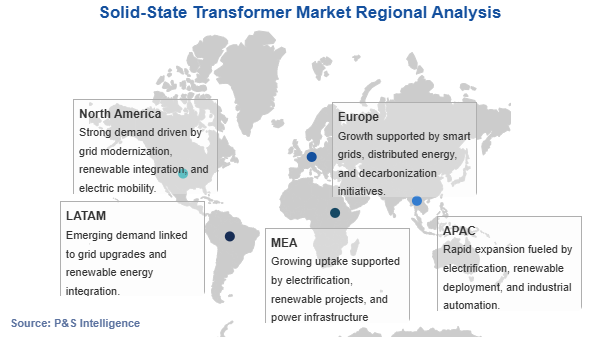
Asia-Pacific held the largest Solid-State Transformer Market share at 36.0% in 2025 and is also projected to record the fastest regional CAGR of 17.2% during 2026–2032. Its position reflects the forecast across charging infrastructure, renewable integration, and advanced electrical systems. Regional leadership should be assessed alongside differences in project readiness and qualification requirements across individual countries.
Revenue realization will depend on the progression from validated designs to repeatable commercial installations. A development partnership, an available platform, and an operating customer installation represent different levels of commercial maturity. Suppliers that translate engineering capability into verified project performance can strengthen their procurement position, while buyers need to evaluate promised architecture benefits against the equipment and service commitments required to deliver them.
Key Market Insights
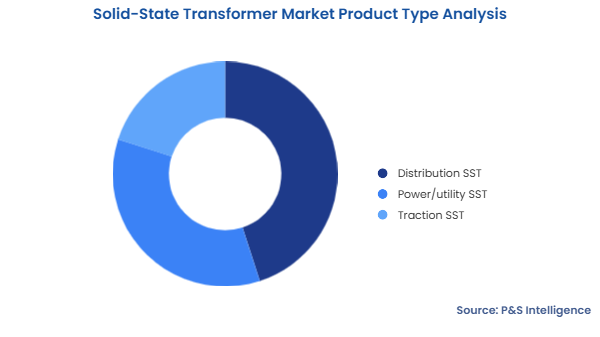
By product type, distribution SST represented the largest category in 2025, while power/utility SST is projected to grow fastest during 2026–2032.
By voltage level, MV/LV SST represented the largest category in 2025 and is projected to grow fastest during 2026–2032.
By component, power electronic converters represented the largest category in 2025, while semiconductor switches/modules is projected to grow fastest during 2026–2032.
By application, power distribution and smart grids represented the largest category in 2025, while data centers and AI power infrastructure is projected to grow fastest during 2026–2032.
By end user, utilities and grid operators represented the largest category in 2025, while data center operators are projected to grow fastest during 2026–2032.
By geography, Asia-Pacific accounted for 36.0% of revenue in 2025 and is projected to register a CAGR of 17.2% during 2026–2032.
Solid-State Transformer Market Trends and Growth Drivers
Variable EV Charging Loads Increase Demand for Grid-Interface Control
Solid-State Transformer Market growth is supported by the need to manage concentrated, variable electrical loads at grid-connected infrastructure sites. Charging hubs bring power conversion and distribution planning into the same investment decision. The investment case becomes more specific when charging demand must be coordinated with other resources at the site. Integrated conversion can be evaluated where site power, utilization, and interconnection conditions support its control functions.
The demand mechanism extends beyond adding charging points. Variable charging demand can change the loading conditions that a feeder and its connected equipment must accommodate. A 2025 National Laboratory of the Rockies cooperative research report examined medium-voltage SST use cases for EV corridor charging and solar-plus-storage, including potential distribution-transformer limitations associated with fluctuating EV loads. Integrated voltage and power-flow control could have value at sites facing those conditions. The research establishes a technical and commercial evaluation pathway, without proving that every charging site requires an SST.
For charging developers, the practical response is to evaluate the grid interface alongside charger output and operating requirements. An SST proposal becomes more relevant when its control capabilities address a documented site problem and its configuration supports the intended expansion plan. Demand could strengthen as suitable projects move from individually engineered demonstrations to repeated deployments. The pace remains conditional on interconnection approval, verified performance, and the cost of alternative equipment arrangements.
Renewable Energy and Storage Integration Broadens SST Applications
The solid-state transformer industry has an opportunity to serve projects combining renewable generation, storage, and controllable loads through a coordinated electrical architecture. Renewable capacity is projected to expand by almost 4,600 GW globally during 2025–2030, with solar PV contributing nearly 80% of the increase, according to the International Energy Agency’s Renewables 2025. The opportunity for SST suppliers lies in selected projects that can use integrated conversion and power routing, rather than in assuming a fixed attachment rate to renewable installations.
Developers combining several power sources need to decide where conversion, isolation, and control should sit within the installation. Sharing those functions through an integrated platform could reduce repeated interfaces when the design supports the required operating modes. The commercial advantage depends on the complete equipment arrangement and the ability to demonstrate reliable transitions between sources and loads. Export permissions, network capacity, and project financing remain separate constraints that a conversion system alone cannot resolve.
Architecture alternatives will shape the size of the opportunity. Integrated conversion must be assessed against the other equipment arrangements that can meet the project requirements. The comparison should account for how each arrangement handles isolation, source coordination, protection, and downstream distribution. Suppliers can improve their position by demonstrating the value of integration within that complete configuration.
Solid-state transformer industry trends are moving toward clearer interfaces and coordinated requirements for DC infrastructure. Product selection in this environment requires compatibility across conversion equipment, protection, energy storage, controls, and load-side distribution. The Open Compute Project’s SST Specification revision 0.3.0, effective June 22, 2026, describes a medium-voltage-to-800 VDC platform and addresses electrical interfaces, ride-through behavior, grounding, and operating sequences. The document represents a developing specification framework, rather than proof that every available product complies.
Reference requirements can make engineering work more reusable across projects. When buyers and suppliers agree on interface behavior, they can focus verification on a defined set of operating conditions. A shared specification also gives suppliers a clearer basis for deciding which capabilities belong inside the SST and which require coordination with other equipment. The result could be a more repeatable procurement process if the surrounding equipment ecosystem supports the same interfaces.
The trajectory favors compatibility demonstrated at system level. A power-conversion product may satisfy its own design targets while still requiring changes to storage controls, fault isolation, or downstream equipment. The value of specification convergence will increase as those relationships are verified together. Revisions to technical requirements or differences between customer architectures could continue to require project-specific engineering.
Reliability and Protection Qualification Slows Commercial Adoption
Reliability and protection qualification constrain the speed at which SST designs can progress into critical infrastructure procurement. The commercial decision includes the ability to contain faults, maintain electrical isolation, and coordinate with upstream and downstream equipment. In its July 2024 Large Power Transformer Resilience Report to Congress, the U.S. Department of Energy identified semiconductor transient exposure, device coordination, and current-limited protection as challenges for SST systems intended to replace large power transformers. The department’s assessment concerns a demanding transformer-replacement context and should not be applied as a blanket judgment on all medium-voltage commercial products.
Qualification remains relevant even where the application is narrower. A current-limited converter and the connected protection system must respond coherently to abnormal conditions. Buyers need evidence that the proposed installation can distinguish manageable disturbances from faults requiring isolation. An efficient conversion stage offers limited commercial value if the wider system cannot meet the required availability and safety conditions.
The resulting adoption path can be phased. A supplier may first validate the operating envelope, then qualify the system for a particular site, and subsequently pursue repeated procurement. Faster progress requires evidence that is relevant to the buyer’s actual load, environment, and protection arrangement. Delays in verification or changes in project requirements can extend engineering work and postpone revenue even when the underlying demand for power infrastructure remains strong.
Distribution SST was the largest product category in 2025. The Solid-State Transformer Market analysis links its position to the need for flexible conversion at distribution interfaces serving changing load and generation conditions. The National Laboratory of the Rockies’ 2025 cooperative research report examined EV corridor charging and solar-plus-storage as medium-voltage SST use cases. Its findings provide a basis for evaluating distribution-level flexibility where voltage behavior and variable equipment loading are relevant to project performance.
For distribution buyers, the purchasing case depends on the problem that controllable conversion can solve at a specific connection point. The value could include managing power flow between connected resources or maintaining suitable conditions for the downstream load. A credible proposal needs to identify the required operating modes and the equipment functions included in the supplied system. The largest-category position does not imply that wholesale replacement of conventional distribution transformers is economically justified.
Power/utility SST is projected to be the fastest-growing product category during 2026–2032. Its forward opportunity includes larger integrated conversion arrangements supporting high-power infrastructure and renewable or storage interfaces. An August 2026 development announcement by Siemens AG and Maschinenfabrik Reinhausen GmbH described an SST design for grid input up to 36 kV and output of 800 VDC for AI data centers. The announcement illustrates engineering direction, while commercial growth will depend on industrialization, qualification, and actual hardware procurement.
Voltage Level
MV/LV SST was the largest voltage category in 2025. Its position reflects the market emphasis on infrastructure that connects medium-voltage supply to lower-voltage application interfaces. The Open Compute Project’s 2026 SST specification describes medium-voltage conversion to an 800 VDC distribution interface for data centers. The specification provides a concrete example of the voltage relationship being developed for concentrated DC loads, without establishing its prevalence across all installations.
The conversion boundary matters commercially because it determines how equipment is arranged between the grid connection and the load. Project teams evaluating an MV/LV system need to assess the isolation strategy, the downstream distribution layout, and the division of responsibility for protection. The proposed system must also fit the facility’s operating requirements. Direct conversion creates an architectural option, but its value depends on the equipment arrangement it replaces or consolidates.
MV/LV SST is also projected to register the fastest growth during 2026–2032. Future demand is linked to direct medium-voltage conversion for suitable AI power and high-power charging configurations. Growth could accelerate where project requirements align around reusable DC interfaces and verified system behavior. Existing facilities may retain alternative conversion arrangements, so adoption will depend on whether the required changes to the wider installation are commercially justified.
Component
Power electronic converters represented the largest component category in 2025. Their position is consistent with the hardware scope of integrated SST hardware, in which conversion performance depends on how electrical stages operate together. The Open Compute Project’s 2026 SST specification sets a power-train efficiency requirement of at least 98% between 50% and 100% utilization. The requirement is a specification target over a stated operating range, rather than a measured efficiency result for the installed market.
Component selection should therefore be evaluated against the system’s operating envelope. Conversion stages must coordinate with isolation, protection, and thermal arrangements. A favorable device measurement does not establish the efficiency or availability of the complete installation. For procurement, the useful comparison is the delivered power train under relevant load conditions, with a clear explanation of auxiliary functions and the equipment included in the performance boundary.
Semiconductor switches/modules is projected to be the fastest-growing component category during 2026–2032. Silicon carbide integration provides an evidenced development pathway. A March 2026 Infineon Technologies AG collaboration announcement stated that DG Matrix Inc. sourced latest-generation silicon carbide technology for its SST platform. The commercial mechanism is improved access to devices suited to the platform’s conversion requirements. System-level gains remain conditional on converter design, device coordination, insulation, cooling, and verification.
Application
Power distribution and smart grids was the largest application category in 2025. The position reflects the role of SST systems in evaluating controllable power delivery at network interfaces. Distribution applications can require coordination between variable demand and connected energy resources. The relevant commercial question is whether an integrated conversion system can deliver useful control within the constraints of the feeder, connected equipment, and interconnection arrangement.
For this application, purchasing decisions should connect the proposed functionality to a documented operating need. A site with variable loads may value a different control configuration from a site focused on integrating storage and generation. Project-specific verification is necessary because the same hardware architecture may face different operating conditions. The largest-application position does not establish that the benefits demonstrated in one configuration will transfer unchanged to another network.
Data centers and AI power infrastructure is projected to be the fastest-growing application during 2026–2032. AI-server power density increased 11 times between 2020 and 2025, according to the International Energy Agency’s 2026 Key Questions on Energy and AI. The resulting pressure on power delivery creates an opportunity for architectures that can support concentrated loads within a suitable electrical layout. SST adoption will depend on compatibility with the facility’s DC distribution, storage, protection, and availability requirements, rather than on server density alone.
End User
Utilities and grid operators represented the largest end-user category in 2025. Their position is associated with the emphasis on distribution infrastructure and controllable network interfaces. Around USD 400 billion was being spent annually on grids worldwide in the International Energy Agency’s World Energy Investment 2025 assessment. The same assessment identified permitting, transformer and cable supply chains, and utility finances as constraints. The grid investment estimate describes the wider spending environment and does not measure SST procurement.
For utilities, an SST investment needs a defensible operating case and an implementation path that fits network requirements. The proposal should establish what equipment functions are included and how the system behaves during disturbances or maintenance. An integrated architecture could have value where it addresses a specific control or loading need. Financing and infrastructure constraints can still limit project execution even when the technical case is credible.
Data center operators are projected to form the fastest-growing end-user category during 2026–2032. Their forward requirement combines power-delivery capacity with electrical compatibility and availability. The adoption case strengthens when the SST fits a coordinated facility architecture and can be verified against the required operating modes. Operators evaluating a new system should distinguish future engineering targets from demonstrated performance and identify the responsibilities for integration, commissioning, and support before committing to deployment.
The complete segmentation hierarchy is as follows:
Product type
Distribution SST
Power/utility SST
Traction SST
Voltage level
MV/LV SST
HV/MV SST
LV/LV or application-specific SST
Component
Power electronic converters
High-frequency transformers
Semiconductor switches/modules
Controls, protection, cooling, and auxiliaries
Application
Power distribution and smart grids
EV charging infrastructure
Data centers and AI power infrastructure
Renewable energy and storage integration
Traction and railways
Industrial/microgrid and other uses
End user
Utilities and grid operators
Charging network/fleet operators
Data center operators
Renewable/storage developers
Rail and transport operators
Industrial/commercial facilities
Drive strategic growth with comprehensive market analysis
Solid-State Transformer Market Regional Analysis
Asia-Pacific was the largest regional market, accounting for 36.0% of global revenue in 2025. Its scale position combines the regional forecast with different pathways for developing advanced power-conversion infrastructure. Singapore provides an example of a research-to-commercialization pathway within the region. An April 2026 Nanyang Technological University account described SST development progressing from a 150 kW proof of concept to a 1 MVA demonstrator, followed by system testing and a port pilot. The example illustrates a particular development route and does not establish a regional shipment total. For suppliers pursuing Asia-Pacific projects, the commercial task is to translate validated capabilities into configurations suited to the buyer’s interconnection and operating requirements. Regional scale can persist where such projects move toward repeatable procurement. A slower transition from demonstrations to qualified installations would weaken the conversion of infrastructure interest into realized hardware demand.
Solid-State Transformer Market growth in Asia-Pacific is projected to be the fastest among regions, at a CAGR of 17.2% during 2026–2032. Its growth case differs from its existing scale position because it depends on new projects adopting advanced conversion as their power requirements develop. The International Energy Agency’s Renewables 2025 revised India’s renewable capacity outlook upward by almost 10% and also raised its ASEAN forecast. Those revisions concern renewable capacity rather than SST demand, but they identify additional contexts for evaluating generation and storage integration. Suppliers can pursue suitable projects where controllable conversion improves the fit between connected resources and the required load interface. The trajectory depends on interconnection conditions, project financing, and the ability to verify the proposed system. Growth could slow if power-conversion requirements remain fragmented across projects or if alternative equipment arrangements offer a more suitable implementation path.
China was the largest country market in the market outlook. Its charging infrastructure provides a distinct adjacent demand context for advanced grid-connected conversion. China had more than 4.7 million public charging points at the end of 2025, representing more than 65% of the global public total, according to the International Energy Agency’s Global EV Outlook 2026. The charging figures establish network scale and must be kept separate from SST installations or country revenue share. The commercial mechanism is strongest at suitable high-power sites where variable load, power routing, and the available grid interface justify integrated conversion. A large charging network can generate many equipment decisions, but only a subset may support the required SST investment case. China's trajectory should therefore be evaluated through qualified project adoption and operating evidence. Slower charging investment, unsuitable site architectures, or interconnection restrictions could reduce the pull-through from adjacent infrastructure into SST hardware procurement.
India is projected to be the fastest-growing country market during 2026–2032. Its opportunity is associated with additional infrastructure requirements as charging and electrical systems expand. Public charging points in India are projected to rise from 88,000 at the end of 2025 to more than 520,000 by the end of 2035 in the International Energy Agency’s Global EV Outlook 2026 Current Policies Scenario. The projection extends beyond the SST report’s forecast endpoint and describes a conditional charging trajectory. It does not provide an SST CAGR or establish future realized deployment. Developers planning suitable high-power sites could evaluate integrated conversion early in the design process, when the division of functions between grid connection, storage, and charging equipment is still open. Early architectural evaluation can clarify whether the SST addresses a documented project need. The growth case remains conditional on financing, equipment qualification, utility coordination, and actual construction. Delays in those areas could extend the time between infrastructure planning and commercial SST installation.
The solid-state transformer industry has an emerging competitive structure with limited comparable supplier revenue disclosure. Available evidence supports a developing field of system platforms, infrastructure engineering capabilities, and enabling component suppliers. It does not support a numerical concentration estimate or a definitive classification based on supplier revenue shares. Competitive intensity should be assessed through the number of qualified options for a particular project and the functions those options can demonstrably deliver.
Participant roles create different routes to a procurement position. System developers can compete through integrated conversion architectures and application fit. Infrastructure suppliers can contribute grid integration, protection, and control capabilities. Semiconductor suppliers compete through devices that enable converter designs, while remaining distinct from system manufacturers. A buyer needs to identify which participant is responsible for the complete supplied system and which supplies an enabling component. Clear responsibility for integration and support can matter as much as the capability of an individual stage.
Qualification creates a barrier to entry that engineering specifications alone cannot remove. A prospective supplier must demonstrate relevant electrical behavior, compatibility with connected equipment, and a credible path to project implementation. Buyers comparing alternatives should evaluate the power-train boundary consistently, including the associated protection, auxiliary functions, and storage coordination. A product with an attractive design target may still require additional project engineering. Conventional transformer-and-converter arrangements also remain an alternative for some DC architectures, making the full installation comparison commercially important.
The competitive structure can evolve as validated designs become repeatable products and procurement evidence accumulates. Suppliers that demonstrate reliable operation across the required operating envelope could strengthen their position in subsequent project evaluations. Buyers, in turn, gain a more useful basis for comparison when testing, integration responsibilities, and service commitments are clearly documented. Manufacturing plans and technical roadmaps should be assessed against actual execution. Neither announced capacity nor an engineering partnership establishes installed-market leadership, and the absence of comparable revenue disclosure limits conclusions about concentration.
Leading Companies in the Solid-State Transformer Market:
Eaton Corporation plc
Delta Electronics Inc.
DG Matrix Inc.
Amperesand Pte. Ltd.
Heron Power Inc.
GridBridge Inc. by ERMCO Inc.
Siemens AG
Maschinenfabrik Reinhausen GmbH
SolarEdge Technologies Inc.
Enphase Energy Inc.
WattEV, Inc. / Watt Systems
Infineon Technologies AG
Magment GmbH
Sungrow Power Supply Co. Ltd.
Solid-State Transformer Market Developments
In July 2026, DG Matrix Inc. established a technical and commercial collaboration with Skeleton Technologies to integrate fast-response energy storage with its SST platform for 800 VDC AI data-center infrastructure. The collaboration supports coordinated conversion and storage development, while completed joint deployments were not established by the announcement.
In February 2026, Heron Power Inc. closed USD 140 million in Series B financing co-led by Andreessen Horowitz’s American Dynamism Fund and Breakthrough Energy Ventures. The financing supports manufacturing and product development, while planned production capacity remains separate from verified operating capacity.
In November 2025, Amperesand Pte. Ltd. closed an oversubscribed USD 80 million Series A financing round co-led by Walden Catalyst and Temasek. The financing supports commercialization and scaling of medium-voltage SST systems for critical power infrastructure, without establishing completion of its planned commercial deliveries.
Frequently Asked Questions About This Report
What was the market size in 2025?+
The global solid-state transformer market size was USD 180.0 million in 2025 and is estimated at USD 205.0 million in 2026.
What shapes commercial demand?+
Commercial demand is centered on infrastructure projects where controllable power conversion, electrical isolation, and integration with DC loads can justify a change in power architecture.
Which region led the market?+
Asia-Pacific held the largest solid-state transformer market share at 36.0% in 2025 and is also projected to record the fastest regional CAGR of 17.2% during 2026-2032.
What slows commercial adoption?+
Qualification remains relevant even where the application is narrower. A current-limited converter and the connected protection system must respond coherently to abnormal conditions.
Want a report tailored exactly to your business need?
Leading companies across industries trust us to deliver data-driven insights and innovative solutions for their most critical decisions. From data-driven strategies to actionable insights, we empower the decision-makers who shape industries and define the future. From Fortune 500 companies to innovative startups, we are proud to partner with organisations that drive progress in their industries.
Client Testimonials
Working with P&S Intelligence and their team was an absolute pleasure – their awareness of timelines and commitment to value greatly contributed to our project's success. Eagerly anticipating future collaborations.
McKinsey & Company
India
Unmatched Standards
Our insights into the minutest levels of the markets, including the latest trends and competitive landscape, give you all the answers you need to take your business to new heights
Complete Data Security
We take a cautious approach to protecting your personal and confidential information. Trust is the strongest bond that connects us and our clients, and trust we build by complying with all international and domestic data protection and privacy laws