This Report Provides In-Depth Analysis of the Solid State Relay Market Report Prepared by P&S Intelligence, Segmented by Mounting Type (Panel Mount, DIN Rail Mount, PCB Mount, Surface Mount / Plug-in), Output Voltage / Load Type (AC Output, DC Output, AC/DC Output), Current Rating / Load Capacity (Medium Current (20A to 50A), Low Current (<20A), High Current (>50A)), End-Use Application (Industrial Automation & Robotics, HVAC & Building Automation, Energy & Infrastructure, Automotive & Transportation, Medical Equipment, Food & Beverage & Commercial Equipment), and Geographical Outlook for the Period of 2022 to 2033
Explore the market potential with our data-driven report
Solid State Relay Market Overview
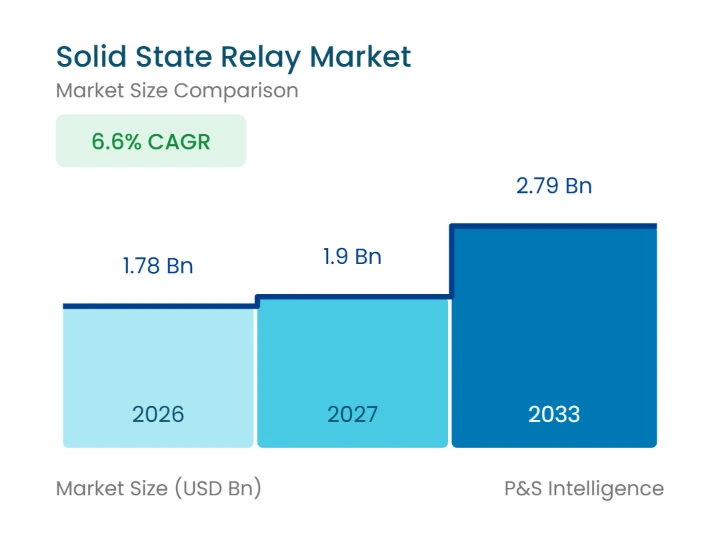
The global solid state relay market size is estimated at USD 1.78 Billion in 2026 and is projected to reach USD 1.90 Billion in 2027. Revenue is expected to climb to USD 2.79 Billion by 2033, advancing at a CAGR of 6.6% during 2027-2033. Machine builders are replacing mechanical contactors on heater circuits that switch every few seconds, because a relay with no contacts removes a routine maintenance job from plastics, packaging, and furnace lines. For suppliers, orders arrive through OEM bills of materials, panel builders, and industrial distributors, so a single design-in can repeat across years of machine shipments.
Fast-cycling temperature control on automated production equipment accounts for the largest block of solid state relay demand, with OEMs designing the devices into extruders, sealing machines, kilns, and PLC output stages that switch loads thousands of times per shift. Figures from the International Federation of Robotics (IFR) put factory installations of industrial robots at more than 600,000 units in 2025, an 11% rise on 2024. That count sizes the automation platform, not relay content per machine, yet each new automated cell can add heater, actuator, and I/O circuits where engineers choose between mechanical and solid-state switching.
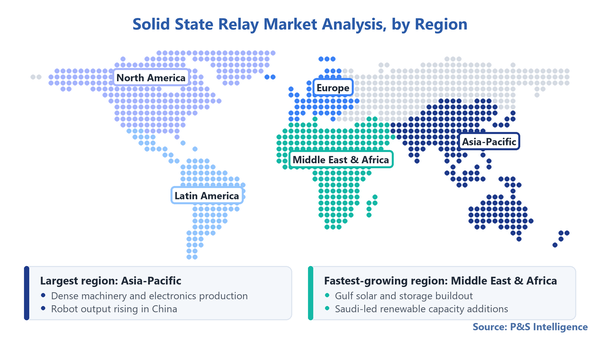
Asia-Pacific held 41.5% of global revenue in 2026, supported by machinery, appliance, electronics, and semiconductor-tool production in China, Japan, South Korea, and Taiwan, where much of the demand comes from new production lines. Middle East & Africa is set to grow fastest, at a 7.7% CAGR during 2027-2033, from a small base as Saudi Arabia, the U.A.E., and South Africa add solar plants, storage, and process capacity that specify relays from the first build. Asia-Pacific orders reward volume and price, while Gulf projects tend to reward certified high-voltage parts.
Key market insights
By mounting type, panel mount held 40.5% in 2026, while DIN rail mount is expected to post a 7.1% CAGR during 2027-2033.
By output voltage / load type, AC output held 53.5% in 2026, while AC/DC output is set to expand at an 8.1% CAGR during 2027-2033.
By current rating / load capacity, medium current (20A to 50A) held 46.0% in 2026, while high current (>50A) is forecast to advance at a 7.45% CAGR during 2027-2033.
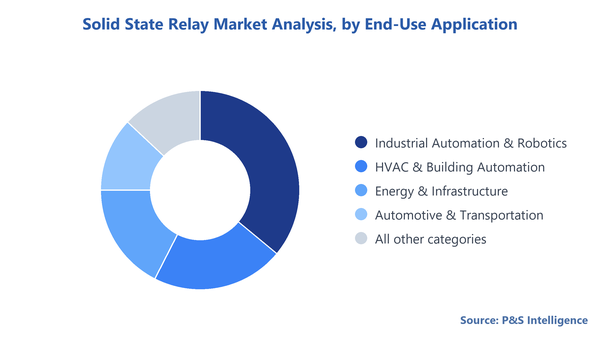
By end-use application, industrial automation & robotics held 36.0% in 2026, while automotive & transportation is projected to rise at an 8.4% CAGR during 2027-2033.
By geography, Asia-Pacific held 41.5% in 2026, while Middle East & Africa is anticipated to record a 7.7% CAGR during 2027-2033.
Solid State Relay Market Dynamics
Networked diagnostics are reshaping how machine builders specify solid-state contactors
Plastics processors and packaging OEMs increasingly want each heater relay to report its own condition, which moves solid-state contactors from commodity switching parts toward networked I/O devices. A relay that streams load current and heatsink temperature lets maintenance teams find a failed heater cartridge before scrap builds up, so purchase decisions start to weigh diagnostics and fieldbus compatibility alongside current rating and price. The relay then becomes part of the controls specification that a machine builder fixes at the design stage, instead of a catalog line chosen at assembly.
Carlo Gavazzi's NRG 3-phase series, launched on January 30, 2026, turns this requirement into a catalog product. Its product page lists PROFINET, EtherNet/IP, EtherCAT, and Modbus connectivity, with voltage, current, and energy readings for each relay, and names plastics and rubber processing, packaging, and semiconductor manufacturing as target lines. Bundling diagnostics into the relay raises the value of each channel. Suppliers with their own fieldbus-ready ranges are better positioned to win these design-ins, since a machine builder that standardizes on one protocol is likely to keep the same relay family across later machine generations.
High-voltage fast-charging rollout is accelerating demand for DC solid-state switching
Charger manufacturers building DC fast chargers on high-voltage bus architectures need insulation-monitoring and pre-charge circuits that switch many times a day, a duty cycle that erodes the contacts of mechanical devices. DC output and photo MOSFET relays perform these measurement and switching tasks without arcing, which suits them to charger and battery-system designs. Each design-in tends to repeat across every unit a charger OEM ships, so a single platform win can supply relay volume for several years.
Public charging networks grew quickly in 2025. The global stock of public charging points passed 7 million by year-end, up more than 33% on 2024, according to the International Energy Agency (IEA). That count sizes the charger platform, and many of those points are slower AC units with lower relay content, so it does not measure solid-state relay adoption directly. Each high-power DC unit added can, however, open sockets for high-voltage relays in its insulation-monitoring and pre-charge circuits, an order stream that favors suppliers holding automotive and charging-equipment certifications.
Tighter thermal control in wafer-fab tools is opening a premium outlet for zero-crossing relays
Equipment makers that build diffusion furnaces, deposition chambers, and wafer-cleaning tools switch resistive heaters under tight temperature tolerances, and they buy zero-crossing AC relays that pair with PID controllers to modulate heat without the electrical noise that disturbs nearby sensors. Fab tools also have to ride through brief voltage sags without dropping a process, which raises the specification for response time and isolation. Requalifying a relay partway through a tool platform costs the tool maker time, so a design-in often holds for the life of that platform and earns more per unit than general machinery sales.
Tool spending gives this outlet scale. Worldwide semiconductor equipment billings reached USD 135.1 billion in 2025, up 15% on 2024, SEMI data show. Billings measure capital spending on finished tools, and relays are a minor line in a tool's bill of materials, so the figure indicates the size of the customer base, not relay revenue. Even so, record tool output widens the pool of heater zones that need qualified switching, and relay makers already approved on one tool maker's platform could add volume as fabs for logic, memory, and AI-related capacity are equipped.
Heat dissipation and on-state losses are limiting cabinet density and price competitiveness
Panel builders that convert heater circuits to solid-state switching must remove the heat each solid state relay generates while conducting, using heatsinks, extra cabinet space, and sometimes forced ventilation. A heater circuit that a mechanical contactor switches with negligible loss therefore needs a larger and costlier assembly in solid-state form, and the required derating grows in warm enclosures. Buyers of low-cycle loads, such as pumps and lighting switched a few times a day, often stay with electromechanical relays because the lifetime advantage of a contactless switch matters little at that duty.
Catalog ratings put a number on the thermal limit. Celduc Relais rates each channel of its four-channel SMQR at 25 A, yet gives the heatsink-mounted version a rating of 18 A per channel at 40°C in still air. Relay makers are answering with denser packages, integrated heatsinks, and push-in terminals that cut cabinet volume and wiring time, which narrows the cost gap on heater-dense panels. Low-cycle applications remain where this restraint holds back conversion most, and price competition with electromechanical relays is likely to stay sharpest there.
Segmentation Analysis
Mounting Type
Panel mount devices accounted for 40.5% of solid state relay market revenue in 2026. The hockey-puck format has been the default for single-phase heater and lamp circuits for decades, so machine drawings, spare-part lists, and heatsink footprints across plastics, packaging, and furnace equipment are built around it. Machine builders that repeat a proven panel layout keep the same footprint on each new build, because changing it means rewiring the panel and updating its documentation. That carry-over favors established panel-mount suppliers on repeat machine orders.
DIN rail mount products are expected to post the fastest growth, at a 7.1% CAGR during 2027-2033. Panel builders favor rail-mounted solid-state contactors with integrated heatsinks because they arrive pre-rated for thermal duty and snap onto the same rail as terminals and PLC I/O, which trims design and wiring hours. The International Electrotechnical Commission (IEC) treats semiconductor contactors for non-motor loads as switchgear under IEC 60947-4-3, separate from component relays under IEC 62314, so a rail contactor is assessed as a complete switching device. Suppliers with broad rail portfolios are better placed to benefit.
Output Voltage / Load Type
AC output relays held 53.5% of revenue in 2026, because resistive heaters and lamps running on mains power are the core loads for solid-state switching in factories, buildings, and commercial kitchens. Zero-crossing AC parts turn on near the voltage zero point, which limits inrush and electrical noise and lets engineers cycle heaters every few seconds for tight temperature control. Random turn-on variants serve phase-angle control and inductive loads. That breadth keeps AC output as the volume line for distributors and machine builders, and price competition is sharpest here because thyristor- and TRIAC-based designs are mature.
AC/DC output devices are projected to grow fastest, at an 8.1% CAGR during 2027-2033. Bidirectional photo MOSFET relays switch either polarity, which suits insulation monitoring, battery management, and test equipment where the same channel may see AC or DC signals. As battery packs and solar strings move to higher voltages, measurement circuits need more headroom, and Broadcom's ASSR-601J photo MOSFET relay datasheet specifies a 1,500 V breakdown voltage and lists battery, motor, and solar-panel insulation resistance measurement among its uses. Suppliers offering high-voltage photo MOSFET relays could capture design-ins in battery and inverter electronics.
Current Rating / Load Capacity
Medium current (20A to 50A) relays accounted for 46.0% of revenue in 2026. The range matches the typical heater zone on injection molding barrels, extruders, sealing bars, and commercial ovens, where 25 A and 40 A single-phase and three-phase parts are standard catalog items. Machine builders size many heater circuits within this band, so distributors stock it deeply and orders follow the output of thermal equipment. Pricing in the band is competitive, and suppliers tend to differentiate through thermal derating curves, terminal design, and delivery reliability.
High current (>50A) relays are expected to expand fastest, at a 7.45% CAGR during 2027-2033. Industrial furnaces, kilns, and large process heaters need switching above 50 A, and their operators can avoid the contact wear that frequent cycling causes in mechanical contactors. Higher ratings carry higher unit prices and larger heatsink assemblies, which lifts revenue per unit for suppliers. The work needed to qualify a 75 A or 125 A part, including short-circuit coordination with semiconductor fuses, narrows the field of credible suppliers and favors those with tested fuse pairings.
End-Use Application
Industrial Automation & Robotics held 36.0% of revenue in 2026. Plastics extrusion, packaging and sealing machines, PLC output stages, and electric furnaces all switch loads hundreds or thousands of times per shift, and a contactless switch removes the contact wear that forces mechanical relay replacements on those lines. Machine builders specify the relay at the design stage and repeat it on every unit they ship, so this segment's volume moves with machinery output more than with plant maintenance budgets. Suppliers with positions on large OEM bills of materials tend to hold the steadiest share of this demand.
Copyright P&S Intelligence. Reuse requires attribution under CC BY 4.0.
Automotive & Transportation is set to post the quickest growth, at an 8.4% CAGR during 2027-2033. Demand comes from battery management systems, wire-harness and battery test equipment, and rail heating, where high-voltage switching must survive vibration and frequent cycling. Munich Electrification presented a solid-state battery disconnect unit for commercial-vehicle high-voltage systems in an August 11, 2026 release, describing it as a replacement for mechanical contactors and pyrotechnic fuses. Introductions of this kind show where relay content per vehicle could rise, though volume would depend on vehicle-maker program awards.
The following segments are analysed in this report.
Mounting Type
Panel Mount
DIN Rail Mount
PCB Mount
Surface Mount / Plug-in
Output Voltage / Load Type
AC Output
DC Output
AC/DC Output
Current Rating / Load Capacity
Medium Current (20A to 50A)
Low Current (<20A)
High Current (>50A)
End-Use Application
Industrial Automation & Robotics
HVAC & Building Automation
Energy & Infrastructure
Automotive & Transportation
Medical Equipment
Food & Beverage & Commercial Equipment
Geographical Outlook
Asia-Pacific solid state relay market outlook
Asia-Pacific held 41.5% of global revenue in 2026 and is expected to grow at a 7.35% CAGR during 2027-2033. The region hosts large clusters of plastics machinery, packaging, appliance, electronics, and semiconductor-tool production, and each machine leaves the factory with relay content specified by its builder. Much of this demand comes from new production lines, which ties order volumes to capital spending by Chinese, Japanese, Korean, and Taiwanese manufacturers. China, the region's largest market, combines domestic machine-tool, robot, and electric-vehicle supply chains that buy relays for both equipment and test lines.
China's machine builders kept raising output through 2025. The value-added output of industrial robots rose 28% that year, according to the National Bureau of Statistics of China (NBS), a measure of machine-building activity that does not count relay purchases directly. Rising machinery production widens the base of OEM sockets for relays, and competition in standard AC panel-mount parts centers on price. Suppliers with high-voltage, photo MOSFET, and semiconductor-tool qualifications are better positioned in the region's higher-value niches, and the regional lead looks likely to hold while electronics and battery production stays concentrated there.
Middle East & Africa solid state relay market growth
Middle East & Africa is projected to grow fastest, at a 7.7% CAGR during 2027-2033, from the smallest revenue base among the five regions. Utility-scale solar plants, battery storage, desalination, and new industrial zones in Saudi Arabia and the U.A.E. are being equipped from scratch, so relays enter as first-fill content in inverters, insulation monitors, heating and pumping skids, and control panels. Saudi Arabia is the region's fastest-growing market, as equipment purchases for its renewable and industrial programs pick up pace.
Renewable buildout gives the clearest signal. IRENA data show that renewable generating capacity in the Middle East rose 28.9% in 2025, led by Saudi Arabia. Capacity additions size the plant base, not relay content, yet solar and storage plants rely on insulation monitoring and isolation switching inside their power electronics. Suppliers with certified high-voltage parts and Gulf distribution partners could secure early design-ins, while South Africa and Egypt add smaller volumes through mining, food processing, and grid projects. Growth from this base can stay uneven, because project timing depends on tender awards and financing.
Copyright P&S Intelligence. Reuse requires attribution under CC BY 4.0.
Europe market analysis
Europe contributes a mature share of global revenue, with orders tied to a large installed base of plastics, packaging, food, and process machinery and to the export output of its machine builders. German, Italian, and Swiss OEMs often specify DIN rail solid-state contactors with diagnostics in export machinery, which lifts value per unit even when unit volumes are flat. High energy costs give plant operators a further reason to convert heater zones from mechanical contactors, since tighter temperature control cuts scrap on lines that run around the clock.
Regulatory timing adds a design cycle. As per the European Commission, Regulation (EU) 2023/1230 on machinery applies from January 20, 2027, replacing the 2006 Machinery Directive. The regulation sets safety requirements for machines and does not require solid-state switching, but builders reworking control cabinets and conformity files for the new rules have an occasion to change relay specifications at the same time. Relay suppliers with certified rail contactors and documentation ready for conformity assessment fit naturally into that redesign window.
Latin America market analysis
Latin America holds a smaller share of revenue, with orders concentrated in Mexico's export manufacturing and in Brazil's food processing, plastics, and mining industries. Mexican plants building appliances, auto parts, and electronics for North American customers often follow relay specifications set by their parent OEMs, which ties local orders to design decisions made in the United States and Asia. In Brazil, food, plastics, and mining plants buy relays as they modernize older control panels, and currency swings can raise the landed cost of imported relays for panel builders there.
Investment flows support the Mexican side of the region. Mexico's Ministry of Economy recorded USD 40.87 billion of foreign direct investment in 2025, a 10.8% increase on 2024. That total covers all sectors, not only factories, so it signals capacity additions without measuring relay demand. Suppliers with stock held in Mexico and engineering support near the northern industrial corridors could win business as new lines open, while Chile and Argentina add demand mainly through mining and process plants.
North America market analysis
North America ranks behind Asia-Pacific in revenue, with demand spread across industrial heating, HVAC and building controls, semiconductor and battery plants, and test equipment. OEMs adding diagnostics to new machine designs often move from panel-mount pucks to rail contactors at the same time, which raises revenue per switched channel. The United States accounts for most regional orders, and its large base of OEMs and distributors makes catalog breadth and delivery speed central to supplier selection.
A cooling factory-construction cycle shapes the near-term outlook. U.S. Census Bureau figures put manufacturing construction spending at a seasonally adjusted annual rate of USD 170.2 billion in September 2026, down from USD 250.2 billion in September 2024. Equipment installation trails construction, so plants started during the earlier peak are still being fitted out, which cushions relay orders as new project starts slow. Once those plants run, demand is likely to lean more on line expansions and retrofits, favoring distributors and suppliers with broad stocked ranges and fast delivery.
The following geographies are analysed in this report.
Asia-Pacific
Japan
South Korea
Taiwan
China
India
Rest of Asia-Pacific
Middle East & Africa
Saudi Arabia
U.A.E.
Rest of Middle East & Africa
Europe
Germany
U.K.
France
Italy
Netherlands
Spain
Rest of Europe
Latin America
Brazil
Mexico
Rest of Latin America
North America
U.S.
Canada
Solid State Relay Market Competitive Landscape
Competition in the solid state relay market is spread across many suppliers, and no single company sets terms across all mounting types, voltages, and end uses. The product range runs from milliamp photo MOSFET relays on circuit boards to 125 A three-phase contactors in furnace panels, and each band calls for different semiconductors, packaging, certification, and sales channels. Low tooling costs for standard panel-mount parts let regional manufacturers compete on price, while high-voltage and diagnostic products need design and qualification work that fewer firms carry out. The structure is evolving as automation suppliers fold relays into networked control portfolios.
Suppliers fall into three broad groups. Specialist relay makers such as Sensata Technologies through its Crydom brand, Carlo Gavazzi, and Celduc Relais compete on the breadth of their panel-mount and DIN rail catalogs, thermal ratings, and distributor reach. Electronic component manufacturers including Panasonic, Littelfuse, Vishay, and Broadcom concentrate on board-level and photo MOSFET relays for test equipment, meters, medical devices, and battery electronics, where isolation ratings and package size decide design-ins. Automation suppliers such as Siemens and Phoenix Contact sell solid-state contactors alongside PLCs, terminals, and engineering software.
For buyers, this structure keeps pricing competitive on standard AC parts, and common panel-mount footprints let an OEM approve an alternative part without redesigning the panel. Switching costs rise in high-voltage, semiconductor-tool, and automotive work, because a relay qualified into a tool or battery system is costly to replace partway through a platform, which gives incumbents on those platforms durable positions. New entrants are more likely to gain ground first in distributor and catalog channels, where footprint compatibility counts for more than qualification history.
Leading Solid State Relay Manufacturers:
Sensata Technologies Holding plc
Omron Corporation
Schneider Electric SE
TE Connectivity plc
Rockwell Automation Inc.
Siemens AG
Carlo Gavazzi Holding AG
Phoenix Contact GmbH & Co. KG
Panasonic Holdings Corporation
Littelfuse, Inc.
Celduc Relais
Broadcom Inc.
Vishay Intertechnology Inc.
Eaton Corporation plc
ABB Ltd
WAGO GmbH & Co. KG
Weidmüller Interface GmbH & Co. KG
FCL Components Limited
Solid State Relay Market News & Developments
In June 2026, Celduc Relais introduced the SF548340 miniature solid-state relay, which switches loads up to 30 A at 230 VAC from a 3 to 32 VDC control signal while needing only 30% of the space of a standard hockey-puck relay. The FASTON-terminal part lets builders of heating, packaging, and automation panels free cabinet space without dropping to a lower current class.
In May 2026, Omron Corporation released the G3VH series of silicon carbide MOSFET relays for 1,800 V and 3,300 V loads, with the 3,300 V version rated at 300 mA continuous current. The line now sits with Aratas Corporation, the relay and components business Omron spun off in July 2026, which places a high-voltage board-level portfolio under a standalone owner.
In March 2026, Littelfuse Inc. launched the CPC1343G OptoMOS solid-state relay, combining 60 V blocking voltage, 900 mA continuous load current, and 5,000 Vrms reinforced input-to-output isolation in DIP-4 and SMD packages rated up to 105°C. The part lets industrial, medical, and instrumentation designers meet reinforced-isolation requirements without moving to a larger relay package.
In November 2025, Vishay Intertechnology Inc. released the VORA1150, a 1,500 V Automotive Grade 1 Form A solid-state relay in a 4-pin SMD-8 package with AEC-Q102 qualification and a 5,300 Vrms isolation test voltage. The part targets pre-charge and insulation-monitoring circuits in 800 V battery systems, on-board chargers, and energy storage, where leakage is held to 1 µA.
Last Updated: November 2026
Frequently Asked Questions About This Report
How big is the solid state relay market?+
The global solid state relay market size is estimated at USD 1.78 Billion in 2026 and is projected to reach USD 1.90 Billion in 2027.
What is driving demand for solid state relays?+
Machine builders are replacing mechanical contactors on heater circuits that switch every few seconds, because a relay with no contacts removes a routine maintenance job from plastics, packaging, and furnace lines.
Which region leads the solid state relay market?+
Asia-Pacific held 41.5% of global revenue in 2026, supported by machinery, appliance, electronics, and semiconductor-tool production in China, Japan, South Korea, and Taiwan, where much of the demand comes from new production lines.
Which region is growing fastest in the solid state relay market?+
Middle East & Africa is projected to grow fastest, at a 7.7% CAGR during 2027-2033, from the smallest revenue base among the five regions.
Which application segment dominates the solid state relay market?+
By end-use application, Industrial Automation & Robotics held 36.0% in 2026, while Automotive & Transportation is projected to rise at an 8.4% CAGR during 2027-2033.
Who are the key players in the solid state relay market?+
Specialist relay makers such as Sensata Technologies through its Crydom brand, Carlo Gavazzi, and Celduc Relais compete on the breadth of their panel-mount and DIN rail catalogs, thermal ratings, and distributor reach.
What are the disadvantages of solid state relays?+
Panel builders that convert heater circuits to solid-state switching must remove the heat each solid state relay generates while conducting, using heatsinks, extra cabinet space, and sometimes forced ventilation.
Want a report tailored exactly to your business need?
Leading companies across industries trust us to deliver data-driven insights and innovative solutions for their most critical decisions. From data-driven strategies to actionable insights, we empower the decision-makers who shape industries and define the future. From Fortune 500 companies to innovative startups, we are proud to partner with organisations that drive progress in their industries.
Client Testimonials
Working with P&S Intelligence and their team was an absolute pleasure – their awareness of timelines and commitment to value greatly contributed to our project's success. Eagerly anticipating future collaborations.
McKinsey & Company
India
Unmatched Standards
Our insights into the minutest levels of the markets, including the latest trends and competitive landscape, give you all the answers you need to take your business to new heights
Complete Data Security
We take a cautious approach to protecting your personal and confidential information. Trust is the strongest bond that connects us and our clients, and trust we build by complying with all international and domestic data protection and privacy laws