This Report Provides In-Depth Analysis of the Solid-State Cooling Market Report Prepared by P&S Intelligence, Segmented by Type (Single Stage, Multi-Stage, Thermocycler), Product (Refrigerators, Freezers, Air Conditioners, Chillers), Technology (Thermoelectric, Electrocaloric, Magnetocaloric), End User (Consumer Electronics, Healthcare, Automotive), and Geographical Outlook for the Period of 2019 to 2032
Explore the market potential with our data-driven report
Solid-State Cooling Market Overview
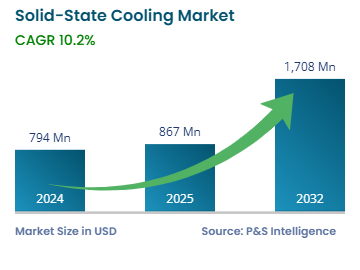
The global solid-state cooling market generated an estimated revenue of USD 794 million in 2024, which is expected to witness a CAGR of 10.2% during 2025–2032, to reach USD 1708.0 million by 2032.
This growth can be attributed to the increasing demand for energy-efficient and environment-friendly cooling technologies across various industries. Solid state cooling, which relies on thermoelectric and other advanced materials, offers significant advantages over traditional cooling methods, including reduced energy consumption, smaller system sizes, and the absence of harmful refrigerants.
Additionally, the technology’s potential to be integrated into a wide range of applications, from portable coolers to industrial cooling systems, is driving market expansion. With continued advancements in material science and increasing consumer awareness of sustainable alternatives, the solid-state cooling market is poised for significant growth in the coming years.
The growing industrialization and urbanization present significant demands for solid-state cooling. As industries expand and urban areas continue to develop, the demand for efficient and sustainable cooling solutions increases, creating a strong need for advanced technologies like solid-state cooling. Globally, the industrial sector accounts for nearly 40% of total energy consumption, driving substantial emissions. In rapidly industrializing regions, such as Asia-Pacific, the demand for cooling systems in manufacturing plants, data centers, and warehouses is rising to ensure optimal operational conditions.
Traditional cooling systems, often reliant on harmful refrigerants and requiring significant maintenance, are being replaced by solid-state cooling solutions, which offer energy efficiency, reduced environmental impact, and lower operating costs. Similarly, urbanization leads to higher population densities—with over 55% of the world’s population living in cities, expected to reach 68% by 2050—resulting in increased cooling demand in residential and commercial buildings.
The building and industrial sectors together contribute approximately 36% of global COâ‚‚ emissions, exacerbating climate change and global warming. Additionally, with growing awareness of climate change and sustainability, consumers and businesses are increasingly opting for energy-efficient cooling solutions that minimize their carbon footprint. Solid-state cooling technologies, which offer compact and quieter operations, present an ideal solution for these spaces.
Solid-State Cooling Market Dynamics
Rising Adoption of Electric and Hybrid Electric Vehicles Is Key Driver
One of the key drivers propelling the growth of the global solid-state cooling market is the rising adoption of electric and hybrid electric vehicles.
Global electric vehicle (EV) sales continue to surge as countries set ambitious targets to reduce pollution and combat climate change.
China aims for EVs to represent 40% of new vehicle sales by 2030, supporting its goal to peak carbon emissions before 2030.
The European Union targets a full phase-out of internal combustion engine vehicles by 2035 to drastically cut transport emissions.
The U.S. plans to reach 50% EV sales share by 2030, aligning with its broader climate goals.
India targets increasing EV adoption to 30% of new vehicle sales by 2030 as part of its strategy to reduce urban air pollution and greenhouse gas emissions.
In 2024, global EV sales surpassed 10 million units, reflecting growing consumer demand and government incentives worldwide.
As the automotive industry shifts towards greener, more energy-efficient solutions, the demand for innovative cooling technologies is increasing.
Traditional cooling systems in vehicles rely on mechanical components and refrigerants, which can be bulky, less efficient, and environmentally harmful.
In contrast, solid-state cooling technologies offer a more compact, energy-efficient, and eco-friendly alternative, making them an attractive option for modern electric and hybrid vehicles.
In EVs and HEVs, maintaining optimal battery temperatures is crucial for performance, safety, and longevity.
Solid-state cooling systems, such as thermoelectric coolers, are highly effective in regulating battery temperatures without the need for complex mechanical refrigeration systems.
These systems can provide precise temperature control, reduce energy consumption, and contribute to the overall efficiency of the vehicle.
Additionally, with increasing government regulations aimed at reducing carbon emissions, the shift toward electric and hybrid vehicles is expected to further accelerate the adoption of solid-state cooling solutions.
Designing and Engineering Challenges Hamper Market Growth
A key challenge in the global solid-state cooling market is the complexity involved in designing and engineering solid-state cooling systems for diverse applications.
Solid-state cooling technology, while promising, is still in its developmental stages, and creating systems that are adaptable to a wide range of industries and use cases requires significant innovation.
Each application, whether for automotive, electronics, or industrial processes, has unique cooling requirements, such as different temperature ranges, cooling capacities, and space limitations.
Designing a versatile system that can efficiently meet these diverse needs is a complex task for engineers.
Moreover, achieving optimal performance and efficiency in solid-state cooling systems often involves balancing various factors, such as heat dissipation, material selection, and power consumption.
Additionally, integrating solid-state cooling into existing infrastructure can pose challenges, as it requires precise compatibility with other systems and may demand significant redesigns or customization.
Solid-State Cooling Market Segmentation Analysis
Type Insights
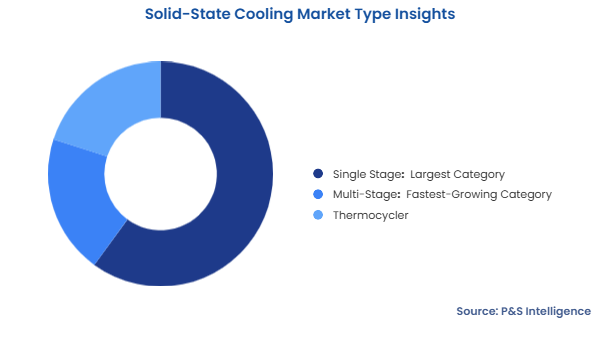
The single stage type category holds the largest market share, of 60% in 2024. This is primarily due to its simplicity, cost-effectiveness, and widespread applicability across various industries. Single-stage cooling systems are typically easier to design, manufacture, and implement compared to multi-stage systems, making them an attractive option for companies seeking straightforward, reliable cooling solutions. These systems use a single thermoelectric module to achieve cooling, which simplifies their operation and reduces maintenance requirements, contributing to lower operational costs.
Furthermore, single-stage systems are well-suited for applications where moderate cooling capacities and temperature differentials are sufficient, such as in electronics cooling, portable cooling devices, and small industrial applications. The ease of integration into existing infrastructure and the relatively low upfront investment makes single-stage systems highly accessible for a wide range of consumers, from small businesses to larger industries looking to optimize their cooling processes.
The multi-stage category has the highest CAGR, of 10.5%, driven by the growing need for efficient, compact, and environmentally friendly cooling technologies. Traditional cooling methods often rely on refrigerants harmful to the environment and bulky mechanical components. Multi-stage solid-state systems offer precise temperature control across wider ranges, making them ideal for applications in electronics, medical devices, and aerospace.
Their scalability and lower maintenance requirements appeal to industries seeking sustainable alternatives. Additionally, the advancement in materials science enables improved performance and reliability, further fueling interest. As energy efficiency and eco-consciousness become priorities, these innovative cooling solutions are increasingly sought after.
During the study, we have analyzed the following types in the report:
Single Stage (Largest Category)
Multi-Stage (Faster-Growing Category)
Thermocycler
Product Analysis
The air conditioners category holds the largest market share, of 40%, in 2024. This is primarily driven by the increasing demand for energy-efficient and sustainable cooling solutions in residential, commercial, and industrial sectors. Air conditioning systems are widely used to maintain comfort in homes, offices, and public spaces, and as global temperatures rise, the need for reliable and efficient cooling solutions continues to grow.
Traditional air conditioning systems, however, often rely on refrigerants that can have a negative environmental impact. As a result, consumers and businesses are increasingly turning to solid-state cooling technologies as an eco-friendlier alternative.
Solid-state cooling systems, such as thermoelectric coolers, are particularly well-suited for air conditioning applications because they are compact, energy-efficient, and free from harmful refrigerants. These benefits align with growing consumer preferences for green technologies and governments' stricter environmental regulations.
Refrigerators are the fastest-growing category, due to their potential to revolutionize cooling technology with enhanced energy efficiency and environmental benefits. Unlike conventional refrigerators that rely on gases with high global warming potential, solid-state refrigerators use thermoelectric or magnetocaloric effects, eliminating harmful refrigerants. Their compact size and silent operation make them ideal for specialized applications such as medical storage, portable cooling, and electronics.
Advances in material science are improving their cooling capacity and durability, making them more practical for everyday use. As consumers and industries prioritize sustainability and innovation, solid-state refrigerators are becoming an attractive alternative to traditional cooling solutions.
Below are the products analyzed:
Refrigerators (Faster-Growing Category)
Freezers
Air Conditioners (Largest Category)
Chillers
Coolers
Technology Insights
Based on technology, the thermoelectric category accounts for the largest share in 2024. This is driven by the growing demand for energy-efficient, compact, and environmentally friendly cooling solutions. Thermoelectric cooling technology, which relies on the Peltier effect to transfer heat, offers significant advantages over traditional cooling systems, such as refrigeration-based methods.
One of the key reasons for its dominance is its ability to provide efficient cooling without the use of harmful refrigerants, making it a more sustainable and eco-friendly solution. Additionally, thermoelectric coolers are compact and versatile, making them ideal for a wide range of applications, from consumer electronics and automotive cooling to medical devices and portable coolers.
Their small size and ability to be easily integrated into various products and systems further contribute to their widespread adoption.
The magnetocaloric category has the highest CAGR, of 11.5%, as industries seek efficient, eco-friendly cooling solutions. This technology offers a promising alternative to conventional refrigeration by using magnetic fields to induce temperature changes without harmful refrigerants. Its potential for higher energy efficiency and reduced environmental impact makes it appealing for both commercial and consumer applications.
Additionally, magnetocaloric systems can be designed for compactness and scalability, fitting diverse needs from medical cooling to household appliances. Ongoing advancements in magnetic materials and system design are enhancing performance and cost-effectiveness, further driving interest in magnetocaloric technology as a sustainable refrigeration innovation.
The following technologies are included in the report:
Thermoelectric (Largest Category)
Electrocaloric
Magnetocaloric (Faster-Growing Category)
End User Insights
The healthcare vertical dominates the market, with 45% share, due to its critical need for precise and reliable temperature control. Medical applications, including vaccine storage, blood preservation, and laboratory equipment, demand consistent cooling without fluctuations that could compromise sensitive materials. As per estimates, global vaccine demand is around 20 billion doses each year, reflecting a huge potential for solid-state cooling in this sector. Solid-state cooling technologies offer compact, quiet, and maintenance-free solutions, aligning well with healthcare settings where space and reliability are vital.
Additionally, the push for eco-friendly alternatives supports adoption in hospitals and clinics. As healthcare continues to prioritize patient safety and operational efficiency, solid-state cooling systems remain integral, ensuring the preservation of temperature-sensitive products and enabling advancements in medical technology.
The automotive category is projected to grow at the highest CAGR, during 2025–2032. This is driven by the increasing adoption of electric vehicles (EVs) and hybrid electric vehicles (HEVs). As the automotive industry moves towards more energy-efficient and environmentally friendly solutions, traditional cooling systems, which rely on mechanical components and refrigerants, are being replaced by advanced technologies such as solid-state cooling. This shift is largely due to the growing emphasis on improving vehicle performance, reducing energy consumption, and meeting stringent environmental regulations.
Solid-state cooling systems, like thermoelectric coolers, are well-suited for automotive applications, particularly in managing battery temperature in electric vehicles. Proper temperature control is critical to optimizing battery efficiency, ensuring safety, and prolonging battery life. Unlike conventional cooling methods, solid-state systems are compact, lightweight, and more energy-efficient, which directly benefits electric and hybrid vehicles seeking to maximize range and performance.
During the study, we have analyzed the following end users in the report:
Consumer Electronics
Healthcare (Largest Category)
Automotive (Faster-Growing Category)
Others
Drive strategic growth with comprehensive market analysis
Solid-State Cooling Market Geographical Analysis
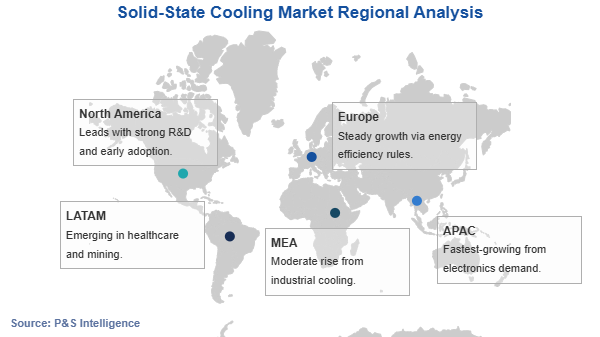
North America holds the largest market share, of 40%, in 2024. This is driven by a combination of technological innovation, strong industrial demand, and a growing focus on energy-efficient and sustainable solutions. The region has a well-established automotive, electronics, and manufacturing base, all of which increasingly rely on advanced cooling technologies to improve performance, reduce energy consumption, and meet environmental regulations.
Additionally, North America is home to leading companies and research institutions that are at the forefront of developing and commercializing solid-state cooling solutions. These entities are driving innovation and making significant advancements in thermoelectric materials and cooling system design. The region’s commitment to sustainability, coupled with stringent regulations aimed at reducing carbon emissions, further accelerates the adoption of solid-state cooling technologies across various sectors.
Moreover, the increasing awareness among consumers and businesses about the environmental benefits of solid-state cooling, such as the reduction of harmful refrigerants, positions North America as a dominant player in the market.
APAC has the highest CAGR, driven by rapidly expanding healthcare, electronics, and automotive industries. The healthcare sector is growing due to aging populations—such as Japan’s projected 36% elderly demographic by 2050—and increased government investment in medical infrastructure, boosting needs for reliable cooling in vaccine storage and medical devices. APAC dominates global semiconductor production, with Taiwan, South Korea, and China leading manufacturing; this sector has seen roughly 10% annual growth fueled by rising demand for smartphones, IoT, and data centers, increasing the need for efficient thermal management.
Meanwhile, the automotive industry, particularly in China and India, is experiencing rapid adoption of electric vehicles—with China selling over 6 million EVs in 2023, a 60% rise—spurring demand for advanced cooling solutions in battery and electronics systems. These interconnected industry expansions underscore why solid-state cooling technologies are increasingly vital across APAC.
Further, regions and countries analyzed for this report include:
Brazil (Largest and Fastest-Growing Country Market)
Mexico
Rest of LATAM
Middle East and Africa (MEA)
Saudi Arabia (Largest Country Market)
South Africa
U.A.E. (Fastest-Growing Country Market)
Rest of MEA
Solid-State Cooling Market Share
The market is relatively fragmented, with numerous players operating across various sectors and offering a range of solutions for different applications. This is largely due to the diversity of industries that benefit from solid-state cooling technologies, such as automotive, consumer electronics, medical devices, and industrial applications. Companies in these sectors require specialized cooling systems tailored to their unique needs, which has led to the emergence of both large multinational corporations and smaller, specialized firms providing custom solutions. The varying requirements across these industries, combined with the technological complexity involved in solid-state cooling systems, means that no single player dominates the market.
Additionally, the market is characterized by ongoing innovation, with new entrants continually developing advanced thermoelectric materials, improved designs, and more efficient cooling methods. While larger companies, including those in the automotive and electronics sectors, have the resources to drive significant market share, smaller companies are also making strides by offering niche or cost-effective solutions.
Key Solid-State Cooling Companies:
Phononic Inc.
Laird Thermal Systems Inc.
Ferrotec Holdings Corporation
Delta Electronics Inc.
Coheretn Corp.
Same Sky
EH4 GmbH
Thermion Company
RMT Ltd.
Mercury Systems Inc.
Crystal Ltd.Achilli S.r.l
TEC Microsystems GmbH
Solid-State Cooling Market News
In January 2025, xMEMS Labs released the xMEMS XMC-2400 µCooling chip, an all-silicon, active micro-cooling fan for ultramobile devices and AI applications.
In March 2024, Solid-state cooling Systems Inc. launched the 200-to-500-Watt ThermoCube II, offering a compact design, ease of use, and reliability. Its thermoelectric technology offers precise temperature control without compressors or harmful refrigerants.
In October 2023, Back Porch International Inc. launched its new thermal design services, which leverage advanced simulation tools to optimize airflow, identify potential hotspots, and create customized cooling solutions tailored to each customer.
In August 2023, Coherent Corp. created an additive manufacturing process designed to manufacture advanced ceramic components for high-performance thermal management, such as for next-generation semiconductor capital equipment.
In July 2023, Delta T Systems launched its Free Cooling System for industrial and commercial applications, designed for energy efficiency and environmental sustainability.
Want a report tailored exactly to your business need?
Leading companies across industries trust us to deliver data-driven insights and innovative solutions for their most critical decisions. From data-driven strategies to actionable insights, we empower the decision-makers who shape industries and define the future. From Fortune 500 companies to innovative startups, we are proud to partner with organisations that drive progress in their industries.
Client Testimonials
Working with P&S Intelligence and their team was an absolute pleasure – their awareness of timelines and commitment to value greatly contributed to our project's success. Eagerly anticipating future collaborations.
McKinsey & Company
India
Unmatched Standards
Our insights into the minutest levels of the markets, including the latest trends and competitive landscape, give you all the answers you need to take your business to new heights
Complete Data Security
We take a cautious approach to protecting your personal and confidential information. Trust is the strongest bond that connects us and our clients, and trust we build by complying with all international and domestic data protection and privacy laws