This Report Provides In-Depth Analysis of the Software-Defined Vehicle Hardware Market Report Prepared by P&S Intelligence, Segmented by Hardware Component/Product Type (Domain/Zonal Control Units, Centralized Compute Platforms (HPC/SoC), In-Vehicle Networking Hardware (Ethernet gateways/switches), Sensors & Actuators, Power Electronics), Vehicle Type (Passenger Cars, Light Commercial Vehicles, Heavy Commercial Vehicles), Propulsion Type (Battery Electric Vehicles (BEV), Internal Combustion Engine (ICE) Vehicles, Hybrid Electric Vehicles (HEV/PHEV), Fuel Cell Electric Vehicles (FCEV)), E/E Architecture (Domain-Centralized Architecture, Zonal Architecture), Application (ADAS/Active Safety, Infotainment & Digital Cockpit, Body Electronics & Comfort Systems, Powertrain Management), and Geographical Outlook for the Period of 2021 to 2032
Explore the market potential with our data-driven report
Software-Defined Vehicle Hardware Market Overview
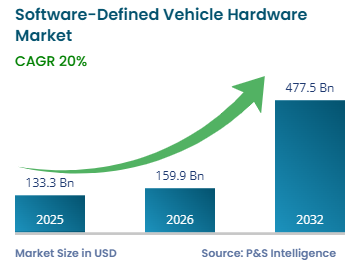
The software-defined vehicle hardware market reached USD 133.3 billion in 2025, with revenue estimated at USD 159.9 billion in 2026. The market is projected to reach USD 477.5 billion by 2032, growing at a CAGR of 20.0% during 2026-2032. Automakers are replacing dozens of scattered electronic control units with a handful of domain and zonal controllers so a single software update can reach the whole vehicle instead of one part at a time. For suppliers, that consolidation turns many small component orders into fewer, higher-value hardware contracts per vehicle platform.
Growth follows a global shift toward regulated, always-updatable vehicle software. The United Nations Economic Commission for Europe's UN Regulations 155 and 156, covering cybersecurity and software-update management, have applied to all new vehicles seeking type approval across more than 60 contracting parties since July 2024. Meeting that requirement calls for a secure gateway and a domain or zonal controller able to verify and apply updates, not a connectivity module bolted onto an older architecture. That pushes hardware content per vehicle higher even before any new feature is added.
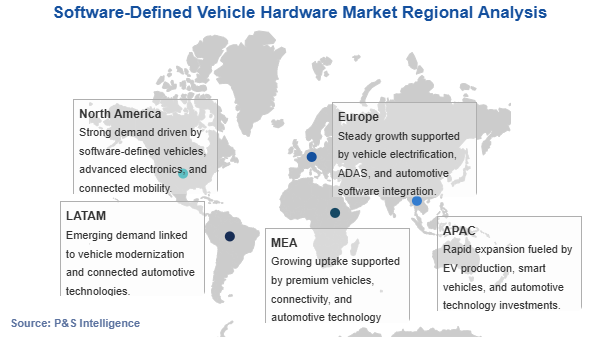
Asia-Pacific generated 45% of 2025 revenue, led by China, Japan, and South Korea, where new-energy-vehicle platforms increasingly launch with domain or zonal hardware built in from the start instead of added later. North America is set to grow fastest, expanding at a 20.5% CAGR through 2032, as U.S. and Canadian automakers redesign existing platforms around centralized compute while growing domestic chip capacity shortens their supply chain. Europe, Latin America, and the Middle East and Africa round out global demand at a smaller scale.
Key market insights
By hardware component, domain and zonal control units led the market in 2025, while centralized compute platforms (HPC/SoC) are on track to post the fastest growth through 2026-2032.
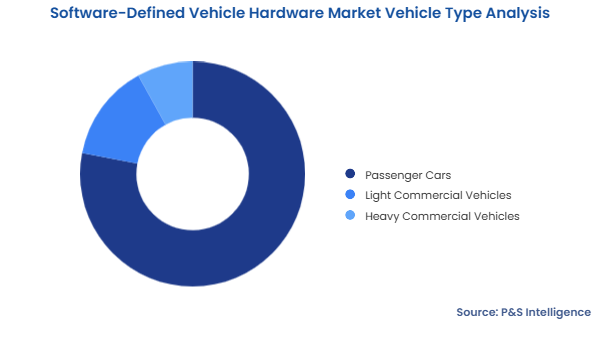
By vehicle type, passenger cars held 78% share in 2025, while commercial vehicles are projected to grow at a 28.2% CAGR during 2026-2032.
By propulsion type, battery electric vehicles held 45% share in 2025, while fuel cell electric vehicles are projected to grow at a 22.4% CAGR during 2026-2032.
By E/E architecture, domain-centralized architecture led the market in 2025, while zonal architecture is set to post the fastest growth through 2026-2032.
By application, ADAS/active safety held 57% share in 2025, while powertrain management is projected to grow at a 26.1% CAGR during 2026-2032.
By geography, Asia-Pacific held 45% share in 2025, while North America is projected to grow at a 20.5% CAGR during 2026-2032.
Software-Defined Vehicle Hardware Market Trends and Growth Drivers
Multi-gigabit in-vehicle networking is redefining domain and zonal hardware design
Automakers consolidating dozens of electronic control units into a handful of domain or zonal controllers need a backbone fast enough to carry camera, radar, and lidar data between zones, not just switch messages. Older CAN and low-speed Ethernet links cannot carry the raw sensor bandwidth a centralized compute platform needs, so the shift to domain and zonal control forces a parallel upgrade in the wiring and switch hardware that connects them. Each new generation of cameras and radar units adds more data to that backbone, turning the network itself into a recurring hardware purchase.
The IEEE Standards Association ratified the 802.3ch amendment in July 2024, defining 2.5, 5, and 10 gigabit-per-second automotive Ethernet over a single twisted pair. That standard gives suppliers of gateways and zonal switches a common specification to design against instead of custom point-to-point links for each automaker. Vendors shipping 802.3ch-compliant switch hardware ahead of competitors can qualify for zonal-architecture programs earlier in a vehicle's development cycle. A shared specification also cuts a supplier's per-program validation cost, letting the same switch design scale across several automaker customers instead of one bespoke build for each.
Government approval of higher automation levels is accelerating compute-platform purchases
Regulators are approving higher levels of vehicle autonomy for production sale, and every added automation level requires more onboard compute to process camera, radar, and lidar streams in real time. Each step up in automation roughly multiplies the sensor-fusion workload the vehicle's compute must handle without added latency. A vehicle cleared to drive itself under defined conditions cannot run on a handful of low-power microcontrollers, so each approval translates directly into orders for centralized HPC or SoC-based platforms over incremental control-unit upgrades.
China's Automotive Industry Steady Growth Work Plan for 2025 and 2026 cleared conditional production access for Level 3 automated-driving models, with the first approved models receiving access permits in December 2025. Each approved model needs a compute platform certified to run its autonomy stack, giving domain and centralized-compute suppliers a policy-linked queue of new vehicle programs to design into. That approval schedule turns each regulatory clearance into a firm design-in deadline suppliers can plan capacity against.
Wiring and weight savings from hardware consolidation are opening an EV range-extension opportunity
Replacing a distributed wiring harness with a zonal architecture removes duplicate cabling and connectors, since each zone controller aggregates local sensors and actuators before sending one data link back to the central compute unit. That is a meaningful amount of weight to recover in an electric vehicle, where every kilogram removed from the harness can be reallocated to battery capacity or used to lower curb weight and extend range. Fewer cable runs also mean fewer connectors to seal and inspect on the assembly line, cutting labor time on top of the weight recovered.
A study published in the peer-reviewed journal Sensors found that a six-zone architecture cuts total in-vehicle wiring length by roughly 45% to 55% compared with a traditional five-domain layout, depending on how many control units the network carries. That range spans lighter and heavier control-unit counts, so the saving scales with how far an automaker consolidates. Suppliers that can put a harness-weight figure against an automaker's vehicle-weight budget have a concrete lever to win zonal-hardware contracts on electric platforms specifically.
Lengthy semiconductor qualification cycles are constraining hardware rollout speed
Domain controllers, zonal gateways, and centralized compute platforms all depend on automotive-grade chips that cannot be swapped in from a consumer-electronics supply chain once a design is finalized. Every new chip variant must pass extended reliability testing before an automaker approves it for a vehicle program, and that window sits on the critical path between a chip design win and the first vehicle shipping with it. A missed qualification window can push a chip's first vehicle application back an entire model year, since automakers rarely reopen a finalized bill of materials mid-program.
The Automotive Electronics Council's AEC-Q100 qualification standard requires new automotive-grade integrated circuits to complete roughly 9 to 18 months of stress testing, covering high-temperature operating life, temperature cycling, and humidity exposure, before a part can be marketed as automotive-qualified. That timeline limits how quickly a supplier can respond to a sudden request for more compute headroom, and favors incumbent chipmakers that already carry a qualified part on the shelf over new entrants still mid-qualification.
Domain and zonal control units account for the largest share of hardware revenue, reflecting how far automakers have already moved from distributed electronic control units into intermediate consolidation nodes. Every domain or zonal architecture requires at least one of these units per vehicle regardless of how centralized the eventual design becomes, so replacing legacy control units already puts a domain or zonal controller in nearly every new SDV-capable vehicle sold, ahead of any full-centralization redesign.
Centralized compute platforms (HPC/SoC) are on track to post the fastest growth of any hardware component through 2026-2032. AI-based driver-assistance and autonomy workloads need more processing power than a distributed set of zonal controllers can provide, pushing automakers toward a single high-performance system-on-chip. Consolidating several domain controllers into one automotive-grade SoC also cuts the total silicon and cooling footprint per vehicle even as each individual chip's price rises.
Vehicle Type
Passenger cars accounted for 78% of hardware revenue in 2025. Passenger-car platforms carry the highest unit volumes of any vehicle class, so automakers bring new domain and zonal hardware to these lines first to spread tooling and qualification costs over the largest production run available. Consumer expectations for connected infotainment, driver assistance, and over-the-air update capability are also more advanced in passenger vehicles than in trucks, giving passenger-car programs the clearest business case for early hardware investment.
Commercial vehicles are projected to grow at a 28.2% CAGR during 2026-2032, the fastest of any vehicle type. Fleet operators are adding domain and zonal hardware to support telematics, predictive maintenance, and driver-assistance features that cut downtime and insurance costs across large fleets, a payback case that is easier to justify per truck than for a single consumer buying one passenger car. As electrification reaches heavier vehicle classes, the added compute needed for battery and drivetrain management gives commercial platforms a second reason to add hardware content.
Propulsion Type
Battery electric vehicles held 45% of hardware revenue in 2025. A battery electric powertrain already needs its own dedicated power-electronics and battery-management hardware, so adding a domain or zonal controller for the rest of the vehicle's functions is a smaller incremental design step than retrofitting a similar architecture onto a combustion driveline. Electric-vehicle programs are also disproportionately new-platform designs, not carryover models, giving automakers a clean-sheet opportunity to build in centralized or zonal compute from the outset.
Fuel cell electric vehicles are set to expand faster than any other propulsion type, at a 22.4% CAGR during 2026-2032, off a much smaller base than battery electric platforms. The International Energy Agency's Global EV Outlook 2025 shows that battery electric models' share of global electric-car sales fell from 80% in 2020 to under 60% in 2024 as automakers diversified into other propulsion architectures. That same diversification is extending to fuel cell platforms in heavy-duty and long-range applications, where each new model still needs a full domain or zonal hardware base plus dedicated fuel-cell-stack control hardware.
E/E Architecture
Domain-centralized architecture remains the leading E/E architecture across production vehicles today. Most automakers adopted domain consolidation as their first step away from distributed control units because it lets a supplier group related functions, such as powertrain or body control, under one controller without redesigning the entire electrical topology in a single program cycle. That incremental path let automakers phase in centralization gradually across successive vehicle generations.
Zonal architecture is set to post the fastest growth of the two architectures through the forecast period as automakers plan their next generation of platforms. A zonal layout groups hardware by physical location rather than by function, shortening wiring runs and simplifying the network topology enough to support the higher data volumes that cameras, radar, and lidar sensors generate. Automakers designing all-new electric platforms increasingly specify zonal architecture from the start instead of migrating an existing domain-based design.
Application
ADAS and active-safety hardware held 57% of application revenue in 2025. Collision-avoidance, adaptive cruise, and lane-keeping features depend on dedicated processing hardware to fuse camera, radar, and sometimes lidar data in real time, and regulators are locking this hardware into every new vehicle instead of leaving it optional. The National Highway Traffic Safety Administration finalized a rule in 2024 requiring automatic emergency braking on all new passenger cars and light trucks sold in the United States by September 2029, guaranteeing ADAS hardware content across the full range of vehicle trims, not premium models only.
Powertrain management hardware is projected to grow fastest among applications, at a 26.1% CAGR during 2026-2032. Electrified powertrains add battery-management, inverter-control, and motor-control functions that a combustion powertrain never needed, and each function typically gets its own dedicated hardware node feeding into the vehicle's broader zonal or domain network. As battery electric and hybrid platforms take a growing share of new vehicle production, the powertrain domain is adding hardware content faster than the already hardware-dense ADAS domain can match.
The following segments are analysed in this report.
Asia-Pacific Software-Defined Vehicle Hardware Market outlook
Asia-Pacific held 45% of global software-defined vehicle hardware revenue in 2025, the largest share of any region. China, Japan, and South Korea run the world's largest electric-vehicle assembly base, and new-energy-vehicle platforms launched there increasingly build in domain or zonal hardware from the first production run instead of adding it later in a model's life. Government-backed vehicle-intelligence programs across the region are also pushing automakers to standardize compute and networking hardware across trim levels instead of reserving it for flagship models.
China, the region's largest market, anchors most of this installed base. The China Association of Automobile Manufacturers reported that the country produced 16.6 million new-energy vehicles in 2025, up 29.0% from 2024, and most of these platforms ship with a domain or zonal hardware base that an equivalent combustion model often lacked. That scale gives regional suppliers a large, recurring set of new vehicle programs to design into each year. Japan and South Korea add further demand as their automakers extend zonal architecture from premium models into mainstream platforms.
North America is projected to register the fastest growth of any region, expanding at a 20.5% CAGR during 2026-2032. Automakers in the United States and Canada are redesigning existing vehicle platforms around centralized or zonal compute instead of launching all-new architectures, since most regional production still runs on platforms first engineered for a distributed control-unit layout. Expanding domestic semiconductor capacity is also giving regional automakers a shorter, more reliable supply chain for the automotive-grade chips these redesigns depend on.
The U.S., the region's fastest-growing market, is where most of this hardware investment is landing. The U.S. Department of Commerce reported that its CHIPS Act incentives had funded 40 semiconductor projects by January 2025, including automotive-grade chip capacity, with a domestic silicon-carbide facility set to begin production in 2026. That expansion shortens the qualification and delivery timeline for automotive-grade chips that domain and centralized-compute suppliers depend on. Canada's parts-supply base is following a similar path as component makers retool for zonal-architecture hardware.
Europe contributes a steady share of the global market, trailing Asia-Pacific and North America but keeping pace with the market's broader expansion as automakers replace older control-unit-based platforms with domain and zonal designs. National regulators across Germany, France, and the U.K. apply the same vehicle type-approval framework requiring certified software-update and cybersecurity management, giving European automakers little choice but to fit compliant gateway and controller hardware into every new model regardless of segment.
The European Automobile Manufacturers' Association reported that EU car production held broadly flat in 2025, at just under 11.5 million units, as cost pressure weighed on output across the region's manufacturing hubs. That plateau means most new hardware content in Europe comes from higher value per vehicle, not a growing unit base, favoring suppliers of higher-specification domain and centralized-compute platforms over those competing on volume alone. Germany's automotive and industrial-machinery supply base anchors most of this demand, while France and the U.K. follow at a smaller scale.
Latin America contributes a smaller slice of global demand, anchored in Brazil's growing electrified-vehicle segment. Brazilian assemblers are adding domain and zonal hardware mainly to new electrified models, not across their full combustion lineup, since electrified platforms already carry the power-electronics hardware that makes a broader domain rollout a smaller incremental step. Mexico's export-manufacturing plants form a secondary demand cluster, as assembly lines near the U.S. border adopt the same domain hardware their North American customers specify.
Brazil's national automakers' association, ANFAVEA, projects domestic electrified-vehicle sales will reach 420,000 to 450,000 units in 2026, up from 285,400 in 2025, with local assembly's share of those vehicles rising from 23% to 40% over the same period. That shift toward locally assembled electrified models gives regional hardware suppliers a growing domestic production base to design into instead of one that depends entirely on imported platforms. Argentina's assembly plants trail this pattern at a smaller scale, tied mainly to regional export programs.
The Middle East and Africa contribute the smallest share of global demand, led by manufacturing and assembly activity in South Africa and by fleet-technology investment among logistics and energy operators in the Gulf states. South Africa's vehicle-assembly plants supply both domestic and export markets, giving them reason to standardize on the same domain and zonal hardware their overseas customers already specify instead of maintaining a separate regional design.
The National Association of Automobile Manufacturers of South Africa reported that new-energy-vehicle sales reached 16,716 units in 2025, up 7.1% from 2024, though they still made up only 2.8% of the country's new-vehicle market. That low but rising base signals early-stage electrified-platform adoption, the segment where domain and zonal hardware content runs highest, giving regional suppliers a small but growing foothold. Gulf state investment in connected-fleet and logistics technology is adding a second demand center as more vehicles there ship with onboard compute and connectivity hardware from the factory.
The following geographies are analysed in this report.
The Software-Defined Vehicle Hardware Market is moderately fragmented, with no single supplier controlling the compute, control-unit, and connectivity layers at once. Building a domain controller or zonal gateway calls for automotive-grade qualification, functional-safety certification, and years of automaker relationship-building, which keeps new entrants out but also means established Tier-1 suppliers compete with pure semiconductor vendors and automakers building hardware in-house, spreading share across three different kinds of competitor. This three-way structure has held steady, with new entrants adding to existing clusters rather than displacing them.
One cluster consists of established Tier-1 suppliers, including Robert Bosch GmbH, Continental AG, and Aptiv PLC. These suppliers compete on the ability to integrate domain controllers, zonal gateways, and sensor hardware into a single qualified module that an automaker can add to an existing vehicle program without redesigning it from scratch.
A second cluster of semiconductor suppliers, including NVIDIA Corporation, Qualcomm Technologies Inc., and NXP Semiconductors N.V., competes on compute performance and reference-platform support that lets an automaker build a centralized architecture around one chip family. A smaller group of automakers, among them Tesla Inc., Volkswagen AG, and NIO Inc., design and build part of their own domain or zonal hardware in-house, competing with their own suppliers for a share of the hardware bill of materials.
Functional-safety certification under ISO 26262 and the multi-year qualification cycle for automotive-grade chips keep the field of credible suppliers narrow at the silicon and control-unit level, even though additional Tier-1, semiconductor, and in-house players compete alongside those named above in each cluster. That combination of many players and high per-program switching costs gives automakers real vendor choice at the design stage but leaves them tied to whichever supplier's hardware family they select for the life of a vehicle platform.
Top Companies in Software-Defined Vehicle Hardware Market:
In September 2026, ZF Friedrichshafen AG secured more than 5 billion euros in new 2026 business for software-defined commercial-vehicle platforms at IAA Transportation, alongside over-the-air update and centralized vehicle-intelligence technology. The order shows fleet and truck manufacturers are now committing budgets to zonal and central-compute hardware instead of only evaluating it.
In May 2026, Qualcomm Technologies Inc. expanded its partnership with Stellantis N.V. to deploy Snapdragon Digital Chassis driver-assistance, cockpit, and connectivity platforms across Stellantis's next-generation vehicle architectures. The expanded deal gives Qualcomm a multi-brand production commitment from one of the world's largest automakers, not a single-model design win.
In January 2026, NXP Semiconductors N.V. launched its S32N7 processor series, extending the S32 automotive platform to consolidate gateway, zonal-control, and safety processing functions on a single automotive-grade chip. The launch lets automakers replace several separate domain and zonal controllers with fewer, higher-integration chips per vehicle.
In January 2026, Infineon Technologies AG unveiled a modular Zone Controller Development Kit with Flex Ltd. at CES 2026, offering automakers reusable, scalable zone-control-unit building blocks built on Infineon's automotive microcontroller and Ethernet portfolio. The kit shortens the design cycle for automakers moving from domain-centralized to zonal E/E architectures.
In September 2025, Robert Bosch GmbH agreed to integrate NVIDIA Corporation's DRIVE AGX Thor computing platform into its next-generation driver-assistance and software-defined vehicle designs, targeting L2++ through L4 automation. The partnership pairs Bosch's sensor and functional-safety expertise with NVIDIA's compute silicon in one qualified hardware and software stack.
Frequently Asked Questions About This Report
How does centralized architecture change wiring requirements in vehicles?+
Automakers consolidating dozens of electronic control units into a handful of domain or zonal controllers need a backbone fast enough to carry camera, radar, and lidar data between zones, not just switch messages.
Why do sensor upgrades create recurring hardware demand?+
Each new generation of cameras and radar units adds more data to that backbone, turning the network itself into a recurring hardware purchase.
Why do higher levels of vehicle autonomy drive hardware demand?+
Regulators are approving higher levels of vehicle autonomy for production sale, and every added automation level requires more onboard compute to process camera, radar, and lidar streams in real time.
What manufacturing benefits does zonal architecture deliver?+
Fewer cable runs also mean fewer connectors to seal and inspect on the assembly line, cutting labor time on top of the weight recovered.
How can missed semiconductor qualification timelines affect vehicle programs?+
A missed qualification window can push a chip's first vehicle application back an entire model year, since automakers rarely reopen a finalized bill of materials mid-program.
Why are centralized compute platforms expected to grow faster?+
AI-based driver-assistance and autonomy workloads need more processing power than a distributed set of zonal controllers can provide, pushing automakers toward a single high-performance system-on-chip.
Why do passenger cars lead the hardware adoption wave?+
Consumer expectations for connected infotainment, driver assistance, and over-the-air update capability are also more advanced in passenger vehicles than in trucks, giving passenger-car programs the clearest business case for early hardware investment.
Want a report tailored exactly to your business need?
Leading companies across industries trust us to deliver data-driven insights and innovative solutions for their most critical decisions. From data-driven strategies to actionable insights, we empower the decision-makers who shape industries and define the future. From Fortune 500 companies to innovative startups, we are proud to partner with organisations that drive progress in their industries.
Client Testimonials
Working with P&S Intelligence and their team was an absolute pleasure – their awareness of timelines and commitment to value greatly contributed to our project's success. Eagerly anticipating future collaborations.
McKinsey & Company
India
Unmatched Standards
Our insights into the minutest levels of the markets, including the latest trends and competitive landscape, give you all the answers you need to take your business to new heights
Complete Data Security
We take a cautious approach to protecting your personal and confidential information. Trust is the strongest bond that connects us and our clients, and trust we build by complying with all international and domestic data protection and privacy laws